 ProMapRanker
Best Local Rank Tracking Tools for Massage Therapists in 2026

Neighborhood map grid tracking for one studio · Pricing starts at: See website
Direct answer
Local Viking is my top pick for massage therapists because it tracks Google Maps grid rankings at the neighborhood level, which is how clients actually find a massage studio, and it keeps review requests and listing checks in the same place. It has a free trial, so check its pricing page for current terms. If you mainly need citation cleanup, Whitespark fits better, and for call tracking on booking calls, CallRail is the other name to compare.
I put this list together from vendor documentation and public sources, not from hands-on tests. I looked at what each tool says it tracks, how it handles Google Business Profile data, and whether the workflow suits a small massage practice with one or two locations. Where a tool is built for agencies or big brands, I say so.
Key takeaways
- Massage clients usually search "massage near me" on a phone and pick from the map pack, so grid-based map tracking matters more than plain web ranking.
- A studio that serves a single neighborhood does not need citywide rank data; look for tools that let you track a tight radius around your address.
- Review volume and recency push map rankings, so pick a tool that combines rank checks with review requests.
- Google Business Profile categories and services change how you rank for "deep tissue massage" versus "sports massage", so check that a tool tracks keyword-level map positions.
- Call tracking helps you see which map keywords turn into bookings, but it adds a tracking number that you must keep consistent with your main listing.
Quick comparison
| Pick | Great for | Pricing starts at | Free tier | |
|---|---|---|---|---|
| Local Viking | Neighborhood map grid tracking for one studio | See website | Free trial | Visit |
 Whitespark | Citation building with local rank checks | See website | Not stated | Visit |
 Semrush Local | Rank tracking alongside broader SEO data | See website | No free plan | Visit |
 Moz Local | Keeping listings accurate across directories | See website | Not stated | Visit |
 Yext | Central listing control for several locations | See website | Not stated | Visit |
 CallRail | Seeing which map keywords produce calls | See website | Free trial | Visit |
 Grade.us | Review requests that lift map rankings | See website | Free trial | Visit |
The best local rank tracking tools for massage therapists compared
Local Viking is built around GeoGrids, which show where your studio ranks across a grid of points around its address. For a massage business, that is useful because someone three blocks away and someone across town see different map results. A studio near a busy shopping street can see exactly how far its map visibility reaches.
In daily use, you add your Google Business Profile location, set the keywords you care about, and let the tool pull grid positions on a schedule. Keywords like "massage therapist near me", "deep tissue massage" and "sports massage" can each be tracked separately, which matters because a studio may rank well for one service and poorly for another. Review requests and listing checks sit alongside the rank data, so you can act on a weak grid point by asking recent clients for reviews.
The limit is scope. If you also want organic web rankings across Bing or a full content workflow, this is not the tool for that. A solo therapist who only wants a monthly map position check may find it more than needed.
- Grid-based Google Maps rank tracking
- GeoGrid heatmaps you can share
- Review and listing tools in the same dashboard
- Centered on Google Maps rather than other search engines
- More features than a single-room studio may use
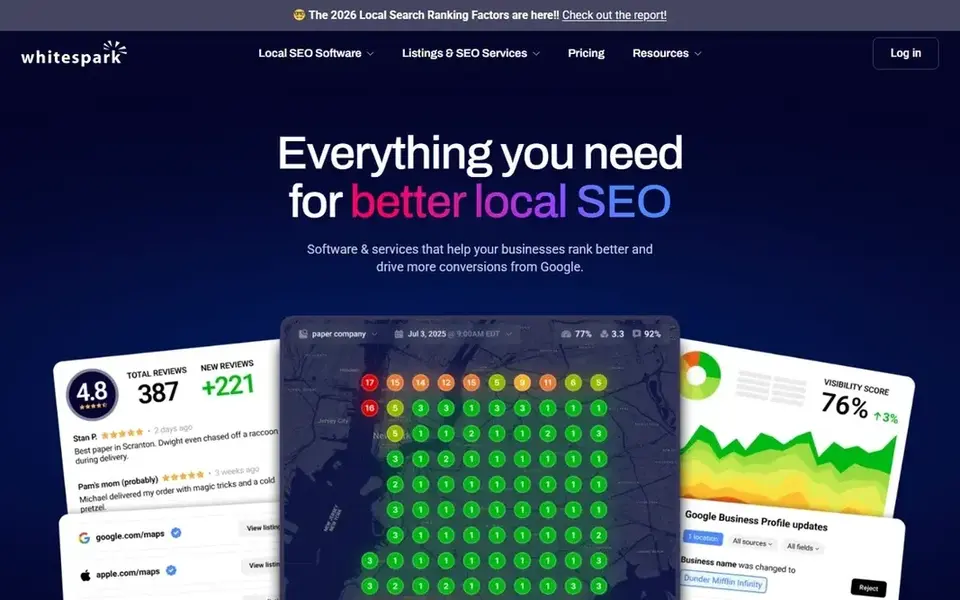
Whitespark is known for citation building, the work of getting your studio name, address and phone number listed consistently across directories. It also offers a local rank tracker that checks where you appear in Google's local results for chosen keywords and locations. For a massage practice, that combination covers two common problems: inconsistent listings and unclear map visibility.
The citation side matters because directories like Yelp, health directories and local business indexes often feed the data Google uses. If your suite number or phone number differs between listings, that can weaken trust signals. Whitespark's tools help you find and fix those mismatches, then watch how local rankings respond. The rank tracker lets you set keywords and a location so you can follow "massage therapy" positions over time.
The trade-off is that Whitespark is a toolkit, not a single simple dashboard. If you have never touched local SEO, expect a learning curve. A therapist who only wants a map heatmap may prefer a simpler tool.
- Strong citation and listing service
- Local rank tracker included
- Agency-friendly reporting
- Interface assumes some SEO knowledge
- Not a booking or client management tool

Semrush Local bundles local rank tracking, listing management and review tools into the wider Semrush platform. The appeal for a massage studio is keyword research: you can see how people search for massage services in your area and then track those terms in local results. That helps when you are deciding whether to promote "prenatal massage" or "couples massage" on your profile.
The local rank tracker follows your Google Business Profile positions for chosen keywords and locations, and the platform can report on changes over time. If you work with a marketing freelancer, sharing access is straightforward because many of them already use Semrush. The listing tools also help keep your address and hours consistent.
The main limit is cost and complexity. Semrush is built for people who manage SEO daily, and a solo massage therapist will pay for a lot of features they never open. Skip it unless you already use the platform or have help.
- Local rank tracking tied to a large keyword database
- Listing management tools
- Reporting for clients or partners
- Priced and sized for marketers
- Steep for a single-studio budget
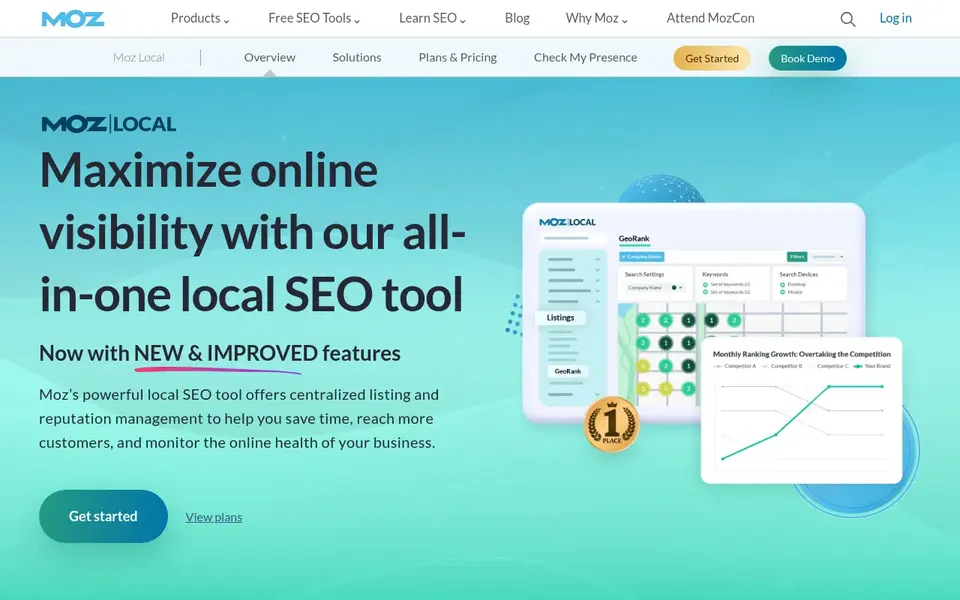
Moz Local focuses on getting your business data correct and consistent across directories, then monitoring how it appears. For a massage studio, that means your name, address, phone and hours stay the same wherever clients look, which supports trust in your Google Business Profile. It also flags duplicate listings that can split reviews and confuse search engines.
Rank tracking here is a supporting feature rather than the main event. You can see local visibility signals, but if grid-level map positions are your priority, a dedicated tracker gives more detail. Moz Local suits a studio that has messy listings after moving suites or changing phone numbers and wants to clean that up first.
Its limits are geographic. Directory coverage is strongest in the US and varies elsewhere, so check that your country and category are supported before subscribing. It also does not handle bookings or client records.
- Listing distribution to major directories
- Duplicate listing detection
- Local ranking visibility
- Rank tracking is a secondary feature
- Directory coverage varies by country
Yext lets you store your business facts in one place and push them to a network of directories, maps and apps. A massage business with two or three studios, or one that plans to open more, can update hours, services and holiday closures once and have those changes flow outward. That reduces the chance of a client showing up to a closed studio.
For rank tracking, Yext provides visibility and performance reporting tied to your listings and reviews. It is less about a fine-grained map grid and more about controlling the data that influences local results. Review monitoring helps you respond to feedback, which supports your profile's health.
One limitation is fit and cost. Yext is priced for organizations with marketing staff, and the quote process is not aimed at a single therapist. A one-room practice should look at lighter tools first.
- Central source of truth for business data
- Wide publisher network
- Review monitoring
- Quote-based pricing
- Built for larger organizations
CallRail tracks phone calls and forms so you can see which marketing source produced each inquiry. For a massage therapist, the useful question is simple: did this booking call come from the Google map listing, a directory, or an ad? CallRail can answer that by assigning tracking numbers to different sources.
In practice, you place a tracking number on your Google Business Profile and another on your website, then check the call log. You can listen to recordings to confirm the caller asked about a specific service, and you can see which keywords or campaigns drove the call. That data tells you whether your map visibility is turning into appointments.
It does not replace a rank tracker. CallRail shows outcomes, not positions, and you need to keep your main number consistent on citations while using tracking numbers carefully. A studio that gets most bookings online may not need it.
- Call tracking with source attribution
- Records calls for quality checks
- Integrates with forms and ads
- Does not track map grid positions
- Adds tracking numbers to manage
Grade.us handles review requests and monitoring. For a massage practice, reviews are one of the strongest levers on map rankings because clients often choose a therapist based on recent feedback and star ratings. Grade.us lets you send requests after appointments and route happy clients to your Google Business Profile.
The workflow fits a clinic: after a session, a request goes out by email or text, and the tool tracks who responded. You can monitor new reviews in one place and reply from the dashboard. Over time, a steady flow of fresh reviews supports your profile's relevance and trust.
It is not a rank tracker, so treat it as a companion. If you want to know where you appear in the map grid, pair Grade.us with Local Viking or a similar tool. Skip it if you already have a booking system that handles review requests.
- Automated review request campaigns
- Review monitoring across sites
- Simple client follow-up workflow
- No map grid rank tracking
- Review-focused rather than SEO-focused
How I chose
I started with vendor documentation for each tool, then checked public sources such as product pages, help centers and feature lists. I did not run hands-on tests, so I am describing what each vendor says it does and how that maps to a massage practice. My filter was simple: does the tool track local rankings in a way that matches how clients search for massage, and does it fit a small studio's workflow?
I also weighed limits. Tools built for agencies or multi-location brands made the list only when they solve a real problem for a therapist, such as citation cleanup or call attribution. I left out anything I could not confirm exists or could not verify an official homepage for. Where pricing is quote-based or unclear, I say so rather than guess.
What to check before you buy
- Confirm the tool tracks Google Maps grid positions, not just organic web rankings, because massage clients pick from the map pack.
- Check whether you can set a small radius around your studio address, since a neighborhood-level view is more useful than a whole-city average.
- Make sure you can track service keywords separately, such as "deep tissue massage" and "prenatal massage", because each may rank differently.
- Ask whether the tool connects to your Google Business Profile for review monitoring and listing checks, or whether you must update things by hand.
- Check the contract length and cancellation terms before you commit, since many local SEO tools bill annually.
- Confirm the tool supports your country and language, because directory coverage and map data vary outside the US.
Frequently asked questions
Do I need a rank tracking tool if I only have one massage studio?
Not strictly, but it helps. A single studio still competes in a small map area, and a tracker shows whether you appear for "massage near me" from different nearby points. That tells you if your profile is visible beyond your immediate block. If you have no budget, start with a free Google Business Profile audit and manual searches.
How often should I check my local rankings?
Weekly is enough for most massage practices. Map positions move slowly and can swing with reviews and profile edits, so daily checks mostly add noise. A weekly grid check plus a monthly review of keywords gives you a clear picture without overreacting to small changes.
Can rank tracking tools help me get more bookings?
They help indirectly. Rank tracking shows where you are visible, and review tools help you improve the signals that influence map rankings. Call tracking shows which listings produce calls. None of them books clients for you, but together they tell you where to focus your effort.
Is call tracking worth it for a massage business?
It can be, if most of your inquiries come by phone. CallRail and similar tools show whether calls come from your map listing, your website or an ad. That helps you decide where to spend time. If most bookings happen online through a booking page, form tracking may matter more than call tracking.
Do reviews really affect map rankings?
Google says reviews and ratings are among the factors that help local results, and review content can match what people search for. A steady flow of honest reviews that mention specific services helps. Never offer incentives for positive reviews or filter out unhappy clients; ask every client the same way and follow Google's review policies.
Sources
See where you really rank - block by block
ProMapRanker scans Google Maps across a grid of your service area. Simple monthly plans from $19, white-label on every plan.
Start freeBrowse all guides
← Best Local Rank Tracking Tools for Concrete Contractors in 2026Best Local Rank Tracking Tools for Optometrists in 2026 →
 best local rank tracking tools for bakeries
Best Local Rank Tracking Tools for Bakeries in 2026
A practical guide to the best local rank tracking tools for bakeries in 2026, covering grid tracking, review monitoring, citations and Google Business Profile.
Read → best listing management software for orthodontists
Best Listing Management Software for Orthodontists in 2026
A practical guide to the best listing management software for orthodontists in 2026, covering multi-location practices, review requests and directory accuracy.
Read → best listing management software for law firms
Best Listing Management Software for Law Firms in 2026
A guide to the best listing management software for law firms in 2026, covering citation accuracy, practice-area categories and multi-office control.
Read → nap consistency local seo
NAP Consistency for Local SEO: The Cleanup Checklist
A practical NAP consistency checklist to audit and clean up your local listings for better rankings.
Read → how to track local rankings
How to Track Local Rankings: A Practical Guide for SMBs
A plain-English guide for small businesses on how to track local rankings without the agency jargon.
Read → local seo for lawyers
Local SEO for Lawyers: Ranking a Law Firm in the Map Pack
How law firms win local search: GBP tactics, reviews, and geo-grid tracking tuned for legal competition.
Read →More in Local SEO & Google Maps · All guides A to Z by date · Latest guides