 ProMapRanker
Best Local Rank Tracking Tools for Concrete Contractors in 2026

Neighborhood Maps grid tracking · Pricing starts at: See website
Direct answer
Local Viking is my top pick for concrete contractors because it tracks Google Maps grid rankings at the neighborhood level, which matches how homeowners search for driveway, patio and foundation work. It offers a free trial. Whitespark suits contractors who also want citation and review tracking, and Semrush Local fits crews already using Semrush for their website. Each option below is compared from vendor documentation and public sources.
I compared these tools using vendor documentation and public sources rather than hands-on testing. My focus was how each one handles the way concrete contractors actually get found: neighborhood-level Maps searches, multiple service cities, review signals and listing accuracy. I noted where each tool fits and where it does not.
Key takeaways
- Concrete work is searched by neighborhood and job type, so grid-based Maps tracking tells you more than a single city-wide rank.
- A homeowner looking for a driveway pour and one looking for foundation repair often see different local results, so track more than one keyword.
- Google Business Profile categories, service areas and review volume move Maps rankings more than on-page changes for most concrete companies.
- Review request tools and rank trackers are separate jobs, and some vendors bundle both.
- Check whether a tool supports multiple service-area cities before you commit, since concrete contractors usually cover several towns.
Quick comparison
| Pick | Great for | Pricing starts at | Free tier | |
|---|---|---|---|---|
| Local Viking | Neighborhood Maps grid tracking | See website | Free trial | Visit |
 Whitespark | Citations and local rank tracking | See website | Not stated | Visit |
 Semrush Local | Contractors already using Semrush | See website | Not stated | Visit |
 Moz Local | Listing accuracy and local visibility | See website | Not stated | Visit |
 Synup | Multi-location concrete companies | See website | Not stated | Visit |
 GatherUp | Review requests and local visibility | See website | Free trial | Visit |
 Yext | Large listing footprints | See website | Not stated | Visit |
The best local rank tracking tools for concrete contractors compared
Local Viking is a local SEO tool built around Google Maps grid tracking. It shows where a concrete business ranks across a map of points rather than one position for the whole city. That matters when a driveway contractor ranks well in one suburb and poorly two towns over. It fits small and mid-size concrete crews that want a clear picture of Maps visibility without buying a full enterprise platform.
For a concrete contractor, the useful part is seeing how rankings shift by neighborhood and by service keyword. You can track terms like "concrete driveway contractor," "stamped concrete patio" and "foundation repair" separately, because a homeowner searching for a patio may see different results than one searching for structural work. The grid view also helps you judge whether a Google Business Profile change, such as adding service areas or new photos, moved anything.
The limits are practical. Grid scans consume credits, so heavy tracking across many keywords and cities adds up. It is also a local SEO tool rather than a website platform, so you still need separate tools for on-page work. Skip it if you only want a single rank number and do not care about neighborhood detail.
- Grid-based Maps rank tracking
- GeoGrid heatmaps by keyword
- Review and listing monitoring features
- Grid scans use credits
- Not a full website SEO suite
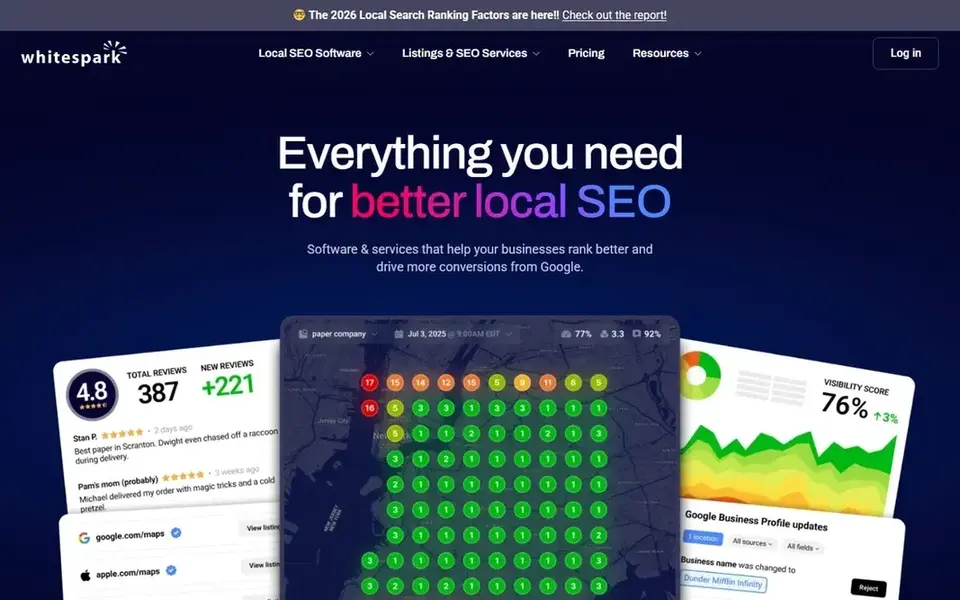
Whitespark is a local SEO company known for citation building and local rank tracking. It combines Maps rank tracking with citation audit and building services, which suits concrete contractors who want to fix inconsistent business listings at the same time as tracking rankings. It fits contractors who are willing to do a bit more setup in exchange for a fuller local picture.
Concrete businesses often have listings scattered across directories with old phone numbers or missing service areas, and those inconsistencies can hold back Maps visibility. Whitespark's citation tools help you find and correct them, while its rank tracking shows whether the cleanup helped in each city you serve. You can track rankings by grid or by city, which is useful when you cover several towns.
The trade-off is complexity. The interface carries more options than a single-purpose rank tracker, so a one-truck crew may find it heavy. It is a better fit for contractors who treat local SEO as an ongoing project rather than a quick check.
- Local rank tracking by grid or city
- Citation building and audit tools
- Review tracking features
- More setup than a simple tracker
- Interface is dense for beginners

Semrush Local brings listing management and local rank tracking into the wider Semrush platform. It makes sense for concrete contractors who already use Semrush for keyword research, backlink checks or competitor analysis, because the local data sits alongside the rest of their SEO work. It fits companies with someone handling marketing part time or a small agency doing it for them.
For concrete work, the value is combining local Maps tracking with the broader picture. You can see how your site ranks for "concrete patio cost" style searches while also tracking your Google Business Profile visibility in each service city. That helps when you want to connect website content, such as project photos and service pages, to local ranking changes.
The limit is that local features are part of a larger subscription. If all you want is Maps grid tracking, a dedicated tool is simpler and cheaper. Skip it if you have no use for the rest of the platform.
- Local listing management
- Maps rank tracking
- Pairs with broader SEO data
- Local features sit inside a larger suite
- Cost is higher than single-purpose tools
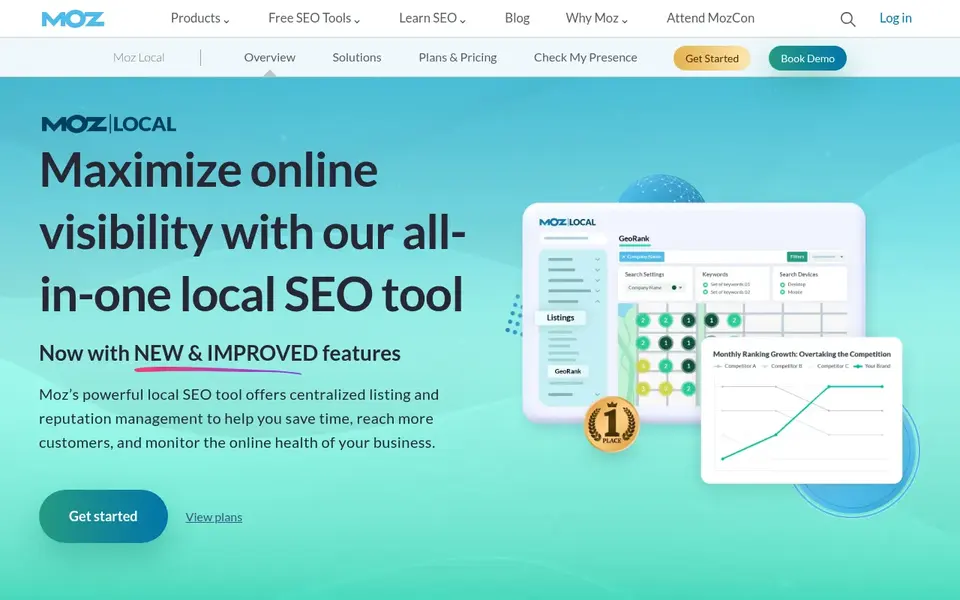
Moz Local focuses on getting business listings accurate and consistent across directories, with local visibility reporting on top. For concrete contractors, that means making sure your name, address, phone number and hours match everywhere, which supports Maps rankings. It fits contractors who suspect their listings are messy and want a straightforward fix.
The tool is less about deep grid tracking and more about the foundation that local rankings rest on. If your Google Business Profile and directory listings disagree, homeowners may see conflicting information and Maps may trust your profile less. Moz Local helps clean that up and gives a visibility score you can watch over time.
If you want detailed neighborhood-level rank grids, Moz Local is not the strongest choice on its own. Pair it with a dedicated tracker or choose a tool that does both.
- Listing distribution across directories
- Local visibility scoring
- Simple dashboard
- Rank tracking is lighter than dedicated tools
- Best value comes from listing management
Synup is a local marketing platform aimed at businesses with several locations. It manages listings, tracks local rankings and monitors reviews across each location. For a concrete company with yards or offices in multiple cities, that structure is useful because each location can be tracked and managed separately.
Concrete contractors who serve a wide region sometimes run several Google Business Profiles, one per office or service hub. Synup helps keep those profiles consistent and shows how each one ranks in its area. That is more practical than juggling separate logins for each location.
For a single-crew operation, Synup is more platform than you need. The setup and cost are aimed at multi-location brands, so a smaller contractor should look at a simpler tracker first.
- Listing management across many locations
- Local rank tracking
- Review monitoring
- Built for multi-location brands
- Overkill for a single crew
GatherUp is a review management and local visibility tool. It automates review requests after a job and monitors reviews across platforms. For concrete contractors, reviews are a major local ranking signal, and a steady flow of them after driveway, patio and foundation jobs supports Maps visibility. It fits contractors who want to build reviews systematically.
The tool's local visibility reporting gives a sense of how you appear in local search, but it is not a deep grid rank tracker. The real value is the review workflow: sending a request after a completed pour and keeping an eye on responses. That supports rankings indirectly rather than showing you a map grid.
If you want precise neighborhood rank data, GatherUp is a complement rather than a replacement. Use it alongside a tracker, or choose it if reviews are your main gap.
- Review request automation
- Review monitoring
- Local visibility reporting
- Rank tracking is secondary
- Focus is reviews rather than grids

Yext manages business listings across a large network of directories and apps, with local presence reporting. For concrete contractors operating across many towns, it can push consistent information to a wide set of places where homeowners might look. It fits larger companies with a real marketing budget.
The practical benefit is reach. A concrete business with several service areas wants its address, phone and hours correct wherever people search. Yext handles that at scale and reports on local presence, which supports the foundation for Maps rankings.
The downside is cost and commitment. Yext is priced for businesses with a serious local marketing budget, and contracts are often annual. A small concrete crew should weigh whether the reach justifies the spend before signing.
- Wide directory network
- Listing sync across many sites
- Local presence reporting
- Can get expensive for small crews
- Annual contracts are common
How I chose
I built this list from vendor documentation and public sources, not from hands-on testing. I read each vendor's own description of its rank tracking, listing management and review features, then checked how those features map to the way concrete contractors get found: neighborhood-level Maps searches, multiple service cities, review volume and listing accuracy. I did not run trials or measure results for any tool.
I also weighed limits. A tool that tracks grids in detail but costs a lot per scan is a different fit from one that focuses on listings or reviews. I tried to match each tool to a realistic concrete business size, from a one-truck crew to a multi-location company, and noted where a tool is more than a smaller contractor needs. Where I was unsure about a free plan or pricing detail, I left it as not stated rather than guess.
What to check before you buy
- Confirm the tool tracks Google Maps grids by neighborhood, not just one city-wide position, since concrete searches vary by area.
- Check how many keywords and service cities you can track before extra charges apply.
- Ask whether review monitoring and review requests are included, because reviews strongly affect local rankings.
- Make sure the tool supports multiple Google Business Profiles if you run more than one office or service hub.
- Look for citation or listing audit features if your directory listings may have old phone numbers or addresses.
- Read the contract terms, especially for annual commitments and per-scan credit costs.
Frequently asked questions
Do concrete contractors need a rank tracking tool at all?
Not strictly, but it helps. Concrete work is searched locally, and a tracker shows whether your Google Business Profile appears in Maps for terms like driveway, patio and foundation repair in each town you serve. Without tracking, you are guessing whether profile changes or new reviews moved anything.
What is grid-based Maps tracking?
Grid-based tracking checks your ranking at many points across a map rather than one position for a whole city. For concrete contractors, that shows whether you rank in one suburb but not another, which is common when service areas and reviews differ by location.
How often should I check local rankings?
Monthly is enough for most concrete crews. Rankings move slowly and are affected by reviews, profile updates and competitor activity. Checking too often can lead to reacting to normal fluctuations rather than real trends.
Do reviews affect local rankings for concrete businesses?
Reviews are a recognized local ranking signal, and they also influence whether homeowners choose you. A steady flow of honest reviews after completed jobs supports visibility. Do not offer incentives for positive reviews or filter out negative ones, since that breaks Google's guidelines.
Can I track rankings without paying for a tool?
You can check manually by searching in an incognito browser, but results are personalized and hard to compare over time. A paid tool gives consistent grid data and history. Some tools offer a free trial, so you can test before committing.
Sources
See where you really rank - block by block
ProMapRanker scans Google Maps across a grid of your service area. Simple monthly plans from $19, white-label on every plan.
Start freeBrowse all guides
← Best Local Rank Tracking Tools for Bakeries in 2026Best Local Rank Tracking Tools for Massage Therapists in 2026 →
 best listing management software for orthodontists
Best Listing Management Software for Orthodontists in 2026
A practical guide to the best listing management software for orthodontists in 2026, covering multi-location practices, review requests and directory accuracy.
Read → best listing management software for law firms
Best Listing Management Software for Law Firms in 2026
A guide to the best listing management software for law firms in 2026, covering citation accuracy, practice-area categories and multi-office control.
Read → best listing management software for handymen
Best Listing Management Software for Handymen in 2026
A handyman-focused guide to listing management software in 2026, comparing tools for citations, Google Business Profile, reviews and call tracking.
Read → google business profile attributes
Google Business Profile Attributes: The Hidden Ranking and Trust Signals
GBP attributes signal trust and relevance to customers and Google. Learn which to enable and why they matter.
Read → google maps relevance prominence distance
Relevance, Prominence, Distance: Google's Local Ranking Trio Explained
A clear breakdown of relevance, prominence, and distance, the three pillars of local ranking.
Read → rank tracker for local seo
Rank Tracker for Local SEO: The Tool Stack Every Local Pro Needs
The right rank tracker for local SEO plus the supporting tools that complete your local visibility stack.
Read →More in Local SEO & Google Maps · All guides A to Z by date · Latest guides