 ProMapRanker
Best Local Rank Tracking Tools for Bakeries in 2026

Grid-based Maps rank tracking · Pricing starts at: See website
Direct answer
Local Viking is my top pick for bakeries because it tracks Google Maps rankings on a grid around each shop, so you see how visibility changes street by street rather than as one citywide number. Pricing is quote-based, so check its pricing page. Whitespark suits bakeries that also want citation and review work in one place, and Semrush Local fits owners who already use Semrush for a website and want map rankings in the same dashboard.
I compared these tools from vendor documentation and public sources rather than hands-on tests. I looked at what each one tracks, how it handles a single shop versus several, whether reviews and citations are included, and where the limits sit for a small food business. The picks below are ordered by fit for a bakery that wants to know where it shows up on Google Maps and why.
Key takeaways
- A bakery competes in a small radius, so grid-based map tracking shows more than a single citywide rank number.
- Rank tracking alone does not fix visibility; your Google Business Profile categories, hours, photos and reviews do most of the work.
- Review monitoring belongs in the same tool as rank tracking, because star ratings and review counts move map rankings.
- Citation consistency matters for multi-location bakeries with several shop addresses and phone numbers.
- Check that a tool supports the locations you actually serve, including delivery-only or wholesale addresses.
Quick comparison
| Pick | Great for | Pricing starts at | Free tier | |
|---|---|---|---|---|
| Local Viking | Grid-based Maps rank tracking | See website | Free trial | Visit |
 Whitespark | Citations plus local rank tracking | See website | Not stated | Visit |
 Semrush Local | Owners already on Semrush | See website | No free plan | Visit |
 Moz Local | Listing management with visibility checks | See website | Not stated | Visit |
 Yext | Multi-location bakery groups | See website | Not stated | Visit |
 GatherUp | Review collection and local visibility | See website | Free trial | Visit |
 Synup | Listings, reviews and visibility together | See website | Not stated | Visit |
The best local rank tracking tools for bakeries compared
Local Viking is built around one idea: showing where a business ranks across a map grid rather than at a single point. For a bakery, that matters because someone searching "bakery near me" two streets away may see you while someone across town does not. You set the center point at your shop address and the tool samples rankings around it, which reflects how real customers search on a phone.
The workflow fits a bakery owner well. You add your Google Business Profile, pick a grid size, and check rankings on a schedule. The profile audit flags missing hours, categories or photos, which are the things that most often hold a bakery back in local results. Review monitoring lets you see new reviews without opening the profile every day.
The limit is scope. Local Viking tracks local visibility and profile health; it does not audit your website content or run keyword research for recipe pages. If you want one dashboard for everything, look at a broader platform. If map visibility is the question, it answers it clearly.
- Grid heatmaps around each shop
- Google Business Profile audit checks
- review and photo monitoring
- Not a full website SEO platform
- Grid reports need interpretation
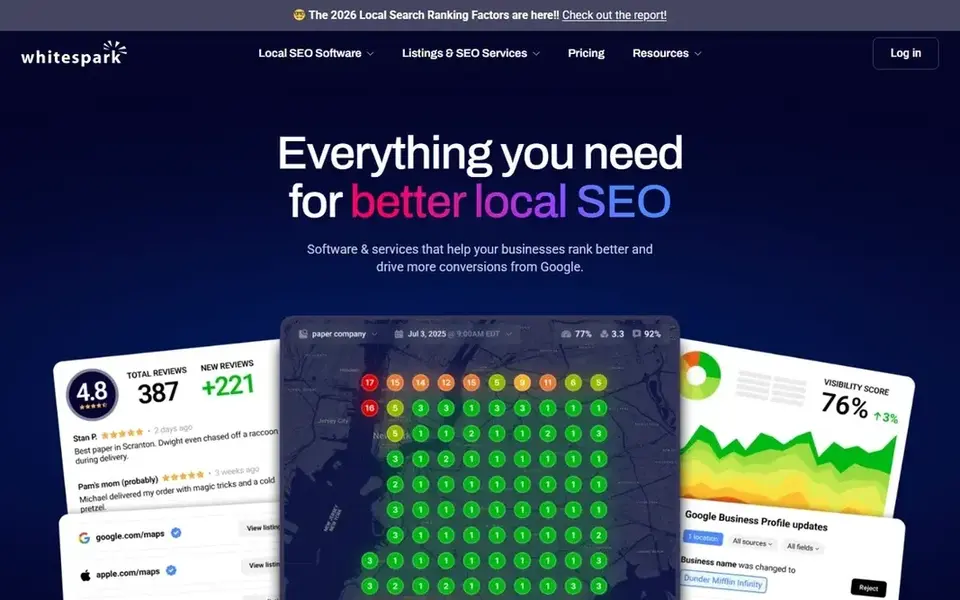
Whitespark is a Canadian local SEO company with a set of tools rather than a single product. The Local Rank Tracker shows Google Maps rankings across a grid, and the citation tools help you find and build listings on directories that matter for food businesses, such as local chamber pages, city guides and review sites.
For a bakery with two or three shops, the citation side is genuinely useful. Duplicate or outdated listings with an old phone number or a closed second location confuse customers and search engines. Whitespark helps you find those and fix them, then track whether map rankings respond.
The trade-off is effort. You are working across separate tools, and the citation work is partly manual. A single-shop bakery that only wants rank numbers may find it heavier than needed. A bakery that wants to clean up its listings and track results in one place will get more from it.
- Citation finder and building tools
- Local Rank Tracker with grid views
- review management add-ons
- Several separate tools to learn
- More manual work than an all-in-one listing service

Semrush is a large SEO platform, and its local features cover Google Business Profile management, listings and map rank tracking. The reason to consider it for a bakery is consolidation: if you already pay for Semrush to track your website, adding local tracking keeps rankings, site health and competitor data in one login.
For a bakery, the practical use is comparing your map position against other bakeries and cafes in the same area, then checking whether profile changes move the needle. Listing management helps keep name, address and phone details aligned across directories, which matters if you have a shop plus a market stall or a second counter.
The limit is cost and complexity. There is no free plan, and the local tools sit inside a bigger product you may not need. A bakery with no website SEO work should skip it and pick a focused tracker.
- Map rankings inside a full SEO platform
- Listing management for multiple locations
- Review monitoring alongside site data
- Paid platform with no free plan
- Local features are one part of a larger subscription
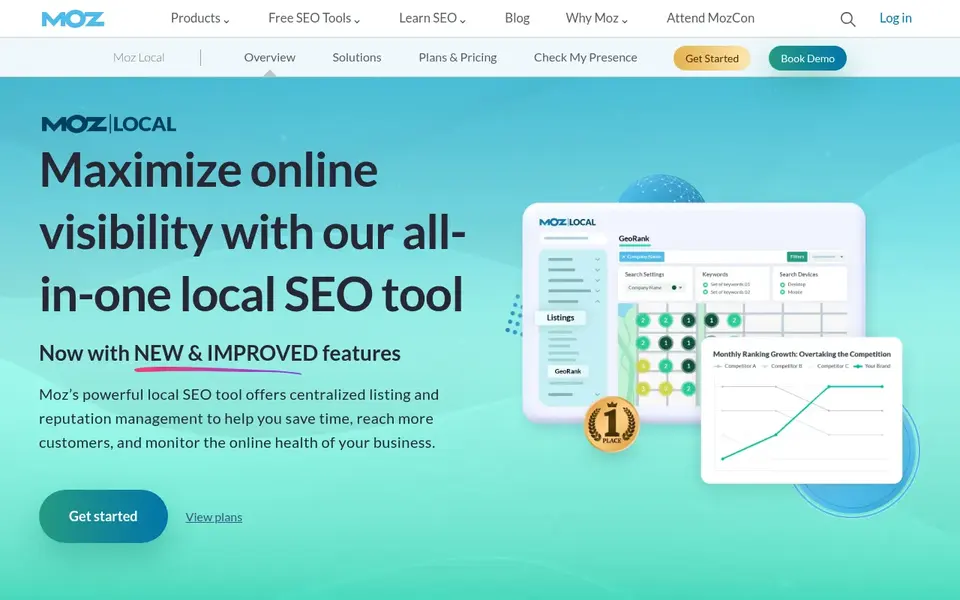
Moz Local is primarily a listings management product. You enter your bakery details once and it pushes them to major data providers and directories, then watches for duplicates and inconsistencies. That is the unglamorous work that keeps a bakery findable when someone searches the shop name plus the town.
Its visibility score gives a rough sense of how complete and consistent your local presence is. It is not a grid rank tracker in the Local Viking sense, so do not buy it expecting street-level Maps positions. What it does well is fix the foundation that rankings depend on.
Skip it if your listings are already clean and you only want rank tracking. Choose it if you have moved premises, changed a phone number, or opened a second shop and listings are a mess.
- Listing distribution across major directories
- Duplicate listing cleanup
- Local visibility scoring
- Rank tracking is not the main feature
- Best value for owners who need listings fixed first
Yext manages business information across a large network of publishers. For a bakery group with several shops, it lets you update hours, holiday closures and menu details in one place and push them everywhere, which reduces the chance of a customer turning up to a closed shop.
It also reports on how people find and interact with your listings, so you can see which locations get attention. That is useful when deciding where to promote a new pastry line or extended opening hours.
One limitation is scale. Yext is built for organizations with multiple locations and a budget to match, and the setup is more formal than a small bakery needs. A single shop should look elsewhere.
- Central control of listings for many shops
- Structured data for hours and menus
- Analytics across locations
- Enterprise-style contracts
- Overkill for a single shop
GatherUp is a customer experience and review platform. For a bakery, reviews are a direct ranking input and a direct sales input: people choose where to buy bread and cake partly on star ratings and recent comments. GatherUp automates review requests after a purchase and pulls reviews from multiple sites into one place.
It also provides local search visibility reporting, so you can see how the shop appears in local results alongside review activity. That combination is useful when you want to connect a review push to a change in map position.
It is not the tool for street-level grid tracking. If your main question is "where do I rank on the map," pick a dedicated tracker. If your question is "how do I get more reviews and see the effect," GatherUp fits.
- Review requests by email and SMS
- Review monitoring in one inbox
- Local search visibility reports
- Not a deep grid rank tracker
- Review-focused rather than rankings-focused
Synup combines listings, reviews and local visibility reporting in one platform. For a bakery with a shop and a second outlet, or a shop plus a wholesale pickup point, it keeps addresses, hours and phone numbers aligned and flags inconsistencies.
The review side lets you monitor and respond from one place, which matters when a bad review about a custom cake order appears on a Saturday. Responding promptly and politely is both good service and good local SEO.
The limit is fit. Synup is designed for businesses managing several locations, and a single-counter bakery will pay for features it does not use. Its rank tracking is also less detailed than a grid-first tool.
- Listings management across directories
- Review monitoring and responses
- Local visibility reporting
- Priced for multi-location use
- Less depth on grid rank tracking
How I chose
I started from vendor documentation and public sources: feature pages, help centers and published product descriptions. I did not run hands-on tests, so I am not claiming measured results. Instead I checked what each tool says it tracks, whether it covers Google Maps rankings on a grid or only a single position, and whether reviews, listings and profile management are included.
Then I filtered for a bakery's real situation. Most bakeries have one or two locations, a small radius of competition, and limited time. That pushed grid tracking and review monitoring up the list and pushed enterprise listing platforms down. I also noted where a tool is clearly built for multi-location groups, so a single shop does not buy more than it needs. Where a free plan or trial was not clear from public information, I marked it as not stated rather than guessing.
What to check before you buy
- Confirm the tool tracks Google Maps rankings on a grid around your shop address, not just one citywide position.
- Check whether it supports the number of locations you have now and the number you plan to open.
- Look for Google Business Profile audit features that flag missing hours, categories and photos, since these affect bakery visibility.
- Make sure review monitoring covers the sites your customers actually use, and that responses can be sent from the tool.
- Ask whether listings management is included if you have moved, changed a phone number or opened a second shop.
- Read the contract terms for location limits and cancellation before paying, especially with enterprise-style platforms.
Frequently asked questions
What is local rank tracking for a bakery?
It is the practice of checking where your bakery appears in Google Maps and local search results for searches like "bakery near me" or "custom cakes in [town]". Grid-based tools sample rankings at points around your shop, so you see visibility by area rather than a single number. It pairs with Google Business Profile work and review management.
Do I need a grid rank tracker if I only have one shop?
It helps more than a single position number. Customers search from homes and workplaces across town, and a grid shows which neighborhoods see you. A single shop with a small budget can start with a basic tracker and add review monitoring, then expand if a second location opens.
How often should I check local rankings?
Weekly is enough for most bakeries. Rankings move slowly and are affected by reviews, profile changes and competitor activity. Checking daily creates noise and wasted time. Review your grid after any profile change, new review push or seasonal menu launch so you can connect cause and effect.
Can rank tracking tools help with reviews?
Some do. Local Viking, GatherUp and Synup include review monitoring, and some support review requests. Reviews influence local rankings and customer decisions, so keeping them in the same workflow as rankings is practical. Avoid any tool that offers review gating or incentives, which break Google's guidelines.
Is a free plan enough for a bakery?
Sometimes. A free trial lets you test whether grid tracking makes sense for your shop before paying. Free plans usually limit locations, keywords or history, so check the limits against your needs. If you have two or more shops, a paid plan is usually necessary to track them properly.
Sources
See where you really rank - block by block
ProMapRanker scans Google Maps across a grid of your service area. Simple monthly plans from $19, white-label on every plan.
Start freeBrowse all guides
← Best Listing Management Software for Orthodontists in 2026Best Local Rank Tracking Tools for Concrete Contractors in 2026 →
 best listing management software for law firms
Best Listing Management Software for Law Firms in 2026
A guide to the best listing management software for law firms in 2026, covering citation accuracy, practice-area categories and multi-office control.
Read → best listing management software for handymen
Best Listing Management Software for Handymen in 2026
A handyman-focused guide to listing management software in 2026, comparing tools for citations, Google Business Profile, reviews and call tracking.
Read → best listing management software for dance studios
Best Listing Management Software for Dance Studios in 2026
A guide to the best listing management software for dance studios in 2026, covering Google Business Profile, maps, reviews and multi-location listings.
Read → us local search engine
Us Local Search Engine: A Complete Guide
Everything you need to know about us local search engine: what it is, why it matters for local SEO, and exactly how to act on it.
Read → local seo for contractors
Local SEO For Contractors: A Complete Guide
Everything you need to know about local seo for contractors: what it is, why it matters for local SEO, and exactly how to act on it.
Read → local seo importance
Local SEO Importance: A Complete Guide
Everything you need to know about local seo importance: what it is, why it matters for local SEO, and exactly how to act on it.
Read →More in Local SEO & Google Maps · All guides A to Z by date · Latest guides