 ProMapRanker
Best Local Rank Tracking Tools for Optometrists in 2026

Neighborhood-level Google Maps grid tracking · Pricing starts at: See website
Direct answer
Local Viking is my top pick for optometrists because it tracks Google Maps grid rankings at the neighborhood level, which matches how patients search for an eye doctor near their home. Pricing is quote-based and I could not confirm a free plan, so check its pricing page. Whitespark suits practices that also want citation work, and Semrush Local fits offices already using Semrush for their website SEO.
I compared these tools from vendor documentation and public sources rather than running hands-on tests. My focus was how each one handles the way people search for eye care: by neighborhood, by "near me", and by service such as contact lens fitting or dry eye treatment.
Key takeaways
- Optometry patients usually search "eye doctor near me" or "optometrist in [suburb]", so you need grid-based Maps tracking, not just one city-wide position.
- A rank tracker only helps if your Google Business Profile categories, hours, and services are accurate first.
- Multi-location practices need tools that group locations and compare them side by side.
- Review signals affect Maps visibility, so tools that combine rank tracking with review requests save you a second subscription.
- Check that the tool tracks the exact map pin locations your patients actually search from, including surrounding suburbs.
Quick comparison
| Pick | Great for | Pricing starts at | Free tier | |
|---|---|---|---|---|
| Local Viking | Neighborhood-level Google Maps grid tracking | See website | Not stated | Visit |
 Whitespark | Rank tracking combined with citation building | See website | Not stated | Visit |
 Semrush Local | Practices already using Semrush for website SEO | See website | No free plan | Visit |
 Moz Local | Listing accuracy with local visibility checks | See website | Not stated | Visit |
 Yext | Multi-location optometry groups | See website | Not stated | Visit |
 GatherUp | Reviews and local visibility together | See website | Free trial | Visit |
 Synup | Managing listings and rankings across many clinics | See website | Not stated | Visit |
The best local rank tracking tools for optometrists compared
Local Viking is built around geo-grid rank tracking, which plots your Google Maps position across a grid of points around your practice. For an optometrist, that is more useful than a single "ranked #4" number, because a patient two suburbs away may see a very different result than someone across the street. It fits single practices and small groups that want to see where they are strong and where they are invisible.
In practice, you set your practice address as the center point and let the grid cover the surrounding suburbs and shopping districts. The heatmap then shows which areas need work, such as a suburb where a competing optical chain outranks you. You can pair that with review monitoring so you notice when a new Google review changes your local standing.
The main limit is transparency on cost. If you need a published price before you commit, ask for a quote first. Practices that only want a simple weekly position report may find the grid more detail than they need.
- Grid heatmaps show rankings across a service area
- geo-grid tracking at small intervals
- review and GBP tools in the same dashboard
- Pricing is not listed publicly
- the grid view can overwhelm a first-time user
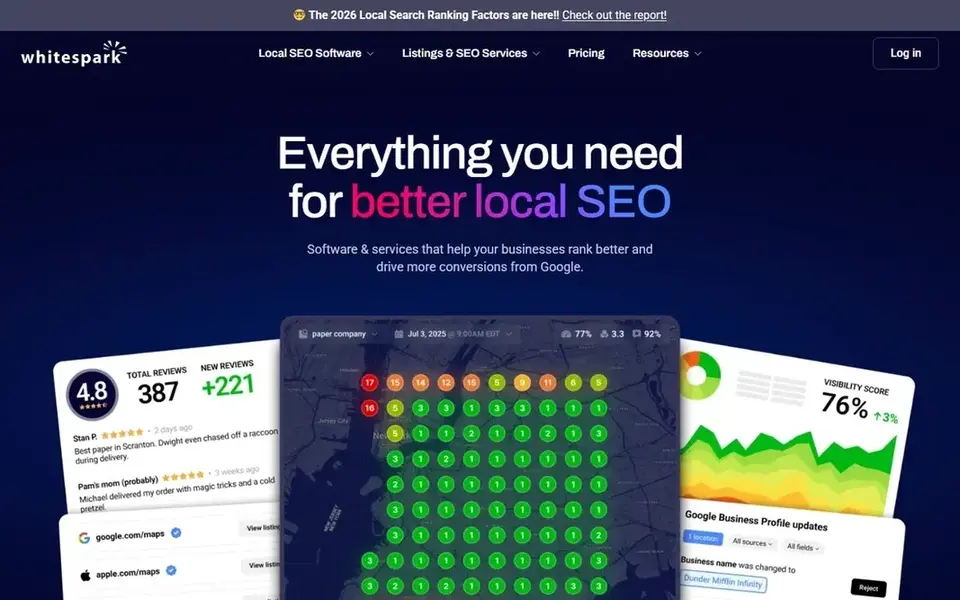
Whitespark is a local SEO toolkit with a rank tracker and a citation-building service. For an optometrist, the appeal is doing two jobs in one place: watching your Maps positions and making sure your name, address, and phone number match across directories that patients and Google both use.
The rank tracker lets you follow keyword sets like "optometrist [suburb]" and "eye exam near me" and review grid results over time. The citation side helps you fix inconsistent listings, which matters when a old phone number from a previous location is still floating around directories.
It is not a set-and-forget tool. Someone has to review the data and act on it. A solo practice with no marketing help may prefer something simpler, while a practice with an in-house marketer will get more from it.
- Local rank tracker with grid views
- strong citation and listing tools
- built specifically for local SEO work
- Requires more manual setup
- not a full practice-management system

Semrush Local adds Maps and local pack tracking to the wider Semrush platform. If your practice website already ranks for service pages like "dry eye treatment [city]", keeping local and organic data in one dashboard saves switching between tools.
For optometrists, the useful part is seeing how your Google Business Profile performs against nearby competitors, including optical chains. You can track local pack positions for your main service keywords and compare them with your organic positions to spot gaps, such as a strong website page but a weak Maps presence.
The trade-off is cost and complexity. There is no free plan, and a single-location practice may not need the full keyword research suite. It makes most sense if you already pay for Semrush.
- Local rankings sit beside organic keyword data
- listing management included
- useful competitor tracking
- No free plan
- the full suite may be more than a small clinic needs
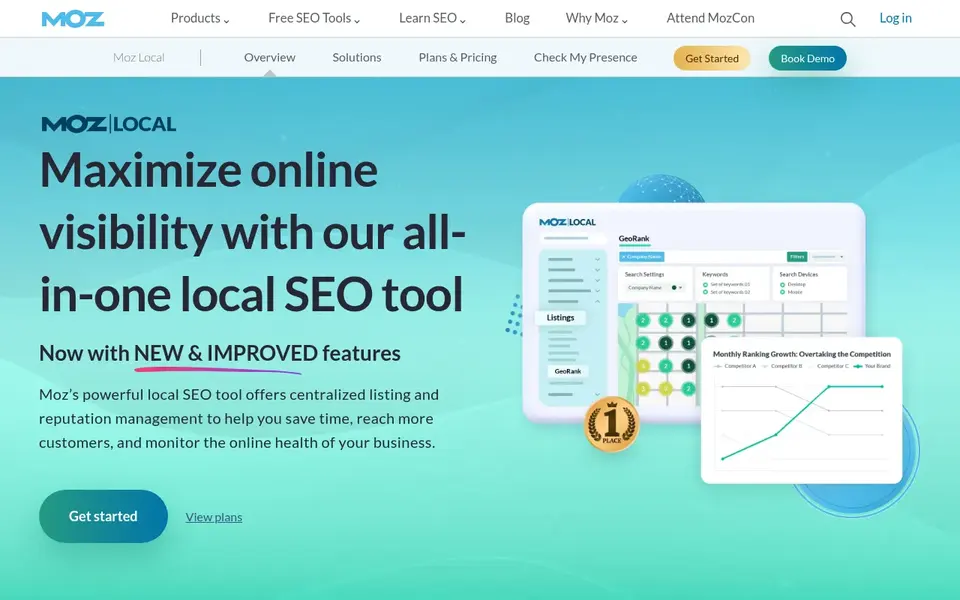
Moz Local focuses on getting your business data correct and distributed across directories. For an optometrist, that means consistent hours, address, and phone details everywhere, which supports both patient trust and Maps accuracy.
Its local visibility reporting gives you a sense of how your listing compares with competitors in the same area. It is less of a day-to-day rank tracker and more of a foundation tool, so it works well as a companion to a dedicated grid tracker rather than a replacement.
If your only goal is watching Maps positions change week to week, Moz Local will feel indirect. It suits practices that suspect their listings are messy and want that fixed first.
- Strong data aggregation for listings
- local visibility scoring
- familiar Moz interface
- Rank tracking is not the core feature
- distribution partners vary by country

Yext manages business listings and location data at scale. A group with several clinics across a region can update hours, services, and holiday schedules from one place instead of editing each profile by hand.
For rank tracking, Yext's value is consistency: when every location's data is accurate, Maps visibility is easier to measure and improve. Groups that open new clinics regularly benefit most, because adding a location follows the same structured process.
A single optometrist with one office will find it heavy and expensive relative to the need. It is a group tool, not a starter tool.
- Central control of listings across many locations
- structured data management
- reporting across a group
- Enterprise-style pricing and contracts
- overkill for one office
GatherUp is primarily a customer review and feedback platform with local search reporting attached. Reviews carry real weight in local pack rankings, and optometry is a trust-driven purchase, so a steady flow of genuine reviews helps both visibility and conversion.
You can send review requests after appointments, monitor new reviews across sites, and watch local search performance in the same account. The review requests must follow Google's rules: ask every patient, never filter for positive feedback only, and never offer incentives.
If you already have a rank tracker you like, GatherUp fills the review gap. If you want deep grid tracking, it will not replace a dedicated tool.
- Review requests by text and email
- review monitoring
- local search reporting
- Rank tracking is secondary
- review features are the main draw
Synup handles listings, reviews, and local rank tracking for businesses with multiple locations. An optometry group with clinics in several towns can keep profiles consistent and compare visibility between branches.
The rank tracking shows how each location performs for local searches, which helps you decide where to put marketing effort. If one clinic ranks poorly for "eye exam [town]" while another is strong, you have a clear starting point.
The interface takes time to learn, and pricing is not published. Small practices should look at simpler options first.
- Listing management at scale
- local rank tracking
- review monitoring
- Learning curve
- pricing requires a conversation
How I chose
I built this list from vendor documentation, public product pages, and general knowledge of how local search works for healthcare-adjacent businesses like optometry. I did not run hands-on tests, and I have not measured results for any specific practice. Where a vendor does not publish pricing or free-plan details, I say so rather than guess.
My selection criteria were fit for optometry workflows, quality of Maps and grid tracking, whether the tool handles multiple locations, and how much manual work it demands. I also weighed whether each tool follows Google's guidelines on reviews and business names. Tools that encourage review gating or keyword-stuffed names were left out.
What to check before you buy
- Confirm the tool tracks Google Maps grid points, not just one city-level position, so you see suburb-level visibility.
- Check whether it supports the number of locations you have now and the number you plan to open.
- Ask whether review requests follow Google's guidelines, with no filtering or incentives.
- Verify it tracks the keywords patients actually use, such as "optometrist near me" and service terms like "contact lens fitting".
- Confirm pricing includes the features you need, since several tools here do not publish prices.
- Check how often rankings refresh and whether historical data is kept so you can see trends.
Frequently asked questions
Do optometrists need a rank tracking tool at all?
Yes, if you want to know whether your Google Business Profile is visible in the areas patients search from. A rank tracker shows changes over time and helps you judge whether profile updates, reviews, or website changes are working. Without one, you are guessing.
What is grid-based rank tracking and why does it matter for eye care?
Grid tracking checks your Maps position from many points around your practice instead of one. Patients travel short distances for eye exams, so a practice can rank well in its own suburb and poorly two miles away. The grid shows that pattern clearly.
Can I track rankings without paying for a tool?
You can check your position manually in Google Maps from different locations, but it is slow and hard to compare over time. Some tools offer free trials, and Google Search Console gives limited local data. For regular tracking, a paid tool is more practical.
Do reviews affect local rankings for optometrists?
Reviews are one of many signals Google uses for local results, and they clearly affect whether patients choose you. A steady flow of genuine reviews collected from all patients, without filtering, supports both visibility and trust. Never offer incentives or gate requests.
How many keywords should a single practice track?
Start with a small set: your main service terms plus "near me" variants and your suburb names. Ten to twenty keywords is usually enough for one office. Groups should track per location so comparisons stay meaningful.
Sources
See where you really rank - block by block
ProMapRanker scans Google Maps across a grid of your service area. Simple monthly plans from $19, white-label on every plan.
Start freeBrowse all guides
← Best Local Rank Tracking Tools for Massage Therapists in 2026Best Local Rank Tracking Tools for Painters in 2026 →
 best local rank tracking tools for concrete contractors
Best Local Rank Tracking Tools for Concrete Contractors in 2026
A concrete contractor's guide to local rank tracking tools in 2026, comparing grid maps, review signals and citation tracking from vendor documentation.
Read → best local rank tracking tools for bakeries
Best Local Rank Tracking Tools for Bakeries in 2026
A practical guide to the best local rank tracking tools for bakeries in 2026, covering grid tracking, review monitoring, citations and Google Business Profile.
Read → best listing management software for orthodontists
Best Listing Management Software for Orthodontists in 2026
A practical guide to the best listing management software for orthodontists in 2026, covering multi-location practices, review requests and directory accuracy.
Read → why geo grid is mostly red
Why Your Geo-Grid Is Mostly Red (and the Fix Workflow)
Why your geo-grid is mostly red and a prescriptive workflow to turn red zones green.
Read → local pack rankings
Local Pack Rankings: A Complete Guide
Everything you need to know about local pack rankings: what it is, why it matters for local SEO, and exactly how to act on it.
Read → google business profile not showing
Google Business Profile Not Showing? How to Get It Back on Maps
Profile not appearing on Maps or Search? Diagnose the cause and follow the fix steps to restore visibility.
Read →More in Local SEO & Google Maps · All guides A to Z by date · Latest guides