 ProMapRanker
Local Competitor Analysis: A Complete Guide

Local competitor analysis is the strategic process of identifying, evaluating, and understanding the strengths, weaknesses, strategies, and market positioning of businesses that target the same local customer base. Its essence lies in uncovering what your local rivals do well, where they fall short, and how their presence impacts your potential customers' choices. By dissecting their Google Business Profile optimization, website performance, local SEO signals, and even offline customer experience, businesses can identify critical gaps and opportunities to refine their own offerings, enhance their online visibility, and ultimately capture a larger share of the local market.
As Md Shihab Mia, founder of ProMapRanker and a product of rankite.com, I’ve seen firsthand how a meticulous local competitor analysis transforms businesses. It’s not just about knowing who your rivals are; it’s about dissecting their playbook to build a superior strategy for yourself. This guide will walk you through every step, ensuring you have the insights to outmaneuver your competition and dominate your local search results.
What is Local Competitor Analysis and Why is it Essential for Local Businesses?
Local competitor analysis is the systematic examination of direct and indirect competitors operating within your specific geographic market to understand their strategies and performance. It is essential because it reveals market opportunities, identifies threats, and provides actionable insights to improve your business's local search rankings, customer acquisition, and overall market share.
For any local business, whether a plumber in Phoenix or a bakery in Brooklyn, understanding the competitive landscape is not optional, it's foundational. Without it, you're operating in the dark, guessing at what resonates with your local audience and why customers might choose a rival. This analysis helps you:
- Identify Market Gaps: Discover services or products your competitors aren't offering, or areas where they provide a poor experience, creating an opportunity for you to step in.
- Benchmark Performance: Understand what "good" looks like in your local market regarding Google Business Profile (GBP) reviews, website speed, or local pack rankings.
- Refine Your Strategy: Learn from competitor successes (and failures) to optimize your pricing, marketing messages, service offerings, and local SEO strategies.
- Anticipate Market Shifts: Stay ahead of emerging trends or changes in competitor tactics that could impact your business.
- Improve Customer Experience: By seeing what customers praise or complain about with competitors, you can enhance your own service delivery.
How Do You Identify Your True Local Competitors?
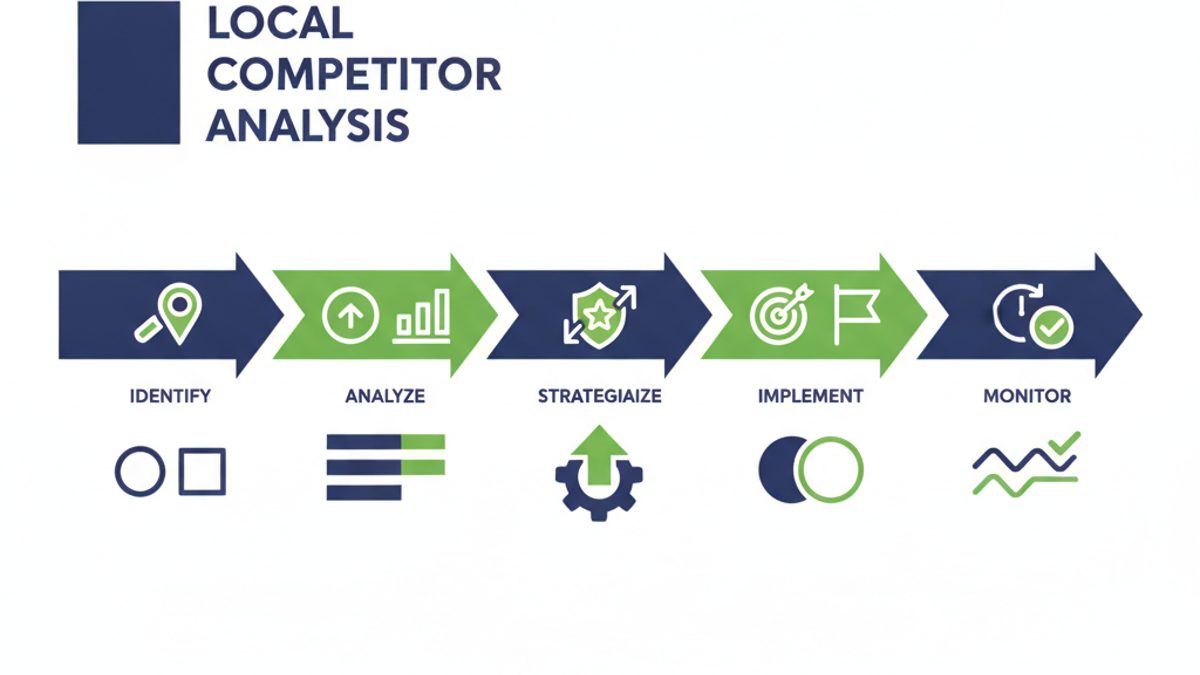
Identifying your true local competitors involves looking beyond obvious rivals to include any business vying for the same local customer’s attention, both online and offline. Start with Google Maps and local search results for your primary keywords, then expand your search to local directories and industry-specific platforms to uncover a comprehensive list of direct, indirect, and perceived competitors.
The first step in any analysis is knowing who you're up against. This isn't always straightforward. Your local competitors aren't just the businesses down the street offering the exact same service; they also include those that might meet a similar customer need in a different way.
Types of Local Competitors:
- Direct Competitors: These are businesses that offer the same products or services to the same target audience in your geographic area. (e.g., two coffee shops on the same block).
- Indirect Competitors: These businesses offer different products or services that can satisfy the same customer need. (e.g., a coffee shop and a juice bar both catering to morning beverage drinkers).
- Perceived Competitors: These are businesses that a customer might consider an alternative, even if they're not direct or indirect. This often comes from online visibility. If a business ranks well for a keyword you target, they're a competitor for that customer's click.
Methods for Finding Local Competitors:
- Google Maps & Local Search: Perform searches for your primary services (e.g., "plumber near me," "best pizza [city name]"). Pay close attention to the Google Map Pack results and the businesses that appear in the "More businesses" list. ProMapRanker's geo-grid scans are invaluable here, showing you exactly who ranks within specific grid points around your service area, revealing local competitors you might not even be aware of.
- Local Directories & Review Sites: Check platforms like Yelp, Yellow Pages, TripAdvisor, and industry-specific directories. See which businesses consistently appear and have high review counts.
- "People Also Search For" & Related Searches: When performing Google searches, look for these sections at the bottom of the results page. They can often reveal unexpected competitors or related service providers.
- Customer Feedback: Ask your existing customers who else they considered before choosing you, or where they go for services you don't offer.
- Local Business Associations/Networking: Attend local events or join business groups. You'll quickly learn who the key players are in your area.
What Key Areas Should You Analyze in Your Local Competitors?
A thorough local competitor analysis focuses on several critical areas, including their Google Business Profile optimization, website performance, local SEO signals like citations and backlinks, and their overall customer experience. By examining these facets, you can pinpoint specific strategies that contribute to their local search visibility and customer appeal, allowing you to develop a more effective competitive response.
Once you have a list of your top 3-5 local competitors, it's time to dive deep. Here are the key areas to scrutinize:
1. Google Business Profile (GBP) Optimization
Your competitor's GBP is often their most visible asset in local search. Analyze:
- Primary and Secondary Categories: Are they using more relevant or specific categories than you?
- Services and Products: What services and products do they list? Are they more comprehensive or descriptive?
- Photos and Videos: Are their GBP listings rich with high-quality, frequently updated photos and videos? Are they showcasing their staff, location, or work effectively?
- Reviews: Look at the quantity, quality, and recency of their reviews. More importantly, analyze their review response strategy. Do they respond to all reviews, both positive and negative? What is their average rating? According to a Google Business Profile Help article, responding to reviews can build customer trust.
- Posts and Q&A: Are they actively using GBP posts to announce offers, events, or updates? Do they answer questions in the Q&A section, or are customers doing it?
- Business Description: How well do they use their business description to incorporate keywords and highlight unique selling propositions?
ProMapRanker offers a comprehensive free GBP audit that can quickly highlight areas where your competitors might be outperforming you, giving you a clear roadmap for improvement.
2. Website Performance and On-Page SEO
A strong website supports local rankings and converts visitors. Examine:
- Website Speed and Core Web Vitals: Use tools like Google PageSpeed Insights. Look for an INP (Interaction to Next Paint) under 200ms and an LCP (Largest Contentful Paint) under 2.5 seconds, as these are crucial for user experience and ranking, as highlighted by web.dev/vitals.
- Mobile-Friendliness: Is their site fully responsive and easy to navigate on a smartphone?
- On-Page SEO:
- Keywords: What local keywords are they targeting on their homepage and service pages? Use tools to identify their top-ranking keywords.
- Content Quality: Do they have detailed, helpful content that answers common customer questions? Are they using location-specific content?
- Local Schema Markup: Are they using LocalBusiness schema to help search engines understand their business details?
- Calls to Action (CTAs): Are their CTAs clear, prominent, and compelling?
- User Experience (UX): Is their website easy to navigate? Does it provide a smooth journey for potential customers?
3. Local SEO Signals
Beyond GBP and website, other signals impact local visibility:
- Citations: Where are your competitors listed online? Look for consistency in their Name, Address, and Phone number (NAP) across at least 20+ prominent local directories (e.g., Yelp, Facebook, chamber of commerce). Inconsistent NAP can hurt rankings. Use a business listing consistency checker to compare.
- Local Link Building: What local websites link back to your competitors? These could be local news sites, community blogs, or other local businesses. Identifying these can reveal opportunities for your own local link building strategy.
- Review Management Strategy: Beyond just responding, do they actively solicit reviews? What platforms do they prioritize?
4. Offline Presence & Offerings
Don't forget the real-world experience:
- Pricing and Promotions: Are they consistently running promotions? How does their pricing structure compare to yours?
- Service Quality: While harder to quantify, customer reviews often hint at service quality. Can you anonymously experience their service?
- Physical Location: If applicable, what is the curb appeal, interior ambiance, and accessibility of their physical location?
- Customer Service: How do they handle inquiries via phone or email?
5. Social Media Engagement
Social signals, while not a direct ranking factor, can influence brand awareness and local buzz:
- Platforms: Which social media platforms do they use most actively (Facebook, Instagram, LinkedIn, etc.)?
- Content Strategy: What type of content do they share? Is it engaging, promotional, or community-focused?
- Engagement: What's their follower count, and more importantly, their engagement rate (likes, comments, shares)?
A Step-by-Step Guide to Performing Local Competitor Analysis
Executing a local competitor analysis requires a structured approach to ensure you gather comprehensive and actionable data. This step-by-step guide helps you systematically evaluate your rivals, turning observations into strategic advantages for your business.
Here’s a practical framework to conduct your analysis:
- Step 1: Define Your Scope and Identify Top Competitors.
- Start by listing your primary services and the geographic area you serve (e.g., "HVAC repair in downtown Austin").
- Use Google Maps and local search results to identify the top 3-5 businesses that consistently appear for your key services. ProMapRanker's geo-grid scans can pinpoint exactly who dominates specific neighborhoods, giving you a precise list of competitors within a 5x5 grid at 5-mile intervals.
- Classify them into direct and indirect competitors.
- Step 2: Collect Google Business Profile Data.
- For each competitor, meticulously record their GBP details: categories, service areas, photos, number of reviews, average rating, and review responses.
- Note any active GBP posts, special offers, or Q&A interactions.
- Utilize ProMapRanker's GBP audit tool to streamline this process and get a score for each competitor's profile compared to yours.
- Step 3: Analyze Competitor Websites.
- Visit each competitor’s website. Assess their design, mobile-friendliness, and overall user experience.
- Use tools like Google PageSpeed Insights to check their Core Web Vitals (INP, LCP, CLS).
- Examine their content for local keyword usage, quality, and calls to action. Look for dedicated service pages and location pages.
- Check for local schema markup implementation.
- Step 4: Evaluate Local Citation & Backlink Profiles.
- Identify where your competitors are listed (Yelp, Facebook, industry-specific directories, etc.). Note their NAP consistency.
- Use backlink analysis tools (e.g., Ahrefs, SEMrush) to see who links to their website. Prioritize local and relevant backlinks.
- Look for any prominent local sponsorships or partnerships that generate links or mentions.
- Step 5: Assess Review and Reputation Management.
- Beyond GBP, check other review platforms like Yelp, TripAdvisor, or industry-specific review sites.
- Analyze the sentiment of reviews. What are common praises and complaints?
- Observe their review solicitation methods and how promptly and professionally they respond to all feedback.
- Step 6: Understand Offline Strategies & Customer Experience.
- If feasible, conduct a "secret shopper" exercise or call their business to inquire about services.
- Note their pricing, special offers, and how they handle customer interactions.
- Observe their physical location's appearance and accessibility, if relevant.
- Step 7: Synthesize Findings & Identify Opportunities.
- Compile all your data. Use a spreadsheet for easy comparison (see example below).
- Look for patterns: Where do most competitors excel? Where are they weak?
- Pinpoint specific gaps or areas where you can differentiate your business or improve your own strategy. For instance, if no one is using GBP posts effectively, that's an easy win.
- Step 8: Implement and Monitor.
- Develop an action plan based on your findings. This might include optimizing your GBP categories, improving website speed, building more local citations, or refining your review strategy.
- Use ProMapRanker to monitor your local rankings and your competitors' on an ongoing basis. Our Share of Local Voice (SoLV) and Average Rank Position (ARP) metrics provide dynamic insights into your competitive standing, helping you track the impact of your changes.
Analyzing Competitor Data: A Comparison Table Example
Organizing your collected competitor data into a comparison table provides a clear, at-a-glance overview of key performance metrics and strategic differences. This structured format highlights strengths and weaknesses across various local SEO and business categories, making it easier to identify actionable insights for your own strategy development.
A structured table makes it easy to compare and contrast your business against your local competitors. Here’s an example for a hypothetical "Local HVAC Company in Springfield":
| Metric/Factor | Your Business (HVAC Pros) | Competitor A (Cool Air HVAC) | Competitor B (Springfield Comfort) | Competitor C (Elite Climate) |
|---|---|---|---|---|
| GBP Primary Category | HVAC Contractor | HVAC Contractor | HVAC Contractor | HVAC Contractor |
| GBP Secondary Categories | Air Conditioning Contractor | Air Conditioning Service, Heating Contractor | HVAC Contractor, Furnace Repair Service | Air Quality Consultant |
| GBP Reviews (Count / Avg Rating) | 120 / 4.7 stars | 280 / 4.9 stars | 95 / 4.5 stars | 150 / 4.8 stars |
| Review Response Rate | 70% | 95% | 50% | 85% |
| GBP Posts Activity | Monthly offers | Weekly tips & offers | Rarely | Bi-weekly service announcements |
| Website Speed (LCP / INP) | 2.8s / 250ms | 2.1s / 180ms | 3.5s / 320ms | 2.3s / 190ms |
| Website Mobile-Friendly | Yes | Yes | No (some issues) | Yes |
| Local Schema Markup | Basic LocalBusiness | Comprehensive LocalBusiness, Service | None | LocalBusiness, FAQPage |
| Number of Citations (Consistent NAP) | 35 | 60 | 20 | 45 |
| Local Backlinks (approx.) | 5 (local blogs) | 15 (local news, chamber) | 2 (directory) | 10 (local charity, supplier) |
| Unique Selling Proposition (USP) | 24/7 emergency service | "Eco-friendly solutions" | "Affordable pricing" | "Certified technicians" |
| Opportunity/Weakness | Improve review response, add more GBP posts, faster site. | Strong GBP & site, high competition. | Poor GBP & site, slow. | Good overall, niche focus. |
From this table, "HVAC Pros" can see that Competitor A has significantly more reviews and a better response rate, suggesting a focus on customer feedback. Competitor B has website issues. Competitor C uses more specific GBP secondary categories and comprehensive schema. HVAC Pros can prioritize improving their website speed, increasing review responses, and expanding their GBP category usage to match or exceed Competitor A and C.
How ProMapRanker Elevates Your Local Competitor Analysis
ProMapRanker provides an unparalleled advantage in local competitor analysis by offering precise geo-grid rank tracking, Share of Local Voice (SoLV) and Average Rank Position (ARP) metrics, and automated Google Business Profile audits. Our AI-powered insights streamline the entire process, allowing you to quickly identify competitive gaps and monitor your progress against rivals across specific local search areas, ensuring your strategies are always data-driven and effective.
At ProMapRanker, we built our tool (a Local Falcon / BrightLocal alternative) specifically to address the complexities of local competitor analysis. Here's how we empower your strategy:
- Precision Geo-Grid Scans: Our core strength lies in geo-grid rank tracking. Instead of a single "average" rank, you see exactly where you and your competitors rank across a user-defined grid (e.g., a 7x7 grid at 1-mile intervals). This reveals hyper-local ranking variations and pinpoints which competitors dominate specific neighborhoods, giving you a tactical advantage.
- Share of Local Voice (SoLV) & Average Rank Position (ARP): Go beyond individual keyword rankings. Our SoLV metric shows your overall visibility compared to competitors across your entire keyword set and service area. ARP provides a weighted average rank, helping you understand your aggregate performance. These are crucial for understanding true competitive presence.
- Automated Google Business Profile Audits: Quickly audit your GBP and your competitors' profiles for optimization opportunities. Identify missing information, category discrepancies, review response rates, and more, all within one dashboard.
- AI-Powered Insights: Our platform is designed to cut through the noise, highlighting the most critical competitive insights and suggesting actionable steps based on the data. This saves you time and ensures you focus on what truly moves the needle.
- Historical Data & Trend Analysis: Track your progress and your competitors' over time. See how their strategies impact their rankings and adapt yours accordingly. This continuous monitoring is key to sustained local search dominance.
Ready to gain an unfair advantage in your local market? Start your journey with ProMapRanker today. Sign up for a free trial and experience the power of precise local competitor analysis. Or, get a free GBP audit to kickstart your competitive review.
Frequently Asked Questions
What are the 4 P's of competitor analysis?
While the traditional "4 P's" (Product, Price, Place, Promotion) are usually associated with marketing mix, in competitor analysis, they can be adapted to evaluate rivals. You'd analyze their Product (services/offerings), Price (pricing strategies), Place (distribution, physical location, online presence), and Promotion (marketing and communication tactics). This framework helps assess a competitor's overall market strategy.
Can ChatGPT do a competitor analysis?
ChatGPT and other large language models can assist with competitor analysis by summarizing industry reports, generating ideas for analysis areas, or even drafting initial competitor profiles based on publicly available text. However, they cannot perform real-time data collection, conduct geo-grid rank tracking, analyze website performance metrics like Core Web Vitals, or audit Google Business Profiles with live data. AI is a powerful assistant, but human expertise and specialized tools like ProMapRanker are essential for accurate, actionable, and data-driven analysis.
How often should I perform local competitor analysis?
For most local businesses, a comprehensive local competitor analysis should be conducted at least once a year, or whenever there's a significant shift in your market (e.g., new competitor, major service change, economic downturn). However, continuous monitoring of key metrics, such as local rankings, review sentiment, and competitor GBP updates, should be ongoing, ideally with a tool like ProMapRanker that provides daily or weekly updates.
What is the biggest mistake businesses make in competitor analysis?
The biggest mistake businesses make in local competitor analysis is focusing solely on direct competitors or only on high-level data, neglecting the granular, hyper-local insights. They often fail to understand *why* a competitor ranks well in specific neighborhoods or overlook critical details in GBP optimization and website performance. This leads to generic strategies that don't address the true competitive landscape.
How can I use competitor analysis to improve my Google Maps ranking?
Competitor analysis directly informs your Google Maps ranking strategy by revealing what successful local businesses are doing. By identifying their optimized GBP categories, high review counts, active GBP posts, consistent citations, and strong local backlinks, you can prioritize improvements to your own profile and website. Tools like ProMapRanker help you track these factors and measure your progress directly against competitors in the local map pack.
See where you really rank - block by block
ProMapRanker scans Google Maps across a grid of your service area. Simple monthly plans from $19, white-label on every plan.
Start free