 ProMapRanker
Best Local SEO Software for Engineering Firms in 2026

Direct answer
Moz Local is my first pick for engineering firms because it keeps the name, address and phone details of a practice consistent across the directories that feed Google Maps, which matters when a firm has several office locations. It has no free plan stated, so check its pricing page. Yext suits firms that want tighter control over listings at scale, and Local Viking fits teams that want to watch map rankings for each office.
I put this list together by reading vendor documentation and public sources, and I did not run hands-on tests of any product. Engineering firms are a specific case: you often have a head office, one or more site or regional offices, a long sales cycle and clients who judge you on credentials and past projects. That shapes which software is worth paying for.
Key takeaways
- Engineering firms usually compete in a small local pool, so accurate office listings and a well-run Google Business Profile matter more than a large content operation.
- Multi-office practices need software that handles separate addresses, service areas and phone numbers without mixing them up.
- Review requests should go to project managers or principals who deal with clients directly, and they should follow Google's review policies.
- Rank tracking for map results is useful when you serve a metro area or a radius around a plant or site office.
- Most tools here are priced by location or by user, so count your offices before you compare plans.
Quick comparison
| Pick | Great for | Pricing starts at | Free tier | |
|---|---|---|---|---|
 Moz Local | Consistent office listings | See website | Not stated | Visit |
 Yext | Large multi-location control | See website | Not stated | Visit |
 Local Viking | Map rank tracking per office | See website | Free trial | Visit |
 BrightLocal | Citations and local audits | See website | Not stated | Visit |
 Whitespark | Citation building and research | See website | Not stated | Visit |
 GatherUp | Review requests for project teams | See website | Free trial | Visit |
 CallTrackingMetrics | Tracking calls from map listings | See website | Free trial | Visit |
The best local SEO software for engineering firms compared
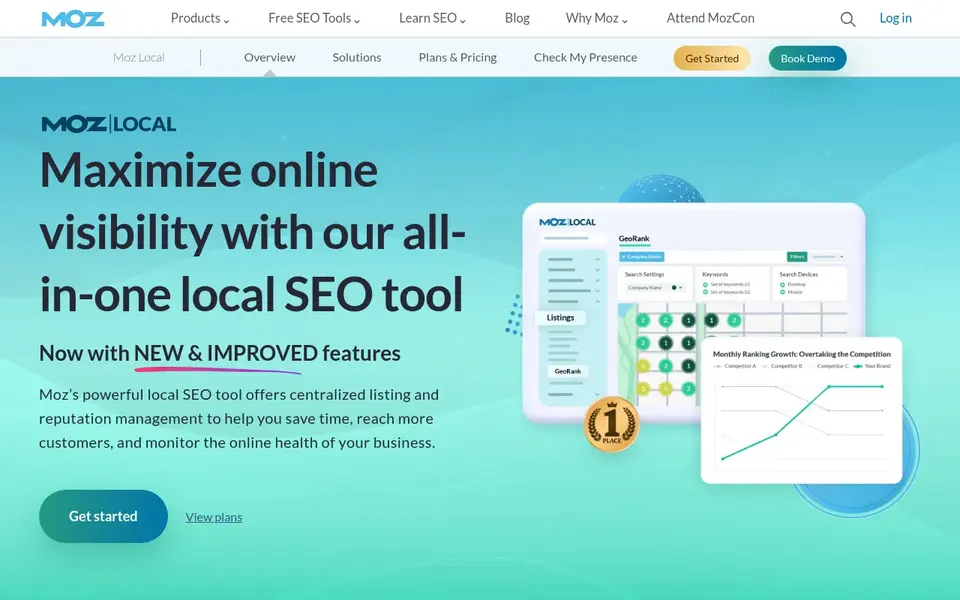
Moz Local is a listing management tool. You enter the firm's name, address, phone number, website and categories once, and it pushes that data to the main data aggregators and directories that Google and other platforms draw on. For an engineering practice with a head office and a couple of regional offices, that removes a lot of manual checking.
The fit for an engineering firm is in the details. Clients often search for a discipline plus a place, such as structural engineer near a city, and then check that the address and phone number match what they see elsewhere. Moz Local helps keep those details aligned across directories, which supports the Google Business Profile and reduces confusion when a receptionist gives out a different number than the one online.
The limits are clear. It is not a review request engine and it will not manage your Google posts. If your main need is asking clients for reviews after a project closes, look at a dedicated review tool instead.
- Distributes business details to major directories
- shows where listings disagree
- works well for a small number of offices
- Review tools are basic
- not built for large enterprise location sets

Yext is an enterprise-leaning listings and answers platform. You keep a single record for each office, including hours, services, staff and photos, and publish it across a large network of directories, maps and apps. It also feeds structured data that search engines can read.
For an engineering firm with offices in several cities, or a firm that opens and closes site offices during long projects, Yext gives one place to update every location at once. That is useful when a project office needs a temporary listing, or when a phone number changes and you do not want stale details sitting on a dozen directories.
The trade-off is scale and cost. A two-person consultancy with one office will find it heavier than needed, and you should confirm the contract terms and pricing directly with the vendor.
- Central control over many location records
- publishes to a wide network of directories and apps
- structured data for services and locations
- Pricing is quote-based
- more than a small firm needs
Local Viking is a local rank tracking and Google Business Profile management tool. It checks where a business appears in Google Maps across a grid of points around a location, so you see whether the firm shows up in the town centre, the industrial estate or the suburbs.
That grid view suits engineering firms that serve a wide area. If you are a civil engineering practice bidding for work across a county, you can see which towns you appear in for terms like drainage engineer or structural survey, and where a competitor is stronger. You can also schedule Google posts and handle reviews from the same dashboard.
It will not fix inconsistent citations, and the grid reports take some reading. Use it alongside a listings tool rather than as a replacement.
- Tracks Google Maps rankings by grid points
- manages multiple locations
- review and posting features alongside tracking
- Ranking focus, not a full listings service
- grid reports need interpretation
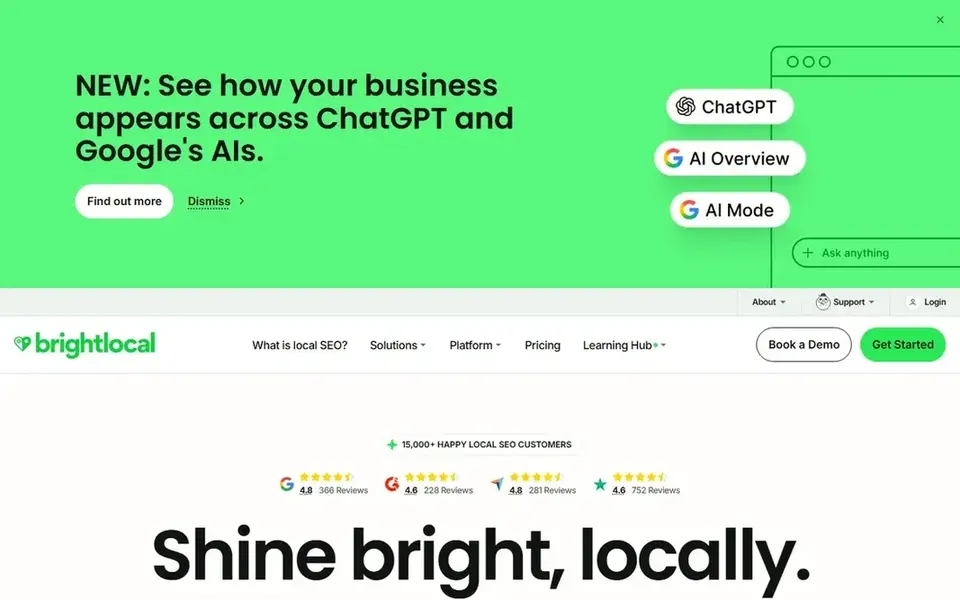
BrightLocal is a broad local SEO platform aimed at agencies and small businesses. It covers citation building, local rank tracking, review monitoring and audit reports, which makes it a practical all-rounder for a firm that wants one subscription instead of several.
For an engineering firm, the citation audit is the most useful part. It finds directories where the office address, phone number or business name does not match, which is common when a firm has rebranded or moved. The rank tracking and review tools then help you see whether the corrections are having an effect.
One limitation is that the platform is modular, so the features you want may sit in different plans. Check what is included before you commit.
- Citation building and audit tools
- local rank tracking
- review and reputation features in one place
- Many features are priced as add-ons
- interface can feel dense
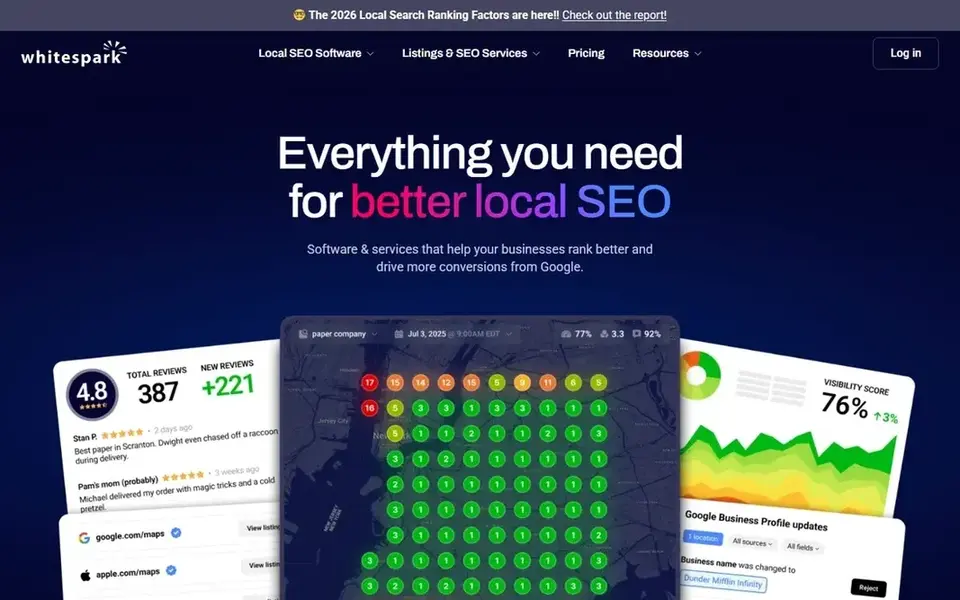
Whitespark is known for citation building. Its team finds and submits listings to directories that matter for your industry and location, and its tools help you research which citations competitors have that you do not.
Engineering firms often sit in a few industry directories as well as general ones, and Whitespark's research approach helps you find those. If your firm has an office in a city where you are not well listed, a citation campaign can close that gap and support the Google Business Profile.
It is not a review management platform and some of the work is done by hand, which means it moves at the pace of a service rather than a self-serve tool. That suits firms that would rather outsource the task.
- Strong citation research and submission service
- local rank tracker
- useful for finding niche directories
- Citation work is partly manual
- not a full reputation suite
GatherUp is a review management and customer feedback tool. You load client contacts, and it sends requests by email or text asking for a review, then routes the feedback into a dashboard where you can respond.
Engineering work is relationship-driven, and a principal or project manager who has just handed over a completed building or plant is in a good position to ask for a review. GatherUp makes that request repeatable without pestering clients. It also helps you reply to reviews in one place, which matters when a review mentions a specific project.
It only works if you feed it contacts and ask in a way that follows Google's review policies. Do not offer incentives for reviews or filter out unhappy clients before they can post.
- Automated review request campaigns
- review monitoring across sites
- simple customer feedback flow
- Needs a reliable contact list
- review volume depends on how you ask
CallTrackingMetrics is a call tracking and contact centre platform. It gives you trackable phone numbers, records and routes calls, and reports which channel produced each lead, including calls that start from a Google Business Profile or a map listing.
For an engineering firm, the value is knowing whether the map listing actually produces enquiries. If a firm gets most work through referrals, a tracked number on the profile shows whether local search adds anything. Call routing can also send enquiries to the right office or duty engineer.
The caution is with numbers. Keep the firm's main number as the primary one on the Google Business Profile where possible, and use tracking numbers in a way that does not confuse clients or break consistency across directories.
- Tracks calls and form leads by source
- call recording and routing
- works with Google Business Profile calls
- Setup needs planning
- call tracking numbers must be used carefully
How I chose
I built this list from vendor documentation and public sources, and I did not run hands-on tests. I looked at what each product actually does, how it is priced at a high level, and whether it fits the way an engineering firm operates: a small number of offices, a long sales cycle, project-based work and clients who check credentials before they call.
I also weighed the limits. Some tools are broad platforms where the feature you need sits in a higher plan, and some are narrow tools that do one job well. I tried to match each product to a real need, such as keeping office details consistent, tracking map visibility across a service area, or asking clients for reviews after a project closes. Where I was unsure about a free plan, I said so rather than guess.
What to check before you buy
- Count your offices and site locations first, because most tools price by location and a temporary project office may need its own record.
- Confirm how the tool handles multiple phone numbers, so tracked numbers do not replace the main office number on your Google Business Profile.
- Check whether citation and listing updates are self-serve or done by the vendor's team, since that changes the time you need to spend.
- Ask whether the tool supports the industry directories your firm relies on, not just the general consumer ones.
- Make sure any review request workflow follows Google's review policies, with no incentives and no filtering of unhappy clients.
- Check the contract length and cancellation terms, because local SEO tools are often annual.
Frequently asked questions
Do engineering firms need local SEO software at all?
Not always. A firm with one office and steady referral work can manage its Google Business Profile by hand. Software earns its place when you have several offices, inconsistent listings across directories, or a need to track map visibility across a service area. Start with a listings check before you buy anything.
Which tool is best for a firm with several regional offices?
Moz Local is a sensible starting point for keeping office details consistent, and Yext is worth a look if you have many locations and want central control. Compare both against the number of offices you actually run, because pricing usually scales with locations.
How should an engineering firm ask clients for reviews?
Ask after a project handover, from the principal or project manager the client knows. Send a direct link to the Google Business Profile and keep the request simple. Do not offer discounts or gifts, do not ask only happy clients, and do not write reviews on a client's behalf. Tools like GatherUp help you keep the requests organised.
Can I track whether my map listing brings in calls?
Yes. CallTrackingMetrics can assign a trackable number to a listing and report on calls by source. Use it carefully so the main number on your Google Business Profile stays consistent with what appears on your website and in directories.
Is citation building still worth it for engineering firms?
It can be, especially if your firm has moved, rebranded or opened an office in a new city. Consistent name, address and phone details across directories support the Google Business Profile. Whitespark and BrightLocal both offer citation work, and you can also do the main directories manually.
Sources
See where you really rank - block by block
ProMapRanker scans Google Maps across a grid of your service area. Simple monthly plans from $19, white-label on every plan.
Start freeBrowse all guides
← Best Local SEO Software for Dietitians in 2026Best Local SEO Software for Escape Rooms in 2026 →
 best local seo software for auto glass shops
Best Local SEO Software for Auto Glass Shops in 2026
A practical guide to the best local SEO software for auto glass shops in 2026, covering map rankings, reviews, listings and call tracking.
Read → best local seo software for art studios
Best Local SEO Software for Art Studios in 2026
A practical guide to the best local SEO software for art studios in 2026, covering listings, reviews, rank tracking and profile tools for studios.
Read → best local seo software for acupuncturists
Best Local SEO Software for Acupuncturists in 2026
A practical guide to the best local SEO software for acupuncturists in 2026, compared from vendor documentation and public sources.
Read → google map pack
What Is the Google Map Pack? A Plain-English Guide
What the Google Map Pack is, why it matters, and how Google decides which three businesses show up.
Read → citation cleanup
Citation Cleanup: A Complete Guide
Everything you need to know about citation cleanup: what it is, why it matters for local SEO, and exactly how to act on it.
Read → google maps ranking
Google Maps Ranking Explained: How Local Listings Get Ordered
Understand how Google Maps ranking works and what decides which businesses appear first in local results.
Read →More in Local SEO & Google Maps · All guides A to Z by date · Latest guides