 ProMapRanker
7 Best Enterprise Platforms for Unified Data and AI Options (2026)

Regulated teams that require governed AI models · Pricing starts at: $1,110 per month (Standard plan)
Direct answer
IBM watsonx leads the list, best for regulated teams that need governed AI models. Listed starting prices: IBM watsonx from $1,110 per month (Standard plan), Oracle Autonomous AI Database from $0.336 per ECPU per hour and Snowflake from $2.00 per credit (Standard, AWS US East). Oracle Autonomous AI Database is the stronger choice for Oracle shops that need an AI lakehouse on OCI, while Snowflake suits managed warehouse with AI in SQL. All 7 tools are compared below on price, free plan and limits.
Short on time? The summary and table above give the quick view of 7 tools for enterprise platforms for unified data and AI, and the profiles that follow give the detail behind each entry.
Key takeaways
- The list opens with IBM watsonx, aimed at regulated teams that require governed AI models.
- Microsoft Fabric is the one to check for Microsoft shops that require BI, lakehouse, and AI in one capacity.
- Starting prices begin at $262.80 per month with Microsoft Fabric.
- 5 of 7 tools offer a free plan: IBM watsonx, Oracle Autonomous AI Database, Google BigQuery, Databricks, Microsoft Fabric.
Quick comparison
| Pick | Great for | Pricing starts at | Free tier | |
|---|---|---|---|---|
| IBM watsonx | Regulated teams that require governed AI models | $1,110 per month (Standard plan) | Yes | Visit |
 Oracle Autonomous AI Database | Oracle shops that require an AI lakehouse on OCI | $0.336 per ECPU per hour | Yes | Visit |
 Snowflake | Managed warehouse with AI in SQL | $2.00 per credit (Standard, AWS US East) | Free trial (30 days) | Visit |
 Google BigQuery | Google Cloud teams with spiky query volume | $6.25 per TiB scanned (on-demand) | Yes | Visit |
 Databricks | Lakehouse teams doing engineering and ML together | $0.15 per DBU (jobs compute, Premium, AWS US East) | Yes | Visit |
 Palantir Foundry | Large operational programs with strict governance | Quote only | No | Visit |
 Microsoft Fabric | Microsoft shops that require BI | $262.80 a month (F2, pay as you go) | Yes | Visit |
The full enterprise platforms for unified data and AI list
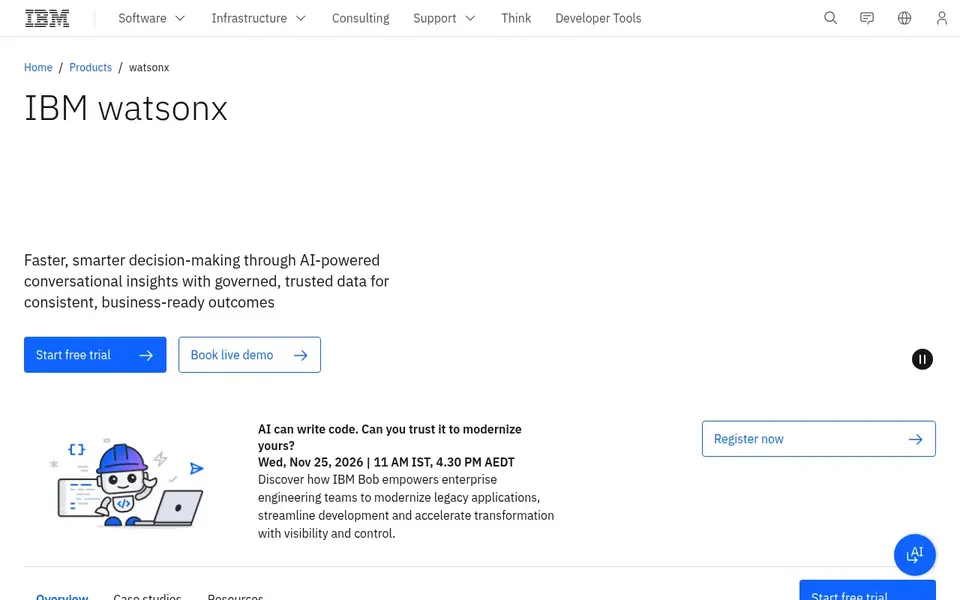
IBM watsonx is aimed squarely at regulated teams that require governed AI models. Model hosting on demand lists at $4.43 per hour for one L40S GPU and $14.50 per hour for one H100 GPU.
Trade-offs to know: token and GPU rates change by model, so inference cost swings widely by model choice.
IBM watsonx.ai lists an Essentials plan from $0 a month and a Standard plan from $1,110 a month, with machine learning models at $0.55 per capacity unit hour on Essentials and $0.45 on Standard. On cost, IBM watsonx starts like this: $1,110 per month. A free plan is available with IBM watsonx.
- Watsonx.ai, watsonx.data
- Model hosting lists GPU rates from $4.43 per hour for one L40S GPU
- The Standard plan begins at $1,110 a month, so light use still carries a high floor
Oracle Autonomous AI Database
Great for: Oracle shops that require an AI lakehouse on OCI
Choose Oracle Autonomous AI Database for Oracle shops that require an AI lakehouse on OCI. Oracle now uses ECPU as the compute metric, with 4 ECPUs equal to 1 older OCPU, and layers on AI features in the database, including vector search. Exadata storage for ECPU lists at $0.0299 per GB a month.
On top of that, the Developer instance is a fixed shape of 4 ECPU with 20 GB of storage at $0.0391 per instance per hour. More specifically, one limit: auto scaling is fixed at up to three times the base ECPUs. So the only control is whether you switch it on and how high you set the base. Oracle Autonomous AI Lakehouse lists at $0.336 per ECPU per hour, with a bring-your-own-license rate of $0.0807 per ECPU per hour. Entry price for Oracle Autonomous AI Database: $0.336 per ECPU per hour. Free access exists with Oracle Autonomous AI Database.
The main drawbacks: Auto scaling can raise a database to three times its base ECPUs and bill the hourly average, so an open scaling limit can lift the bill.
- Autonomous AI Lakehouse bills at $0.336 per ECPU per hour with auto tuning and patching
- A Developer instance lists at $0.0391 per instance per hour
- Storage bills on top of compute
Pick Snowflake if this describes you: managed warehouse with AI in SQL. Snowflake bills compute in credits, storage at $23.00 per TB a month on demand in AWS US East, and data transfer as a third line.
Warehouses bill per second with a 60-second minimum, and a suspended warehouse uses no credits. In practice, the 30-day trial contains $400 in credits. On cost, Snowflake starts like this: $2.00 per credit. Free options: Free trial (30 days).
Drawbacks to consider: Gen2 warehouses use 35 percent more credits per hour than Gen1.
- No cluster to handle, with per-second billing and a 60-second minimum
- Cortex AI functions let SQL users call models without moving data
- Even for work that does not use Enterprise features
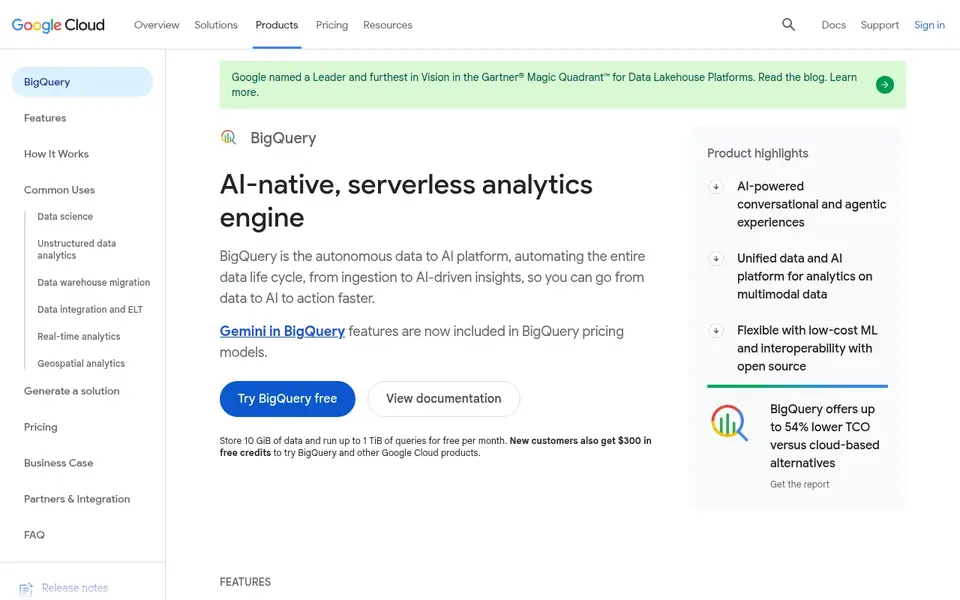
Google BigQuery is built with Google Cloud teams with spiky query volume in mind. Gemini in BigQuery is included in the pricing models.
Worth adding: one limit: on-demand billing punishes careless queries, so a team that scans full tables every day will pay more than a team on a capacity edition wit Google BigQuery pricing: $6.25 per TiB scanned. A free plan is available with Google BigQuery.
Drawbacks to consider: capacity editions start at $0.04 per capacity hour, so steady heavy use needs a reservation to control cost.
- BigQuery ML and Gemini in BigQuery sit next to the data
- The first 1 TiB scanned a month is free
- A broad query over unpartitioned tables can scan a large volume and cost far more than expected
For Lakehouse teams doing engineering and ML together, Databricks is a natural candidate. Databricks runs on Delta Lake tables in your own cloud storage, so BI, pipelines, and machine learning read the same data, with Unity Catalog governing tables. Choose Databricks when your team writes Python and SQL in the same project.
Worth adding: jobs compute lists at $0.15 per DBU on Premium in AWS US East, SQL Classic at $0.22 per DBU, SQL Pro at $0.55 per DBU, and SQL Serverless at $0.70 per DBU, with serverless rates already including the cloud compute. In practice, one limit: classic clusters leave VMs running if you forget to stop them. So the DBU bill plus the cloud VM bill can surprise a team that only budgete Price to start with Databricks: $0.15 per DBU. You can start on Databricks without paying.
Where it is weaker: Classic compute brings a second bill from your cloud provider for VMs.
- One copy of data in open formats for SQL, engineering, ML
- AI features in one place
- DBU rates change by workload, so SQL Serverless at $0.70 per DBU costs far more per unit than jobs compute
Choose Palantir Foundry for large operational programs with strict governance. Palantir lists no list price for Foundry.
Where it is weaker: Palantir lists no list price, so every deal is a negotiated annual product fee.
One limit: there is no self-serve plan, no free level, and no list price to budget against, so a small team cannot try it the way it can try BigQuery o Palantir Foundry does not publish a starting price; ask for a quote. No free plan comes with Palantir Foundry.
- The Ontology maps data to real business objects, so AI workflows act on governed objects
- Apollo gives the same product across cloud, on-premises
- Implementation and staffing in year one frequently match or exceed the product fee
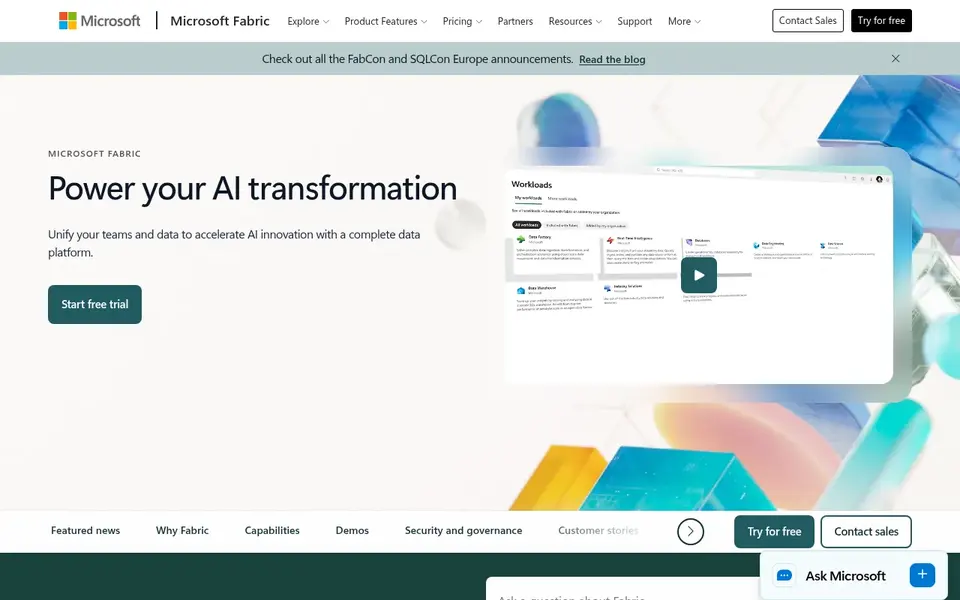
Microsoft Fabric works best for Microsoft shops that require BI, lakehouse, and AI in one capacity. One limit: F64 is the real enterprise threshold, since only F64 and bigger remove the per-viewer license.
So a small team on F2 still pays per-user A one-year reservation cuts F2 to about $156.33 per month and F64 to about $5,002.67 a month, a saving of about 41 percent. Microsoft Fabric starts at: $262.80 per month. Microsoft Fabric has a free plan.
The main drawbacks: OneLake storage bills on top at $0.023 per GB a month.
- One capacity pool serves Power BI, lakehouse, pipelines, Spark, Copilot
- Below F64
What went into this list
Selection started from tools commonly considered for enterprise platforms for unified data and AI, then narrowed to 7 that have clear pricing information or a clear quote process. Figures are shown as the vendors publish them. Billing terms, seat minimums and add-ons can change the real cost. Tools are placed by general fit for enterprise platforms for unified data and AI, with price clarity and free access as tie-breakers. A different team can reasonably rank them differently.
Pre-purchase checklist
- Get a written quote from Palantir Foundry; the list shows no starting price for them.
- Check what the free option really includes: IBM watsonx, Oracle Autonomous AI Database, Google BigQuery and others offer a free plan, and usage caps differ.
- Run a trial of Snowflake with real work before paying for a year; your own workflow is the best test.
- Before choosing IBM watsonx, weigh its main limit: the Standard plan begins at $1,110 a month, so light use still carries a high floor.
- Price Oracle Autonomous AI Database for your actual team size; headline prices rarely include add-ons or overage.
- Confirm the exact Snowflake plan that includes your must-have features.
Frequently asked questions
Do these tools publish their prices?
Not all of them. Palantir Foundry publishes no starting price, so expect a quote request for it. The rest, IBM watsonx included, show a starting price, though seats and billing terms still change the final cost.
How much does a unified data and AI product cost a month?
BigQuery begins at $6.25 per TiB scanned with the first 1 TiB free, Redshift Serverless begins at $1.50 per active hour at 4 RPUs, Fabric F2 costs $262.80 a month on pay as you go, and IBM watsonx Standard begins at $1,110 a month. A quiet month costs far less than a busy one on usage-billed systems.
Which options for enterprise platforms for unified data and AI have a free plan?
On this list, IBM watsonx, Oracle Autonomous AI Database, Google BigQuery, Databricks and Microsoft Fabric include a free plan. Caps on seats, usage or features are common, so test the free plan against your real workload. One other tool offers a trial instead.
How are the tools for enterprise platforms for unified data and AI ordered?
The order follows typical fit for enterprise platforms for unified data and AI, with IBM watsonx first and Microsoft Fabric last, then price clarity and free access. It is editorial judgement, not a score, so another team could rank the tools differently.
Why do prices for the same workload differ so much across products?
Prices differ since each vendor bills a different unit: DBUs, credits, capacity units, TiB scanned, RPU hours, ECPU hours, tokens, and GPU hours. Compare the same workload, with the same data volume and query count, on each product before you choose.
Is IBM watsonx the right pick for everyone comparing enterprise platforms for unified data and AI?
No single tool suits every team. IBM watsonx comes first because it fits regulated teams that need governed AI models, while Oracle Autonomous AI Database suits Oracle shops that need an AI lakehouse on OCI and Snowflake suits managed warehouse with AI in SQL. Match the tool to your own size, budget and workflow before deciding.
Sources
See where you really rank - block by block
ProMapRanker scans Google Maps across a grid of your service area. Simple monthly plans from $19, white-label on every plan.
Start freeBrowse all guides
← Best All in One AI Workspace tool: 2026 Prices and Picks6 Best Live Transfer Service for AI Receptionists in 2026 →
 best ai tools for enterprise with secure data
AI Tools for Enterprise with Secure Data: Best Picks of 2026
Searching for the best AI tools for enterprise with secure data? Here are 8 options with prices and free plans. Each entry gets a plain verdict. Details below.
Read → best ai research assistants
AI Research Assistants: Best Picks of 2026
Best AI research assistants: 6 contenders ranked by fit, with entry costs and free tiers. The weak spots sit next to the strengths. Narrow your shortlist.
Read → best ai agents for research
AI Agents for Research in 2026: Top 6 Compared
Best AI agents for research in 2026: 6 tools with starting prices, free plans and limits. Cost notes and weak points included. Current for November 2026.
Read → best enterprise etl tools
Best Enterprise ETL Tools in 2026
Compare the best enterprise ETL tools for managed pipelines, connectors, change data capture, governance, and usage based pricing models for large teams, 2026.
Read → apache nifi alternatives
Apache NiFi Alternatives in 2026
Compare apache nifi alternatives for data flow, ingestion, and integration, from Airbyte and Fivetran to SnapLogic, dbt, Airflow, and more tools compared.
Read → alternatives to scala
Alternatives to Scala in 2026
We compared alternatives to Scala in 2026, covering general purpose, functional, and systems languages for backend, data, web, and application work today.
Read →More in Data & Analytics · All guides A to Z by date · Latest guides