 ProMapRanker
Best Agentic Analytics Tools for Data Analysis in 2026

No-code AI dashboards from spreadsheets · Pricing starts at: See website
Direct answer
This list puts Polymer first for no-code AI dashboards from spreadsheets. Listed starting prices: ThoughtSpot from $25 per user/month (Essentials, billed yearly) and Julius AI free; Pro from $16/month. If your case is different, Hex suits data teams that want notebooks plus AI workflows and ThoughtSpot suits enterprises adopting agentic BI at scale. All 6 tools are compared below on price, free plan and limits.
Choosing agentic analytics tools for data analysis usually comes down to price, fit and limits. This ProMapRanker guide sets 6 tools side by side on those three points, with the facts kept short and checkable.
Key takeaways
- This list starts with Polymer, which is built for no-code AI dashboards from spreadsheets.
- Starting prices begin at $25 per user/month with ThoughtSpot.
- Check the limits for Hex before you commit: pricing is not published on the vendor site.
- 3 of 6 tools offer a free plan: Polymer, Hex, Julius AI.
- For individuals and small teams analyzing files, Julius AI is worth a look.
Quick comparison
| Pick | Great for | Pricing starts at | Free tier | |
|---|---|---|---|---|
| Polymer | No-code AI dashboards from spreadsheets | See website | Yes | Visit |
 Hex | Data teams that want notebooks plus AI workflows | See website | Yes | Visit |
 ThoughtSpot | Enterprises adopting agentic BI at scale | $25 per user/month (Essentials, billed yearly) | Free trial | Visit |
 AnswerRocket | Custom AI analysts on company data | See website | No | Visit |
 Sigma | Spreadsheet-style analysis on warehouse data | See website | Free trial | Visit |
 Julius AI | Individuals and small teams analyzing files | Free; Pro from $16/month (billed yearly) | Yes | Visit |
Agentic Analytics Tools for Data Analysis, one by one
Polymer is a good fit for no-code AI dashboards from spreadsheets. Polymer is very good at spreadsheet-scale problems and less suited to firms with strict governance needs or multi-source warehouse architectures.
What to check first: Restricted depth for complicated enterprise data modeling.
No starting price is listed for Polymer here; confirm pricing on the vendor site. Free access exists with Polymer.
- Conversational follow-ups keep exploration going
- Much lower barrier than traditional BI
- API and custom plans lack public detail

In short, Hex is for data teams that want notebooks plus AI workflows. Finished work can be published as interactive apps, so stakeholders explore results without touching code.
In daily use, Hex sits between the analyst's notebook and the business user's dashboard. No starting price is listed for Hex here; confirm pricing on the vendor site. Hex has a free plan.
The main drawbacks: Pricing is not published on the vendor site.
- Magic AI assists with SQL and Python inside notebooks
- Links well with modern data stacks
- Casual business users face a ramp-up time
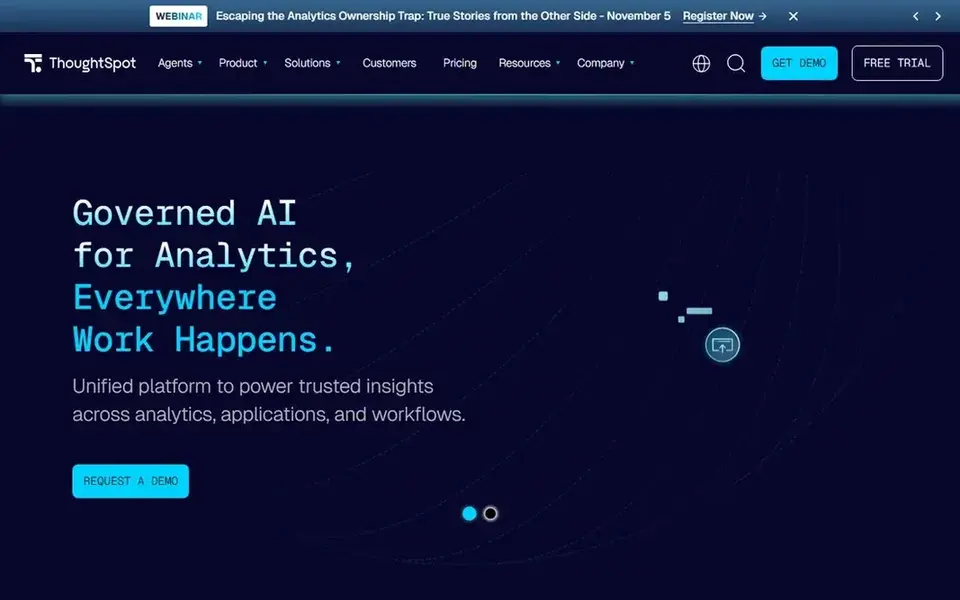
ThoughtSpot is a good fit for enterprises adopting agentic BI at scale. ThoughtSpot built its reputation on search-driven analytics, and its agentic push is the most mature in this lineup. That design matters: when the definitions are approved in advance, the agent's answers stay consistent with what finance and leadership already trust.
Where it falls short: Costs rise rapidly as user counts grow.
The pricing is public at the entry level, with Essentials beginning at $25 per user a month billed yearly and Pro from $50. Worth adding: the agent is only as decent as the semantic layer beneath it, so businesses with messy or undocumented data will need modeling work before the AI earns trust. As for the details, teams should also be honest about data readiness. What you pay to start with ThoughtSpot: $25 per user/month. On free options: Free trial.
- Spotter AI agent answers natural-language questions on governed data
- Search-driven interface business users actually adopt
- Well-modeled data to perform well
AnswerRocket is built with custom AI analysts on company data in mind. AnswerRocket does not sell a generic chatbot. It builds custom AI analysts trained on a company's own data, metrics, and vocabulary, so answers reflect how the business actually talks about itself.
That customization is the reason regulated and complicated organizations consider it: a generic agent guesses at terminology, whereas AnswerRocket's agents are taught it. Smaller teams should be realistic about fit. If your need is a dashboard with a chat box on top, the lighter tools here will get you there quicker and less expensive. Pricing for AnswerRocket is not stated here, so ask the vendor for current figures. AnswerRocket has no free tier.
The main drawbacks: Custom pricing means a long sales cycle.
- Solid fit for complicated or regulated domains
- Dedicated onboarding for enterprise deployments
- Overkill for teams that require straightforward self-serve dashboards
Sigma is built with spreadsheet-style analysis on warehouse data in mind. Sigma's insight is that most business users already think in spreadsheets. So it puts a spreadsheet interface straight on top of cloud data warehouses.
Where it is weaker: Heavy usage needs warehouse cost discipline.
On top of that, the vendor gives you a free trial but publishes no pricing, which is typical for warehouse-native BI sold to mid-market and enterprise teams. More specifically, since Sigma queries live data, a team that builds costly queries will see the cost in its warehouse invoice, not just in the Sigma contract. Sigma shows no starting price here, so confirm the cost on the vendor site. Free plan details: Free trial.
- Governed metrics with live data and no extracts
- Familiar spreadsheet interface running on cloud warehouses
- No public pricing makes budgeting harder
Where Julius AI fits: individuals and small teams analyzing files. The free plan handles light usage, and Pro begins at $16 a month billed yearly, which keeps it low-cost for freelancers and small teams.
Also, if your analysis starts with a CSV on your laptop, Julius AI is the shortest path to an answer. Entry price for Julius AI: Free. Julius AI includes a free tier.
Where it falls short: Not a governed BI system for company-wide reporting.
- Genuinely handy free level for light work
- Creates charts and written analysis in plain language
- Restricted depth for advanced data modeling
How we compared the tools
The comparison looks at four things: starting price, free access, how well the feature set matches agentic analytics tools for data analysis, and the main limit of each tool. Treat prices as a snapshot: vendors change plans often, so check the vendor site for the figure that applies today. The order reflects how well each tool fits the most common buying scenario for agentic analytics tools for data analysis, then price clarity, then free plan access. It is a starting point, not a verdict.
What to confirm before you sign up
- Confirm the entry price on the vendor page. For Polymer, Hex, AnswerRocket and Sigma that means a quote rather than a fixed price.
- Look at free plan limits closely: Polymer, Hex and Julius AI have one, and the caps decide whether it is usable for real work.
- Run a trial of ThoughtSpot and Sigma with real work before paying for a year; your own workflow is the best test.
- Before choosing Polymer, weigh its main limit: restricted depth for complicated enterprise data modeling.
- List the apps you already depend on and check that Polymer supports each one on the plan you would buy.
- Check whether the features you need in ThoughtSpot sit on the entry plan or only on higher tiers.
Frequently asked questions
Can I try these tools before paying?
Often, yes. Polymer, Hex and Julius AI have a free plan and ThoughtSpot and Sigma offer a free trial. Use your own data and a real task during the test, and check what the free tier or trial limits before you rely on it.
Which options for agentic analytics tools for data analysis have a free plan?
On this list, Polymer, Hex and Julius AI include a free plan. Caps on seats, usage or features are common, so test the free plan against your real workload. Several others offer a trial instead.
How are the tools for agentic analytics tools for data analysis ordered?
The order follows typical fit for agentic analytics tools for data analysis, with Polymer first and Julius AI last, then price clarity and free access. It is editorial judgement, not a score, so another team could rank the tools differently.
What is agentic analytics?
Agentic analytics refers to AI agents that perform analysis tasks on their own: interpreting a question, querying data, choosing a visualization, and explaining the result. Unlike a static dashboard, the agent decides the steps.
Is Polymer the right pick for everyone comparing agentic analytics tools for data analysis?
No single tool suits every team. Polymer comes first because it fits no-code AI dashboards from spreadsheets, while Hex suits data teams that want notebooks plus AI workflows and ThoughtSpot suits enterprises adopting agentic BI at scale. Match the tool to your own size, budget and workflow before deciding.
Sources
See where you really rank - block by block
ProMapRanker scans Google Maps across a grid of your service area. Simple monthly plans from $19, white-label on every plan.
Start freeBrowse all guides
← Agentic Analytics Tools for AI Insights: Best Picks of 2026AI Agents for Research in 2026: Top 6 Compared →
 cheaper alternatives to peec ai for geo
6 Peec AI Alternatives Compared (2026)
6 tools for cheaper alternatives to peec ai for geo, compared on pricing, free plans and best-fit use. Every pick includes one clear drawback. Plain facts.
Read → best new ai tools updates
New AI Tools Updates in 2026: Top 6 Compared
Comparing the best new AI tools updates? 6 contenders, each with entry cost, free tier and best-fit buyer. Verdicts stay brief and factual. Pick by budget.
Read → best ai data analysis tools
7 Best AI Data Analysis Tools for 2026
Best AI data analysis tools in 2026: 7 contenders with entry costs and free tiers. Akkio opens the ranking for no code predictions. Jump to the table.
Read → who offers the best data observability services
Who Offers the Best Data Observability Services in 2026
Find who offers the best data observability services and tools in 2026, with monitoring, lineage, anomaly detection, and pricing notes for data teams.
Read → best data quality tools
Best Data Quality Tools in 2026
Compare the best data quality tools for profiling, cleansing, validation and monitoring, including Informatica, Ataccama, Soda and Monte Carlo in 2026.
Read → best tech companies for life sciences solutions
Best Tech Companies for Life Sciences Solutions in 2026
We compared the best tech companies for life sciences solutions, from clinical and regulatory platforms to research data, lab software, and analytics.
Read →More in Data & Analytics · All guides A to Z by date · Latest guides