 ProMapRanker
Best Data Quality Tools in 2026


Enterprise data quality · Pricing starts at: See website
Key takeaways
- Informatica, Ataccama and Precisely suit enterprises that need profiling, cleansing, matching and governance in one platform.
- Soda and Great Expectations suit engineering teams that want code-based checks and data contracts in pipelines.
- Monte Carlo suits teams that want observability, lineage and incident management alongside quality monitoring.
- OpenRefine suits analysts who need free, interactive cleaning for spreadsheets and smaller datasets.
- Collibra suits governance-led teams that want quality scores tied to a data catalog.
Quick comparison
| Pick | Great for | Pricing starts at | Free tier | |
|---|---|---|---|---|
| Informatica Data Quality | Enterprise data quality | See website | Free trial | Visit |
 Ataccama ONE | Unified quality and governance | See website | Free trial | Visit |
 Qlik Talend | Quality inside integration pipelines | See website | Free trial | Visit |
 Precisely Data Integrity Suite | Address and enterprise data integrity | See website | No | Visit |
 Collibra Data Quality and Observability | Governance-led quality monitoring | See website | No | Visit |
 Monte Carlo | Data observability and monitoring | See website | No | Visit |
 Soda | Automated checks and data contracts | $750 per month | Yes | Visit |
 Great Expectations | Developer-led validation | Free | Yes | Visit |
 OpenRefine | Free interactive data cleaning | Free | Yes | Visit |
 WinPure Clean and Match | No-code cleansing and matching | See website | Free trial | Visit |
The best data quality tools
We compared official product pages, pricing pages and public 2026 data quality guides, and kept only tools operating in October 2026 that profile, cleanse, validate, match or monitor data. Prices below use vendor pricing where confirmed; where pricing is enterprise and quote-based, we wrote See website rather than repeating an estimate as fact. Data quality here covers both classic cleansing and modern monitoring, since many teams now need both.
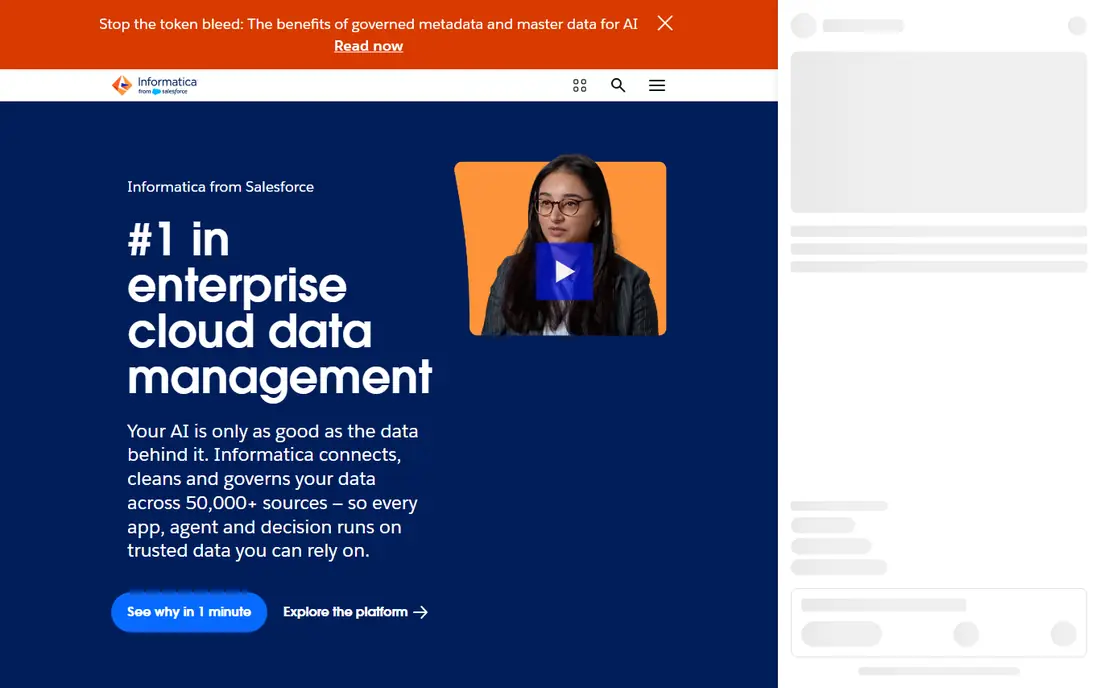
Informatica Data Quality is part of a broad cloud data management platform, and that breadth is its main advantage for large enterprises. It profiles data to find duplicates, missing values and format problems, cleanses and standardizes records, matches entities across systems and enriches data where needed. Teams already using Informatica for integration often keep quality in the same platform to avoid moving data between vendors.
The cost and complexity reflect enterprise scale. Pricing is quote-based and, in cloud deployments, consumption-based, so buyers should model data volumes and job frequency before signing. Smaller teams will find simpler tools cheaper and faster, but large Informatica estates often find this the natural quality choice.
- Profiling, cleansing, matching and enrichment at scale
- Large connector library
- Cloud data management integration
- Enterprise pricing and complexity
- Consumption-based pricing can be hard to forecast
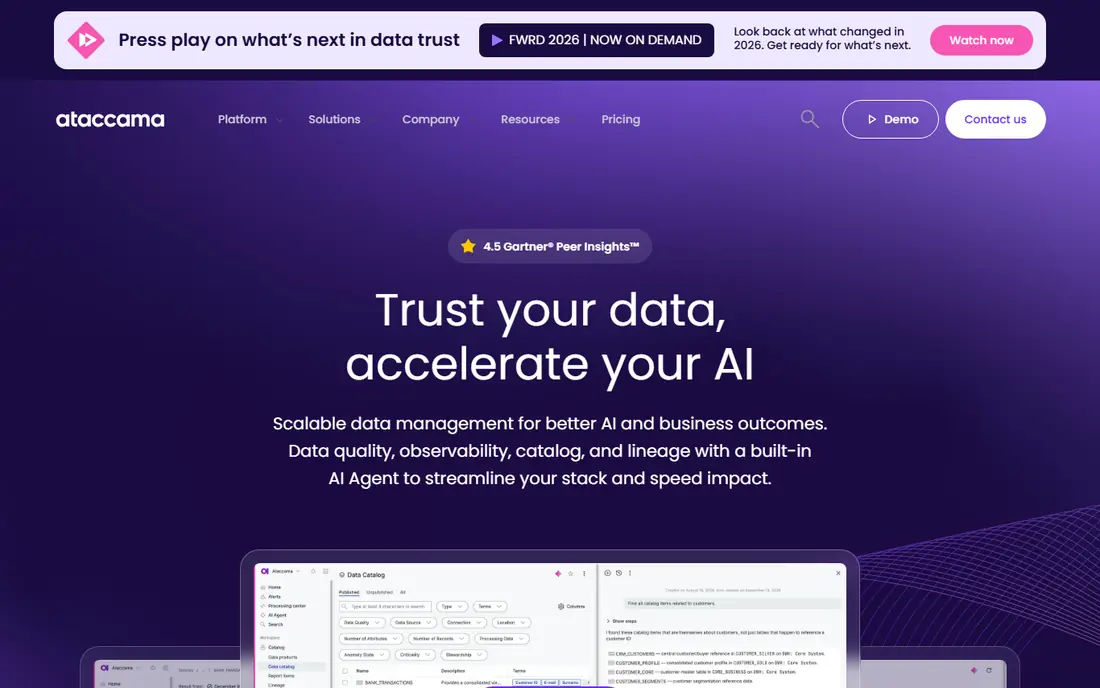
Ataccama ONE combines a data catalog, data quality, lineage and master data management in one product, so quality scores, lineage views and mastered records stay connected. That unified view helps governance teams answer not only whether data is clean, but where it came from and which version is trusted. Public reports praise how quickly new quality rules can go live, sometimes within a day for straightforward rules.
Unified usually means enterprise-priced and enterprise-complex, and pricing is not published as a simple monthly figure. Teams that only need cleansing or only need monitoring may find a focused tool cheaper, but teams consolidating catalog, quality and mastering tools should shortlist Ataccama.
- Catalog, quality, lineage and master data management in one platform
- AI-assisted stewardship
- Fast rule deployment in public reports
- Enterprise pricing
- Learning curve for small teams
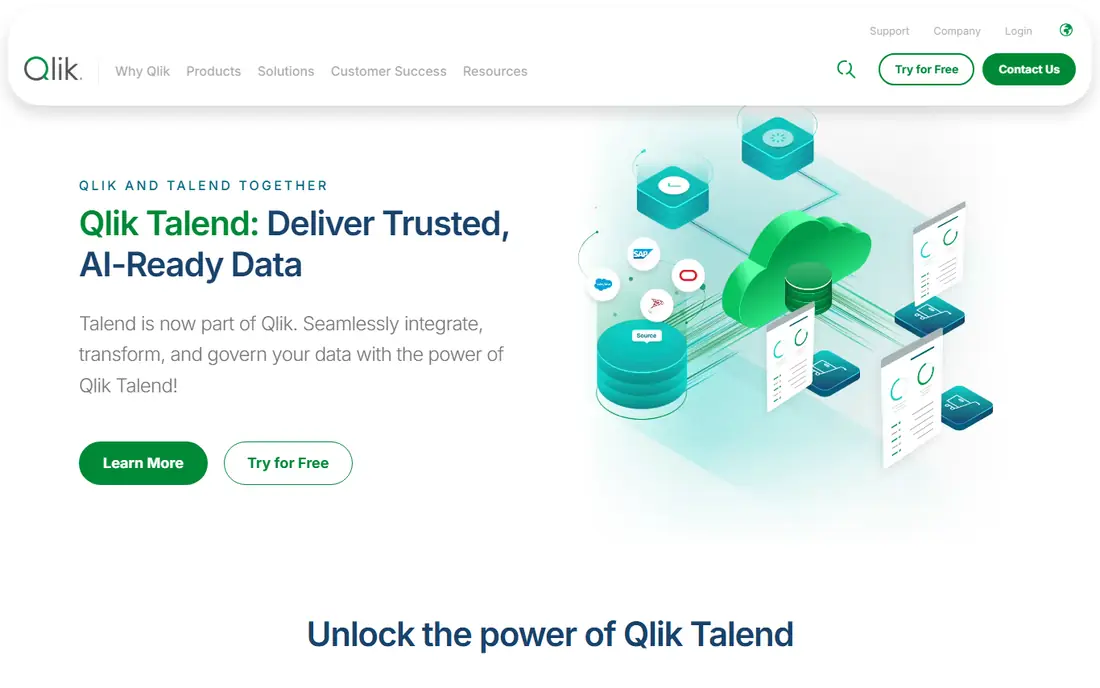
Qlik Talend, formerly Talend, embeds data quality in data integration pipelines, so cleansing and validation happen as data moves rather than as a separate afterthought. Profiling, standardization, deduplication and enrichment tools sit alongside connectors for databases, cloud warehouses and applications. Teams building pipelines in Talend gain quality checks without a second platform to maintain.
Standalone quality buyers should check whether they need the full integration platform, since pricing and setup reflect that scope. For Talend and Qlik users, though, keeping quality in the pipeline is often simpler and more reliable than exporting data to a separate tool.
- Data quality inside integration and ETL workflows
- Profiling and cleansing tools
- Qlik ecosystem integration
- Quote-based pricing
- Best fit is teams already using Talend or Qlik
Precisely, including its Trillium heritage, focuses on data integrity across address quality, customer matching, enrichment and governance. Address verification is a particular strength, which matters for shipping, billing, compliance and customer records where a bad address creates real cost. Enterprises with large customer databases often use Precisely to standardize, match and enrich records at scale.
Pricing is enterprise and quote-based, and the suite breadth can feel heavy for a team that only needs to clean a spreadsheet. For large customer data programs, though, Precisely is a long-established option with deep address and matching capability.
- Address verification and enrichment
- Enterprise data integrity and matching
- Long history in location and customer data
- Enterprise pricing
- Breadth can be complex for simple cleansing jobs
Collibra Data Quality and Observability
Great for: Governance-led quality monitoring
Collibra Data Quality and Observability ties quality monitoring to a data catalog and governance program, so a quality score appears alongside ownership, definitions and lineage for a dataset. Automated monitors check freshness, completeness and other dimensions, while custom monitors cover business-specific rules. That governance link helps data owners prioritize fixes that affect trusted, widely used datasets first.
Teams without a governance program may not need the full Collibra platform, and pricing is enterprise subscription-based. For large organizations already building a catalog and governance practice, Collibra quality monitoring is a natural extension.
- Quality monitoring tied to catalog and governance
- Automated and custom monitors
- Push-down execution in some setups
- Enterprise subscription pricing
- Best fit is teams already investing in governance
Monte Carlo is a data observability platform that monitors pipelines and warehouses for freshness, volume, schema and distribution changes, then links incidents to lineage so teams can find the upstream cause. That incident workflow is its main advantage over a simple testing tool: when a dashboard breaks, Monte Carlo helps teams trace the break to a source table or pipeline change. Large analytics teams with many pipelines often value that speed.
Pricing is subscription and credit-based in public descriptions, so buyers should model monitors, tables and data volumes carefully. Smaller teams with a few pipelines may find Soda or Great Expectations enough, but large observability programs often shortlist Monte Carlo first.
- Automated freshness, volume, schema and distribution monitors
- Lineage and incident management
- Broad warehouse support
- Enterprise pricing
- Credit-based pricing needs careful forecasting
Soda combines an open-source core with a paid cloud platform for automated data quality checks, data contracts and monitoring. Teams write checks in SodaCL, a YAML-based language, to test freshness, completeness, uniqueness and other rules, then track failures, assign owners and guide remediation in the cloud. Public sources list a free plan and a Team plan at $750 per month, giving growing teams a published entry point that many enterprise rivals lack.
The main learning cost is SodaCL itself, which suits SQL and analytics engineering teams more than business-only users. Teams already comfortable with code-based pipelines will find Soda lightweight and practical, while teams wanting a fully no-code tool should compare WinPure or enterprise suites.
- Open-source Soda Core
- SodaCL checks and data contracts
- Published Team pricing
- Collaboration and incident workflows
- Paid Team plan starts at $750 per month in public listings
- SodaCL learning curve for non-technical users
Great Expectations, often called GX, is an open-source framework for validating data against expectations such as uniqueness, range, completeness and referential rules. Engineering teams integrate it into Python pipelines, dbt projects and Airflow workflows, so bad data fails a pipeline or raises an alert before it reaches dashboards. Its expectation library and documentation support make it a strong choice for code-first teams and regulated workflows that need auditable checks.
It is not a no-code product. Teams without Python or pipeline engineering capacity will struggle to maintain it, and hosted GX Cloud pricing should be confirmed for teams that want managed hosting. For developer-led data teams, GX remains one of the most flexible free options available.
- Free open-source core
- Declarative expectations
- Python, dbt and Airflow integrations
- Large expectation library
- Needs engineering time
- Hosted cloud pricing varies
- Less no-code support than enterprise tools
OpenRefine is a free, interactive tool for cleaning messy data, and it remains popular with analysts, journalists and researchers. Faceting lets users see value distributions, clustering finds near-duplicate spellings, and transformation expressions clean, split and reconcile values without writing a full pipeline. For a one-off dataset, a spreadsheet export or a research file, it is often faster than setting up an enterprise platform.
Its limits are scale and automation. OpenRefine is not designed to monitor production pipelines continuously or to enforce data contracts at warehouse scale. Treat it as a cleaning workbench for analysts, and pair it with Soda, GX or Monte Carlo when production monitoring is needed.
- Free and open source
- Interactive faceting, clustering and transformation
- Good for messy spreadsheets and smaller datasets
- Not a pipeline monitoring tool
- Limited scale for very large enterprise datasets
WinPure Clean and Match Enterprise focuses on no-code cleansing, matching, deduplication and entity resolution for business users who do not want to write code. It helps teams standardize names, addresses and other fields, find duplicates and merge records into a trusted view, with a free trial for evaluation. Small and mid-sized businesses often use it for CRM, marketing and customer list cleaning.
It is not primarily a production observability platform, so teams needing continuous pipeline monitoring should pair it with a monitoring tool or choose a different platform. For no-code cleansing and matching, though, WinPure is a practical, focused option.
- No-code cleansing, matching and deduplication
- Entity resolution tools
- Free trial available
- Windows and web focus
- Enterprise-scale pipeline monitoring is not its main strength
How we picked these
We compared official product pages, pricing pages and public 2026 data quality guides, and kept only tools operating in October 2026 that profile, cleanse, validate, match or monitor data. We favored a mix of enterprise platforms, engineering-led tools, observability platforms and free options, so different team sizes and technical levels are covered. Where pricing was enterprise, quote-based or consumption-based, we wrote See website rather than presenting an estimate as a vendor price.
What to check before you choose a data quality tool
Start with the problem, not the category. Cleansing a customer list, validating a warehouse pipeline, monitoring dashboard freshness and governing trusted datasets are different jobs, and one tool rarely wins all four. Map your data sources, volumes, update frequency and who owns each dataset, then test the tool on a real, messy dataset from your own systems.
Next, check integration and ownership. Confirm connectors for your warehouse, database and pipeline tools, how checks are written and scheduled, how failures alert owners, and how quality scores are shared with business users. Finally, compare total cost including implementation, compute or credits, and maintenance time, since a free open-source tool can still cost significant engineering time, while an enterprise tool can cost significant license fees.
Frequently asked questions
What are the best data quality software tools for enterprises?
Informatica Data Quality, Ataccama ONE, Precisely and Collibra are strong enterprise options, with different strengths in integration, unified governance, address integrity and catalog-led quality. Choose by your existing platform, governance maturity and data volumes.
What are the best data quality platforms for engineering teams?
Soda and Great Expectations suit engineering teams that want code-based checks, data contracts and pipeline integration. Monte Carlo suits teams that also want observability, lineage and incident management across many pipelines.
What is the best platform for data quality on a small budget?
OpenRefine is free for interactive cleaning, Great Expectations is free as open-source validation, and Soda offers a free plan alongside its paid Team tier. Budget teams should weigh license cost against the engineering time needed to run and maintain each tool.
What is the best data quality tool for cleansing customer lists?
WinPure Clean and Match suits no-code cleansing and deduplication, while Precisely suits enterprise address verification and customer matching at scale. Test both on a sample of your own customer data before choosing, since match quality depends on your data.
Do data quality tools replace data governance?
No. Quality tools find and fix data problems, while governance defines ownership, definitions, access and trusted datasets. Tools such as Collibra and Ataccama combine both, but governance still needs people, policies and ownership decisions behind the software.
Sources
See where you really rank - block by block
ProMapRanker scans Google Maps across a grid of your service area. Simple monthly plans from $19, white-label on every plan.
Start freeKeep reading
 zscaler alternatives
Best Zscaler Alternatives in 2026
Looking for zscaler alternatives? We compare 9 SASE and zero trust platforms on architecture, data protection, pricing, and fit for your network and team.
Read → zapier alternatives free
Best Zapier Alternatives Free in 2026
Nine automation tools for zapier alternatives free in 2026, all with genuinely free tiers, plus free plan limits, starting prices and upgrade paths explained.
Read → which platform is best for online reputation
Which Platform Is Best for Online Reputation in 2026
Wondering which platform is best for online reputation? We compare 8 review, listing, and response tools for small and multi-location businesses and agencies.
Read →