 ProMapRanker
Best Local SEO Tools for Pool Service Companies (2026)

All-in-one local SEO for pool companies · Pricing starts at: See website
Direct answer
BrightLocal is my first pick for pool service companies because it puts Google Business Profile audits, review requests, citation checks and local rank tracking in one place, which matches how a route-based pool business actually gets found. It has a free trial, so you can check the workflow before committing. Semrush suits owners who want keyword and competitor research alongside local listings, and Whitespark is the better fit when citation building and local rank grids are the main job.
I put this list together from vendor documentation and public sources, and I did not run hands-on tests of each product. My aim was to match each tool to how a pool service company actually operates: recurring weekly or biweekly routes, seasonal demand spikes, several service towns, and a steady flow of one-off repair and resurfacing jobs.
Key takeaways
- Pool service companies win local search through a complete Google Business Profile, steady reviews and consistent name, address and phone data, so pick tools that cover those three jobs first.
- A route-based business serves several cities and suburbs, so you need rank tracking by location rather than one city-level number.
- Review requests should go to every customer after a service visit, and you should never filter who gets asked or offer incentives for positive reviews.
- Citation tools matter more than most pool companies expect, because old addresses and tracking numbers on directory listings cause real confusion.
- Start with one all-in-one platform plus a review tool, then add citation or rank-grid tools only when you have a clear gap.
Quick comparison
| Pick | Great for | Pricing starts at | Free tier | |
|---|---|---|---|---|
| BrightLocal | All-in-one local SEO for pool companies | See website | Free trial | Visit |
 Semrush | Keyword and competitor research | See website | No free plan | Visit |
 Whitespark | Citation building and local rank grids | See website | Not stated | Visit |
 Moz Local | Listing management and local audits | See website | No free plan | Visit |
 Yext | Large multi-location listing control | See website | No free plan | Visit |
 GatherUp | Review collection and responses | See website | Free trial | Visit |
 Google Business Profile | The listing itself | See website | Free plan | Visit |
The best local SEO tools for pool service companies compared
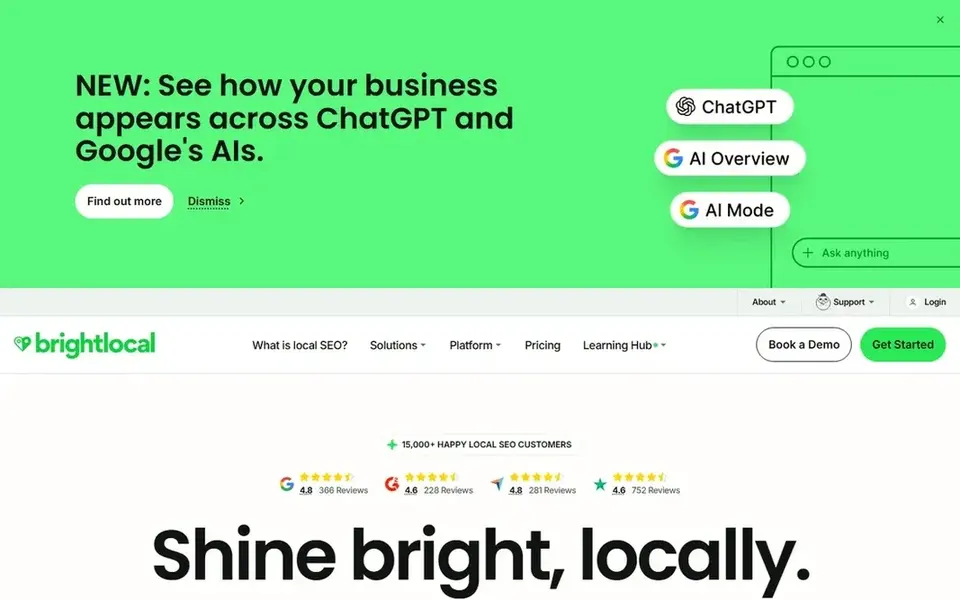
BrightLocal is built around local search rather than general SEO, which fits a pool company that serves a set of towns instead of a national audience. The platform covers Google Business Profile auditing, local rank tracking, review management and citation checks, so you can manage the pieces that decide whether you show up for "pool cleaning near me" in each service area.
For a pool business, the useful part is location-level rank tracking. You can watch how you rank for terms like "pool service" and "pool repair" across the suburbs on your route, then adjust service pages or the profile when one area falls behind. Review requests can be sent after each visit, which suits recurring customers.
The limit is that BrightLocal is a subscription with several modules, so a one-person operation may pay for features it never opens. Skip it if you only want rank tracking and nothing else.
- Local rank tracking by location
- review and citation tools in one place
- Google Business Profile audit
- Costs add up when you need several modules
- Some features overlap with other tools
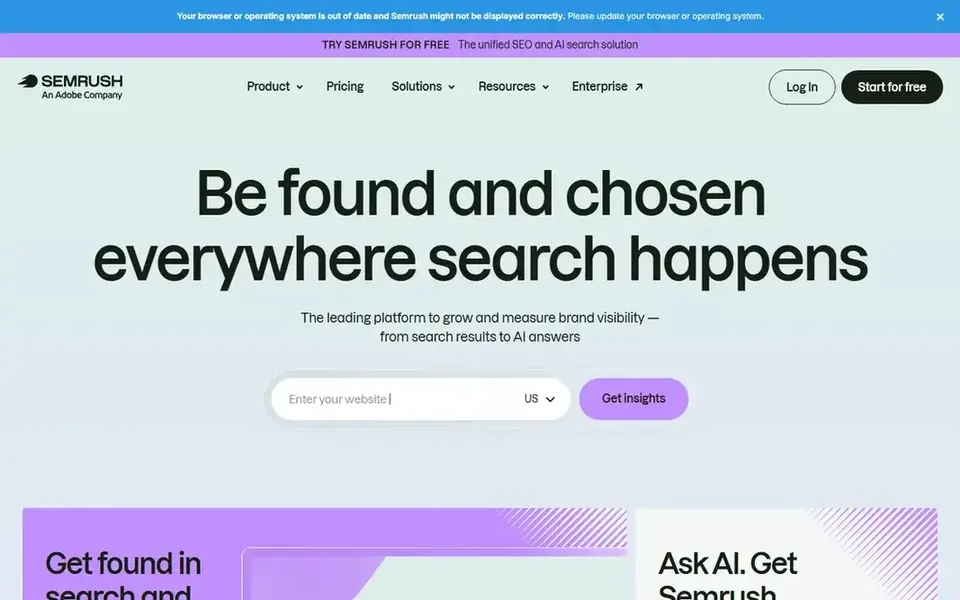
Semrush is a general SEO platform with a local listings add-on. It suits a pool company owner or marketer who wants to see which service terms competitors rank for, how their websites are structured, and where the gaps are before writing new service pages.
For pool service companies, the research side is the draw. You can check demand for terms around pool cleaning, equipment repair, resurfacing and seasonal openings, then build pages that match what people search in your area. The local listing tools help keep business data consistent across directories.
The downside is that Semrush is a large platform, and the local features are a small part of it. If you only need a Google Business Profile audit and review requests, a local-first tool is simpler.
- Deep keyword data
- Competitor tracking
- Local listing management features
- Broad platform with a learning curve
- Local tools are one part of a bigger product
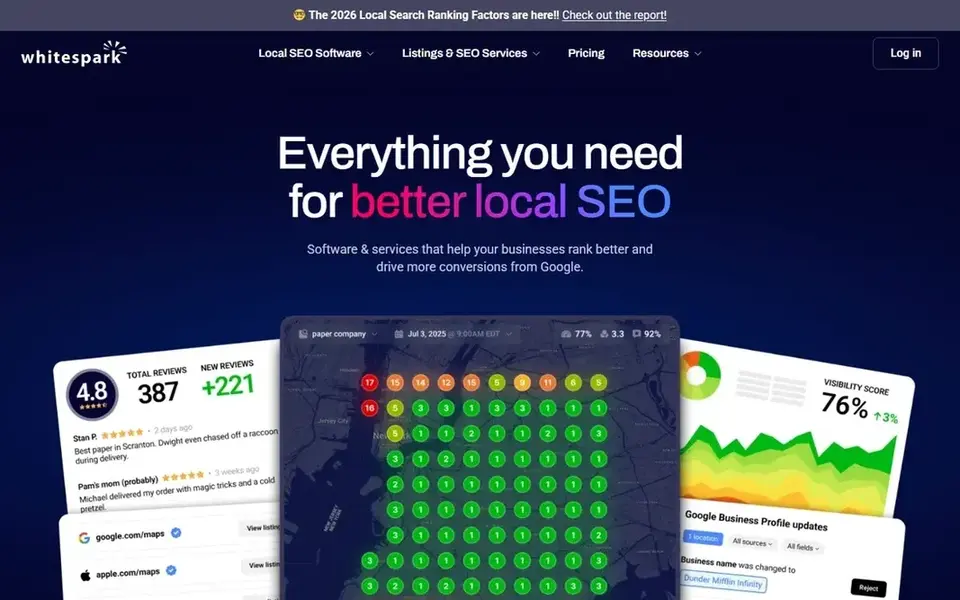
Whitespark focuses on local search, with citation building and local rank grid tools. It fits a pool company that has moved or changed phone numbers over the years and now has inconsistent listings across directories, which is common for small service businesses.
The citation service is the practical part. You give the team your correct business details, and they fix or create listings across directories. The local rank grid shows how you rank across a map area, which helps when your routes cover several suburbs and you want to see where visibility drops.
The main limit is cost and scope. Citation building is a service you pay for, not just a dashboard, so it suits companies ready to clean up listings properly. Skip it if your listings are already consistent.
- Citation building service and software
- Local rank grid tracking
- Strong focus on local search
- Citation work is often a paid service
- Less useful if you do not need listings work
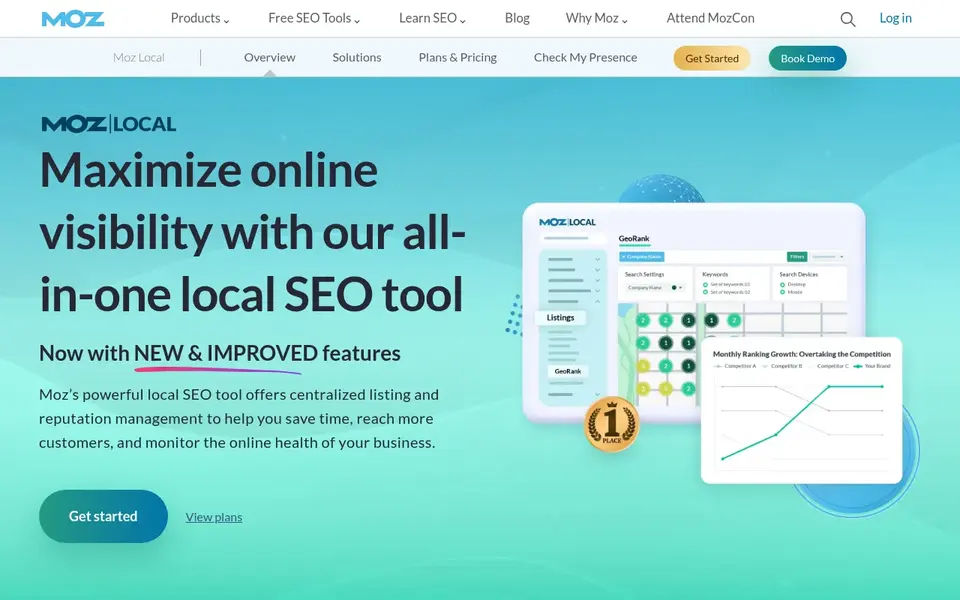
Moz Local handles business listing management and local audits. It suits a pool company that wants its name, address, phone number and hours to match across the main directories without checking each one by hand.
For a service business, listing accuracy matters because customers often find you through maps and directories rather than the website. Moz Local checks and corrects that data, and the audit shows where listings disagree. That is useful after a move, a rebrand or a new phone number.
The limit is scope. Moz Local does not replace a full SEO platform, and it does not do keyword research for your service pages. Skip it if you want one tool for everything.
- Listing distribution and correction
- Local audit tools
- Clear reporting on listing accuracy
- Narrower than full SEO suites
- Fewer content and research features
Yext is a listings and location data platform. It fits a pool company with several branches, or a franchise-style operation where each location needs its own consistent listing data.
For pool service companies, Yext is useful when you have multiple offices or service hubs and want one place to update hours, phone numbers and service descriptions. That keeps data consistent across directories and maps.
The limit is scale. Yext is built for larger listing footprints, so a single-location pool company will likely find it more than needed. Skip it unless you manage several locations.
- Central control of listings
- Works well for many locations
- Structured data management
- Built for larger footprints
- Can be more than a small pool company needs
GatherUp is a review management tool. It fits a pool company that wants a steady stream of reviews after service visits, because reviews are one of the strongest signals for local rankings and for customer trust.
For a pool business, the workflow is simple: after a cleaning or repair visit, the customer gets a request to leave a review. You can monitor new reviews and respond from one place. That matters when a customer raises a problem publicly and you want to reply quickly.
The limit is that GatherUp does not track rankings or manage citations. Skip it if reviews are already handled and your gap is elsewhere.
- Review request automation
- Review monitoring
- Response tools
- Not a rank tracking tool
- Review-focused only
Google Business Profile is the free listing that decides whether your pool company appears in the map pack. It is not a paid SEO tool, but it is the foundation every other tool works around.
For pool service companies, the profile should list the service area, hours, phone number and services, with regular photos of completed jobs and posts about seasonal offers. Respond to reviews and questions, and keep the service list accurate.
The limit is that the profile does not track rankings or manage citations elsewhere. You still need other tools for that. Skip nothing here: every pool company should claim and complete this listing.
- Free to use
- Direct control of your map listing
- Posts, photos and Q&A tools
- No rank tracking
- No citation management
How I chose
I chose these tools by reading vendor documentation and public sources, then matching each one to the way a pool service company gets customers. That means a complete Google Business Profile, steady reviews, consistent listings across directories, and rank tracking across several service towns. I did not run hands-on tests, so treat this as a starting point for your own trial.
I also weighed limits. A one-person pool route does not need an enterprise listing platform, and a company with several branches may need more than a single local tool. The list runs from all-in-one platforms to focused review and citation tools, so you can pick based on the gap you actually have rather than buying the biggest package.
What to check before you buy
- Confirm the tool tracks rankings by location or grid, not just one city-level number, because pool routes often cross several towns.
- Check whether review requests can be sent automatically after a service visit, and make sure the tool does not filter or gate who gets asked.
- Ask whether citation management covers the directories that matter in your area, and whether it can fix old addresses or phone numbers.
- Look for Google Business Profile audit features that flag missing services, hours or photos, since the profile drives most map pack visibility.
- Match the plan to your team size: a solo operator and a multi-branch company need very different levels of access.
- Confirm the tool follows Google's review and listing guidelines, and avoid anything that promises review gating or keyword-stuffed business names.
Frequently asked questions
What is the most important local SEO tool for a pool service company?
The Google Business Profile is the foundation, because it controls your map listing. Around it, a tool like BrightLocal helps with audits, reviews and local rank tracking. Start with the free profile, then add a paid tool when you need to track rankings across several service areas or manage reviews at scale.
How do I get more reviews for my pool service business?
Ask every customer after a service visit, using an automated request from a tool like GatherUp or BrightLocal. Do not filter who gets asked and do not offer incentives for positive reviews. Reply to every review, including critical ones, because responses show other customers how you handle problems.
Do pool companies need citation building?
Yes, if your business details are inconsistent across directories. Pool companies often change phone numbers or move, and old data lingers. A citation service like Whitespark or a listing tool like Moz Local can correct that. If your listings are already consistent, put the budget into reviews and service pages instead.
Can I rank in several suburbs with one website?
Yes, but you need pages that match each service area and a profile that reflects where you actually work. Use location-level rank tracking to see which suburbs lag, then improve those pages. Avoid copying the same page for every town with only the name changed, because that adds little value.
How often should I check local rankings?
Check monthly for a stable pool route, and more often during seasonal peaks when demand for cleaning, openings and repairs rises. Weekly checks are rarely needed unless you are actively changing pages or the profile. The point is to spot a drop in one area early enough to fix it.
Sources
See where you really rank - block by block
ProMapRanker scans Google Maps across a grid of your service area. Simple monthly plans from $19, white-label on every plan.
Start freeBrowse all guides
← Best Local SEO Tools for Pest Control Companies (2026)Best Locksmith Software in 2026: 7 Tools Compared →
 best local seo tools for franchises
Best Local SEO Tools for Franchises in 2026
Compare the best local SEO tools for franchises in 2026. See how each handles multi-location listings, reviews and reporting, plus what to check before buying.
Read → best local seo chrome extensions
Best Local SEO Chrome Extensions in 2026
A practical guide to the best local SEO Chrome extensions in 2026, covering what each tool does for Google Business Profile and Maps work.
Read → best local schema markup generators
Best Local Schema Markup Generators in 2026
A practical guide to the best local schema markup generators for 2026, compared by use case, output format and workflow fit for local businesses.
Read → local seo importance
Local SEO Importance: A Complete Guide
Everything you need to know about local seo importance: what it is, why it matters for local SEO, and exactly how to act on it.
Read → heatmap action plan
From Heatmap to Action Plan: Prioritizing Red Grid Points
Turn a geo-grid heatmap into a prioritized action plan that fixes the highest-impact zones first.
Read → local seo for restaurants
Local SEO for Restaurants: Get Found on Google Maps and Win Diners
A restaurant local SEO guide: menus, photos, reviews, and geo-grid tracking to fill more tables.
Read →More in Local SEO & Google Maps · All guides A to Z by date · Latest guides