 ProMapRanker
Best Local SEO Software for Self Storage Facilities in 2026

Geo-grid rank tracking for storage sites · Pricing starts at: See website
Direct answer
For most self storage operators, Local Viking is the best fit because it tracks Google Business Profile rankings by grid point and handles geo-grid heatmaps for multiple facilities from one dashboard. It has no free plan stated, so check its pricing page. If reviews are your weak spot, Grade.us and NiceJob are worth a look, and Semrush Local suits operators who want listings plus broader keyword data in one place.
I compared these tools from vendor documentation and public sources rather than hands-on testing. My focus was on how each one handles the things storage operators actually deal with: many facilities across different towns, a steady flow of phone calls, and reviews that mention gates, access hours and unit sizes.
Key takeaways
- Self storage searches are usually "near me" or suburb-based, so grid-based rank tracking matters more than a single city ranking number.
- Multi-facility operators need a tool that groups locations by region and lets you compare them side by side.
- Review volume and recency drive map pack visibility for storage, so a review platform with automated requests is often the highest-value purchase.
- Call tracking separates phone enquiries from form fills, which matters because many storage leads still call before they reserve a unit.
- Listings accuracy across Apple Maps, Bing and Waze is worth fixing once, then monitoring monthly rather than rebuilding constantly.
Quick comparison
| Pick | Great for | Pricing starts at | Free tier | |
|---|---|---|---|---|
| Local Viking | Geo-grid rank tracking for storage sites | See website | Not stated | Visit |
 Grade.us | Review generation per storage facility | See website | Free trial | Visit |
 NiceJob | Reviews plus simple customer marketing | See website | Free trial | Visit |
 Semrush Local | Listings plus keyword research in one | See website | Not stated | Visit |
 Whitespark | Citation building and local audits | See website | Not stated | Visit |
 CallRail | Call tracking for storage enquiries | See website | Free trial | Visit |
 Uberall | Large multi-location listing management | See website | Not stated | Visit |
The best local SEO software for self storage facilities compared
Local Viking is built around Google Maps rank tracking at the grid level. For a storage facility, that means you can see how you rank in the neighbourhoods where your customers actually live, not just one central point. If you run several facilities in one metro, you can group them and compare performance without switching accounts.
The workflow suits storage well because demand is hyper-local. Someone looking for a 10x10 unit will search from their own postcode, and a single city-wide rank hides that. Grid heatmaps show which surrounding suburbs you are visible in, which helps you decide where to build citations or run a local ad. You can also schedule Google posts for move-in offers and see whether visibility shifts afterwards.
The limit is scope. Local Viking does not send review requests or manage listings across directories, so you would pair it with a review tool. Single-facility owners may find a simpler rank tracker is enough.
- Grid-based heatmaps per location
- Google Business Profile post scheduling
- Multi-location grouping
- No review request automation
- Rank tracking is the core, not a full suite
Grade.us focuses on getting reviews from customers after they move in. For storage, the best moment to ask is right after the first successful payment or after a smooth move-in, and the tool lets you trigger requests from a CSV import or integration. Each facility can have its own campaign and landing page.
Storage reviews tend to mention specific things: gate access, security cameras, staff helpfulness, and whether the unit was clean. A review platform that lets you route happy customers to Google and capture feedback from unhappy ones privately helps you build a realistic profile without gating. You can monitor Google, Facebook and other sites in one inbox and reply from the dashboard.
Skip it if reviews are already strong and your main gap is map visibility. It also depends on having accurate customer emails or phone numbers at move-in.
- Automated review request campaigns
- Review monitoring across sites
- Reports per location
- Not a listings or rank tool
- Requires clean customer contact data
NiceJob combines review collection with basic marketing automation. For a storage operator with two or three facilities, it covers the common gap: getting a steady stream of Google reviews without manually emailing every new tenant. Requests can go out by text, which tends to get faster responses than email for this audience.
It also lets you turn positive reviews into social posts and simple location pages. That is useful when you want each facility to have its own web presence without building a full site per location. The review funnel keeps negative feedback private so you can follow up before it reaches Google.
The trade-off is depth. If you need grid-level rank tracking or listings sync across many directories, you will still need another tool. Larger portfolios may outgrow the reporting.
- Review requests by text and email
- Simple landing pages per location
- Social posting from reviews
- Lighter rank tracking
- Best value at small portfolios

Semrush Local adds listings management and review monitoring to the wider Semrush platform. For storage operators, the useful part is combining directory accuracy with keyword data, so you can see whether people search "storage units [suburb]" or "self storage near [landmark]" and adjust your Google Business Profile description and posts accordingly.
The listings sync covers the main directories that matter for local pack visibility, and you can manage multiple facilities from one account. Reporting per location helps when you need to show a regional manager which sites are improving.
It is a bigger commitment than a standalone listings tool. If you only need citations fixed once, a citation service is cheaper and simpler. Semrush Local makes more sense when someone on the team already uses Semrush for keyword work.
- Listings management across major directories
- Keyword and competitor data
- Location-level reporting
- Priced for teams
- Overkill for a single facility
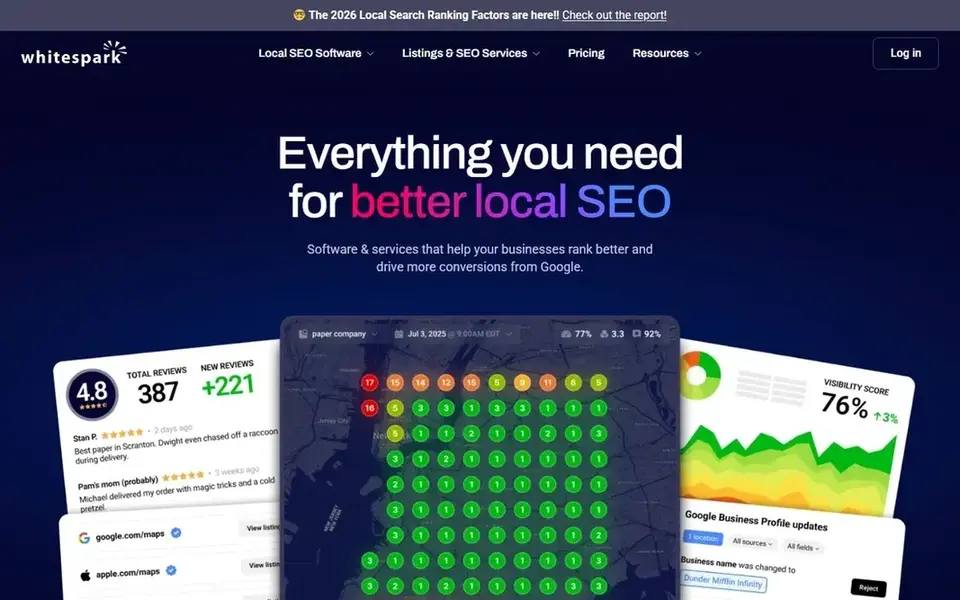
Whitespark is known for citation work and local search research. For storage, citations matter because directories like Yelp, Apple Maps and local chamber listings feed the signals Google uses to confirm a facility's address and category. A facility on an industrial estate can be hard for Google to place, so consistent name, address and phone data across directories helps.
The citation building service handles manual submissions, and the tracker shows where your data is inconsistent. You can also use the local audit to spot gaps in categories and descriptions. This is a project purchase rather than an ongoing subscription for most operators.
It will not send review requests or track rankings daily. Treat it as a foundation step you repeat when you open a new facility or change an address.
- Citation building service and tooling
- Local search ranking factors research
- Citation tracker
- Citations are a one-off project
- Not a review platform
CallRail tracks phone calls and attributes them to the source that produced them. Storage enquiries often start with a call to check gate hours, unit availability or pricing, so knowing whether that call came from Google Business Profile, a directory or a paid ad changes where you spend effort.
You can provision tracking numbers per facility and per channel, route calls to the right office, and record them for training. Form and chat tracking sit alongside, so you get one view of leads. For multi-site operators, this is often the missing piece between SEO work and actual reservations.
It does not manage listings or reviews, so it complements rather than replaces the other tools here. Small single-site operators may find the setup more than they need.
- Tracks which channel produced each call
- Call recording and routing
- Form and chat tracking alongside calls
- Not a listings or review tool
- Needs number provisioning per source
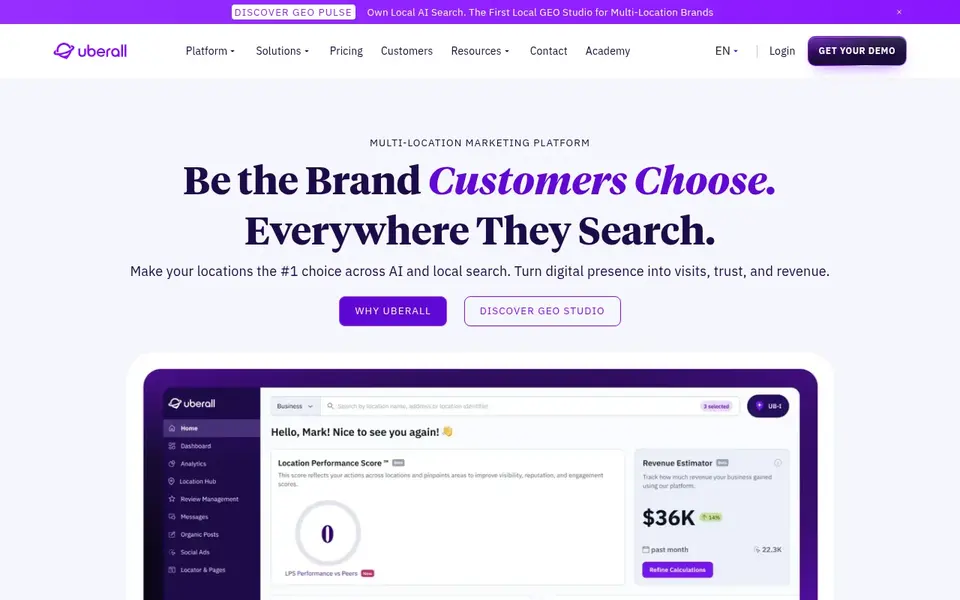
Uberall is aimed at brands with many locations. A storage group with facilities across several states can use it to keep opening hours, holiday hours, amenities and photos consistent everywhere. Storage listings often go stale when gate hours change seasonally, and a central sync fixes that.
Review management sits in the same dashboard, so a regional manager can see which facilities are getting feedback and respond. Location pages help each facility have a consistent web presence without a separate site build.
The setup takes real work: you need clean location data and someone to own the process. A single-facility owner should look at simpler tools first.
- Listings sync across many directories
- Review management in one inbox
- Location pages and local ads support
- Setup effort is significant
- Better value at scale
How I chose
I started from vendor documentation, pricing pages and public product information, then filtered for the tasks a self storage operator actually does. That means managing several facilities in different towns, keeping opening and gate hours accurate, collecting reviews after move-in, and tracking calls that come before a reservation. I did not run hands-on tests, so treat the workflow notes as a guide to what each tool is documented to do rather than a lab result.
The second filter was fit versus overlap. Several tools here do one job well and would be wasted money if you bought them for something else. Local Viking is rank tracking, Grade.us and NiceJob are reviews, Whitespark is citations, CallRail is attribution, and Uberall and Semrush Local are broader platforms. I also weighed setup effort, because a storage operator with three facilities does not want a six-week implementation. Where a tool is clearly built for larger portfolios, I said so.
What to check before you buy
- Confirm the tool supports the number of facilities you have now plus the ones you plan to open in the next year, and check how it groups them by region.
- Check whether Google Business Profile categories and attributes for storage, such as drive-up access and climate control, can be managed or at least audited from the tool.
- Ask how seasonal hours and gate access changes are handled, since storage listings go stale when hours shift.
- Confirm review requests can be triggered after move-in rather than at signing, and that negative feedback is routed privately rather than gated.
- Check whether call tracking numbers can be assigned per facility and per channel without breaking your main listing number.
- Ask for a sample report per location before you commit, and confirm you can export the data if you leave.
Frequently asked questions
Do self storage facilities need local SEO software at all?
If you have one facility and a steady referral stream, you can manage Google Business Profile manually and skip most tools. Once you have two or more facilities, or you are competing in a dense metro, software saves time on listings consistency, review requests and rank tracking. The value comes from repetition, not from a single feature.
What is the most important local SEO task for a storage facility?
Keeping your Google Business Profile accurate and getting a steady flow of recent reviews. Storage customers check hours, access type and security before they call. A profile with correct categories, current hours and reviews that mention clean units and helpful staff will usually outperform extra keyword work on the website.
Should I use grid rank tracking or a simple rank checker?
Grid tracking is more useful for storage because demand comes from surrounding neighbourhoods, not one central point. A single rank number can look fine while you are invisible two suburbs away. Grid heatmaps show that gap, which helps you decide where to build citations or run local ads.
How do I get more Google reviews for a storage facility?
Ask after move-in, when the customer has actually used the gate and the unit. Automate the request by text or email through a tool like Grade.us or NiceJob, keep it short, and never offer incentives or filter out unhappy customers. Replying to every review, positive or negative, also helps.
Can one tool handle listings, reviews and rank tracking together?
Semrush Local and Uberall cover listings and reviews with location reporting, and both can be paired with a rank tracker. No single tool here does all three at full depth. Most operators end up with one platform plus a specialist tool, which is usually cheaper than forcing one product to do everything.
Sources
See where you really rank - block by block
ProMapRanker scans Google Maps across a grid of your service area. Simple monthly plans from $19, white-label on every plan.
Start freeBrowse all guides
← Best Local SEO Software for Painters in 2026Best Local SEO Software for Towing Companies in 2026 →
 best local seo software for hardware stores
Best Local SEO Software for Hardware Stores in 2026
A practical guide to the best local SEO software for hardware stores in 2026, covering listings, reviews, rank tracking and calls, based on vendor docs.
Read → best local seo software for concrete contractors
Best Local SEO Software for Concrete Contractors in 2026
A practical guide to the best local SEO software for concrete contractors in 2026, covering listings, reviews, rank tracking and call tracking tools.
Read → best local rank tracking tools for self storage facilities
Best Local Rank Tracking Tools for Self Storage (2026)
A guide to the best local rank tracking tools for self storage facilities in 2026, compared from vendor docs for multi-facility map and grid tracking.
Read → local rank tracker
Local Rank Tracker: How to Track Local Rankings That Actually Matter
What a local rank tracker does, why geo-grid beats single-point checks, and how to choose one.
Read → ahrefs rank tracker alternatives
7 Tools That Compete With Ahrefs Rank Tracker in 2026
7 options for Ahrefs Rank Tracker alternatives, with entry costs, free tiers and the buyer each one serves. Read the caveats before you buy. Start here.
Read → local seo for dance studios
Local SEO for Dance Studios
A local SEO guide for dance studios: Google Business Profile setup, reviews, and class-schedule-focused local SEO.
Read →More in Local SEO & Google Maps · All guides A to Z by date · Latest guides