 ProMapRanker
Best Local Rank Tracking Tools for Tailors (2026)

Grid-based Google Maps rank tracking · Pricing starts at: See website
Direct answer
Local Viking is my first pick for tailors because it tracks Google Maps rankings on a grid around your shop and connects those positions to Google Business Profile changes, which suits a business that serves a walk-in neighbourhood and a delivery radius. Pricing is quote-based, so check its pricing page. Semrush Local suits tailors who want rank tracking next to broader keyword research, and GatherUp fits shops that want review requests and local rank checks in one place.
I compared these tools from vendor documentation and public sources, not from hands-on testing. I looked at what each product says it does, how it fits a tailoring business with a physical shop and a delivery area, and where the limits sit. Prices change, so treat every figure as something to confirm on the vendor's own page.
Key takeaways
- A tailor's map ranking changes block by block, so a grid-based rank tracker tells you more than a single city-level position.
- Rank tracking alone does nothing for a shop; pair it with Google Business Profile work such as correct categories, hours and photos of finished garments.
- Review platforms matter for tailors because fittings and alterations are trust-based services, and reviews are what convince a new customer to book.
- Check that a tool supports the languages and service areas you actually serve, especially if you take online orders or ship internationally.
- No tool can fix a thin profile, so confirm your address, service area and appointment link before you read any ranking report.
Quick comparison
| Pick | Great for | Pricing starts at | Free tier | |
|---|---|---|---|---|
| Local Viking | Grid-based Google Maps rank tracking | See website | Free trial | Visit |
 Semrush Local | Rank tracking alongside keyword research | See website | No free plan | Visit |
 GatherUp | Review requests with local rank checks | See website | Free trial | Visit |
 Moz Local | Listing accuracy and local visibility | See website | Free plan | Visit |
 BrightLocal | Citation and rank reports in one place | See website | Free trial | Visit |
 Local Falcon | Wide-area map grid scans | See website | Free trial | Visit |
 Yext | Multi-location listing control | See website | No free plan | Visit |
The best local rank tracking tools for tailors compared
Local Viking is a local SEO tool built around Google Business Profile and Google Maps visibility. For a tailor, the useful part is the grid: it shows where your shop ranks in a pattern of points around your address rather than one number for the whole town. That matters when your customers come from specific neighbourhoods, a nearby business district or a commuter route.
In practice you would set your shop address as the centre, choose a radius that covers your realistic catchment, and scan on a schedule. The tool keeps a history, so you can see whether a profile update, a new set of photos or a batch of reviews moved your position in the grid. It also tracks changes to your Google Business Profile, which helps you notice edits you did not make.
The limits are practical. Grid scans cost credits and a single scan is a snapshot, so you need to run them over weeks before the pattern means anything. If you only want a simple position check once a month, this is more tool than you need.
- Map grid heatmaps
- Google Business Profile change tracking
- GeoGrid history over time
- Pricing is quote-based
- Best value only if you actively use the grid data
Semrush Local brings listing management and local rank tracking into the wider Semrush platform. A tailor who also runs a website with service pages, such as alterations, bespoke suits or wedding dress fitting, can track both the website keywords and the map positions in one account. That saves switching between tools.
The local side lets you monitor how your business appears in local search results and manage business listings from the same dashboard. If you sell online or take enquiries through a site, the keyword data helps you see which service terms bring people in, while the local tracking shows whether the shop itself surfaces for nearby searches.
The downside is scale. The platform is built with agencies and marketing teams in mind, and a one-person tailoring business will pay for features it never opens. Skip it if you want a narrow, cheap rank checker.
- Local rank tracking inside a wider SEO suite
- Listing management tools
- Strong reporting
- Priced for agencies and serious marketers
- Steep learning curve for a single shop
GatherUp is a customer experience and review platform with local search monitoring built in. For tailors, reviews carry a lot of weight: a customer deciding between two shops will read about fit, turnaround time and how alterations were handled. GatherUp sends review requests after a job, which fits naturally after a collection or delivery.
The local rank monitoring gives you a view of where you appear in local search, so you can connect review volume and response habits to visibility. It also helps you keep responses organised, which matters when a complaint about a missed fitting date appears publicly.
Its rank tracking is not as detailed as a dedicated grid tool, and the review features are the main event. A tailor who already has a review process and only wants map positions should look elsewhere.
- Automated review requests
- Local search rank monitoring
- Review response tools
- Rank tracking is secondary to reviews
- Not a deep grid tool
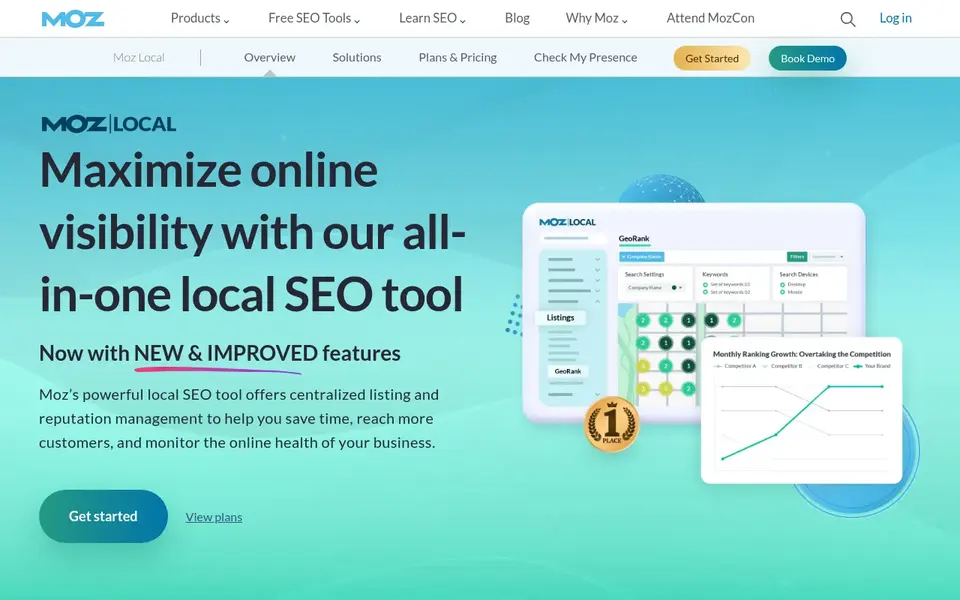
Moz Local focuses on getting your business data consistent across directories and data providers. For a tailor, that means the same name, address, phone number and hours everywhere, which reduces confusion for customers and for search engines. Duplicate listings for an old shop location are a common problem and this tool is built to find them.
It also gives a local visibility view, so you can see how your listings perform across the directories it manages. That is useful context next to rank tracking, because inconsistent data can hold back map visibility even when your profile looks fine.
The rank tracking side is not the reason to buy it. If your main question is "where do I rank in the map grid around my shop", a dedicated tracker answers it better.
- Listing distribution and duplicate cleanup
- Local visibility scoring
- Familiar Moz interface
- Rank tracking is limited
- Best value when listings are the priority
BrightLocal is a local marketing platform with rank tracking, citation tools, review features and reporting. A tailor can use it to check local search positions, audit citations for the shop address, and build new listings where the business is missing. The reporting is clear enough to keep as a monthly record.
The citation side is genuinely useful for a shop that has moved or changed its trading name, since old directory entries linger. Pairing that cleanup with rank tracking shows whether the fixes had an effect.
The risk is feature sprawl. A solo tailor will not use most of the platform, and the reports can be more than you need. It suits someone who wants one dashboard for several local tasks.
- Local rank tracking reports
- Citation building and audit tools
- Review and listing features together
- Wide feature set for a small shop
- Reports can overwhelm a solo owner
Local Falcon specialises in map grid scans. You set a centre point and the tool checks rankings across a pattern of locations, then shows the result as a heatmap. For a tailor with a shop in a town centre and customers driving in from surrounding villages, this shows how far your visibility reaches.
The heatmap is easy to read and useful for spotting gaps, such as a nearby neighbourhood where you never appear. Scheduling repeated scans turns those snapshots into a trend you can compare against profile changes.
Because scans use credits, heavy use adds cost, and a single scan tells you little on its own. It is a focused tool for someone who wants grid data and nothing else.
- Large grid scans
- Clear heatmap visuals
- Scan scheduling
- Snapshot-based, so trends need repeated scans
- Credit-based usage
Yext manages business information across a large network of directories and platforms from one place. A single tailoring shop can use it, but the product is designed for businesses with several locations or a franchise model, where keeping hours, services and addresses consistent is a real job.
If you run a shop plus a concession in a department store, or you are planning a second location, Yext keeps the data aligned. It also supports structured updates when something changes, such as seasonal hours or a new service.
For one shop with one address, the setup effort and cost are hard to justify. Most tailors are better served by a simpler listing tool plus a dedicated rank tracker.
- Central control of business data
- Wide directory network
- Structured listing updates
- Built for larger organisations
- Cost and setup suit multi-location brands
How I chose
I started from vendor documentation and public product pages, then checked each tool against how a tailoring business actually operates: one shop, a catchment of a few neighbourhoods, appointments and fittings, and a steady flow of reviews. I did not run hands-on tests, so my judgements come from what each vendor documents and from public information about the products.
The second filter was fit. A tool that tracks map grids in detail is useful for a shop that wants to know its reach; a review platform is useful for a business built on trust and repeat customers. I also noted where a product is clearly aimed at agencies or multi-location brands, because paying for that scale rarely makes sense for a single tailor. Where a vendor's pricing is not public, I have said so rather than guess.
What to check before you buy
- Confirm the tool can centre a grid on your exact shop address, not just a city name, so the scan reflects your real catchment.
- Check whether scans are included or credit-based, since repeated scans are what turn a snapshot into a trend.
- Make sure the tool supports your Google Business Profile categories and service areas, including delivery or online order options if you offer them.
- Ask whether review requests can be sent after a collection or fitting, which is the natural moment for a tailoring customer.
- Look for listing and citation tools only if your address, name or hours have changed, since stale directory data is the usual culprit.
- Read the vendor's own pricing page before you commit, because plans and limits change and no comparison table stays current for long.
Frequently asked questions
Do I need a rank tracking tool if I only have one tailoring shop?
No, but it helps. A single shop still competes for map visibility in its own neighbourhood, and a tracker shows whether profile work is moving the needle. Start with a free trial from a grid tool, run a few scans over a month, and decide whether the data changes what you do.
How often should I run local rank scans for my shop?
Monthly is a reasonable rhythm for a small tailoring business, with an extra scan after a significant profile change such as new photos, updated hours or a batch of reviews. Weekly scans rarely tell a one-shop business anything new and use up credits faster than needed.
Can rank tracking help me get more alteration and fitting bookings?
Only indirectly. Rank tracking shows where you appear; the booking comes from a complete profile, clear service list, good photos and reviews that mention fit and turnaround. Use the tracker to check whether those changes helped, not as a substitute for them.
Should I track reviews and rankings in the same tool?
It can be convenient. Review platforms with local rank checks let you see whether review volume and responses line up with visibility, and they keep your customer contact in one place. If you want deep grid data, a dedicated tracker still does that job better.
What should I do before buying any local SEO tool?
Fix the basics first: claim and complete your Google Business Profile, correct your categories and hours, add photos of finished work, and remove duplicate directory listings. Then buy a tracker, because clean data makes the ranking reports meaningful instead of confusing.
Sources
See where you really rank - block by block
ProMapRanker scans Google Maps across a grid of your service area. Simple monthly plans from $19, white-label on every plan.
Start freeBrowse all guides
← Best Local Rank Tracking Tools for Summer Camps in 2026Best Local SEO Software for Acupuncturists in 2026 →
 best local rank tracking tools for personal trainers
Best Local Rank Tracking Tools for Personal Trainers in 2026
A practical guide to the best local rank tracking tools for personal trainers, compared from vendor documentation and public sources.
Read → best local rank tracking tools for it support companies
Best Local Rank Tracking Tools for IT Support Companies in 2026
A guide to the best local rank tracking tools for IT support companies, compared from vendor documentation and public sources, with grid and keyword tracking notes.
Read → best local rank tracking tools for home inspectors
Best Local Rank Tracking Tools for Home Inspectors in 2026
A practical guide to the best local rank tracking tools for home inspectors, comparing grid tracking, review signals and citation checks for 2026.
Read → best keyword rank tracker software
Best Keyword Rank Tracker Software in 2026
Compare the best keyword rank tracker software for daily rankings, local tracking and AI search visibility, with current pricing and keyword limits included.
Read → local seo for property management companies
Local SEO for Property Management Companies
A local SEO guide for property management companies: Google Business Profile setup, reviews, and multi-property and owner-focused local SEO.
Read → local seo trends 2027
Local SEO Trends for 2027
The local SEO trends that will actually matter in 2027, from AI Overviews to geo-grid visibility tracking.
Read →More in Local SEO & Google Maps · All guides A to Z by date · Latest guides