 ProMapRanker
Best Local Rank Tracking Tools for Personal Trainers in 2026

Map-grid rank tracking around a training spot · Pricing starts at: See website
Direct answer
Local Dominator is my top pick for personal trainers because it tracks Google Maps grid rankings around a studio or training location, which is exactly how clients near you find a trainer. It has no free plan stated, so check its pricing page. Synup suits trainers who want listings and rank data in one place, and Local Falcon fits trainers who mainly want map-grid visibility checks on a budget.
I compared these tools from vendor documentation and public sources rather than hands-on tests. My focus was how each one handles the way a personal trainer actually gets found: a client searching "personal trainer near me" or "bootcamp in [suburb]" on a phone and picking from the Google Maps pack. I looked at map-grid reporting, location handling, listing features and the practical limits a solo trainer will hit.
Key takeaways
- Personal trainers rank inside a small radius, so grid-based map tracking tells you more than a single city-wide position.
- A trainer who travels to clients, parks or homes needs tracking set around more than one point, not just a studio address.
- Rank tracking only helps if your Google Business Profile category, service area and reviews are already set up correctly.
- Review signals carry weight in local results, so pair any tracker with a simple, policy-compliant review request routine.
- Check that a tool reports Google Maps grid positions, not just classic organic blue-link rankings.
Quick comparison
| Pick | Great for | Pricing starts at | Free tier | |
|---|---|---|---|---|
| Local Dominator | Map-grid rank tracking around a training spot | See website | Not stated | Visit |
 Synup | Listings and local rank data together | See website | Not stated | Visit |
 Local Falcon | Simple map-grid visibility scans | See website | Not stated | Visit |
 BrightLocal | Citation building with local rank reports | See website | Free trial | Visit |
 Whitespark | Citation building and local rank tracking | See website | Not stated | Visit |
 Semrush Local | Trainers already using Semrush | See website | Not stated | Visit |
 CallRail | Tracking calls from local leads | See website | Free trial | Visit |
The best local rank tracking tools for personal trainers compared
Local Dominator is built around tracking where a business appears across a grid of points on Google Maps rather than at one central position. For a personal trainer, that matters because someone three suburbs away is unlikely to see you in the map pack, while someone two streets from your studio should. It fits independent trainers and small studios that want to see the shape of their local visibility.
In practice you set your training location, choose a grid size and run scans over time. The report shows which points around you rank and which do not, so you can tell whether a drop is a real problem or just noise at the edge of your area. If you train clients at a park or a second site, you can set up additional locations and compare them.
The limit is that Local Dominator is a tracking tool, not a listing or review manager. If your Google Business Profile is incomplete, the scans will show weak visibility you cannot fix inside the tool. Trainers who want an all-in-one dashboard should look further down this list.
- Grid-based Google Maps tracking
- location-focused reports
- useful for spotting radius-level visibility
- suited to single-location businesses
- Credit-based scanning needs planning
- not a full listing manager
Synup is a local marketing platform that manages business listings, monitors reviews and reports on local search visibility. A personal trainer with one studio may find it more than they need, but trainers running sessions from two or three sites, or a small team of coaches, get a single place to keep name, address and phone details consistent everywhere.
The rank side shows how you appear in local results for chosen keywords, which you can line up against the listing data. That helps when a visibility dip traces back to an inconsistent address or a missing category on a directory. You can also watch reviews come in and respond from the same dashboard.
The main limit is scale. Synup is designed for businesses with several locations and a marketing budget to match. A single trainer who only wants position checks should start with a lighter, grid-focused tool and revisit Synup if the business grows.
- Combines listing management with local visibility reporting
- handles multiple locations
- review monitoring included
- Priced and structured for larger businesses
- can feel heavy for a solo trainer
Local Falcon specialises in Google Maps grid reports. You enter a business and a keyword, and it scans a spread of points around the location to show where you appear. For a personal trainer, that is a quick way to answer the question "how far does my visibility actually reach" without guessing.
The reports are easy to read, which helps if you are explaining results to a partner or a coach you work with. You can run scans for different services, such as one-to-one training versus group sessions, and compare how each performs across the same area.
It is lighter on listing management and review tools than the bigger platforms. If you mainly want to know where you stand on the map and you already keep your profile tidy by hand, Local Falcon covers that job without extra complexity.
- Clear map-grid reports
- straightforward setup
- good for checking a small service radius
- Fewer listing and review features
- grid scans are the core, not the whole workflow
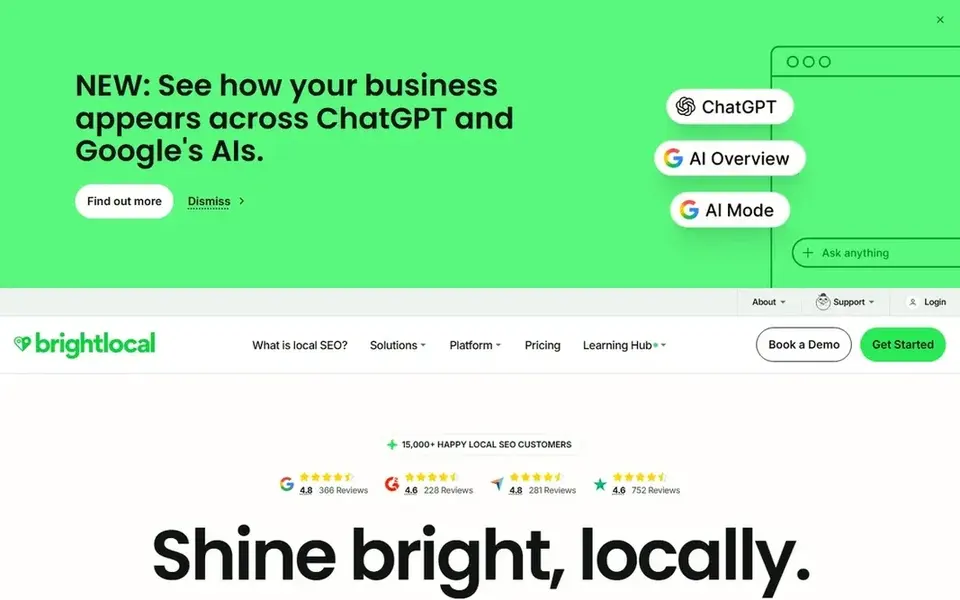
BrightLocal is a well-known local SEO platform with citation building, listing audits, review tools and local rank tracking. For a personal trainer, the citation side is the draw: getting your name, address and phone number listed consistently on directories supports the map visibility you are tracking.
You can run rank reports for chosen keywords and locations, then cross-check them against citation and listing health. That combination helps when a visibility problem turns out to be a duplicate listing or a wrong phone number on a directory rather than a ranking issue.
The trade-off is breadth. BrightLocal does many things, and a solo trainer may only use a fraction of them. It is a good fit if you want citations and rank tracking from one vendor and do not mind a learning curve.
- Citation building and audit tools
- local rank tracking reports
- review and reputation features
- Rank tracking is one module in a broad suite
- the range of options can overwhelm a beginner
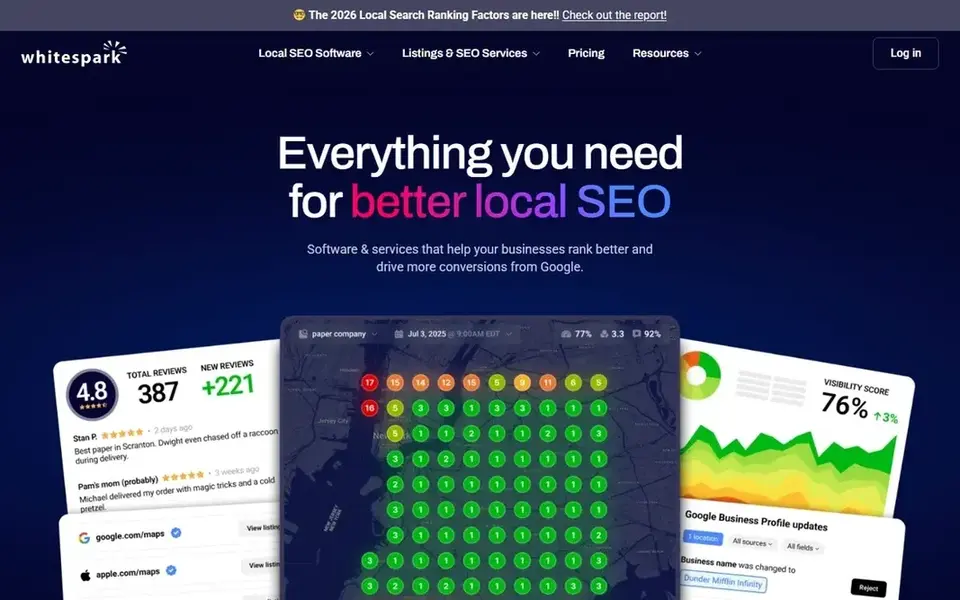
Whitespark is known for citation building and local rank tracking, and it is widely used by agencies working on local visibility. A personal trainer who wants to build directory listings properly, rather than buying a bulk package, can use its citation finder to work through relevant local directories.
The rank tracker lets you follow positions for chosen keywords around a location, so you can see whether citation work moves the needle over time. That feedback loop is useful if you are doing your own local SEO between training sessions.
The limit is the audience. Whitespark is designed for people who do this regularly, and the interface assumes some familiarity with local SEO. A trainer who wants a simple "where do I rank" answer may find it more involved than needed.
- Strong citation-finding tools
- local rank tracker included
- respected in local SEO circles
- Built with agencies in mind
- interface assumes some SEO knowledge

Semrush is a broad SEO platform, and its local features cover listing management, review monitoring and local visibility. A personal trainer who already uses Semrush for website keyword research or content planning can keep local tracking in the same account rather than adding another tool.
For local rank tracking, you can follow how your business appears for service and location keywords, then compare that with the traffic your site gets. If you write blog posts about training programmes, that link between local and organic performance is handy.
One limitation is cost and scope. Semrush is a large platform, and if all you want is map-grid position checks, you are paying for a lot you will not use. It suits trainers who treat their website as a serious lead source.
- Local listing and review tools
- rank tracking within a larger SEO platform
- useful if you also run a website
- Local features are part of a bigger subscription
- more than a rank tracker alone
CallRail is a call tracking platform, not a rank tracker, but it belongs in this list because a personal trainer's local visibility only matters if it turns into enquiries. CallRail assigns trackable numbers so you can see which calls come from your Google Business Profile, your website or a directory listing.
Used alongside a rank tracker, it closes the loop. You can see that map visibility improved and check whether calls from the profile went up in the same period, rather than assuming a ranking change produced new clients.
The limit is scope: CallRail will not tell you where you rank. It is an add-on for trainers who get most enquiries by phone and want to know which local channel is producing them.
- Call tracking with source attribution
- helps show which channels produce enquiries
- works alongside rank data
- Not a rank tracker
- adds a phone number layer to manage
How I chose
I picked these tools by reading vendor documentation and public sources, then matching each one to how a personal trainer gets found locally. I did not run hands-on tests, so I have not scored speed, accuracy or support response times. What I looked at was whether a tool reports Google Maps grid positions, how it handles a single location versus several training sites, whether it bundles listings or reviews, and how much setup a solo trainer can realistically handle.
I also weighed the limits honestly. Some tools here are full local marketing platforms that a one-person training business will barely use, and one is a call tracker rather than a rank tracker. I kept them in because they solve adjacent problems trainers ask about, but I have said plainly where each one stops. Pricing changes often, so I have not quoted figures and pointed you to each vendor's site instead.
What to check before you buy
- Confirm the tool reports Google Maps grid positions, not only classic organic rankings, because map results are where local clients look.
- Check whether you can track more than one location if you train at a studio, a park and clients' homes.
- Look at how scans are counted, since grid tracking can consume credits fast if you scan a wide area often.
- Make sure the keyword set can cover your real services, such as one-to-one training, group sessions or online coaching.
- Check whether listings and review monitoring are included, or whether you need a second tool for those.
- Read the cancellation and plan-change terms before committing, especially for platforms built for larger businesses.
Frequently asked questions
Do I need a rank tracking tool if I only have one training location?
Not strictly, but it helps. A single-location trainer can check visibility by searching manually, though that is slow and inconsistent. A grid tracker shows how far your map visibility reaches around the studio, which manual checks cannot show reliably. If you are serious about local enquiries, tracking is worth the small ongoing cost.
Why does map-grid tracking matter more than a single ranking position for a trainer?
Clients choose a trainer close to them, so your position at one central point tells you little. Grid tracking shows which surrounding areas you appear in and which you do not. That helps you decide whether to target nearby suburbs, adjust your service area or ask recent clients for reviews to strengthen local signals.
Can rank tracking fix a low Google Maps position?
No. A tracker measures; it does not change your position. What moves you is a complete and accurate Google Business Profile, the right primary category, consistent listings, genuine reviews and a website that matches your services. Use the tracker to see whether those changes are working over time.
Should I ask clients for reviews to improve local rankings?
Yes, asking happy clients for honest reviews is fine and follows Google's guidelines. What is not allowed is review gating, offering incentives for positive reviews only, or buying reviews. Ask every client the same way, make it easy with a direct link, and respond to reviews whether they are positive or negative.
Is a call tracking tool necessary for a personal trainer?
Only if phone enquiries are a big part of your business. CallRail and similar tools show which local channel produced a call, which is useful when you want to know whether map visibility turned into real leads. If most of your clients book through a website form or Instagram, you can skip it and rely on rank tracking plus your booking data.
Sources
See where you really rank - block by block
ProMapRanker scans Google Maps across a grid of your service area. Simple monthly plans from $19, white-label on every plan.
Start freeBrowse all guides
← Best Local Rank Tracking Tools for IT Support Companies in 2026Best Local Rank Tracking Tools for Summer Camps in 2026 →
 best local rank tracking tools for home inspectors
Best Local Rank Tracking Tools for Home Inspectors in 2026
A practical guide to the best local rank tracking tools for home inspectors, comparing grid tracking, review signals and citation checks for 2026.
Read → best local rank tracking tools for eyewear stores
Best Local Rank Tracking Tools for Eyewear Stores in 2026
A practical guide to the best local rank tracking tools for eyewear stores in 2026, covering grid tracking, reviews and listing accuracy.
Read → best local rank tracking tools for event planners
Best Local Rank Tracking Tools for Event Planners in 2026
A practical guide to the best local rank tracking tools for event planners, compared from vendor docs and public sources, with limits and buying checks.
Read → top rated local seo tracking software
Comparing 6 Rated Local SEO Tracking Software Options in 2026
6 options for the top rated local SEO tracking software, with entry costs, free tiers and the buyer each one serves. Real limits included. Pick with confidence.
Read → local seo for wedding venues
Local SEO for Wedding Venues
A local SEO guide for wedding venues: Google Business Profile setup, reviews, and photo-heavy GBP profiles and venue listings.
Read → local seo for barbershops
Local SEO for Barbershops
How barbershops can rank higher in local search and fill more chairs with GBP and review strategy.
Read →More in Local SEO & Google Maps · All guides A to Z by date · Latest guides