 ProMapRanker
Best Local Rank Tracking Tools for Home Inspectors in 2026

Grid map rank tracking for inspectors · Pricing starts at: See website
Direct answer
Local Viking is my first pick for home inspectors because its grid-based map tracking shows how your inspection company ranks block by block across a service area, not just at one pin. Pricing is quote-based, so check its pricing page for current plans. If you also want review and citation management in the same place, look at Semrush Local, and if you need multi-location control across several metro areas, Uberall is worth a look.
I put this comparison together from vendor documentation and public sources, and I did not run hands-on tests of these tools. My focus was on what matters to a home inspection business: how a tool measures map visibility across a service radius, whether it handles reviews and citations, and how it fits a small operator's workflow.
Key takeaways
- Home inspectors usually serve a wide radius, so grid-based map tracking matters more than a single city-level rank number.
- Review volume and recency affect map visibility, so pick a tool that tracks review signals alongside rankings.
- Citation consistency on directories like Google Business Profile, Yelp and industry listings supports local rankings, so check whether the tool audits them.
- Rank tracking is a measurement layer; you still need a Google Business Profile that follows Google's guidelines for reviews and business names.
- Match the tool to the number of service areas you cover, since multi-city inspectors need more location slots than single-town operators.
Quick comparison
| Pick | Great for | Pricing starts at | Free tier | |
|---|---|---|---|---|
| Local Viking | Grid map rank tracking for inspectors | See website | Free trial | Visit |
 Semrush Local | Reviews and listings with rank data | See website | No free plan | Visit |
 Uberall | Multi-city inspectors with several offices | See website | No free plan | Visit |
 BrightLocal | Citations and local audits for inspectors | See website | Free trial | Visit |
 Whitespark | Finding and building local citations | See website | Free trial | Visit |
 Local Falcon | Detailed grid scans and shareable reports | See website | Free trial | Visit |
 GatherUp | Review generation and monitoring | See website | Free trial | Visit |
The best local rank tracking tools for home inspectors compared
Local Viking is built around GeoGrid tracking, which scans a grid of points around a location and shows where your inspection business appears in Google Maps at each point. For a home inspector who covers a county or several towns, that picture is more useful than a single "ranked #4 in your city" line, because it shows which neighborhoods you actually reach.
The workflow fits inspection work well. You set your office or service-area address, define a grid size, and schedule scans. Over time you can see whether a new batch of reviews or a corrected business category moved your visibility in the outer parts of your service area. It connects to Google Business Profile so you can compare ranking movement with profile changes.
The limit is scope. Local Viking is a ranking tool first, so if you want citation building, review requests and listing sync in one dashboard, you will need another product alongside it. Inspectors who only want clean map tracking will be fine.
- Grid-based map heatmaps
- GeoGrid history over time
- Google Business Profile integration
- Pricing is quote-based
- Fewer extras beyond local ranking
Semrush Local bundles local ranking data with review management and business listing tools. For an inspector who already uses Semrush for website keyword research, keeping local map tracking in the same account avoids juggling logins. It suits a business that wants one place to watch both organic search and map visibility.
For home inspectors, the useful part is seeing how your service pages and your Google Business Profile perform together. If someone searches "home inspector near me," you can check whether your profile or your website page is doing the work. Review monitoring also helps you spot new reviews that mention specific towns, which you can reflect in your service area content.
The main drawback is size. Semrush is a full SEO platform, and a one-person inspection company may pay for features it never opens. Inspectors who want a narrow, cheap rank checker should compare lighter options first.
- Review management tools
- Listing management
- Local rank tracking inside a larger SEO suite
- Larger suite than a small inspector needs
- No free plan
Uberall manages business listings and local presence across many directories, and it includes location-level visibility data. It fits an inspection company that has grown to several offices or franchises across different metros and needs each location's listings kept consistent. Consistency across directories is one of the foundations of local visibility.
For rank tracking purposes, Uberall shows how each location performs and where listing errors might be holding a branch back. If your Dallas office ranks well but your Fort Worth office does not, the listing data can help explain why. Review management is included, so you can respond to reviews from the same dashboard.
The fit is narrower than the feature list suggests. A single-office inspector covering one metro will likely find Uberall heavier than needed. It makes most sense once you have multiple physical locations to manage.
- Listing sync across many directories
- Location-level performance data
- Review management
- Aimed at larger location counts
- Pricing is quote-based
BrightLocal is a well-known local SEO toolkit with rank tracking, citation building, audit reports and review tools. For home inspectors, the citation side is often the reason to sign up: inspection businesses appear on general directories plus industry-specific ones, and mismatched name, address or phone details across them can weaken local signals.
The rank tracking module covers map and organic positions for your target terms, and you can run reports to see movement after citation or profile changes. The audit tools flag listing problems you might not notice, such as duplicate listings or wrong categories. That combination suits an inspector who wants to fix foundations, not just watch numbers.
The trade-off is breadth. BrightLocal does many things, and the rank tracking view is less specialized than a dedicated grid tool. Inspectors who want only map heatmaps may prefer a narrower product.
- Citation building and cleanup
- Local rank tracking
- Reputation and review tools
- Rank tracking is one module among many
- Interface takes time to learn
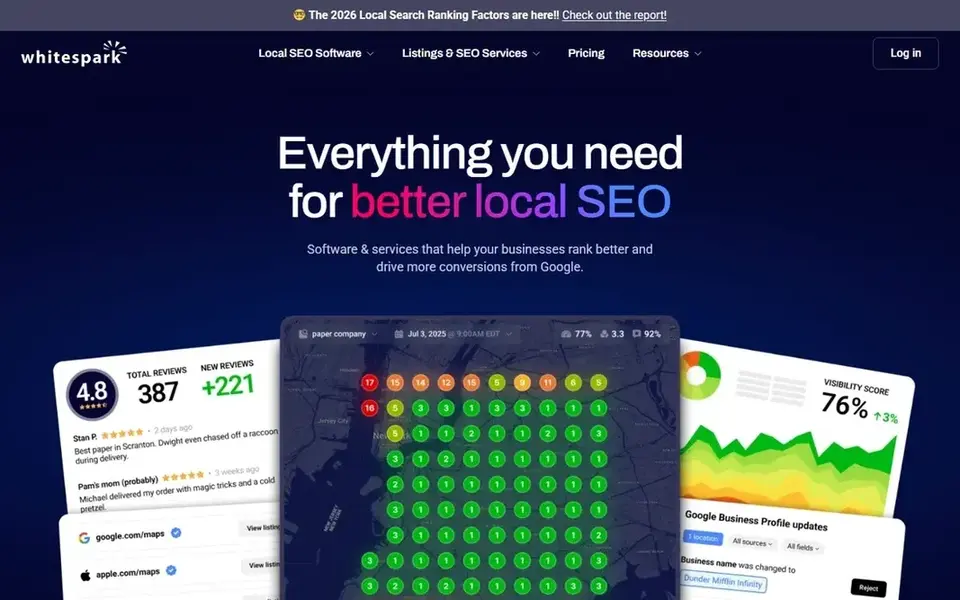
Whitespark is known for its citation finder, which surfaces directories relevant to a business category and location. For home inspectors, that means finding the general directories plus the local and industry listings where an inspection company should appear. It also offers a local rank tracker and citation building services if you would rather hand the work off.
The rank tracker gives you position data for target keywords, and it pairs naturally with citation work: you build or fix listings, then watch whether map visibility shifts. That loop is useful for inspectors in competitive metros where several companies fight for the same "near me" searches.
The caveat is that Whitespark's strength is citations, not deep grid analysis. If your main question is "where exactly in my service area do I appear," a grid-focused tool answers it more directly.
- Citation finder with industry listings
- Local rank tracker
- Citation building services
- Rank tracking is secondary
- Citation work needs manual follow-through
Local Falcon focuses on grid-based local rank scans and presents them as clear maps. For a home inspector, that means seeing your position at many points around your base, which reflects how a homeowner a few towns away might find you. The visuals are easy to read, which helps if you ever explain local visibility to a partner or a marketing helper.
The tool keeps scan history, so you can compare a scan from this month with one from last quarter and see whether changes to your profile or reviews had an effect. Reports can be exported, which is handy if you work with an SEO consultant who wants evidence of movement.
Its focus is also its limit. Local Falcon does not manage citations, listings or reviews, so it is a measurement tool only. Inspectors who want an all-in-one local dashboard should pair it with something else or choose a suite.
- Grid scan maps with clear visuals
- Scan history and comparisons
- Reports you can share with clients
- Narrower than full local suites
- No citation or listing management
GatherUp is a review management platform, and I include it because reviews are one of the strongest inputs into local map visibility for service businesses. A home inspector who collects steady, honest reviews after each job builds the kind of profile signal that supports rankings. GatherUp automates review requests and monitors incoming reviews across sites.
It is not a rank tracker in the grid sense. Its value for this list is indirect: better review flow, better local signals, and a way to see what customers mention. If your rankings stall, review volume and recency are worth checking before you change anything else.
Skip it if you already have a review process and only want ranking data. It works best as a companion to a tracker like Local Viking or Local Falcon, not a replacement.
- Review request automation
- Review monitoring across sites
- Insights from review content
- Not a dedicated rank tracker
- Ranking features are limited
How I chose
I started from vendor documentation and public sources for each tool, reading what the products actually claim to do rather than relying on marketing summaries. I looked for grid-based map tracking, because home inspectors serve wide areas and a single city rank hides the neighborhoods where they do or do not appear. I also weighed whether a tool handles reviews and citations, since those support local visibility.
Then I filtered by fit for a small service business. A one-person inspection company does not need enterprise location management, and a multi-office franchise does not want a bare rank checker. I noted where pricing is quote-based and where a free trial exists, based on what the vendors publish. I did not run hands-on tests, so treat the pros and cons as a starting point for your own trial.
What to check before you buy
- Confirm the tool scans a grid around your service area, not just one city-level position, so you see coverage across towns you serve.
- Check how many locations and keywords your plan allows, since inspectors covering several counties need more than a single pin.
- Look for Google Business Profile integration so ranking changes can be tied to profile edits.
- Ask whether review monitoring is included, because review signals affect map visibility for service businesses.
- Check for citation auditing if your listings on directories are inconsistent or outdated.
- Read the vendor's own documentation on scan frequency and data refresh before you commit.
Frequently asked questions
Do home inspectors need a rank tracking tool at all?
Not strictly, but it helps. A rank tracker shows whether your Google Business Profile and website appear when homeowners search for an inspector nearby. Without measurement, you cannot tell whether profile edits, new reviews or citation fixes made a difference. A basic grid tracker is enough to start.
What is grid-based map tracking and why does it matter for inspectors?
Grid tracking checks your map position at many points around a location instead of one. Home inspectors serve wide areas, so a single rank can hide the fact that you appear in one town but not the next. A grid map shows that pattern, which helps you decide where to focus reviews and content.
Can I track rankings without paying for a big SEO suite?
Yes. Several tools on this list focus on local rank tracking alone, and some offer a free trial. Start with a narrow tool, confirm it scans the area you serve, and only move to a larger suite if you also need citation or review management.
How do reviews affect local rankings for inspection businesses?
Reviews are one of the signals Google uses for local results, and recency and volume both matter. A steady flow of honest reviews after completed inspections supports your profile. Never offer incentives for positive reviews or filter out unhappy customers; follow Google's review policies.
Should I fix citations before tracking rankings?
It helps to fix obvious listing errors first, then track. Inconsistent name, address or phone details across directories can weaken local signals, so cleaning them up gives you a clearer baseline. After that, track rankings over a few months to see whether the fixes had an effect.
Sources
See where you really rank - block by block
ProMapRanker scans Google Maps across a grid of your service area. Simple monthly plans from $19, white-label on every plan.
Start freeBrowse all guides
← Best Local Rank Tracking Tools for Eyewear Stores in 2026Best Local Rank Tracking Tools for IT Support Companies in 2026 →
 best local rank tracking tools for event planners
Best Local Rank Tracking Tools for Event Planners in 2026
A practical guide to the best local rank tracking tools for event planners, compared from vendor docs and public sources, with limits and buying checks.
Read → best local rank tracking tools for courier services
Best Local Rank Tracking Tools for Courier Services in 2026
A guide to the best local rank tracking tools for courier services in 2026, covering grid tracking, review signals and map ranking checks for delivery areas.
Read → best local rank tracking tools for countertop installers
Best Local Rank Tracking Tools for Countertop Installers in 2026
A guide to local rank tracking tools for countertop installers, comparing grid tracking, listings and review features from vendor documentation.
Read → local seo for handyman services
Local SEO for Handyman Services
A local SEO guide for handyman services: Google Business Profile setup, reviews, and broad-service-list local SEO for handymen.
Read → local seo for tutoring centers
Local SEO for Tutoring Centers
A local SEO guide for tutoring and learning centers to rank for parent searches in their area.
Read → whitespark alternative
Whitespark Alternative for Geo-Grid Rank Tracking
A Whitespark alternative that adds geo-grid rank tracking and AI visibility in one tool.
Read →More in Local SEO & Google Maps · All guides A to Z by date · Latest guides