 ProMapRanker
Best Local Rank Tracking Tools for Eyewear Stores in 2026

Grid-based local rank tracking · Pricing starts at: See website
Direct answer
Local Dominator is my first pick for eyewear stores because it was built around grid-based local rank tracking, which shows where a shop ranks across a whole city rather than at one point. Pricing is quote-based, so check its pricing page. If you mainly need listing accuracy across many store locations, Moz Local fits better; if you need review requests after eye exams and frame fittings, Broadly is the other one to look at.
I compared these tools from vendor documentation and public sources, not from hands-on tests. I looked at what each one claims to do for local businesses, how it handles multiple locations, and where the limits sit for a shop that sells frames, lenses and eye exams.
Key takeaways
- Eyewear stores compete in tight local packs, so grid tracking that shows rankings street by street matters more than a single city-level number.
- Multi-location opticians need tools that track each branch separately, because a store in a mall and a store on a high street rank differently.
- Review tools matter as much as rank trackers, since star ratings and review counts feed into how often a shop appears in the map pack.
- Listing accuracy across Google, Apple Maps and Bing is the base layer; rank tracking on top of bad listings gives you misleading data.
- Check whether a tool supports Google Business Profile locations at the scale you run, and whether it exports reports you can actually read.
Quick comparison
| Pick | Great for | Pricing starts at | Free tier | |
|---|---|---|---|---|
| Local Dominator | Grid-based local rank tracking | See website | Not stated | Visit |
 Moz Local | Listing accuracy across many branches | See website | No free plan | Visit |
 Synup | Local SEO software for multi-branch opticians | See website | Not stated | Visit |
 Broadly | Review requests after fittings | See website | Not stated | Visit |
 CallRail | Tracking calls from map listings | See website | Free trial | Visit |
 Whitespark | Citation building and local rank checks | See website | Not stated | Visit |
 Local Falcon | Scan-based map grid reports | See website | Not stated | Visit |
The best local rank tracking tools for eyewear stores compared
Local Dominator is a rank tracking tool built specifically for local search. Instead of checking one keyword at one point, it scans a grid of points around a location and shows where the business appears in Google Maps results across that area. For an eyewear store, that matters because a shop on a retail park may rank well for "glasses near me" two streets away but disappear across town.
The workflow fits a store that wants to know which neighbourhoods it actually reaches. You add the Google Business Profile location, set the keywords people use for frames, lenses, contact lenses and eye tests, and read the grid to see where the shop is visible. If you run two branches, you track each one separately and compare.
The limit is that it is a tracking tool, not a full local SEO suite. If you need review management or listing sync in the same dashboard, you will need another product alongside it. Single-location shops with a small budget may also find the quote-based pricing hard to justify.
- Grid and heatmap views of local rankings
- Tracks multiple locations separately
- Built around local search rather than general SEO
- Pricing is quote-based
- Less useful if you only want citation cleanup
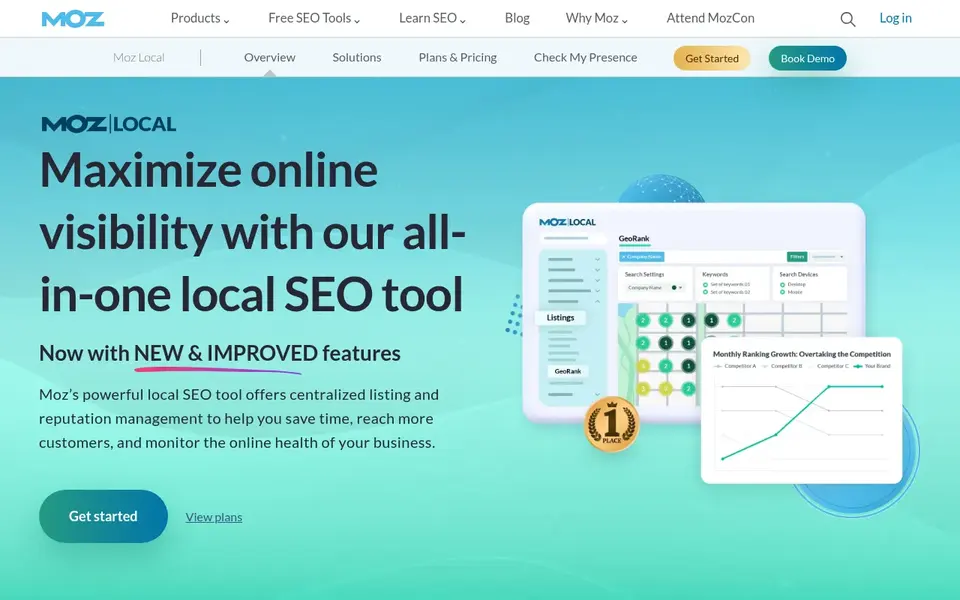
Moz Local focuses on making sure a business's name, address and phone number match across directories. For an eyewear store, that means the address on Google, Apple Maps, Bing and the data aggregators behind them all agree, which is the foundation any rank tracking sits on.
It fits opticians with several branches, especially where a store has moved or changed phone numbers and old listings are still floating around. You connect the Google Business Profile locations, review the listing data, and fix duplicates. Once that is clean, rank tracking from another tool becomes more trustworthy.
The limit is that Moz Local is not a deep rank tracker. If your main question is "where do I rank across the city", this is not the tool that answers it. It is the cleanup step before tracking.
- Listing distribution to major directories
- Duplicate listing detection
- Dashboard for multiple locations
- Rank tracking is secondary
- No free plan
Synup is a local marketing platform that brings listings, reviews and local visibility into one place. For an eyewear chain or a group of independent stores under one owner, it gives a single view of how each branch appears in local search without logging into each profile separately.
The practical use is comparing branches. If the city-centre store ranks well for "designer glasses" but the out-of-town store does not, the dashboard shows that side by side. You can then look at reviews, listing accuracy and local content for the weaker branch. It also helps when a new store opens and needs its profile and listings set up from scratch.
The limit is that a single-store optician will pay for features they never use. The setup also takes real time, so it suits a business with someone responsible for marketing rather than a owner doing it on a Sunday evening.
- Combines listings, reviews and local rank checks
- Location-level dashboards
- Handles many locations from one account
- Broad feature set can be more than a single shop needs
- Setup takes time
Broadly is a customer interaction and review management tool. For an eyewear store, the useful part is the review request: after a customer collects new glasses or finishes an eye exam, the store sends a message asking for feedback. That flow matters because map pack visibility responds to review volume and recency.
It fits shops that already collect phone numbers or emails at the till or booking step. Staff add the customer, the tool sends the request, and replies land in a shared inbox. Over a few months, the store builds a steadier stream of reviews instead of asking only when someone remembers.
The limit is that Broadly does not track rankings. It also depends on staff actually entering customer details, so it needs a simple routine at the counter. Shops that cannot collect contact details consistently should fix that first.
- Automated review request messages
- Inbox for customer replies
- Web chat and messaging in one place
- Not a rank tracker
- Review volume depends on staff collecting contact details
CallRail tracks phone calls and shows where they came from. For an eyewear store, that answers a question rank tracking cannot: when someone taps the call button on a Google Maps listing, does it turn into a booking for an eye test or a question about frames?
The setup is straightforward. You use a tracking number on the website and in campaigns, and the tool records the call source, duration and whether it was answered. For a shop that gets most enquiries by phone, that data tells you whether local visibility is producing real appointments.
The limit is that CallRail is not a rank tracker and should not replace one. It also needs care with tracking numbers on directory listings, because inconsistent numbers can confuse customers and listing platforms. Use it as a measurement layer, not a listing tool.
- Call tracking numbers for each channel
- Records which source generated a call
- Works alongside Google Business Profile
- Not a rank tracker
- Call tracking numbers need care on listings
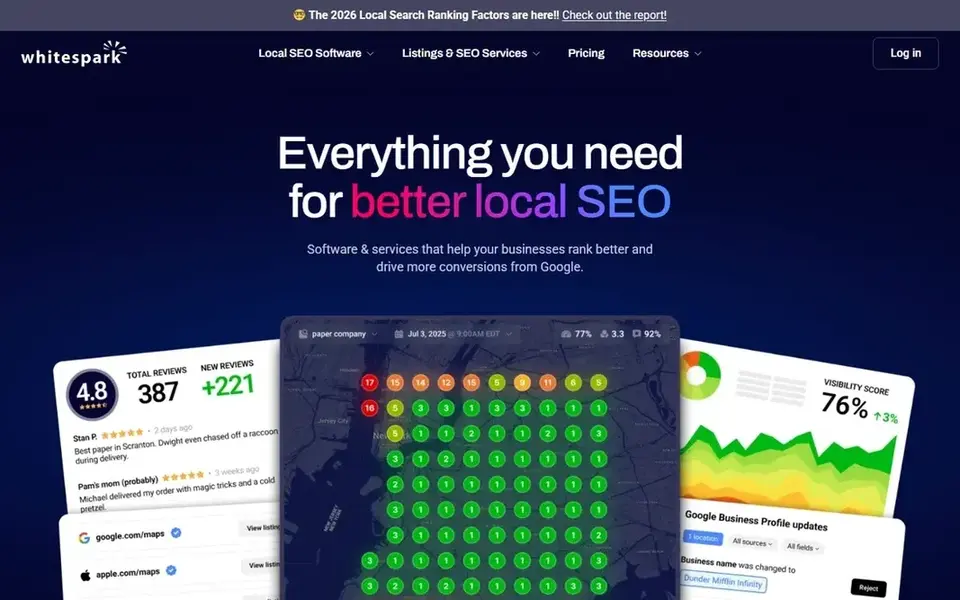
Whitespark is a local search toolset with citation building and local rank tracking. For an eyewear store, the citation side helps get the shop listed consistently on local directories, optician associations and city guides, which supports the trust signals behind map rankings.
The rank tracking side lets you check how the store appears for terms like "opticians near me" or "glasses shop" in the local area. The two features work together: clean citations support visibility, and rank checks show whether the work is moving anything.
The limit is that citation building is labour. Someone has to review the opportunities and submit them, and new directories appear over time. It suits a store with agency help or a marketing person, not a shop owner with no time to spare.
- Citation finding and submission workflows
- Local rank tracking reports
- Strong focus on local search
- Citation work is manual and ongoing
- Not a full marketing suite
Local Falcon scans Google Maps results across a grid around a location and turns them into a heatmap. For an eyewear store, that shows how far the shop's visibility reaches: strong near the high street, weaker a few miles out where a competitor's branch sits closer to the customer.
It is useful for a periodic check, for example after a new competitor opens nearby or after a review push. You run a scan, look at the map, and see whether the store's coverage changed. It is also easy to show to a manager who wants a picture rather than a table.
The limit is that it is a focused tool. It does not manage listings, reviews or content, so it works best alongside a broader platform or an agency doing the rest of the work. Shops wanting one dashboard for everything will find it narrow.
- Grid scans of Google Maps rankings
- Visual heatmaps for a location
- Useful for spot checks and reports
- Narrower than a full local SEO platform
- Scan frequency depends on plan
How I chose
I built this list from vendor documentation and public sources, not from hands-on testing. I read what each product says it does, checked which features are aimed at local businesses with physical locations, and looked at where each one stops. For an eyewear store, the questions are specific: does it track each branch separately, does it handle map pack visibility rather than only organic results, and does it fit a business whose main conversions are phone calls and booked eye tests.
I also weighed the limits honestly. Some tools are rank trackers first and everything else second; others are listing or review platforms that happen to include rank checks. Mixing those up is how shops end up paying for features they never open. Where a tool's pricing is not public, I say so rather than guess.
What to check before you buy
- Confirm the tool tracks Google Maps and local pack rankings, not just organic search results.
- Check that it supports the number of Google Business Profile locations you actually run, including any planned new stores.
- Ask whether it tracks keywords the way customers search, such as "opticians near me", "glasses shop" and "eye test".
- See whether reports can be exported or scheduled, so a manager or owner can read them without a login.
- Check how it handles listing data, because rank tracking on top of inconsistent addresses wastes money.
- Confirm review features follow Google's guidelines: no review gating, no incentives, no fake reviews.
Frequently asked questions
Do I need a rank tracker if I only have one eyewear store?
Not always, but it helps. A single store still competes in a local pack, and a grid tracker shows whether visibility reaches the neighbourhoods where customers live. If your budget is tight, start with a clean Google Business Profile and steady review requests, then add tracking once you have something to measure.
Can rank tracking show why my store is not in the map pack?
It shows where you appear and where you do not, but not the cause. Use it alongside your Google Business Profile: check categories, opening hours, photos and review recency. A tracker tells you the pattern; the profile and reviews usually explain it.
How often should an eyewear store check local rankings?
Monthly is enough for most shops. Rankings move slowly unless something changes, such as a new competitor, a relocation or a review push. After a change, check more often for a few weeks, then return to a monthly routine.
Do review tools help local rankings?
Reviews are one of the signals behind map pack visibility, and a steady flow of recent reviews supports it. Tools like Broadly make asking easier, but the reviews must be genuine and follow Google's rules. Never offer incentives or filter out unhappy customers.
Can I use these tools for several branches?
Yes, but check location limits before you buy. Synup and Moz Local are built for multiple locations, and Local Dominator tracks each location separately. Confirm the plan covers every branch, including any store you plan to open later.
Sources
See where you really rank - block by block
ProMapRanker scans Google Maps across a grid of your service area. Simple monthly plans from $19, white-label on every plan.
Start freeBrowse all guides
← Best Local Rank Tracking Tools for Event Planners in 2026Best Local Rank Tracking Tools for Home Inspectors in 2026 →
 best local rank tracking tools for courier services
Best Local Rank Tracking Tools for Courier Services in 2026
A guide to the best local rank tracking tools for courier services in 2026, covering grid tracking, review signals and map ranking checks for delivery areas.
Read → best local rank tracking tools for countertop installers
Best Local Rank Tracking Tools for Countertop Installers in 2026
A guide to local rank tracking tools for countertop installers, comparing grid tracking, listings and review features from vendor documentation.
Read → best local rank tracking tools for boat dealers
Best Local Rank Tracking Tools for Boat Dealers in 2026
A boat dealer's guide to local rank tracking tools in 2026. I compare grid scanners, review trackers and call tracking from vendor docs and public sources.
Read → google business profile photos
Google Business Profile Photos: How Many, Which Types, and How Often
A practical guide to GBP photos: which types to upload, ideal counts, and how a fresh photo cadence helps rankings.
Read → how to show up on google maps
How to Show Up on Google Maps: A Beginner's Guide for Local Businesses
New to Google Maps? Learn how to get your business listed, verified, and visible to nearby customers searching for you.
Read → fix my local seo
Fix My Local SEO: A Complete Guide
Everything you need to know about fix my local seo: what it is, why it matters for local SEO, and exactly how to act on it.
Read →More in Local SEO & Google Maps · All guides A to Z by date · Latest guides