 ProMapRanker
WooCommerce Alternatives in 2026

Key takeaways
- Shopify is our top pick for most stores leaving WordPress, thanks to hosted infrastructure, a huge app store, and simple scaling.
- BigCommerce suits larger catalogs and B2B sellers that want more built-in features, while Wix and Squarespace suit small, design-led shops.
- PrestaShop and OpenCart are the best free, self-hosted options for teams with developer help, since the software itself costs nothing.
- Ecwid and Shift4Shop suit sellers that want to add a store to an existing site or keep platform costs low, with different trade-offs on payments.
Quick comparison
| Pick | Great for | Pricing starts at | Free tier | |
|---|---|---|---|---|
 Shopify | Most stores, hosted and scalable | $29 per month | Free trial | Visit |
 BigCommerce | Larger catalogs and B2B | $29 per month | Free trial | Visit |
 Wix | Small design-led stores | $29 per month | Yes | Visit |
 Squarespace | Design-first brands | $19 per month | Free trial | Visit |
 Adobe Commerce | Enterprise complexity | See website | No | Visit |
 PrestaShop | Free open source selling | Free | Yes | Visit |
 OpenCart | Free self-hosted shops | Free | Yes | Visit |
 Ecwid | Adding a store to an existing site | $5 per month | Yes | Visit |
 Shift4Shop | Low-cost hosted selling | Free | Yes | Visit |
The best WooCommerce alternatives
This list covers alternatives only, for store owners who want to move away from a WordPress-based shop or who never want to start on WordPress at all. We compared these platforms on hosting, ease of setup, catalog size, payments, app ecosystems, and published pricing. Open source options have no platform subscription, but hosting, themes, and extensions still cost money, so factor those in.

Shopify is our pick for most stores moving off WordPress, because it removes hosting, security patching, and scaling worries in one subscription. The Basic plan is $29 per month when billed annually, or $39 month to month, and it includes hosting, a checkout, payment processing through Shopify Payments, and access to thousands of apps. A store can start small and grow to high volume without migrating platforms.
The trade-offs are cost and control. You pay every month, selling or not, and using an outside payment provider adds a transaction fee on top of processing. You also work within Shopify's structure rather than owning every line of code. For most small and mid-size stores, that trade is worth it for the time saved on maintenance.
- Hosted infrastructure and security handled for you
- Huge app ecosystem
- Strong checkout and payments
- Monthly fee plus possible transaction fees with outside providers
- Less code control than open source
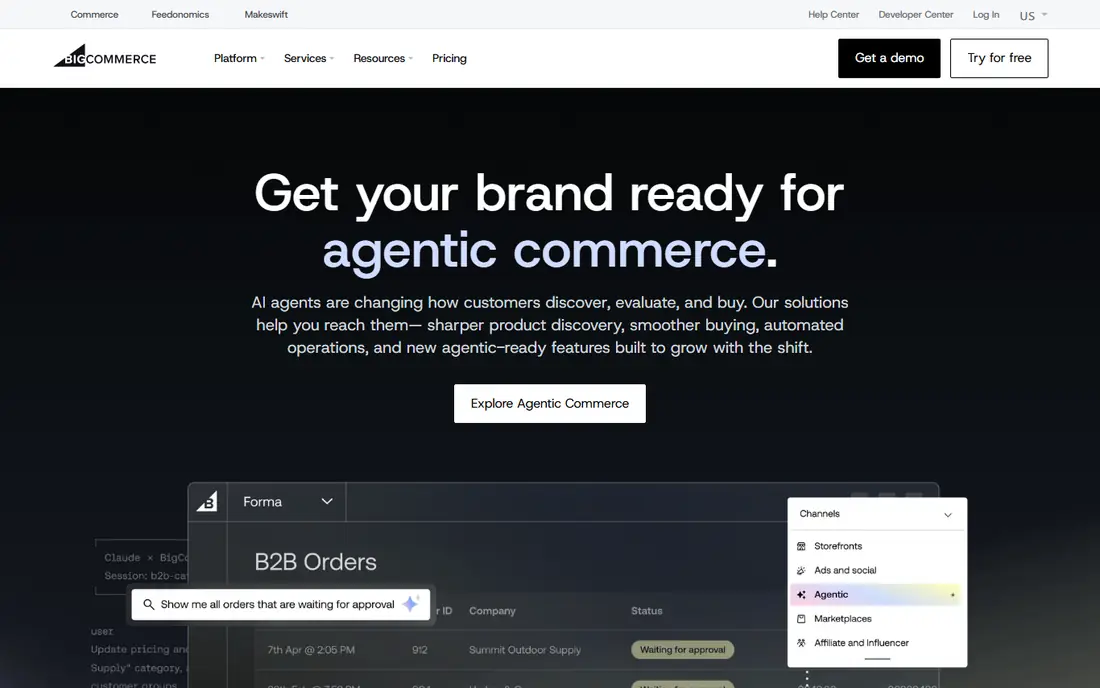
BigCommerce suits stores with large catalogs, complex product options, or B2B customers that need price lists and customer groups. Its entry plan is $29 per month when billed annually, and it charges no extra transaction fee regardless of payment provider, which helps stores with tight margins. Many features that need a paid app on other platforms, such as advanced product filtering and multi-channel selling, are built in here.
The downside is ecosystem size. The app store is smaller than Shopify's, so a niche integration may need custom work. The admin area also feels more businesslike and takes a little longer to learn. If you sell many products or sell to other businesses, BigCommerce is the stronger hosted pick.
- More features built in without apps
- No extra transaction fees
- Strong B2B and multi-channel tools
- App ecosystem is smaller than Shopify
- Interface takes longer to learn

Wix is a good choice for a small shop that wants a website and a store in one builder without touching code. The Core commerce plan is $29 per month when billed annually, and the drag-and-drop editor lets owners design pages, add products, and take payments quickly. A free site builder plan exists for testing, though selling needs a paid commerce plan.
The limits show at scale. Very large catalogs, complex B2B needs, and heavy custom development fit other platforms better, and moving a Wix site elsewhere is not as clean as exporting from an open source platform. For a side business or a small brand with under a few hundred products, Wix is fast and friendly.
- Drag-and-drop builder
- Site and store in one place
- Easy for non-technical owners
- Less suited to very large catalogs
- Moving away later can be awkward
Squarespace suits brands where the look of the site matters as much as the products. Its templates are polished out of the box, and the platform handles pages, blogging, and commerce in one place, which suits creators, artists, and small brands. The Basic commerce plan is $19 per month when billed annually, with a 14-day free trial to test it.
The catch is the entry plan's 2% transaction fee on online store sales, which disappears on higher plans, so growing stores should price that in. The app ecosystem is also smaller than Shopify's, so unusual integrations may be harder. If design leads your buying decision and your catalog is modest, Squarespace is a strong, calm choice.
- Excellent templates
- Content and commerce in one platform
- Simple setup
- Transaction fee on the entry plan
- Smaller app ecosystem than Shopify
Adobe Commerce, formerly Magento, is the enterprise option for companies with complex catalogs, multiple storefronts, and heavy B2B requirements. It offers deep control over code, hosting, and integrations, and a mature agency ecosystem can build almost anything on it. Large companies with dedicated developers use it precisely because it does not force them into a template.
The cost and effort are serious. Pricing is custom-quoted, implementations can run into six figures, and a small team will struggle to maintain it. This is not a pick for a first store or a solo founder. It belongs on the list for larger businesses that have outgrown hosted platforms and need full control.
- Deep customization
- Multi-store and B2B strength
- Mature agency ecosystem
- Custom-quoted pricing
- Needs a dedicated development team
PrestaShop is a solid open source choice for teams that want to own their store without a monthly platform fee. The software itself is free, it handles multiple languages and currencies well, and its module marketplace covers payments, shipping, and marketing add-ons. For a European-focused shop or a team with developer support, it offers a lot of control for little license cost.
The real cost sits elsewhere. Hosting, a good theme, paid modules, and developer time add up, and you own security updates and backups. A non-technical owner who wants a hands-off store should pick a hosted platform instead. A team with technical help that wants control without a subscription will find PrestaShop a fair trade.
- Software is free to download
- Strong European features and languages
- Large module marketplace
- Hosting, themes, and modules cost extra
- Needs technical help to run well
OpenCart is another free, self-hosted option, and it suits smaller shops that want a lightweight system without a monthly fee. The core software is free, it runs well on modest hosting, and its extension marketplace covers payments, shipping, and themes. For a straightforward catalog with standard checkout needs, OpenCart gets a store running with little fuss.
The limits are polish and community size. Out-of-the-box design feels dated next to hosted builders, and some features need paid extensions. Support comes mainly from community forums and documentation, so a team without technical help may struggle. If you have basic technical skills and want a free, simple store, OpenCart is worth testing.
- Software is free
- Lightweight and fast
- Large extension marketplace
- Smaller community than some rivals
- Design and features need extensions
Ecwid takes a different path: instead of rebuilding your site, it drops a store into the site you already have, or onto social pages. The Starter plan is $5 per month when billed annually, and a limited free plan covers a tiny catalog. That makes Ecwid ideal for a blogger, creator, or business with an existing site that only needs to sell a few products.
The trade-off is scope. Ecwid is not a full website builder, so if you need a brand-new site from scratch, Shopify or Wix will serve you better. Larger catalogs also need higher Ecwid plans. Choose Ecwid when the site already exists and the store is the add-on, not the whole project.
- Embeds into an existing website or social page
- Free plan for tiny catalogs
- Simple setup
- Not a full website builder
- Higher plans needed for larger catalogs
Shift4Shop stands out on price. Its end-to-end plan is free when you use Shift4 as your payment processor, with unlimited products and full features, and paid plans start at $29 per month if you prefer another processor. That makes it one of the cheapest hosted options for a US store that is happy to process through Shift4.
The catch is the payment tie-in on the free plan, and an admin interface that feels older than Shopify's. If you are comfortable with Shift4 processing and want a full hosted store at minimal platform cost, Shift4Shop is a genuine bargain. If you need a specific outside processor and a modern admin, compare the paid plans carefully.
- Free end-to-end plan with Shift4 payments
- Unlimited products
- No extra transaction fees on paid plans
- Free plan ties you to Shift4 processing
- Interface feels older than Shopify
How we picked these
We compared official pricing pages, platform documentation, and recent ecommerce comparisons, focusing on hosting model, entry price, catalog limits, and payment terms. We kept only platforms that are actively maintained and that can run a real store without WordPress, and we excluded the product this article is an alternative to, as the brief requires. Prices are US list prices and change often, so confirm the current plan before migrating.
Moving off WordPress without losing sales
Migration is where stores lose money, so plan it like a project, not an afternoon task. Export products, customers, orders, and content, map old URLs to new ones with redirects, and test checkout, taxes, and shipping on the new platform before switching your domain. Keep the old site readable until you confirm orders and customer logins work on the new one.
Match the platform to your team, not just your catalog
A hosted platform suits a team with no developers, while an open source platform suits a team that already manages servers and code. Count the hours your team can spend on updates, backups, and security, not just the monthly fee. A free platform that needs ten hours a month of developer time is not free.
Check payments, taxes, and shipping before you commit
Confirm that your payment provider, tax rules, and shipping carriers work on the new platform, and test a real order end to end. Check if the platform charges its own transaction fee on top of processing, and if your country and currency are fully supported. These details cause more migration pain than design choices.
Budget for apps and themes, not just the plan
The entry plan is rarely the total cost. Themes, apps, payment fees, and email tools add up, and a platform with a cheap plan but costly essential apps can end up pricier than a rival. List the features you actually need, price them on each platform, and compare the yearly total before you choose.
Frequently asked questions
What are the best WooCommerce alternatives for WordPress users?
Shopify is the best hosted alternative for most WordPress users, since it removes hosting and maintenance work. BigCommerce suits larger catalogs, Wix and Squarespace suit small design-led shops, and PrestaShop and OpenCart suit teams that want free open source software with developer help. The right pick depends on your catalog size and technical team.
What is the best WooCommerce alternative for a small business?
For most small businesses, Shopify or Wix offers the fastest path to a working store, with hosting and checkout included. Ecwid is a strong pick if you already have a website and only need to add selling. Pick the platform your team can run without outside help, since a store you cannot update will cost more than a slightly higher plan.
Are there free WooCommerce alternatives?
Yes. PrestaShop and OpenCart are free to download as open source software, though hosting and extensions still cost money. Ecwid has a limited free plan, and Shift4Shop has a free plan when you process through Shift4. A free platform fee does not mean a free store, so budget for hosting, themes, and payment fees.
Can I migrate my store from WordPress to Shopify or BigCommerce?
Yes, both platforms offer migration tools and apps that import products, customers, and orders, and agencies can handle larger moves. Plan redirects for old product URLs, test checkout and taxes thoroughly, and keep the old site available until the new store is proven. Back up everything before you start.
Do WooCommerce alternatives work without WordPress?
Yes, every platform on this list runs without WordPress. Hosted platforms like Shopify, BigCommerce, Wix, and Squarespace include hosting, while open source options like PrestaShop and OpenCart run on your own hosting. You do not need a WordPress site at all to use them.
Sources
See where you really rank - block by block
ProMapRanker scans Google Maps across a grid of your service area. Simple monthly plans from $19, white-label on every plan.
Start freeKeep reading
 which software is best for pdf page removal
Which Software Is Best for PDF Page Removal in 2026
Find which software is best for pdf page removal, from free online tools to desktop editors, with page controls, privacy, safety, and pricing compared.
Read → when i work alternatives
Best When I Work Alternatives in 2026
Looking for when i work alternatives? We compare 8 scheduling apps for hourly teams, covering pricing, free plans, time clocks and the best fit for business.
Read → the best tool for keyword analysis
The Best Tool for Keyword Analysis in 2026
Find the best tool for keyword analysis with our 2026 comparison of 10 keyword analysis software tools on data depth, difficulty scores and price today.
Read →