 ProMapRanker
Web Scraping Companies With Best Reviews in 2026


Large scale proxy and dataset work · Pricing starts at: See website
Key takeaways
- Bright Data and Oxylabs suit large teams that need scale, proxy depth, and managed unblocking, while Apify suits teams that want ready-made scrapers.
- ScrapingBee and ScraperAPI offer simpler API pricing for developers who want to send a URL and receive structured results without managing proxies.
- Octoparse and ParseHub are the clearer picks for people who prefer a visual builder over writing code.
- Zyte fits engineering teams that want automatic ban handling and a long track record in open source scraping tools.
- Every tool here should be used only for lawful collection that respects site terms, robots guidance where applicable, and applicable privacy law.
Quick comparison
| Pick | Great for | Pricing starts at | Free tier | |
|---|---|---|---|---|
| Bright Data | Large scale proxy and dataset work | See website | Yes | Visit |
 Oxylabs | Enterprise proxy and scraping APIs | See website | Free trial | Visit |
 Apify | Ready-made scrapers from a marketplace | $49 per month | Yes | Visit |
 ScrapingBee | Simple API with JavaScript rendering | $49 per month | Free trial | Visit |
 ScraperAPI | Simple API with proxy rotation | $49 per month | Free trial | Visit |
 Zyte | Managed API with ban handling | See website | Free trial | Visit |
 Octoparse | Visual no-code scraping | See website | Yes | Visit |
 ParseHub | Visual scraping for desktop users | See website | Yes | Visit |
 Decodo | Proxy-led scraping for smaller teams | See website | Free trial | Visit |
The best web scraping companies
These companies cover different ways of working, from fully managed APIs to visual builders. We compared official pricing pages, product documentation, and public review patterns, and we focused on tools that remain actively sold and supported in October 2026.
Bright Data is the pick for teams that collect data at high volume and need many locations, proxy types, and ready-made datasets. Its Web Scraper API and proxy products are built for companies that run collection as an ongoing operation, not a one-off task. Support for residential, datacenter, mobile, and ISP proxies gives buyers flexibility when a target site is hard to reach.
The trade-off is complexity. Pricing depends on the product, the proxy type, and the volume, so a small team should start with a narrow use case and check the current price page before committing. We would not pick it first for a single small scrape, but for sustained, large work it is one of the most complete options here.
- Very large proxy network
- Ready-made datasets and scrapers
- Strong enterprise controls
- Pricing can be complex
- Smaller projects may find it costly
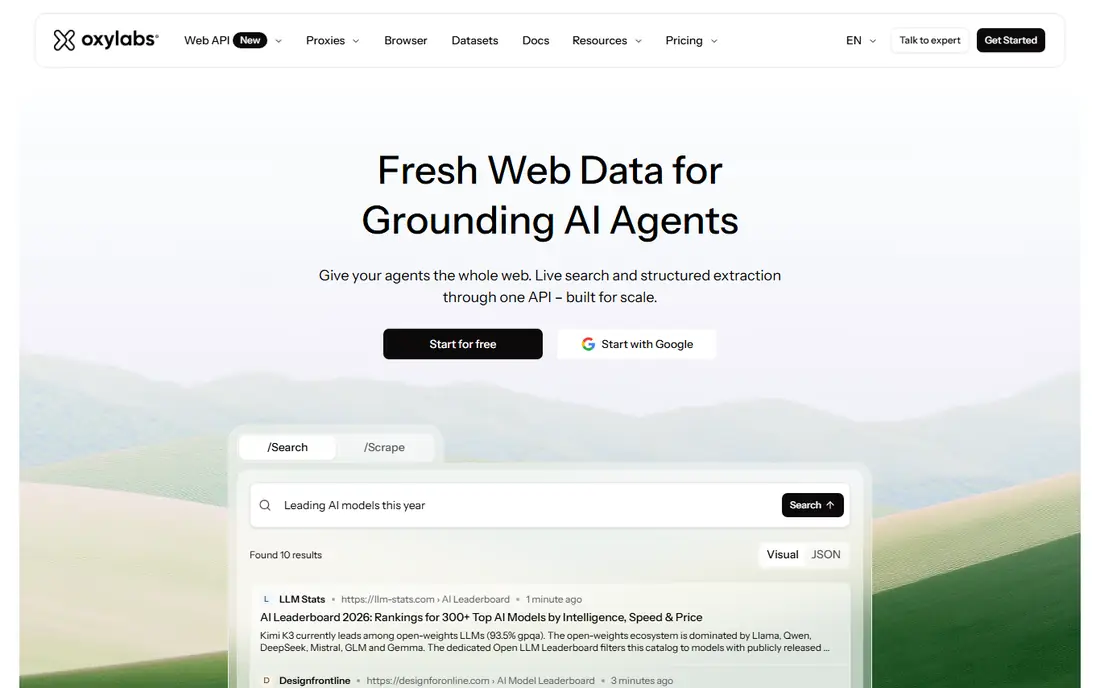
Oxylabs pairs a large proxy network with a Web Scraper API that returns structured data, which helps teams that want results without parsing raw HTML themselves. Its documentation puts weight on ethical collection, consent, and compliance, a useful signal for companies that must show how data was gathered. The platform also suits teams that need country and city targeting.
Costs rise quickly at enterprise volume, and buyers should ask for a trial or quote tied to their actual target sites. For mid-size and larger teams that need reliability and clear governance, Oxylabs is a strong alternative to Bright Data, with a slightly more API-first feel.
- Large residential proxy pool
- Web Scraper API for structured results
- Compliance focused documentation
- Enterprise pricing
- Less friendly for very small budgets
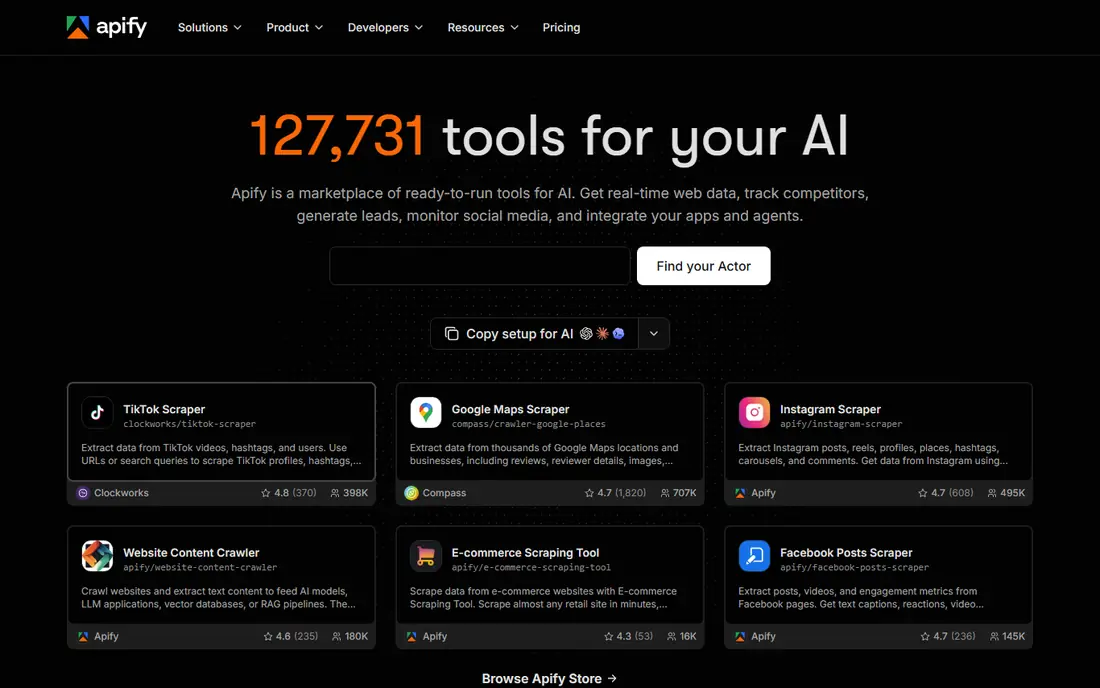
Apify works differently from a single scraping API. Its store lists thousands of ready-made tools called Actors, each built for a specific site or task, and you can run them on a schedule through the console or API. That model saves time when someone has already built a scraper for your target, and the free plan lets you test small runs before paying.
The catch is that total cost depends on the Actor you choose and how much compute it uses, so two projects can cost very different amounts. Teams that build custom Actors get more control, but they need developer time. For buyers who want a head start rather than a blank API, Apify is a practical choice.
- Large marketplace of ready-made Actors
- Free plan with monthly credit
- Scheduling and API access
- Costs vary by Actor
- Learning curve for custom Actors
ScrapingBee is aimed at developers who want a simple request in and clean HTML or extracted data out. It handles JavaScript rendering, proxies, and headless browsing behind one endpoint, which removes much of the setup work that makes scraping fragile. Screenshots and extraction options help teams that need proof of what a page showed.
Pricing is credit based, and features such as rendering use extra credits, so heavy use needs careful budgeting. For a team that wants predictable API work without managing a proxy pool, ScrapingBee is one of the easiest options to start with and test.
- Straightforward API credits
- JavaScript rendering
- Screenshot support
- Credit costs rise with rendering and premium proxies
- Trial is limited
ScraperAPI takes a similar approach to ScrapingBee, with one endpoint that rotates proxies, renders JavaScript when asked, and retries failed requests. That simplicity is its main appeal for developers who already have parsing code and just need reliable fetching. The credit model is easy to explain to a finance team, even if exact costs still depend on features used.
It is less of a full data platform than Apify or Bright Data, and teams that want ready-made datasets may need to look elsewhere. For straightforward fetching at moderate volume, however, it remains a solid, well reviewed choice.
- Single endpoint for proxies and rendering
- Automatic retries
- Clear credit model
- Structured extraction is more limited than some rivals
- Higher tiers needed at scale
Zyte, formerly Scrapinghub, has a long history in web scraping, and its API is built around handling blocks automatically so developers spend less time fixing broken runs. Pricing by successful response and by site difficulty can make simple sites cheap and hard sites more costly, which is fair but requires checking your targets first. The free trial credit helps with that check.
Engineering teams will like the depth of documentation and the link to Scrapy, the open source framework Zyte supports. Smaller buyers may prefer a fixed monthly plan elsewhere, but for teams that run scrapers in production, Zyte offers a mature and well supported route.
- Automatic ban and anti-bot handling
- Made by the team behind Scrapy
- Pay per successful response options
- Pricing varies by site difficulty
- Enterprise sales process for larger deals
Octoparse lets people build scrapers by clicking elements on a page rather than writing code, which makes it a good fit for analysts, marketers, and small business owners. Templates cover common tasks such as product listings and directories, and paid plans add cloud runs and scheduling so jobs can repeat without a computer left on. The free tier is useful for learning the tool.
Visual builders have limits on sites with heavy bot protection or complex logins, and results may need cleaning after export. For teams without developers, though, Octoparse gives a faster path to structured data than starting from code.
- Point-and-click workflow builder
- Cloud scheduling on paid plans
- Templates for common sites
- Advanced sites may still need workarounds
- Desktop app focus for free use
ParseHub is another visual tool, aimed at users who want to select data on a page and export it to a spreadsheet or API. It handles JavaScript-heavy pages better than a simple fetcher, and the free tier covers small projects with a limited number of pages. That makes it a low risk way to test whether visual scraping fits your workflow.
Paid plans are needed for larger jobs, scheduled cloud runs, and priority support. Teams that need polished collaboration features may prefer Octoparse or Apify, but ParseHub remains a dependable choice for solo users and small teams.
- Visual selection of data
- Handles JavaScript pages
- Free tier for small projects
- Cloud runs and higher limits sit on paid plans
- Interface feels dated next to newer tools
Decodo, formerly Smartproxy, combines proxies with scraping APIs in one dashboard, which suits teams that want to manage both without juggling vendors. Its residential proxy pool covers many locations, and the scraping APIs handle rendering and retries for common use cases. Pricing is usage based, so buyers should compare proxy types before choosing.
It does not match the largest vendors on ready-made datasets, and very large enterprise buyers may want deeper account support. For small and mid-size teams that need a capable proxy-led setup at a manageable starting point, Decodo is worth a trial.
- Residential and datacenter proxies
- Scraping APIs
- Straightforward dashboard
- Smaller dataset library than Bright Data
- Pricing varies by proxy type
How we picked these
We compared official pricing pages, product documentation, and public review coverage for tools that are actively sold in October 2026. We kept only companies with a working official homepage, a clear scraping product, and a fit for lawful business use such as price monitoring, market research, and public data collection. We excluded tools that were discontinued, that lacked a clear product page, or that promoted collection in ways that ignored site terms.
What to check before you buy
Lawful use comes first
Only collect data you have a right to collect, respect site terms and robots guidance where it applies, and avoid personal data unless you have a lawful basis and a clear purpose. Check whether a target site offers an official API first, since that route is often more stable and more clearly permitted.
Match the tool to your skill level
Developers tend to do best with APIs such as ScrapingBee, ScraperAPI, or Zyte, while non-developers should start with Octoparse, ParseHub, or a ready-made Apify Actor. Buying a developer API for a team without developers usually leads to unused credits and stalled projects.
Test on your real target sites
Scraping success varies sharply by site, so run a trial on your actual targets before paying for a year. Watch success rates, data quality, and total credits used, and ask the vendor how it handles blocks, retries, and changes to page structure.
Frequently asked questions
What are the best web scraping companies?
The best choice depends on your team. Bright Data and Oxylabs lead for large scale work, Apify leads for ready-made scrapers, and ScrapingBee and ScraperAPI lead for simple API fetching. Visual users should look at Octoparse and ParseHub first.
Is web scraping legal?
It can be lawful when done carefully, but it is not lawful in every case. Respect site terms, applicable privacy and computer access law, and any contract that governs the data. Avoid personal data, login-protected content, and copyrighted material unless you have clear permission, and seek legal advice for sensitive projects.
Do I need proxies for web scraping?
Not always, but proxies help when you collect at volume, need different locations, or face rate limits. Managed APIs bundle proxies for you, while proxy-led vendors such as Bright Data, Oxylabs, and Decodo let you manage proxy choice directly.
What is the cheapest way to start?
Apify, Octoparse, and ParseHub offer free tiers for small projects, and several APIs offer trials. Start free, measure credits used on your real targets, and only then choose a paid plan that matches that usage.
How do I pick between an API and a visual builder?
Pick an API if you have developers and want to feed data into your own systems. Pick a visual builder if you want spreadsheets or simple exports without code. Apify sits between the two, with ready-made tools plus code options.
Sources
See where you really rank - block by block
ProMapRanker scans Google Maps across a grid of your service area. Simple monthly plans from $19, white-label on every plan.
Start freeKeep reading
 wpforms alternatives
Best WPForms Alternatives in 2026
We compare 9 wpforms alternatives for WordPress forms, with free and paid options, current pricing notes, and honest limits for small business sites in 2026.
Read → windows task scheduler alternatives
Best Windows Task Scheduler Alternatives in 2026
Looking for Windows Task Scheduler alternatives? We compare 9 schedulers for Windows and cross-platform work, from free tools to enterprise automation.
Read → which ai video service is best
Which AI Video Service Is Best in 2026
which ai video service is best? We compare 10 legitimate AI video services on price, avatars, editing and output quality to help you pick the right tool.
Read →