 ProMapRanker
Wayback Machine Alternatives in 2026

Key takeaways
- No single tool replaces a broad historical archive, so most researchers need two tools: one for new snapshots and one for old captures.
- Archive.today is the fastest way to save a single page now, while Perma.cc is the best choice for a stable citation in academic or legal work.
- Common Crawl suits bulk research and data analysis, not quick browsing of one old page.
- ArchiveBox and Webrecorder suit people who want their own archive, with files they can keep and replay offline.
- Always record the original URL, the archive URL, and the capture date, because a snapshot without a date is hard to cite.
Quick comparison
| Pick | Great for | Pricing starts at | Free tier | |
|---|---|---|---|---|
 Archive.today | Quick single-page snapshots | Free | Yes | Visit |
 Perma.cc | Stable academic citations | Free | Yes | Visit |
 Common Crawl | Bulk web data research | Free | Yes | Visit |
 ArchiveBox | Self-hosted personal archives | Free | Yes | Visit |
 Webrecorder | High-fidelity interactive captures | Free | Yes | Visit |
 Memento Time Travel | Searching many archives at once | Free | Yes | Visit |
 Library of Congress Web Archive | Curated historical collections | Free | Yes | Visit |
 Pagefreezer | Business compliance archiving | See website | No | Visit |
The best wayback machine alternatives
We compared tools that save, find, or replay old web pages, using official product pages and public documentation. We list alternatives only, not the named product itself, and we focus on what each tool does best in 2026.
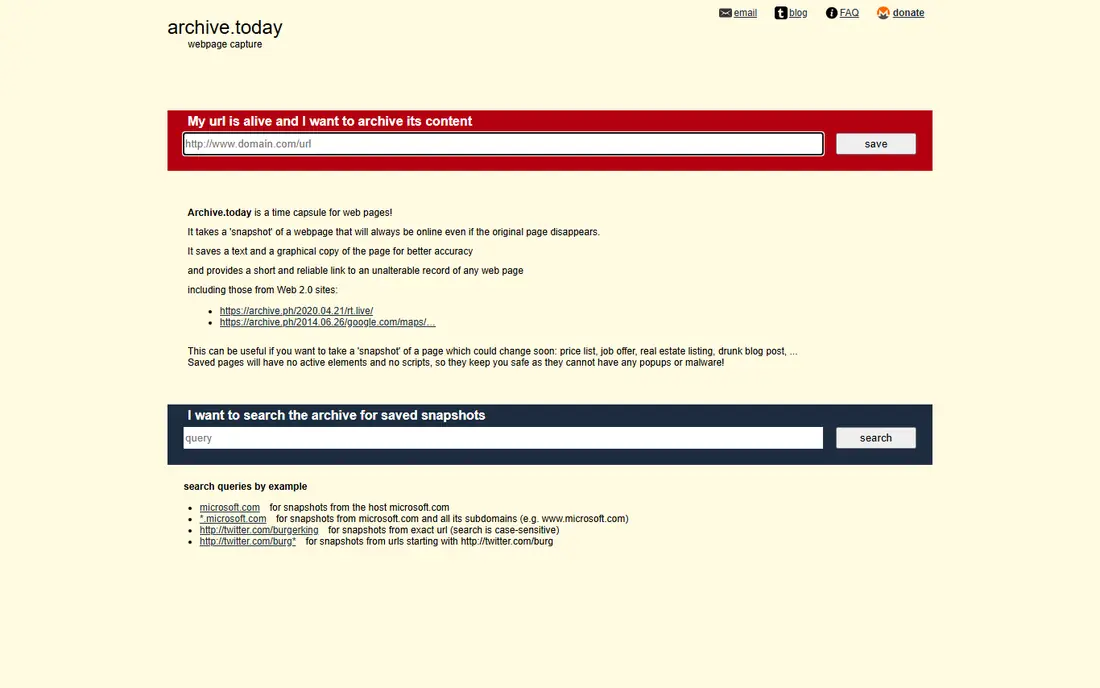
Archive.today, also known under mirrors such as archive.ph, is the fastest alternative when you need to save one page right now. Paste a URL, create a snapshot, and share the resulting link. That speed makes it useful for journalists, researchers, and anyone who wants proof of a page before it changes or disappears. It does not crawl the web on its own in the same way as a large archive, so it works best for pages you choose yourself.
The catch is trust and scope. Archive.today is a private service, not a library archive, so it does not offer the same institutional backing as Perma.cc or the Library of Congress. It also focuses on single pages, not a full history of a site. Use it for quick evidence, save your own copy as well, and check the snapshot carefully before you cite it.
- Fast snapshot creation
- No account needed for basic use
- Permanent links to saved pages
- Operator details are less clear than library archives
- Heavy pages can capture imperfectly
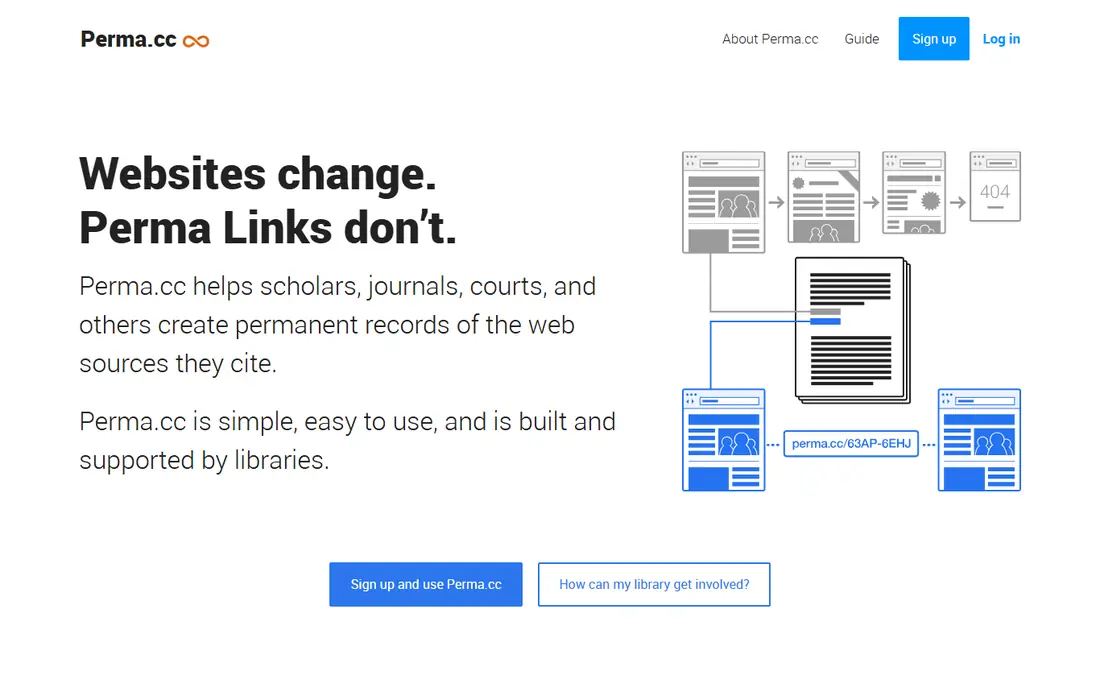
Perma.cc is built by the Harvard Library Innovation Lab and run with a consortium of libraries, and it is designed for one job: making a web link that still works when the original page changes. Scholars, lawyers, and journalists use it to preserve a cited page, so a reader can open the same version years later. That library backing is a major advantage over a private snapshot service when a citation must last.
The limit is access model. Perma.cc is free for users affiliated with participating libraries, while other users can buy links on a pay-as-you-go basis, with recent listings showing $30 for 100 links. That model suits citation work, not bulk archiving of whole sites. If you need a link that a reader can trust in a paper or a filing, Perma.cc is our first pick.
- Permanent links built for citations
- Library-backed preservation
- Simple snapshot creation
- Free use is tied to library partners for full access
- Paid links apply to other users
Common Crawl is a nonprofit that publishes large, open datasets of crawled web pages. Researchers use it to study the web at scale, build search indexes, and analyze language, links, and site structure across billions of pages. The data is free, which makes it a powerful resource for universities, startups, and independent researchers who cannot run their own web crawl.
The catch is usability. Common Crawl is a dataset, not a website where you type a URL and see an old page in a browser. You need to query crawl indexes, download data, and process it with code or analysis tools. If you want to view one old page quickly, use Archive.today or Memento first. If you want to study thousands of pages, Common Crawl is the right tool.
- Huge open crawl datasets
- Free to access
- Useful for research, search, and AI training data
- Needs technical skill to query
- Not a simple page browser
ArchiveBox is open-source software that lets you build your own web archive. You give it URLs, and it saves pages, PDFs, screenshots, and media in standard formats you can keep on your own machine or server. That control appeals to researchers, journalists, and archivists who do not want to depend on a third-party service for important evidence.
The limit is setup. ArchiveBox is not a website you visit to look up an old page; you must install it, run it, and maintain storage and backups. It also only archives pages you add, so it cannot show you a page from ten years ago unless you saved it then. For a personal or team archive of pages you care about now, it is a strong, free choice.
- Open-source self-hosting
- Saves pages in standard formats
- You control your own archive
- Needs setup and server care
- Not a public historical archive
Webrecorder is a set of tools for capturing interactive web pages with high fidelity, including pages that rely on JavaScript, video, or user interaction. Instead of a simple crawl, Webrecorder records your browsing session, so the resulting archive replays more like the original page. That makes it useful for social media pages, interactive exhibits, and dynamic sites that a simple snapshot misses.
The trade-off is effort. You must open and interact with each page to capture it, which takes longer than pasting a URL into a snapshot tool. Hosted options also have storage limits, though you can download WARC files and replay them locally with free viewer tools. For a page that must replay correctly, Webrecorder is worth the extra time.
- Captures interactive pages well
- Exports standard WARC files
- Free tools for local replay
- You must browse the page to capture it
- Hosted storage has limits on free plans
Memento Time Travel is an aggregator that searches many web archives at once and finds the capture closest to a date you choose. That is useful when one archive lacks a page, because another archive may hold it. It works through the Memento protocol, which many archives support, and it can save time compared with checking each archive by hand.
The limit is that Memento does not create snapshots itself. It only finds what archives already hold, so a page that no archive captured will still be missing. It also cannot fix a broken replay in the source archive. Use Memento as a first search step, then open the best capture it finds and check the date and content before you cite it.
- Searches many archives from one place
- Finds the closest capture to a date
- Free to use
- Results depend on what each archive holds
- Not a snapshot creator itself
The Library of Congress Web Archive holds curated collections of websites on topics such as government, elections, culture, and major events. Because a national library selects and preserves these collections, they carry authority for historical research that a private snapshot service cannot match. Access is free, and collections are organized by theme, which helps researchers find related sites.
The catch is coverage. The Library of Congress does not archive the whole web, and it does not offer on-demand snapshots of any page you choose. If your page falls inside a collected theme, it is an excellent source. If it does not, you will need Archive.today, Perma.cc, or another tool in this list for that specific page.
- Curated, authoritative collections
- Free public access
- Long-term preservation mission
- Coverage is selective, not the whole web
- Search is collection based
Pagefreezer is a paid archiving service for businesses, government agencies, and legal teams that need automated, defensible records of websites and social media. It captures pages on a schedule, stores them in a central dashboard, and offers features for compliance, litigation, and audit. That automation suits organizations that must prove what a page said on a given date, without relying on staff to save pages by hand.
The drawback is cost and scope. Pagefreezer is priced as a business service, so we list it as See website, and it is more than a personal researcher needs for a few snapshots. It also focuses on the sites you configure, not on browsing the historical web. For a company with compliance duties, that automated, auditable capture is the point.
- Automated website and social media archiving
- Compliance and legal features
- Centralized dashboard
- Paid business pricing
- More than most personal users need
How we picked these
We compared official product pages and public documentation for tools that are active in 2026 and that save, find, or replay web pages. We kept tools that cover different needs: quick snapshots, stable citations, bulk data, self-hosting, interactive capture, multi-archive search, curated collections, and business compliance. We excluded tools that only list old pages without offering a working archive or capture function.
How to choose the right archive tool
Start with your goal. If you need to save a page today, use Archive.today or Webrecorder. If you need a citation that lasts, use Perma.cc. If you need to find an old page, search Memento first, then check curated archives. If you need bulk data, learn Common Crawl. For a business record, use Pagefreezer or a similar paid service with audit features.
Save more than a link. Download a copy, note the capture date, and record the original URL alongside the archive URL. Archives can change policies, lose captures, or restrict access, so your own copy is the safest backup. Also respect privacy and copyright: do not archive private pages, login-protected content, or personal data without a lawful reason and proper care.
Frequently asked questions
What are alternatives to the wayback machine for saving a page now?
Archive.today, Perma.cc, Webrecorder, and ArchiveBox all save pages you choose, with different strengths. Archive.today is fastest for a single page, Perma.cc is best for citations, Webrecorder handles interactive pages best, and ArchiveBox gives you your own archive files. Choose based on whether you need speed, citation stability, fidelity, or control.
What are alternatives to the wayback machine for old pages?
Memento Time Travel searches many archives at once, which helps when one archive lacks a capture. The Library of Congress Web Archive covers curated historical collections, and Common Crawl covers bulk historical data for research. No tool holds every old page, so check more than one source and note the capture date you find.
Is archive.today free?
Yes, basic snapshot creation and viewing on Archive.today are free, with no account needed for basic use. That makes it useful for a quick snapshot, though it lacks the library backing of Perma.cc. For a citation that must last for years, Perma.cc is the safer choice even though its free access model is more limited.
Can I archive my own website with these tools?
Yes. ArchiveBox and Webrecorder let you build your own archive, while Pagefreezer automates archiving for businesses. Your own backups and server logs are also important, because they are the most complete record of your own site. An external archive is a useful second copy, not a replacement for your own backups.
Which tool is best for academic citations?
Perma.cc is the best pick for academic citations, because it is library-backed and built to create permanent links for cited sources. The Library of Congress Web Archive is also strong for curated historical sources. In both cases, include the archive URL and the capture date in your citation, so a reader can verify the exact version you used.
Sources
See where you really rank - block by block
ProMapRanker scans Google Maps across a grid of your service area. Simple monthly plans from $19, white-label on every plan.
Start freeKeep reading
 supabase alternatives
Supabase Alternatives in 2026
Compare the best Supabase alternatives for auth, databases, storage, and realtime, with pricing, hosting, and data models to help you choose well in 2026.
Read → square alternatives
Square Alternatives in 2026
We compared square alternatives for shops, restaurants, and mobile sellers, from Shopify POS and Clover to Helcim, Stripe, and low-cost card readers in 2026.
Read → best wealth management apps
Best Wealth Management Apps in 2026
Compare the best wealth management apps in 2026, platforms and services, with fees, minimums, advisor access and planning tools explained for US investors.
Read →