 ProMapRanker
Top Software for Cyber Threat Intelligence in 2026


Broad intelligence coverage · Pricing starts at: See website
Key takeaways
- Most enterprise threat intelligence tools are sold by quote, so the real comparison is data coverage, workflow fit, and integration depth, not a headline price.
- Recorded Future and Google Threat Intelligence suit teams that want broad analyst-written context alongside machine-readable indicators.
- Flashpoint and Intel 471 stand out for closed-source and criminal underground coverage, which matters most for fraud, brand abuse, and targeted attack work.
- Smaller teams should start with a focused feed or a platform that can grow, rather than buying a full enterprise suite on day one.
- Every tool here is framed for lawful defence, incident response, and authorised testing only, with human review before any action is taken.
Quick comparison
| Pick | Great for | Pricing starts at | Free tier | |
|---|---|---|---|---|
| Recorded Future | Broad intelligence coverage | See website | No | Visit |
 Google Threat Intelligence | Incident-led APT context | See website | No | Visit |
 CrowdStrike Falcon Intelligence | Falcon-centred teams | See website | No | Visit |
 Flashpoint | Deep and dark web coverage | See website | Free trial | Visit |
 Anomali ThreatStream | Feed consolidation and sharing | See website | No | Visit |
 ThreatConnect | Operationalising intelligence | See website | No | Visit |
 EclecticIQ Platform | Analyst workbench and STIX workflows | See website | No | Visit |
 Intel 471 | Adversary and malware intelligence | See website | No | Visit |
The best cyber threat intelligence software
We compared official product pages, pricing pages, and public documentation for tools that help defence teams understand who is attacking them, how, and what to do next. Our pick for most teams with a mature security programme is Recorded Future, because its coverage is broad and its analyst reporting is easy to hand to both technical staff and managers.
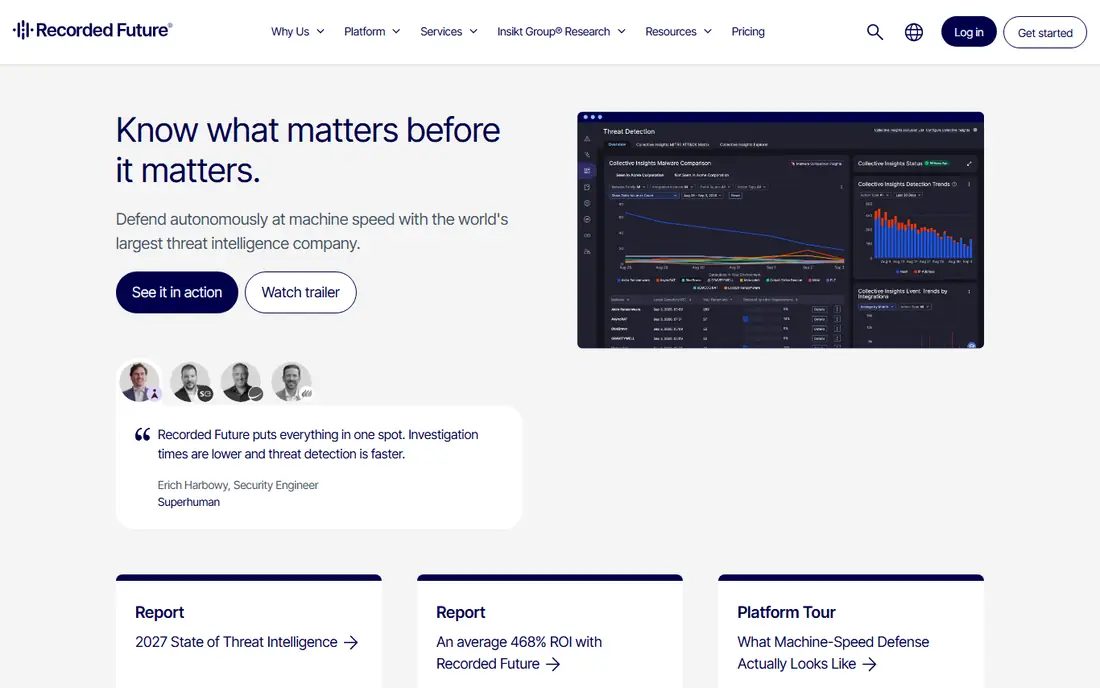
Recorded Future collects intelligence across open, deep, and dark web sources and ties it together in an intelligence graph, so an indicator, a vulnerability, or a threat actor can be viewed with the evidence behind it. For a defence team, that context matters more than a raw list of bad addresses, because it helps analysts decide what to block first and what can wait. Its solutions cover cyber operations, digital risk protection, third-party risk, and payment fraud, which lets one platform serve several teams inside the same company.
The trade-off is cost and scope. Pricing is not published as a simple monthly rate, and smaller teams may find that a single module still stretches the budget. Teams that buy it should start with the use case that hurts most, such as vulnerability triage or brand monitoring, and add modules only after the first workflow is working well in daily practice.
- Very broad collection
- Analyst-written reporting
- Strong integrations with SIEM and security tools
- Pricing is quote-based and can be high for small teams
- The range of modules takes time to learn
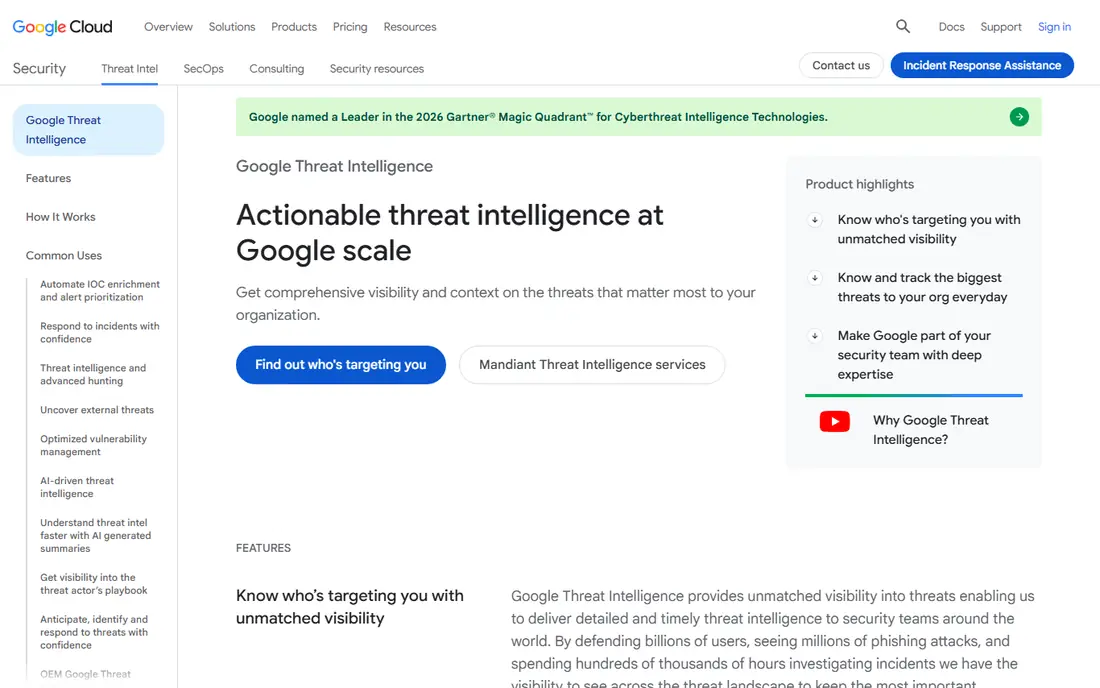
Google Threat Intelligence brings together Mandiant incident-response research, VirusTotal data, and Google telemetry, which gives it unusual depth on advanced persistent threat groups and the campaigns they run. If your team needs to explain to leadership why a particular actor matters, or to check whether a file, domain, or campaign has been seen in real investigations, this is a strong place to start. The reporting is polished and well sourced, which helps when a decision needs a written record.
The catch is that this depth comes at an enterprise price and with an enterprise sales process. It is not a casual tool for a one-person security team, and buyers should confirm which tier includes the feeds, the browser overlay, and the analyst reports they actually plan to use, since those pieces can sit in different packages.
- Deep incident-response research
- VirusTotal telemetry
- Strong actor and malware reporting
- Pricing is licensed by organisation size and quoted
- Less focused on brand and leak monitoring
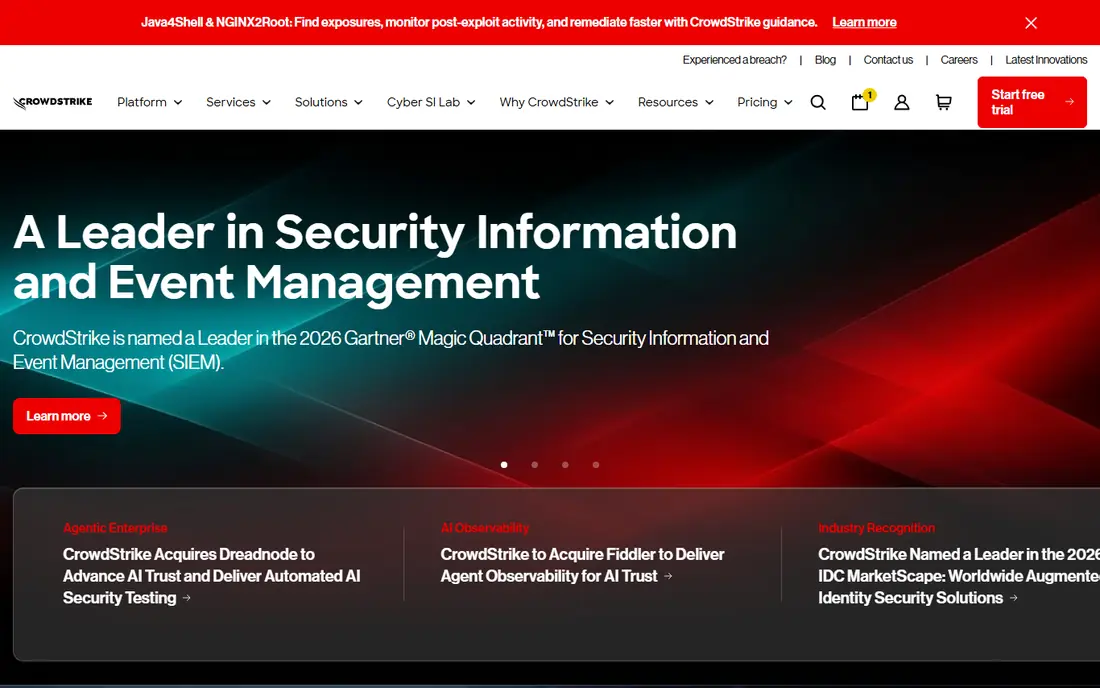
CrowdStrike Falcon Intelligence is the natural choice for teams already running Falcon endpoint protection, because intelligence about adversary tradecraft arrives already linked to what is happening on their own devices. That link shortens the step from reading about an attack technique to checking whether it has touched your environment. Its adversary profiles and malware analysis are also useful for threat hunting, since they give hunters a clear picture of how a group normally operates.
Outside the Falcon ecosystem, the case is weaker. Teams that do not run Falcon will need to weigh whether the intelligence alone justifies the cost, and they should ask for a clear quote that separates the intelligence module from endpoint licensing. For Falcon shops, though, the integration alone often settles the decision.
- Intelligence tied to endpoint telemetry
- Strong adversary profiles
- Fast malware analysis
- Much of the value depends on running Falcon
- Standalone pricing is module-based
Flashpoint is known for reaching places automated collection alone cannot reach, including closed forums, encrypted messaging channels, and illicit marketplaces, with human analysts checking what matters. For teams worried about stolen credentials, brand impersonation, fraud, or early warning of an attack being planned, that access can surface risk before it becomes an incident. Its Ignite platform, API access, and request-for-information hours give analysts a way to ask follow-up questions rather than just reading a feed.
The honest limit is scope. Flashpoint is not a replacement for endpoint or network detection, and teams should plan to pair it with their existing security tools. Pricing is packaged by use case, so buyers should compare the Cyber Threat Intelligence package with the vulnerability and physical security packages before signing, and confirm how many analyst hours are included.
- Strong closed-community coverage
- Analyst-validated reporting
- Credential and vulnerability intelligence
- Pricing is quote-based
- Less tied to internal endpoint telemetry
Anomali ThreatStream takes in intelligence from hundreds of open, commercial, and community sources, enriches it, and pushes the combined indicators to a SIEM or SOAR platform where a security team can act on them. That consolidation role is valuable for teams drowning in separate feeds, because one normalised stream is easier to tune, filter, and trust than a dozen overlapping ones. Its trusted circles also make it practical to share intelligence with industry peers and sharing groups.
The downside is that ThreatStream is a platform for working with intelligence, not a primary collector in the same way as some rivals, so teams still need good sources feeding into it. Pricing is quote-based, and buyers should test how well its enrichment, MITRE ATT&CK mapping, and browser Lens tool fit their analysts' daily habits during a trial or pilot.
- Aggregates many open and commercial feeds
- Sharing through trusted circles
- SIEM and SOAR delivery
- Pricing is not published
- Some workflow customisation can feel clumsy
ThreatConnect, now part of Dataminr, is built for teams that want intelligence to trigger action, not just sit in a report. Analysts can build no-code playbooks that enrich an indicator, open a ticket, or run response steps in other tools, which cuts down on repetitive manual work during an incident. It normalises data from hundreds of sources and scores indicators using anonymised data from other customers, which helps separate widely seen threats from one-off noise.
The platform rewards teams that invest in learning it, and that learning curve is real. New users may find the interface dense, and some marketplace integrations carry their own licence costs, so a pilot should include a real workflow, such as triaging a phishing campaign, rather than a guided demo alone. For mid-size and larger security operations teams, the automation payoff is the main reason to choose it.
- Playbook automation
- Broad source normalisation
- Collective analytics scoring
- Interface can be hard to learn
- Some marketplace apps need extra licences
EclecticIQ Platform is an analyst-centred threat intelligence platform that pulls intelligence from open sources, commercial suppliers, and industry partnerships into one collaborative workbench. Analysts can link indicators, actors, campaigns, and techniques using STIX, the standard format for sharing threat intelligence, which makes it a good fit for teams that already exchange intelligence with partners or government sharing groups. It can run hosted, hybrid, or on-premise, which matters for regulated organisations with strict data rules.
That strength is also its limit. EclecticIQ works best for teams that already have an intelligence process and know what they want to produce, such as finished reports or shared packages. Teams without a dedicated analyst may find it more platform than they need, and they should ask for a scoped pilot tied to one output, such as a weekly threat briefing, before committing.
- Analyst-centred workbench
- Strong STIX support
- Flexible deployment options
- Pricing is quote-based
- Best suited to teams with established intelligence processes
Intel 471 focuses on adversary and malware intelligence gathered from closed sources where threat actors collaborate and plan attacks. Its TITAN platform and malware tracking give fraud, security, and intelligence teams a close view of criminal infrastructure, compromised credentials, and malware families, which is hard to get from open feeds alone. For organisations that track specific actors or need to understand how a criminal service operates, that depth is the point of the product.
It is a specialised tool, and its pricing reflects that. Smaller teams without a clear investigative need may get more value from a broader platform, while teams that do have that need should confirm which intelligence components, such as human, malware, vulnerability, credential, and marketplace coverage, are included in their package, since those are sold as separate pieces.
- Deep criminal underground access
- Malware tracking
- Strong actor and credential coverage
- Quote-based pricing
- Specialised focus suits teams with an investigative mandate
How we picked these
We compared official vendor product pages, pricing pages, and public documentation, and we favoured tools that are still sold and supported in October 2026, that clearly fit cyber threat intelligence, and that serve different team sizes and use cases. We checked whether pricing was published or quote-based, whether a free plan or trial was offered, and how each tool delivers intelligence into the systems a defence team already uses, such as a SIEM, SOAR platform, or endpoint tool. We did not claim hands-on testing, and we avoided tools that only repackage public feeds without adding analysis, workflow, or collection of their own.
What to check before you buy
Start with the question your team must answer every week. A team chasing ransomware should prioritise vulnerability and malware coverage, while a team worried about fraud should prioritise credential leaks, brand abuse, and underground chatter. Write that question down, then ask each vendor to show how its product answers it with your own data, not a canned demo.
Next, check delivery and tuning. Intelligence that cannot reach your SIEM, firewall, or endpoint tool in a usable format will sit unread, so confirm feed formats, API access, update frequency, and how easy it is to suppress false positives. Ask how much analyst time is needed to keep the platform useful, and whether finished reports, alerting, and analyst support are included or sold separately.
Finally, agree on the rules for use. These tools are for lawful defence, incident response, and authorised testing only. Set clear approval steps before any indicator is blocked, any account is actioned, or any external party is contacted, and keep a human in the loop for decisions that affect customers or staff. A short pilot with a fixed success measure, such as faster triage on a set of real alerts, will tell you more than a feature checklist ever will.
Frequently asked questions
What is cyber threat intelligence software?
It is software that collects, analyses, and delivers information about threats, attackers, and vulnerabilities so a defence team can prevent, detect, and respond to attacks. It can include indicators such as malicious domains and file hashes, context about threat actors and their methods, and finished reports that explain what a threat means for a specific organisation.
How much does cyber threat intelligence software cost?
Most enterprise tools in this list are sold by quote, and prices vary widely by data coverage, user count, and included services. Smaller teams should expect a sales conversation even for a single module, while larger teams should budget for implementation, feed tuning, and ongoing analyst support on top of the subscription itself.
Which cyber threat intelligence platform is best for a small team?
A small team should start narrow, with one clear use case such as credential monitoring or vulnerability triage, and a tool that offers a trial or a focused package. A broad enterprise suite can wait until the team has the staff to tune feeds, review alerts, and act on finished reports every week.
What is the difference between a threat feed and a threat intelligence platform?
A feed delivers indicators, while a platform collects, enriches, links, and shares those indicators, and turns them into workflows, reports, and actions. Teams that only need blocking lists may manage with a feed, while teams that produce analysis for others usually need a platform.
Can threat intelligence tools be used for offensive work?
No, in the context of this guide they are for lawful defence, incident response, and authorised testing only. Any testing against systems you do not own or do not have written permission to test is out of scope, and teams should follow their organisation's legal and approval policies before acting on intelligence.
Sources
See where you really rank - block by block
ProMapRanker scans Google Maps across a grid of your service area. Simple monthly plans from $19, white-label on every plan.
Start freeKeep reading
 wpforms alternatives
Best WPForms Alternatives in 2026
We compare 9 wpforms alternatives for WordPress forms, with free and paid options, current pricing notes, and honest limits for small business sites in 2026.
Read → windows task scheduler alternatives
Best Windows Task Scheduler Alternatives in 2026
Looking for Windows Task Scheduler alternatives? We compare 9 schedulers for Windows and cross-platform work, from free tools to enterprise automation.
Read → which ai video service is best
Which AI Video Service Is Best in 2026
which ai video service is best? We compare 10 legitimate AI video services on price, avatars, editing and output quality to help you pick the right tool.
Read →