 ProMapRanker
Top Software Companies in 2026

Cloud, office productivity, and enterprise software · Pricing starts at: See website
Key takeaways
- Microsoft, Alphabet, and Apple remain the largest software and platform companies by market value in October 2026, with NVIDIA close behind on AI hardware and software.
- Enterprise buyers will meet Oracle, Salesforce, SAP, and Adobe most often, since those firms run databases, customer systems, business planning, and creative work.
- These are companies, not subscription products, so starting price is listed as See website, and the right pick depends on your stack, not on size alone.
- Market value changes daily, so treat rankings as a snapshot for October 2026 rather than a permanent order.
Quick comparison
| Pick | Great for | Pricing starts at | Free tier | |
|---|---|---|---|---|
| Microsoft | Cloud, office productivity, and enterprise software | See website | Yes | Visit |
 Alphabet | Search, cloud, and AI software platforms | See website | Yes | Visit |
 Apple | Devices, operating systems, and consumer services | See website | No | Visit |
 NVIDIA | AI computing, graphics, and developer platforms | See website | Yes | Visit |
 Oracle | Databases, enterprise cloud, and business applications | See website | No | Visit |
 Salesforce | Customer relationship and sales software | See website | No | Visit |
 Adobe | Creative, document, and marketing software | See website | No | Visit |
 SAP | Enterprise resource planning for large companies | See website | No | Visit |
The best top software companies
This list ranks companies by their importance to software buyers in 2026, not just by market value. The first group builds the platforms most people use daily, while the second group builds the systems that run large businesses, and each entry notes what the company is actually best known for in software.
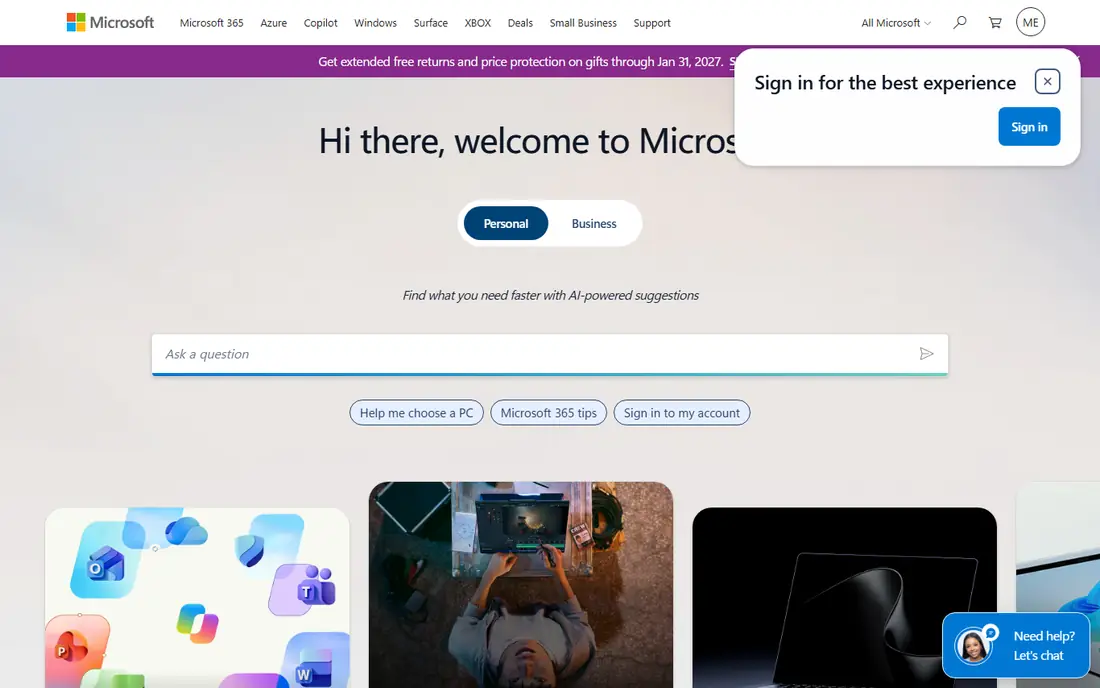
Microsoft is the most complete enterprise software company on this list. Azure powers cloud workloads, Microsoft 365 runs email, documents, and collaboration for millions of organizations, Windows remains the standard business desktop, and developer tools such as GitHub and Visual Studio Code support software teams. For a business that wants one vendor for cloud, productivity, security, and development, Microsoft is the default shortlist.
The catch is complexity. Microsoft licensing spans many plans, bundles, and business tiers, and it is easy to overbuy. Small firms should start with the smallest plan that covers their real needs and add features only when a team actually uses them. Even with that caveat, no other company matches Microsoft breadth across business software.
- Broadest enterprise software stack, from Azure to Microsoft 365
- Strong AI integration across office and developer tools
- Widely used in business and education
- Licensing can be complex across plans
- Smaller firms may pay for features they never use
Alphabet, the parent company of Google, is best understood as a software platform company with two faces. For consumers, it runs Search, YouTube, Gmail, Maps, Chrome, and Android. For businesses, Google Cloud, Workspace, and AI tools such as Gemini compete directly with Microsoft and Amazon in cloud and productivity. That dual reach gives Alphabet unusual influence over how people find information and how companies build AI products.
The honest catch is trust and fit. Some businesses and public sector buyers weigh Google data practices more heavily than Microsoft or Apple alternatives, and Google enterprise support can feel less tailored than a traditional enterprise vendor. For most consumers and many cloud buyers, though, Alphabet software is unavoidable and often the best free or low-cost starting point.
- Google Search, Gmail, Drive, and Android reach billions of users
- Google Cloud is a major enterprise cloud
- Strong AI research and products
- Consumer privacy concerns affect some buyers
- Enterprise sales support is less established than Microsoft in some sectors
Apple belongs on a top software companies list because its operating systems and services shape how software is built and sold. iOS, macOS, and related services such as the App Store, iCloud, and Apple Music set standards for mobile apps, privacy controls, and subscriptions. Developers who want to reach iPhone users must work within Apple rules, which gives Apple outsized influence beyond its own apps.
The limit for business buyers is scope. Apple does not compete with Microsoft, Oracle, or SAP as a general enterprise software vendor, and its hardware prices put it out of reach for some buyers. For consumers and creative professionals who value integration and privacy, Apple is a top pick. For enterprise back-office software, look further down this list.
- Tight integration across iPhone, Mac, iPad, and services
- Strong privacy positioning
- Large app and developer ecosystem
- Hardware costs are high
- Business software choice is narrower than Microsoft or Google
NVIDIA rose to the top of global market value rankings in 2026 because AI computing runs largely on its chips and software. Its CUDA platform, libraries, and data center systems let developers train and run AI models at scale, and cloud providers, research labs, and enterprises all build on that stack. In software terms, NVIDIA is less a consumer app company and more the platform layer that makes modern AI possible.
The risk is concentration. NVIDIA fortunes rise and fall with AI infrastructure spending, and buyers who only need a finished AI app will never buy NVIDIA software directly. For developers, researchers, and cloud builders, however, NVIDIA is now one of the most important software companies in the world, even if most users never see its name on screen.
- Leading AI chips and CUDA software platform
- Essential for AI training and data centers
- Strong developer tools and libraries
- Business is heavily tied to AI hardware cycles
- Consumer graphics prices can be high
Oracle is the enterprise workhorse that many large companies rely on without thinking about it daily. Its databases store critical business data, its cloud platform hosts enterprise workloads, and its applications run finance, human resources, supply chain, and customer operations for large organizations. If you work in a big company, there is a good chance an Oracle system sits behind at least one core process.
The downside is cost and complexity. Oracle licensing is famously hard to compare, and large implementations usually need consultants and careful planning. Small businesses will rarely choose Oracle first, and should look at simpler cloud tools. For large enterprises that need proven database and application scale, Oracle remains a top-tier vendor.
- Deep database and enterprise application expertise
- Oracle Cloud is a major enterprise option
- Strong in finance, HR, and supply chain systems
- Pricing and licensing are complex
- Implementation often needs specialist partners
Salesforce is the standard most sales and service teams are measured against. Its CRM tracks leads, customers, deals, and support cases in one system, with marketing, service, and analytics products built around that customer record. The AppExchange marketplace adds thousands of integrations and extensions, which helps companies adapt Salesforce to their own sales process.
The catch is total cost. Per-user pricing, add-on products, and customization can push the annual bill well above the headline plan price, and small teams may find simpler CRMs easier to run. We list pricing as See website because Salesforce plans and editions vary and change often. For a growing sales organization that needs a shared customer system, Salesforce is still the safest enterprise choice.
- Leading CRM platform with a large app marketplace
- Strong sales, service, and marketing tools
- Extensive partner ecosystem
- Costs rise with users and add-ons
- Customization can require administrators or consultants
Adobe dominates creative and document software in a way few companies match. Photoshop, Illustrator, Premiere Pro, and After Effects define professional design and video work, while Acrobat defines how businesses create, sign, and share PDFs. For design, marketing, and publishing teams, Adobe tools are often a job requirement rather than a preference.
The trade-off is subscription pricing. Adobe moved to subscriptions years ago, and users who want a single app or a one-time purchase will be disappointed. Creative Cloud bundles can also be costly for occasional users, though single-app plans and the free Acrobat Reader help. For professional creative work, Adobe remains the top software company in its field.
- Industry standard creative tools including Photoshop and Premiere Pro
- Acrobat is the document standard
- Strong for design and marketing teams
- Subscription-only pricing frustrates some users
- Costs add up across Creative Cloud apps
SAP is the company behind the business systems that run many of the largest manufacturers, retailers, and public sector organizations. Its ERP software ties finance, procurement, inventory, production, and sales together, so a global company can manage operations in one system rather than many disconnected tools. That breadth is why SAP appears in almost every top enterprise software list.
The honest catch is scale. SAP projects are major undertakings, with long timelines, consultant costs, and change management, and they make little sense for a small business. Mid-size firms should test whether a lighter ERP or a set of best-of-breed tools fits better. For large, complex organizations, SAP is one of the few vendors that can handle the full scope.
- Leading ERP for finance, supply chain, and manufacturing
- Deep industry solutions
- Strong global enterprise presence
- Implementations are large, slow, and costly
- Overkill for small and mid-size firms without complex operations
How we picked these
We compared market value rankings for October 2026, enterprise software market position, and relevance to ordinary software buyers, rather than ranking by revenue alone. That is why the list mixes consumer platform companies such as Microsoft, Alphabet, and Apple with enterprise specialists such as Oracle, Salesforce, and SAP. We avoided invented revenue, employee, or market value figures in product blocks, since those numbers change daily, and we focused on what each company actually sells and who should consider it.
How to use this list as a buyer
Do not pick a company because it ranks first, since the largest company is not always the best vendor for your job. A small business that needs customer tracking should compare Salesforce with simpler CRMs, a design team should compare Adobe with lower-cost creative tools, and a company choosing a cloud should compare Microsoft, Google, and Amazon on the specific services it will use. Size signals stability and ecosystem, not fit.
Check three things before committing to an enterprise vendor. First, total cost including users, add-ons, and implementation, not just the headline plan. Second, whether your team already uses that vendor stack, since integration saves more time than a slightly better single feature. Third, exit options, including data export and contract length, since switching enterprise software is costly. A short pilot with a real team and real data will reveal more than any ranking.
Frequently asked questions
What are the top software companies in the world?
By market value in October 2026, NVIDIA, Alphabet, Apple, and Microsoft lead global rankings, followed by other large technology firms. By enterprise software use, Microsoft, Oracle, Salesforce, SAP, and Adobe are among the most important vendors. The right ranking depends on whether you measure market value, revenue, or relevance to a specific buyer.
What are the top 5 software companies?
A common top five by market value in 2026 includes NVIDIA, Alphabet, Apple, Microsoft, and Meta, though order changes with share prices. A top five for business software buyers looks different, with Microsoft, Oracle, Salesforce, SAP, and Adobe featuring more prominently. Use the list that matches your question, not a single universal ranking.
What are the top US software companies?
Microsoft, Alphabet, Apple, NVIDIA, Oracle, Salesforce, and Adobe are all US-based and rank among the top software companies globally. SAP is the major non-US exception on this list, headquartered in Germany. US dominance in software reflects the size of its cloud, platform, and enterprise markets.
What are the top enterprise software companies?
Microsoft, Oracle, Salesforce, and SAP are the leading enterprise software companies, with Adobe strong in creative and document workflows. These firms sell the systems that run finance, sales, supply chain, and employee operations at scale. Smaller firms often prefer lighter tools from other vendors before moving to an enterprise platform.
Which software company is best for small businesses?
For small businesses, Microsoft and Google offer the most useful low-cost starting stacks, with office, email, cloud storage, and collaboration in one bundle. Adobe suits creative small firms, while Salesforce suits growing sales teams. Enterprise vendors such as Oracle and SAP are usually too large and costly for a small firm.
Is NVIDIA a software company?
NVIDIA is primarily known for chips, but it is also a major software company through its CUDA platform, AI libraries, and developer tools. Those software tools are a key reason developers build AI products on NVIDIA hardware. For most consumers, NVIDIA software is invisible, but for AI developers it is central.
Sources
See where you really rank - block by block
ProMapRanker scans Google Maps across a grid of your service area. Simple monthly plans from $19, white-label on every plan.
Start freeKeep reading
 zoom alternatives
Best Zoom Alternatives in 2026
Compare Zoom alternatives in 2026, with free meeting limits and prices, so you can pick the best alternative to Zoom for your team, class, or community.
Read → which software is best for remote work
Which Software Is Best for Remote Work in 2026
Answering which software is best for remote work, we compare Slack, Zoom, Asana, Notion, Teams and more, with pricing and honest tradeoffs in 2026 now.
Read → which ai tool is best for content writing
Which AI Tool Is Best for Content Writing in 2026
Wondering which ai tool is best for content writing? We compare ChatGPT, Claude, Jasper, Grammarly, and more on price, quality, and best use in 2026 now.
Read →