 ProMapRanker
Top 10 EHS Software in 2026


Mid-size teams that want EHS live without a long project · Pricing starts at: See website
Key takeaways
- VelocityEHS suits mid-size teams that want a usable platform without a long enterprise project, while Cority and Intelex suit larger, more complex programs.
- EHS Insight publishes a starting price from $5,000 per year, which makes it one of the few mid-market suites with a public entry point.
- SafetyCulture and other frontline tools can start free or at a low per-user price, which suits small teams that mainly need inspections and incident reports.
- Software alone does not make an organisation compliant with safety regulations. Procedures, trained people, and timely reporting still matter, and the software mainly keeps records and follow-up in one place.
Quick comparison
| Pick | Great for | Pricing starts at | Free tier | |
|---|---|---|---|---|
| VelocityEHS | Mid-size teams that want EHS live without a long project | See website | No | Visit |
 Cority | Large enterprises needing full EHSQ coverage | See website | No | Visit |
 Intelex | Enterprises that need EHSQ configured to exact processes | See website | No | Visit |
 Benchmark Gensuite | Multi-site compliance and risk programs | See website | No | Visit |
 EcoOnline | Chemical safety within a broader EHS platform | See website | No | Visit |
 EHS Insight | Mid-market teams that want a published starting price | $5,000 per year | No | Visit |
 SafetyCulture | Frontline inspections, checklists, and incident reports | See website | Yes | Visit |
 Evotix | Safety management with a frontline focus | See website | No | Visit |
 Sphera | Global EHS and product stewardship programs | See website | No | Visit |
 Dakota Software | Regulatory obligation tracking and compliance calendars | See website | No | Visit |
The best EHS software
EHS software covers environment, health, and safety work such as incident reports, audits, inspections, training records, and chemical inventories. The tools below range from free frontline apps to enterprise suites priced by quote.
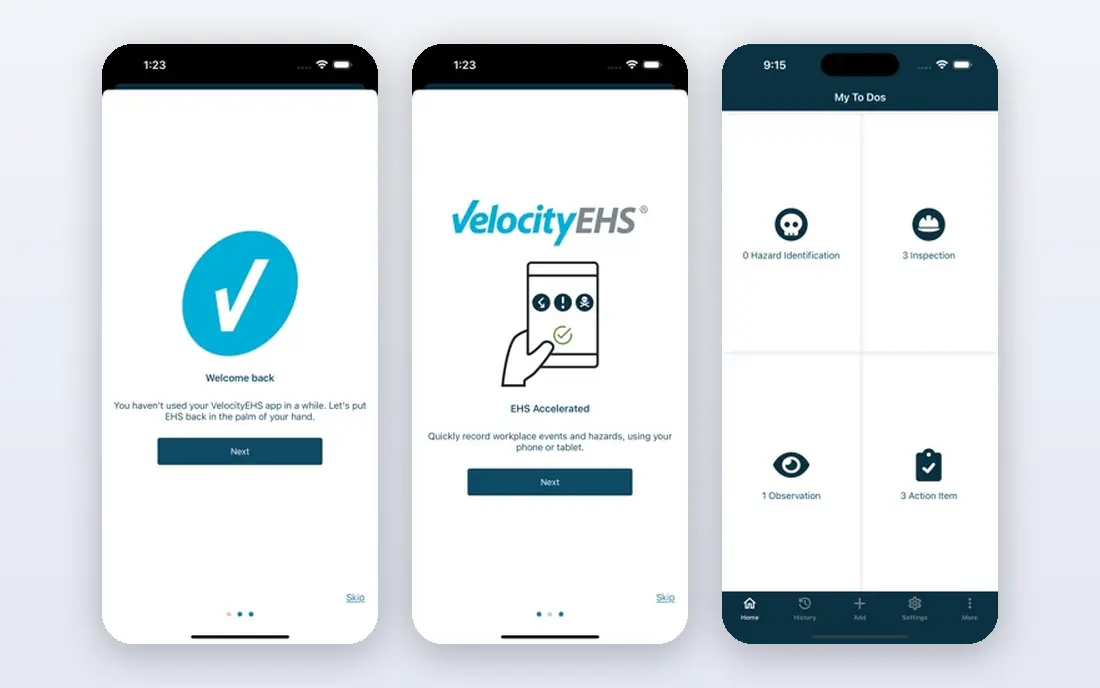
VelocityEHS grew from chemical management into a full EHS platform, and that history still shows in its chemical inventory, safety data sheet library, and labeling tools. Around that core, it covers incidents, audits, ergonomics, industrial hygiene, and training, which lets a mid-size team consolidate several spreadsheets into one system.
The limit is depth for the most complex global programs. Very large organisations with many sites and unusual workflows may find Cority or Intelex more configurable. For a team with a few sites and a small safety staff, VelocityEHS offers a faster route to a working system.
- Strong chemical management roots
- Broad safety, training, and ergonomics coverage
- Approachable implementation for mid-size teams
- Quote-based pricing
- Less configurability than the largest enterprise suites
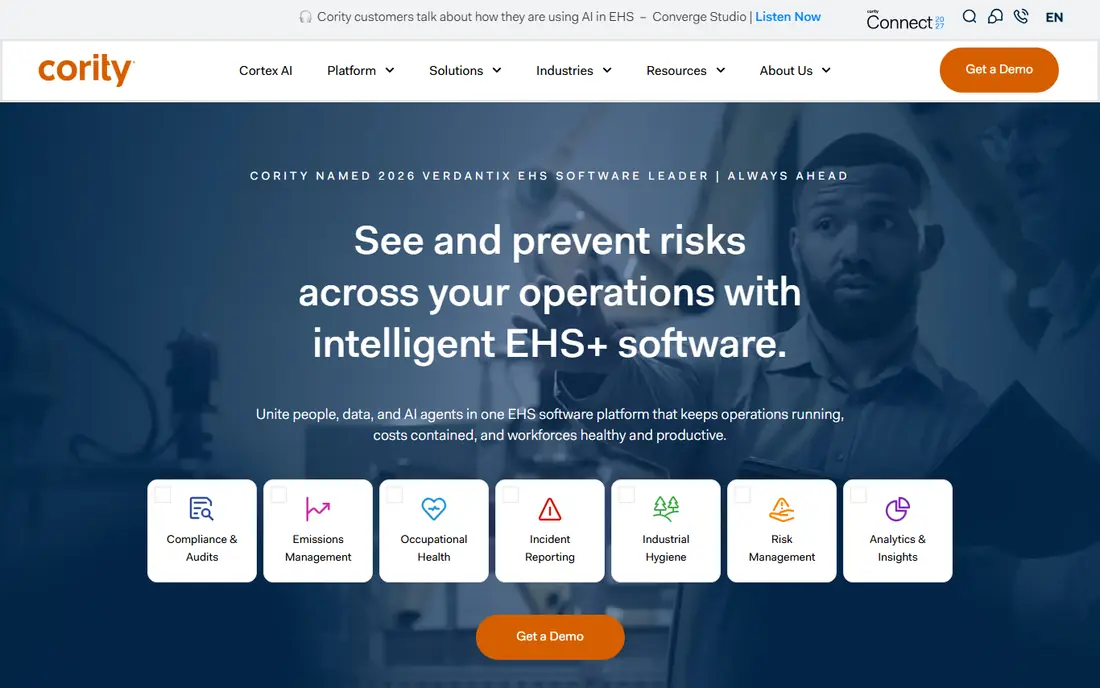
Cority is an EHSQ platform, which means it adds quality management to the usual environment, health, and safety workflows. That breadth suits large enterprises that already run quality systems alongside safety, since one platform can hold both sets of records, audits, and corrective actions. Occupational health and industrial hygiene are also strong areas.
Breadth brings cost and complexity. Expect a quote-based price, a structured implementation, and a need for administrators who own the system day to day. Cority is a good fit when the program is large enough to justify that investment, and a heavy choice for a small team that only needs inspections and incident logs.
- Broad EHS and quality coverage
- Occupational health and industrial hygiene depth
- Suited to global rollouts
- Quote-based pricing
- Needs dedicated administration and a longer rollout
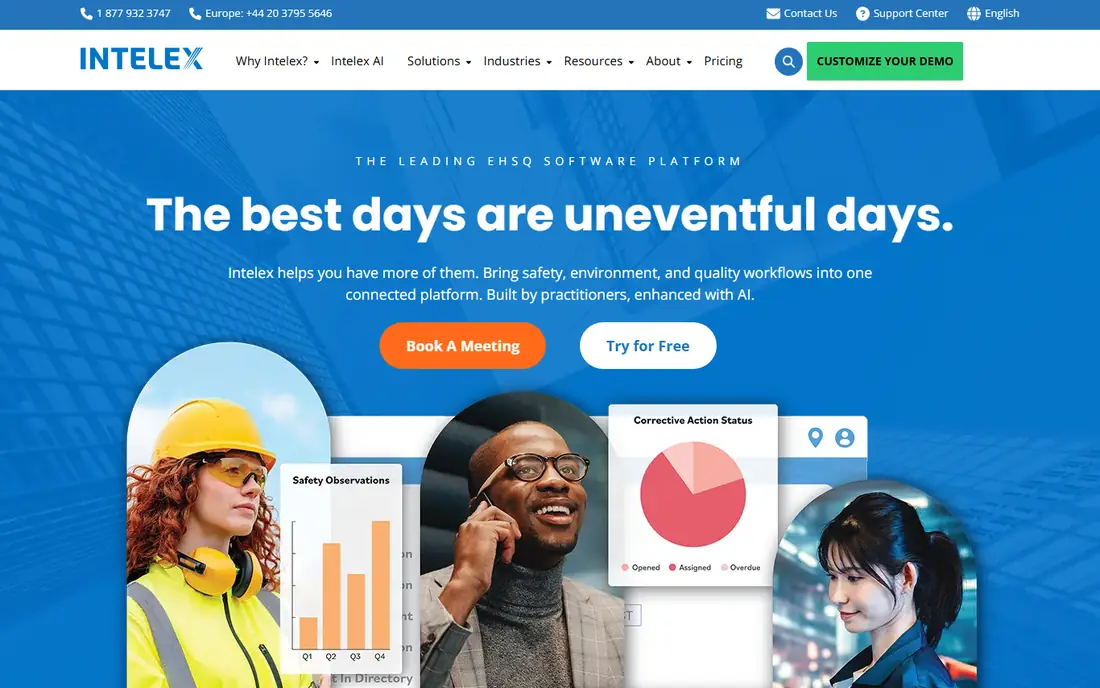
Intelex, part of Fortive, is the configurability pick in this list. Its applications cover safety, environment, quality, and supplier management, and they can be shaped to match how an organisation actually works rather than forcing a fixed template. Multinationals use it to standardize reporting across sites without flattening local differences.
That flexibility is also the cost. Implementations are measured in months, pricing is quote-based, and the platform expects dedicated administrators. Buy Intelex when your EHS program is too complex for a simpler tool, not before that point, since a smaller team may never use the depth it pays for.
- Deep configurability
- Broad application library
- Strong for complex multi-site programs
- Quote-based pricing
- Implementations can take months
Benchmark Gensuite covers a wide set of EHS and risk workflows, including incidents, audits, permits, and compliance tasks across many sites. That range suits organisations that need one reporting view across locations, rather than a separate system per site or region.
The trade is effort. A broad suite needs configuration, data migration, and training before it feels natural to frontline users. Teams should ask for a written implementation timeline and a clear list of which modules are included in the quote, since the total price depends heavily on scope.
- Broad compliance and risk modules
- Suited to multi-site reporting
- Established enterprise customer base
- Quote-based pricing
- Setup and configuration take time
EcoOnline combines chemical safety with wider EHS workflows, which suits teams that handle hazardous substances alongside general safety work. Safety data sheets, risk assessments, and incident reporting sit in one environment, so a chemical record is not stranded in a separate database.
As with other enterprise suites, pricing is quote-based and the full value depends on configuration. Smaller teams that only need chemical data sheets may find a narrower tool cheaper, while teams that need chemical safety plus audits and training will get more from the full platform.
- Chemical safety and risk controls
- EHS and ESG coverage
- Mobile access for field teams
- Quote-based pricing
- Breadth needs configuration for large programs
EHS Insight stands out in this list because it publishes a starting price, which makes early budgeting far simpler than a quote-only shortlist. Its modules cover incidents, audits, inspections, and corrective actions, with mobile reporting for field staff who need to log an issue at the point of work.
The limit is scale. It does not match Cority or Intelex on the full EHSQ spectrum, and organisations with very complex quality or occupational health needs may outgrow it. For a mid-market team that wants a clear entry price and core EHS workflows, it is a practical middle option.
- Published starting price
- Modular incident, audit, and inspection tools
- Mobile reporting
- Less breadth than the largest enterprise suites
- Higher modules add cost
SafetyCulture
Great for: Frontline inspections, checklists, and incident reports
SafetyCulture is the easiest starting point for a small team. Staff can build checklists, run inspections on a phone, and log incidents without a long implementation project. The free tier covers small teams, which makes it a low-risk way to move inspections off paper and spreadsheets.
It is not a full EHSQ suite. Organisations that need deep chemical management, occupational health, or complex quality workflows will likely need a larger platform, or a second system alongside it. For frontline safety work, however, its simplicity is a genuine strength, since a tool field staff actually use beats a powerful tool they avoid.
- Free tier for small teams
- Easy checklist building
- Mobile-first inspections
- Less depth than full EHSQ suites
- Advanced analytics sit on higher plans
Evotix, formerly SHE Software, focuses on safety management for operational teams. It covers incidents, risk assessments, audits, and actions, with mobile access for staff who work away from a desk. That focus suits organisations where most safety work happens on site, not in an office.
Pricing is quote-based, so early budgeting needs a sales conversation and a clear scope. Teams should also check how Evotix handles their specific reporting needs, such as regulatory forms or multi-site dashboards, before assuming it matches a larger suite feature for feature.
- Incident and risk workflows
- Mobile reporting
- Suited to operational safety teams
- Quote-based pricing
- Smaller public pricing detail than some rivals
Sphera serves large, global organisations that need EHS alongside product stewardship and sustainability reporting. Its chemical data and regulatory content depth suit companies with complex product lines and operations across many countries. For that audience, one governed system beats a patchwork of local tools.
The cost is enterprise scale in both price and implementation. Small and mid-size teams will find the platform more than they need, and should look at VelocityEHS, EHS Insight, or SafetyCulture first. Sphera fits when global scope and product stewardship are core requirements, not optional extras.
- Global EHS coverage
- Product stewardship and chemical data depth
- Suited to large enterprises
- Quote-based pricing
- Enterprise implementation effort
Dakota Software
Great for: Regulatory obligation tracking and compliance calendars
Dakota Software takes a narrower, useful angle: tracking which regulations apply to each site and when each obligation falls due. Its decision-tree approach helps a team work out site-specific requirements rather than applying one generic checklist everywhere. Compliance calendars and audit trails then keep deadlines visible.
That focus is also its limit. Dakota Software is not a full incident and training suite, so many teams will pair it with a broader EHS platform or use it where regulatory tracking is the main gap. If missed deadlines are your biggest risk, that specialization is worth more than a broader tool with weaker regulatory tracking.
- Site-specific regulatory applicability tracking
- Compliance calendars
- Audit support
- Quote-based pricing
- Narrower focus than full EHS suites
How we picked these
We compared official feature pages, pricing pages, and public comparison coverage checked in October 2026, and kept only platforms that are live and still sold for EHS work. We included enterprise suites, a mid-market option with public pricing, and frontline tools, so the list covers different team sizes rather than only large buyers. Where a vendor does not publish a price, we wrote See website rather than guessing.
What to check before you buy
Start with who will actually use the system every day. A platform that pleases a safety manager but frustrates field staff will end up with patchy data, and patchy data undermines audits and trend reports. Run a trial with a real inspection and a real incident report, including offline or low-signal conditions if your sites have them.
Next, check reporting and regulatory forms. Ask the vendor to show the exact reports your organisation needs, such as OSHA 300 logs in the United States, and confirm whether those reports are included or need configuration. Finally, confirm implementation time in writing, including data migration and training, since simple tools can go live in days while enterprise suites can take months. Remember that software alone does not make an organisation compliant with safety regulations; it supports the procedures, training, and follow-up that compliance depends on.
Questions to ask on a demo
- Can field staff log an incident in under two minutes on a phone?
- How are corrective actions assigned, tracked, and closed?
- What does the implementation timeline include, and who owns it on each side?
Frequently asked questions
What is EHS software?
EHS software manages environment, health, and safety work in one system, including incident reports, inspections, audits, training records, and chemical inventories. It replaces scattered spreadsheets with shared records, assigned actions, and reports that managers and auditors can review.
Will EHS software keep us compliant?
It helps, but it does not guarantee compliance on its own. Good software keeps OSHA logs, incident tracking, audit trails, and training records in one place, which covers much of what an inspection asks for. Correct procedures, trained people, and timely reporting are still required.
How much does EHS software cost?
Costs range widely. Frontline tools can start free or at a low per-user price, EHS Insight publishes a starting price from $5,000 per year, and enterprise platforms are quote-based and can run into five or six figures per year depending on modules and scale. Always confirm what modules and users are included in a quote.
How long does implementation take?
Simple tools can be running in days. Mid-market platforms typically take four to twelve weeks including configuration, data migration, and training. Enterprise suites can take three to nine months for a full multi-module rollout, so ask for a written timeline before signing.
What is the difference between EHS and EHSQ software?
EHS covers environment, health, and safety. EHSQ adds quality management, so platforms like Cority and Intelex include quality workflows alongside safety. If your organisation manages quality systems alongside safety, an EHSQ platform can avoid a separate quality system.
Do small businesses need EHS software?
Many small teams benefit, especially once they have more than one location or more than about 50 employees. Free and low-cost tools handle inspections, incidents, and basic compliance without an enterprise price, and the admin time saved often outweighs the subscription cost.
Sources
See where you really rank - block by block
ProMapRanker scans Google Maps across a grid of your service area. Simple monthly plans from $19, white-label on every plan.
Start freeKeep reading
 wpforms alternatives
Best WPForms Alternatives in 2026
We compare 9 wpforms alternatives for WordPress forms, with free and paid options, current pricing notes, and honest limits for small business sites in 2026.
Read → windows task scheduler alternatives
Best Windows Task Scheduler Alternatives in 2026
Looking for Windows Task Scheduler alternatives? We compare 9 schedulers for Windows and cross-platform work, from free tools to enterprise automation.
Read → which ai video service is best
Which AI Video Service Is Best in 2026
which ai video service is best? We compare 10 legitimate AI video services on price, avatars, editing and output quality to help you pick the right tool.
Read →