 ProMapRanker
Best SQLite Alternatives in 2026

Key takeaways
- PostgreSQL is the most common upgrade path when you need many writers, row-level locking, and a full server database.
- DuckDB suits analytics on local files, while LibSQL suits apps that need SQLite compatibility with replication and edge deployment.
- Realm and ObjectBox suit mobile apps that want an object model rather than raw SQL tables.
- Keep SQLite if your data is local, single-writer, and modest in size, and switch only when concurrency, scale, or sync forces the move.
Quick comparison
| Pick | Great for | Pricing starts at | Free tier | |
|---|---|---|---|---|
 PostgreSQL | General server replacement | Free | Yes | Visit |
 MySQL | Widely supported server database | Free | Yes | Visit |
 MariaDB | Open-source MySQL-compatible server | Free | Yes | Visit |
 DuckDB | Local analytics on files | Free | Yes | Visit |
 LibSQL | SQLite-compatible with replication | Free | Yes | Visit |
 Realm | Mobile object database | Free | Yes | Visit |
 H2 Database | Embedded Java database | Free | Yes | Visit |
 Firebird | Embedded and small server use | Free | Yes | Visit |
 ObjectBox | Fast mobile and edge storage | Free | Yes | Visit |
The best SQLite alternatives
SQLite is a small, serverless, single-file database that works well for local storage, mobile apps, and embedded systems. Teams look for alternatives when they need many concurrent writers, client-server access, encryption, replication, or analytics at larger scale. The tools below cover those needs in different ways, from full server databases to embedded and mobile options. We compared official documentation and product pages, and we kept only products that are live and working in October 2026. We did not list SQLite itself, since this guide is about alternatives to it.
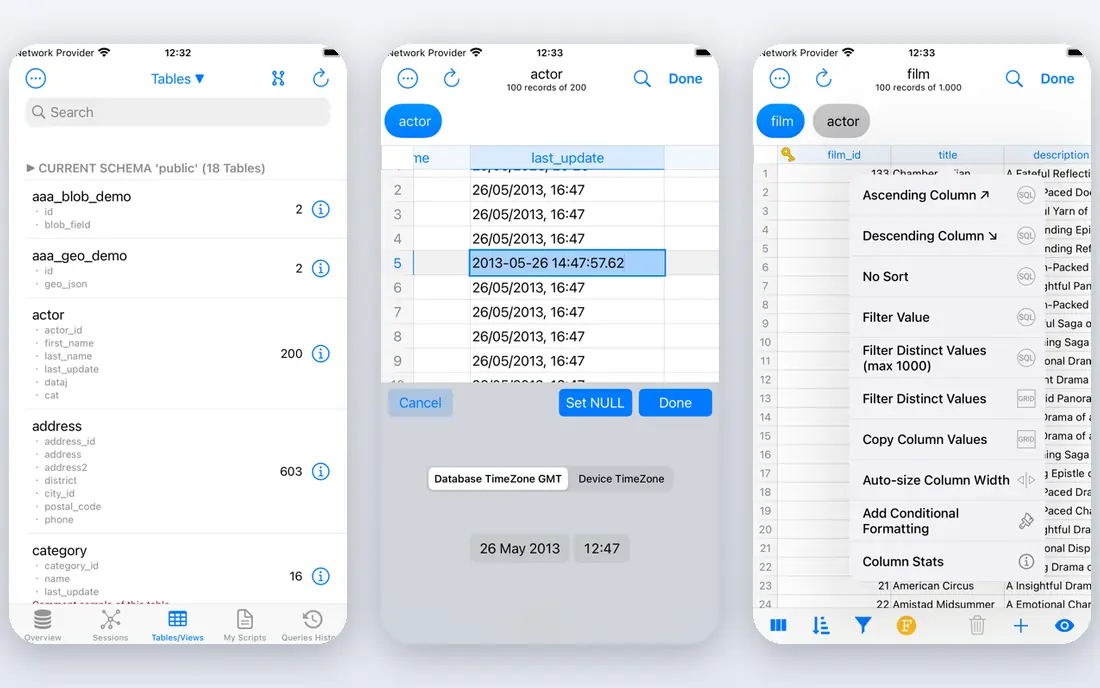
PostgreSQL is the standard answer when SQLite runs out of room. It runs as a server, supports many readers and writers at once, and offers advanced features such as JSON columns, full-text search, window functions, and extensions for vector search. Its ecosystem of tools, hosting options, and drivers is one of the largest in open source.
The cost is operational. You must run, back up, patch, and monitor a server, or pay a managed provider to do it. For a simple local app, that overhead is not worth it. For a web service, a multi-user app, or a growing data set, PostgreSQL is usually the safest long-term choice.
- Open source with row-level locking and strong SQL support
- Handles many concurrent connections
- Rich extensions for JSON, search, and vectors
- Needs server setup and maintenance
- Heavier than a single file for simple apps
- Tuning takes experience for large workloads
MySQL is a practical server alternative for web applications, content systems, and services that already run on common hosting stacks. Its InnoDB engine supports transactions and row-level locking, and its driver support covers almost every language and framework. Managed MySQL is available from most cloud providers, which reduces the setup burden.
Edition differences deserve attention. The community edition is free and open source, while some enterprise features require a commercial licence. Check which features your workload needs before you assume they are included, and test replication and backup procedures on your real data size.
- Very widely supported by hosting and frameworks
- Good performance for web workloads
- Large community and tooling
- Some advanced features sit in commercial editions
- Licensing and edition differences need care
- Tuning matters for large write loads
MariaDB began as a community fork of MySQL, and it remains a strong open-source server choice. It offers similar SQL, similar drivers, and a choice of storage engines, which helps teams that want MySQL compatibility without commercial edition concerns. Many Linux distributions and hosting providers offer MariaDB as a standard option.
Compatibility is high but not perfect. A few MySQL-specific features and defaults differ, so migrate a real application and run its test suite before you switch production data. For most web and business applications, MariaDB is a clean and cost-free server replacement.
- Open source and largely compatible with MySQL
- Good performance and storage engine choices
- Active community development
- Compatibility is close but not identical for every feature
- Tooling differs slightly from MySQL
- Large-scale support may need a vendor contract
DuckDB is an in-process analytical database that feels like SQLite for data analysis. You can query CSV and Parquet files directly, run complex aggregations fast, and keep everything local without a server. Analysts use it to explore large local data sets, build reports, and prototype queries before moving them to a warehouse.
It is not a transactional server database. DuckDB suits read-heavy analytics and single-user exploration, not many concurrent writers or a multi-user web service. Pair it with PostgreSQL or a warehouse when your analytics grow beyond local files, and use it alone when local analysis is the whole job.
- Fast analytical queries on local files
- Reads CSV, Parquet, and other formats directly
- Simple single-file or in-process use
- Optimised for analytics, not high-concurrency writes
- Newer ecosystem than PostgreSQL
- Some extensions are still maturing
LibSQL is a fork of SQLite that adds features SQLite lacks, most notably replication and a server mode. That makes it attractive for apps that want to keep SQLite compatibility but also sync data to replicas, run at the edge, or serve data from a remote database. Turso, the company behind LibSQL, also offers a managed platform built on it.
Because LibSQL is newer, its tooling and extension support differ in places from plain SQLite. Test your specific SQLite features, migrations, and drivers before you commit, especially if you use extensions or unusual pragmas. For edge and sync use cases, it is one of the most interesting SQLite successors available.
- Largely compatible with SQLite
- Adds replication and remote access
- Suits edge and multi-region apps
- Newer ecosystem than SQLite
- Some SQLite features and extensions differ
- Managed hosting adds cost at scale
Realm, now part of MongoDB's mobile offerings, suits mobile developers who prefer working with objects rather than SQL tables. You define model classes, store objects directly, and query them in code, which removes a layer of mapping code. Local reads are fast, and the database is designed for phones and tablets with limited resources.
Sync history needs care. Realm's managed sync service has been deprecated in its previous form, so teams that need cloud sync should check the current MongoDB offering and plan their own sync if needed. For a local-first mobile app without complex joins, Realm remains a strong and free choice.
- Object model avoids much ORM code
- Fast local reads for mobile apps
- Cross-platform for iOS and Android
- Managed sync service has changed over time
- Complex relational queries are less natural than SQL
- Migration needs planning
H2 is a popular embedded database for Java applications, similar in spirit to SQLite but for the Java ecosystem. It can run in memory for fast tests, on disk for a small service, or as a small server for a team. Developers use it for unit tests, prototypes, and small Java tools where a full server database would be overkill.
It is not a general replacement for a production server database at scale. Large concurrent workloads and multi-language projects will usually fit PostgreSQL or MySQL better. For a Java project that needs an embedded store with SQL support, H2 is a clean and free option.
- Free embedded Java database
- Runs in-memory or on disk
- Good for testing and small Java services
- Java-focused, so other languages need extra work
- Not suited to large multi-user production loads
- Tooling is smaller than PostgreSQL
Firebird is a mature open-source relational database that can run embedded in an application or as a small server. It supports transactions, triggers, and stored procedures, which helps small business applications that need more than a single file but do not want a large server setup. Its long history means its core engine is stable.
The ecosystem is smaller than PostgreSQL or MySQL, so drivers, hosting, and hiring are less straightforward. For a small desktop or business application, especially one already built on Firebird or InterBase, it is a solid choice. For a new web service, PostgreSQL will usually offer more tooling and support.
- Free and open source
- Runs embedded or as a small server
- Mature transactions and stored procedures
- Smaller community and tooling than PostgreSQL
- Driver support varies by language
- Less common in modern cloud stacks
ObjectBox suits mobile and edge apps that need fast local storage with a small footprint. It stores objects directly, avoids SQL mapping overhead, and performs well on phones, embedded devices, and IoT hardware. Its sync features help connected apps share data when a network is available.
SQL developers should expect a learning curve, since queries and data modelling follow an object model rather than tables and joins. For a performance-sensitive mobile or edge app, that trade is often worth it. For a reporting-heavy or relational workload, a SQL database such as PostgreSQL or DuckDB will fit better.
- Very fast local object storage for mobile and edge devices
- Small footprint
- Sync options for connected apps
- Object model differs from SQL, so SQL teams need adjustment
- Ecosystem is smaller than Realm
- Complex relational queries are less natural
How we picked these
We compared official documentation and product pages for databases that cover embedded, mobile, server, and analytical work, and we kept only products that are live and working in October 2026. We favoured open-source tools with clear documentation, and we noted where a tool is optimised for analytics, mobile, or server use rather than all three. We did not claim hands-on testing, and we did not list SQLite itself.
What to check before you switch
Start with the reason you are leaving SQLite. If the problem is concurrent writes, a server database such as PostgreSQL or MySQL is the answer. If the problem is analytics speed, DuckDB is the answer. If the problem is mobile sync or edge replication, Realm, ObjectBox, or LibSQL may fit. A tool chosen for the wrong reason will disappoint even if it is excellent in its own area.
Next, test migration on a copy of your data. Check data types, indexes, transactions, and query results, and run your application test suite against the new database. Pay special attention to locking, case sensitivity, and date handling, since those differ between engines and cause subtle bugs.
Finally, plan operations. A server database needs backups, monitoring, and patching, while an embedded database needs file handling and corruption recovery. Budget time for operations, not just for code changes, and keep a rollback plan until the new database has run in production for a full cycle.
If you need a server database
PostgreSQL is our default pick, with MySQL and MariaDB close behind for web workloads. All three are free and open source, with managed hosting available if you do not want to run a server yourself.
If you need local or mobile storage
DuckDB suits local analytics, LibSQL suits SQLite-compatible apps with replication, and Realm and ObjectBox suit mobile apps that prefer objects to SQL. H2 and Firebird suit embedded and small-server use in their respective ecosystems.
Frequently asked questions
What is the best alternative to SQLite for a web app?
PostgreSQL is the best general pick for a web app that needs many users, concurrent writes, and a full server database. MySQL and MariaDB are strong alternatives for common web stacks. The choice often depends on your hosting, framework, and team experience, so test your application against each before you commit.
Can I use DuckDB instead of SQLite?
You can for analytics, since DuckDB reads local files fast and runs complex queries well. For transactional apps with many writes, DuckDB is less suited than SQLite or PostgreSQL, since it is optimised for read-heavy analysis. Use DuckDB for exploration and reporting, and keep a transactional database for app data.
Is LibSQL compatible with SQLite?
LibSQL is largely compatible with SQLite and is built as a fork of it, which helps migration. Some features, extensions, and behaviours differ, so test your schema, queries, and drivers on a copy of your data. Its main additions are replication and remote access, which suit edge and multi-region apps.
Which SQLite alternative is best for mobile apps?
Realm and ObjectBox are strong mobile picks because they store objects directly and perform well on phones. LibSQL also suits mobile apps that want SQLite compatibility with sync. The best choice depends on whether you prefer an object model, SQL, or SQLite compatibility, and whether you need cloud sync.
Do I need to leave SQLite at all?
Not always. SQLite remains a good choice for local, single-writer, and modest-size data, and it is widely deployed on mobile devices. Leave SQLite only when concurrency, client-server access, replication, encryption, or analytics scale force the move. Many apps keep SQLite locally and add a server database for shared data, rather than replacing it entirely.
Is PostgreSQL free?
Yes, PostgreSQL is free and open source, with no licence cost for the database itself. You pay for hosting, managed services, or support if you choose them, but the software can be run on your own server at no licence cost. Managed PostgreSQL from cloud providers is priced by compute and storage, so check those costs for your workload.
Sources
See where you really rank - block by block
ProMapRanker scans Google Maps across a grid of your service area. Simple monthly plans from $19, white-label on every plan.
Start freeKeep reading
 wpforms alternatives
Best WPForms Alternatives in 2026
We compare 9 wpforms alternatives for WordPress forms, with free and paid options, current pricing notes, and honest limits for small business sites in 2026.
Read → windows task scheduler alternatives
Best Windows Task Scheduler Alternatives in 2026
Looking for Windows Task Scheduler alternatives? We compare 9 schedulers for Windows and cross-platform work, from free tools to enterprise automation.
Read → which ai video service is best
Which AI Video Service Is Best in 2026
which ai video service is best? We compare 10 legitimate AI video services on price, avatars, editing and output quality to help you pick the right tool.
Read →