 ProMapRanker
Best Signal Alternatives in 2026

Key takeaways
- Session, SimpleX Chat, and Olvid offer the strongest break from phone-number identity, which matters if you want no link between an account and a SIM card.
- Threema gives strong default encryption with a one-time purchase, while Wire and Element suit teams that need admin controls or self-hosting.
- Telegram and WhatsApp are the easiest for reaching people you already know, but their privacy trade-offs are very different.
- Default encryption matters more than a marketing claim: check whether every chat is protected, or only a special mode.
Quick comparison
| Pick | Great for | Pricing starts at | Free tier | |
|---|---|---|---|---|
 Telegram | Large groups and channels | Free | Yes | Visit |
 WhatsApp | Reaching almost everyone | Free | Yes | Visit |
 Session | Anonymous messaging | Free | Yes | Visit |
 Threema | No phone number, paid privacy | See website | No | Visit |
 Wire | Secure team messaging | Free | Yes | Visit |
 Element | Federated and self-hosted chat | Free | Yes | Visit |
 SimpleX Chat | No identifiers at all | Free | Yes | Visit |
 Olvid | No central contact directory | Free | Yes | Visit |
The best signal alternatives
Signal sets a high bar: end-to-end encryption by default, minimal metadata, and open-source code. The tools below match part of that model, and each one trades something away for reach, features, or anonymity. We list them by the problem they solve best, not by raw popularity alone.
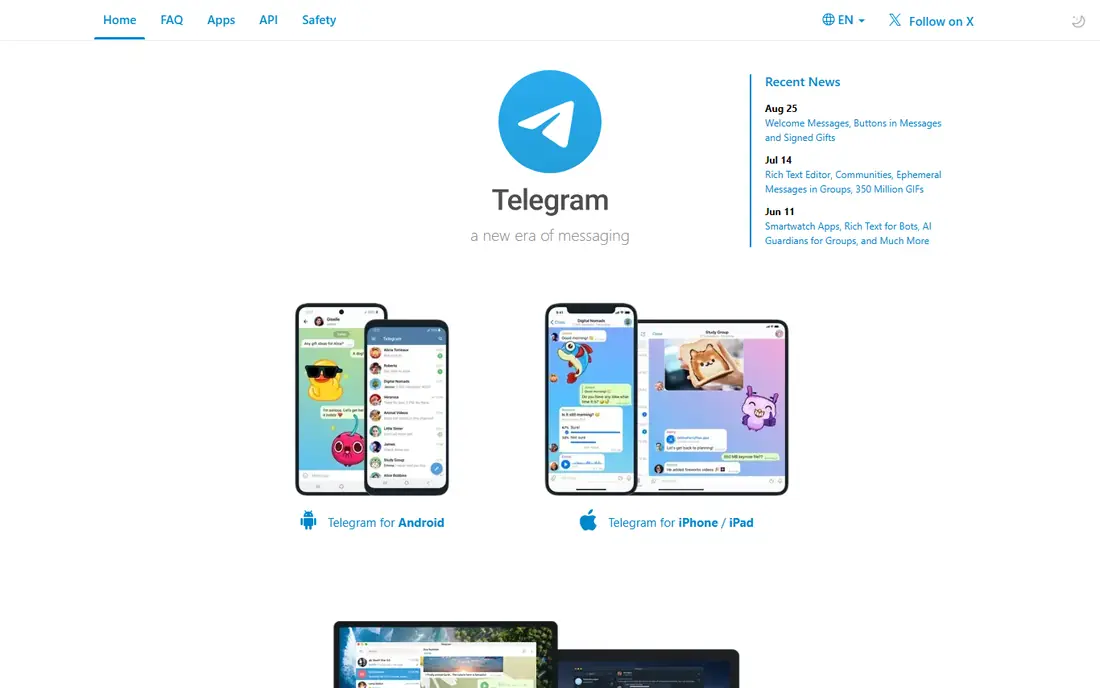
Telegram is the easiest switch if your contacts already use it. Groups can hold very large numbers of members, channels work well for announcements, and messages sync across phone, desktop, and web without friction. File sharing and bots add practical value for communities and small teams.
The privacy catch is central. Regular cloud chats are encrypted in transit and stored on Telegram servers, but they are not end-to-end encrypted. If you need that level of protection, you must start a Secret Chat, which is device-specific and lacks cloud sync. Use Telegram for reach and community, and use a different app for sensitive one-to-one talks.
- Huge groups and channels
- Fast sync across devices
- Bots and file sharing
- Cloud chats are not end-to-end encrypted by default
- Only Secret Chats use that protection
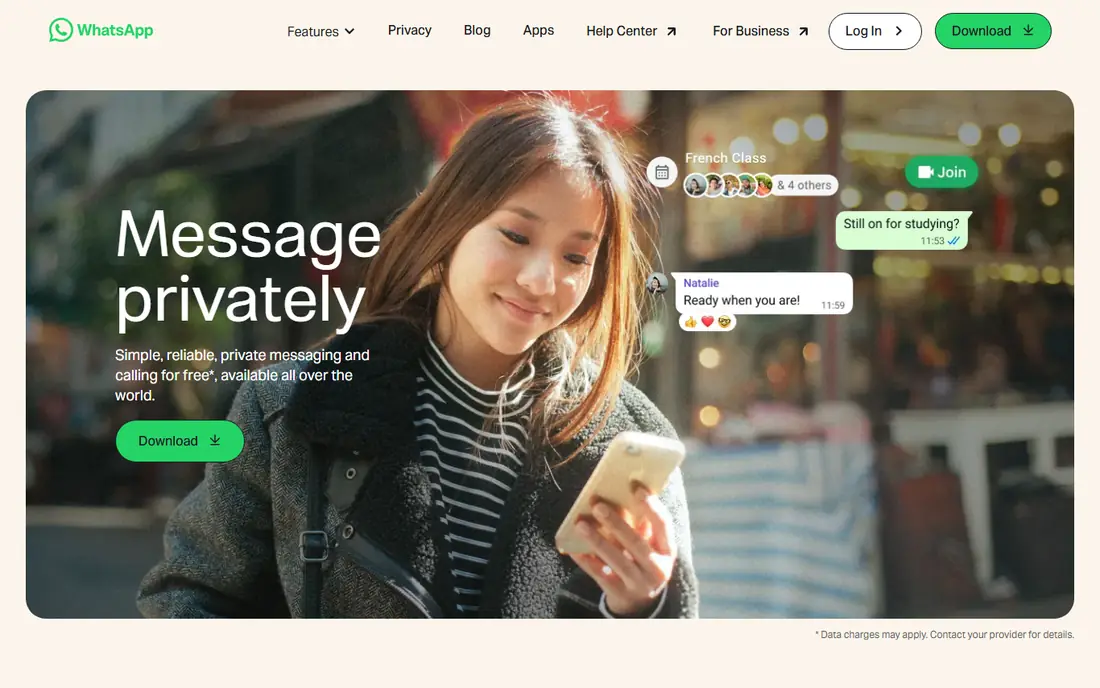
WhatsApp wins on network effect. In many countries, asking someone to install another app is a barrier, while WhatsApp is already on their phone. Personal chats and calls use end-to-end encryption based on the Signal protocol, and group chats are also protected by default.
The trade-off is metadata and ownership. You need a phone number to sign up, and Meta can collect data about who you contact, when, and from which device, even if it cannot read message content. If your main concern is message content, WhatsApp is solid. If your main concern is hiding who you talk to, look at Session or SimpleX Chat instead.
- End-to-end encryption on personal chats
- Almost everyone already has it
- Voice and video calls
- Requires a phone number
- Meta collects metadata such as contacts and timestamps
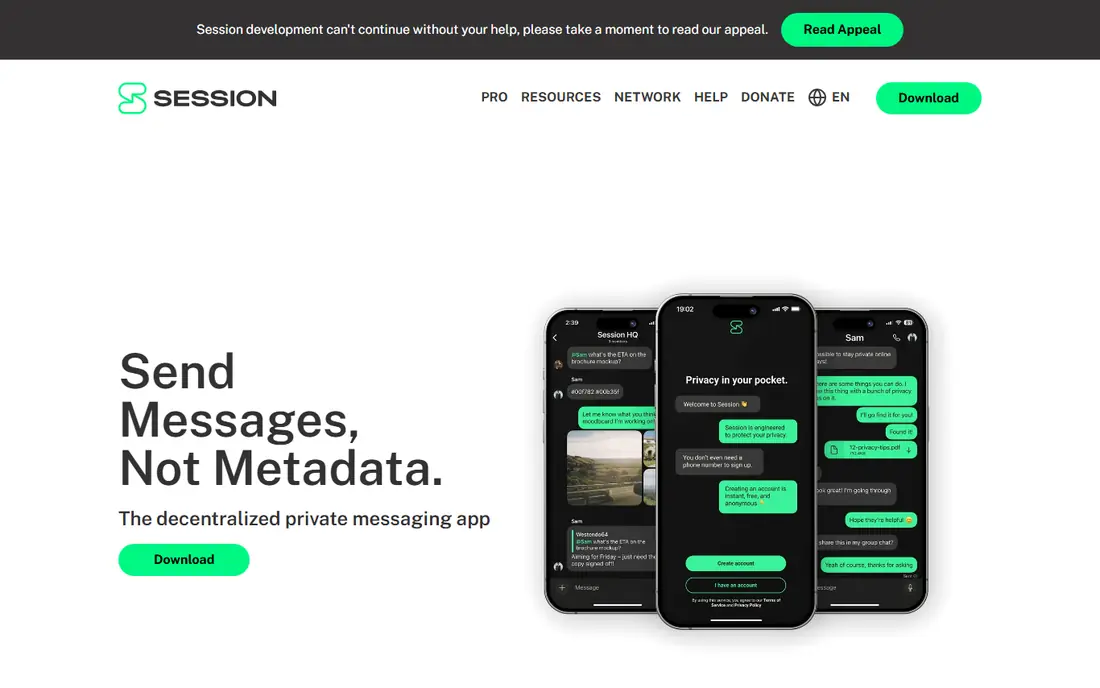
Session creates an account from a generated ID, with no phone number or email required. Messages travel through a decentralized network designed to hide who is talking to whom, which goes beyond content encryption alone. That design suits journalists, activists, and anyone who wants a low-trace account.
Everyday use is the cost. Delivery can be slower, group features are more limited than Telegram, and you will likely need to persuade contacts to install it. Keep Session for sensitive contacts and use a mainstream app for casual chats, rather than trying to move everyone at once.
- No phone number or email needed
- Onion routing hides routing metadata
- Open source
- Can feel slower than mainstream apps
- Smaller network means fewer contacts use it
Threema gives you a random ID when you sign up, so your messaging identity is not tied to your SIM card. All chats, including groups, use end-to-end encryption by default, and the company states that it collects minimal metadata. That combination is rare in a polished, consumer-friendly app.
The price is modest but real: it is a paid app rather than a free download, and the exact store price varies by platform. The smaller network is the bigger limit. Threema works best with a small circle that agrees to use it, such as family members or a close team.
- Random ID instead of a phone number
- End-to-end encryption by default
- Swiss provider
- One-time purchase
- Smaller user base
- Some features need a separate work version for teams
Wire started as a consumer messenger and now focuses heavily on teams and regulated work. Messages, calls, and file sharing use end-to-end encryption, and administrators can manage members, retention, and access. You can sign up with an email or username rather than a phone number, which helps for work accounts.
For casual personal use, Wire feels more formal than WhatsApp or Telegram. The interface is clean, but the social features are thinner. It earns its place here for workgroups that need both encryption and control, such as legal, health, or finance teams handling sensitive discussion.
- End-to-end encryption for messages and calls
- Team admin controls
- No phone number required
- Free personal use is more limited than team plans
- Some advanced features are paid
Element is built on Matrix, an open, federated protocol. That means different servers can talk to each other, and an organization can run its own server instead of trusting a single company. End-to-end encryption is available for rooms, and the apps are open source.
The flexibility brings complexity. Your privacy depends in part on which server you choose, and self-hosting needs maintenance. For a community or company that wants control over its data and its own domain, that trade is worth it. For a single person who just wants a private chat, Session or Threema is simpler.
- Open Matrix protocol
- You can run your own server
- Bridges to other chat networks
- Setup can be technical
- Encryption and server choice affect privacy in practice
SimpleX Chat pushes anonymity further than most apps on this list. It has no usernames, no phone numbers, and no central user directory. Contacts connect through single-use invitation links or QR codes, and each conversation uses separate message queues. That design makes it hard to map a social graph from server data.
The same design makes onboarding less familiar. You cannot search for a friend by name, and losing your device data can mean losing contacts unless you back them up. SimpleX Chat suits people who accept that friction in return for a very low-metadata design.
- No usernames or persistent IDs
- Messages use one-time queues
- Open source
- Contact setup uses QR codes or links
- Smaller network
- Interface takes getting used to
Olvid also avoids phone numbers and email addresses, and it does not keep a central directory linking users together. You add contacts by exchanging an identifier in person or through a trusted channel, which limits mass discovery. Messages use end-to-end encryption by default, and the apps are open source.
That privacy-first discovery is also its limit. You cannot find old friends by searching a phone book, so Olvid works best when both people agree to set it up together. For a small, trusted circle, it is a credible, modern option that avoids the metadata trail of mainstream apps.
- No phone number or email needed
- No central directory of users
- End-to-end encryption by default
- Smaller network
- Discovery relies on sharing an ID or QR code
- Paid tiers add features
How we picked these
We compared official privacy pages, protocol documentation, and app listings for messengers that offer end-to-end encryption and that work on current phones in October 2026. We included a mix of mainstream reach, team use, and high-anonymity designs, and we noted where encryption is default and where it needs a special mode. We did not list apps that had shut down or that only offered transport encryption.
How to choose without overthinking it
Start with who you need to reach. If your contacts will not switch, WhatsApp or Telegram is the practical answer, and you should use their encrypted modes carefully. If your circle will switch, pick based on identity: Threema for a simple paid ID, Session or SimpleX Chat for no phone number, Olvid for a small trusted group.
Next, check the defaults. Open the app settings and confirm whether encryption covers every chat, whether backups are encrypted, and whether disappearing messages are available. A backup that uploads plain chat history to a cloud account can undo strong in-app encryption, so turn on encrypted backups where the app offers them.
Finally, test with one conversation before you migrate a group. Send text, images, and a voice note, try a call, and check how the app handles a lost device. The best private messenger is the one your contacts will actually keep using, with settings you understand.
Frequently asked questions
What are the best alternatives to signal for privacy?
Session, SimpleX Chat, Threema, and Olvid are the strongest privacy-first picks, because they reduce or remove phone-number identity and keep encryption on by default. Wire and Element add team controls and self-hosting for work use.
Are there free alternatives to signal?
Yes. Telegram, WhatsApp, Session, Wire, Element, SimpleX Chat, and Olvid all offer free apps. Threema is the exception here, since it is a paid purchase rather than a free download.
Which signal alternative does not need a phone number?
Session, Threema, SimpleX Chat, and Olvid do not require a phone number. Wire and Element can also work without one, depending on how you sign up, while WhatsApp and Telegram require a number.
Is Telegram a safe signal alternative?
Telegram is useful for large groups, but only Secret Chats are end-to-end encrypted. Regular cloud chats are stored on Telegram servers, so do not treat them as equivalent to Signal chats for sensitive topics.
Can I use more than one private messenger?
Yes, and many people do. Keep a mainstream app for everyday contacts and a privacy-first app for sensitive conversations, and be clear with contacts about which app to use for which topic.
Sources
See where you really rank - block by block
ProMapRanker scans Google Maps across a grid of your service area. Simple monthly plans from $19, white-label on every plan.
Start freeKeep reading
 wpforms alternatives
Best WPForms Alternatives in 2026
We compare 9 wpforms alternatives for WordPress forms, with free and paid options, current pricing notes, and honest limits for small business sites in 2026.
Read → windows task scheduler alternatives
Best Windows Task Scheduler Alternatives in 2026
Looking for Windows Task Scheduler alternatives? We compare 9 schedulers for Windows and cross-platform work, from free tools to enterprise automation.
Read → which ai video service is best
Which AI Video Service Is Best in 2026
which ai video service is best? We compare 10 legitimate AI video services on price, avatars, editing and output quality to help you pick the right tool.
Read →