 ProMapRanker
Best Shodan Alternatives in 2026

Key takeaways
- Censys is our pick for most researchers because its certificate search and structured query language cover a wide range of internet-facing assets.
- ZoomEye and FOFA are worth checking when you need coverage in Asia-Pacific regions that other indexes may underrepresent.
- Netlas and Onyphe offer useful free starting points, but their depth and history vary, so check a query you care about before paying.
- GreyNoise stands apart because it filters out background internet noise, which helps teams focus on scans that look unusual.
- Use these tools only on systems you own or have clear permission to test, and treat every finding as a starting point for verification, not proof of a flaw.
Quick comparison
| Pick | Great for | Pricing starts at | Free tier | |
|---|---|---|---|---|
 Censys | Certificate and host research | See website | Yes | Visit |
 ZoomEye | Asia-Pacific asset coverage | See website | Yes | Visit |
 BinaryEdge | Historical internet data | See website | Yes | Visit |
 Criminal IP | Threat scoring and risk context | See website | Yes | Visit |
 FOFA | Broad cyberspace search | See website | Yes | Visit |
 Netlas | Low-cost daily searching | See website | Yes | Visit |
 GreyNoise | Filtering out mass scanning noise | See website | Yes | Visit |
 Onyphe | Combined search and threat data | See website | Yes | Visit |
The best shodan alternatives
Shodan made internet-wide searching familiar, but it is far from the only index of exposed services. The tools below index hosts, banners, certificates, and open ports in different ways, and the best choice depends on the question you are asking. We compared official feature pages, pricing pages, and public documentation for each tool.
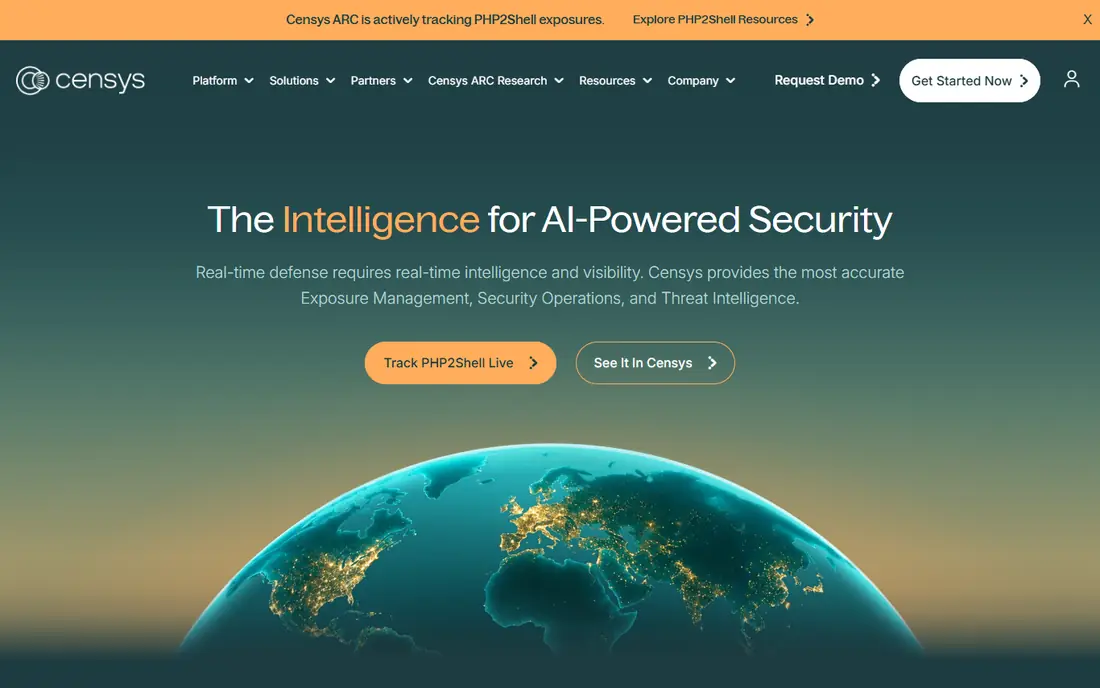
Censys grew out of academic internet measurement work, and that background still shows in how it presents data. Its host and certificate indexes let you search by domain names in certificates, open services, software banners, and network details in a structured way. For a team mapping its own attack surface, that structure makes it easier to repeat a search, save it, and compare results over time.
The free tier gives a limited number of queries each month, which is enough to test whether the index covers your assets and to learn the query syntax. Paid plans add volume, API access, and team features, so check the current pricing page before you plan a large project. The main catch is the learning curve, because precise queries need care with field names and filters. Once you learn that syntax, though, Censys is one of the most flexible tools on this list for certificate-led research.
- Strong certificate search
- Structured queries
- IPv6 coverage
- Query language takes time to learn
- Paid tiers can get costly for heavy use
ZoomEye is a cyberspace search engine that indexes devices, services, and web applications, with a particular strength in infrastructure hosted in Asia-Pacific regions. If your targets or your own estate include servers in that region, a search here can surface hosts that a US-focused index misses. That alone makes it a useful second check rather than a straight replacement for every use case.
The service offers a free tier with limited results, plus paid plans for higher volume and API use. Its search syntax will feel familiar if you have used other internet search engines, with filters for ports, products, countries, and organisations. The catch is that result quality varies by region and service, so cross-check important findings with a second index or a direct, authorised scan. Used that way, ZoomEye adds coverage where other tools have gaps.
- Distinct regional coverage
- Device and web app search
- API access
- Interface can feel busy
- Some features need a paid plan
BinaryEdge scans the internet and builds a data platform that covers hosts, services, and related data sources, including historical records. That history matters when you want to know what a host exposed last month, not just what it exposes today, or when you are tracing how an exposed service changed over time. Researchers who track infrastructure trends will get more from this angle than from a tool that only shows the latest snapshot.
A free tier lets you try basic searches, while paid plans raise limits and add API access. The documentation is clear about the main data types, but the site is less chatty about use cases than some rivals, so new users may need a short period of trial and error. The honest trade-off is breadth against polish: BinaryEdge is a capable index, yet it does not have the same size of community guides and tutorials as Censys or ZoomEye.
- Historical scan data
- Torrent and data leak context
- API access
- Smaller community than the leaders
- Pricing is not always clear at a glance
Criminal IP pairs an internet search index with threat intelligence, scoring IPs, domains, and other indicators for risk. That scoring helps a security team sort a long list of exposed hosts into a sensible order, starting with assets that look malicious, abused, or tied to known bad activity. It also links an asset to related indicators, which can speed up triage when an alert arrives with little context.
The free tier is useful for checking a handful of indicators, while paid plans add volume and API access for regular monitoring. Treat the score as a signal, not a verdict, because a high score can reflect shared hosting, a past incident, or a misconfigured service rather than current malice. When you pair the score with banner data, certificate history, and your own asset records, Criminal IP becomes a strong triage tool for threat hunting and incident response.
- Risk scores for IPs and domains
- Threat intelligence context
- Clear dashboards
- Scores need human review
- Free tier is limited
FOFA is a cyberspace search engine with a large index of internet assets, and it is widely used alongside Shodan and Censys for cross-checking results. Its query syntax is close enough to other search engines that most researchers can start searching quickly, with filters for protocols, products, countries, and organisations. For global infrastructure work, FOFA often returns hosts that other indexes rank lower or miss entirely.
A free tier gives limited results without registration in some cases, and paid membership raises limits and adds features. The main friction for English-speaking users is that some help material appears in Chinese first, although the search interface itself is usable in English. If you work with infrastructure in China or across Asia, FOFA is close to essential as a second source. For everyone else, it is still a solid cross-check tool.
- Large index
- Familiar query syntax
- Global coverage
- Some documentation is in Chinese first
- Paid plans needed for deep use
Netlas is an internet search engine that stands out for its free tier, which has been reported to allow dozens of searches per day with API access included. That makes it a practical choice for students, independent researchers, and small teams who need regular searches without a large budget. The interface is plain and quick, and the query language covers the usual host, port, and certificate filters.
The trade-off is scale: Netlas does not claim the same index size or historical depth as Censys or BinaryEdge, so a missing result does not prove that a host is unexposed. Use it as a first pass or a daily check, then confirm important findings elsewhere. For the price, which is free to start, that is a fair deal, and the API access on the free tier is a genuine advantage over rivals that lock API use behind paid plans.
- Generous free tier
- API included on free use
- Fast searches
- Smaller index than the leaders
- Fewer historical features
GreyNoise takes a different approach from most tools on this list. Instead of helping you find every exposed device, it watches internet-wide scanning and labels traffic that comes from mass scanners, bots, and common background noise. That context helps a defender decide whether an IP that hit their firewall is part of a broad sweep or something more targeted and worth urgent attention.
A free tier and community tools let you check individual IPs, while paid plans add API volume, integrations, and alert enrichment. GreyNoise will not replace Censys for asset discovery, and it is not meant to, so pair it with a search index when you need both views. On its own terms, though, it solves a real problem: alert fatigue caused by treating every scan as equal. Teams that tune alerts with GreyNoise tags often spend less time chasing background noise.
- Separates mass scans from targeted activity
- Useful alert context
- API access
- Not a general asset search engine
- Best paired with another index
Onyphe is a cyber defense search engine that combines internet asset search with threat intelligence data, including information on open ports, services, and malicious indicators. Its API-first design suits teams that want to pull results into their own dashboards, scripts, or alert pipelines rather than working only in a web interface. Data categories are clearly separated, which helps when you need to explain a finding to a colleague.
A free tier lets you test searches and API calls, with paid plans for higher volume. Onyphe does not have the same volume of community tutorials as the biggest names, so expect to read the official docs carefully when you start. The payoff is a single source that covers both asset discovery and threat context, which can reduce the number of tools a small team needs to maintain. For API-led workflows, it deserves a trial.
- Combines host search with threat data
- API first design
- Clear data categories
- Smaller name recognition
- Documentation takes some digging
How we picked these
We compared official feature pages, pricing pages, and public documentation for internet search engines that index exposed hosts, services, or certificates and that are still active in October 2026. We favoured tools with a working free tier or a clear trial, a documented API, and a distinct strength, rather than listing every scanner that mentions Shodan. We did not claim hands-on testing of live customer systems, and we did not use any tool against systems we do not own. Prices change often, so we wrote See website where a vendor page did not give a stable, verifiable starting price at the time of writing.
What to check before you pay
Start with the question, not the tool. If you need certificate history, pick a tool with a strong certificate index. If you need regional coverage, pick one with strength in that region. If you need alert context, pick a tool that labels scanning traffic. Run the same query for your own domains and IP ranges across two tools, and compare what each one finds, because no single index sees the whole internet.
Check the free tier limits against your real workload, including API calls, result pages, and history. A tool that looks cheap for occasional web searches can get costly when you automate it. Read the acceptable use terms, and keep all active scanning inside your own estate or a written scope of permission. Passive searching of a public index is different from probing a live host, and the second step needs authorisation. Finally, save the queries you run and the dates you ran them, so a later reviewer can see what you found and when.
Frequently asked questions
What is the best free Shodan alternative?
Censys and Netlas are strong free starting points, with Censys offering certificate-led search and Netlas offering a generous daily free tier with API access. The right free pick depends on whether you need certificates, host banners, or simple daily checks. Try the same query on both before you commit to one workflow.
Is it legal to use a Shodan alternative?
Searching a public index is generally different from probing or logging into a system you do not own. The index only shows data that hosts already exposed, but using that data to access, test, or disrupt a system without permission can break the law. Keep your work to your own assets or a written, authorised scope.
Which Shodan alternative has the best certificate search?
Censys is the usual pick for certificate research, because it indexes certificate transparency data and lets you search by names, issuers, and related fields in a structured way. That makes it useful for finding subdomains and forgotten services tied to your organisation. Other tools include certificate data, but Censys puts it at the centre.
Do these tools replace Nmap?
No, they complement it. An internet search engine gives you a pre-built index that you can query in seconds, while Nmap gives you a live, authorised scan of a specific target at a specific time. Use the index for discovery and the scanner for verification, and note that live scans need permission when the target is not yours.
Can I use these tools for attack surface management?
Yes, that is one of their main legitimate uses. Search your own domains, IP ranges, and certificate names on a regular cycle, remove or protect forgotten services, and track changes after deployments. Pair the search index with your asset inventory, because an index alone cannot tell you which hosts you actually own.
Sources
See where you really rank - block by block
ProMapRanker scans Google Maps across a grid of your service area. Simple monthly plans from $19, white-label on every plan.
Start freeKeep reading
 which software is best for pdf page removal
Which Software Is Best for PDF Page Removal in 2026
Find which software is best for pdf page removal, from free online tools to desktop editors, with page controls, privacy, safety, and pricing compared.
Read → when i work alternatives
Best When I Work Alternatives in 2026
Looking for when i work alternatives? We compare 8 scheduling apps for hourly teams, covering pricing, free plans, time clocks and the best fit for business.
Read → the best tool for keyword analysis
The Best Tool for Keyword Analysis in 2026
Find the best tool for keyword analysis with our 2026 comparison of 10 keyword analysis software tools on data depth, difficulty scores and price today.
Read →