 ProMapRanker
Best Sharetribe Alternatives in 2026

Key takeaways
- Sharetribe suits no-code service and rental marketplaces, but product-heavy and enterprise marketplaces often fit other tools better.
- Arcadier and Kreezalid are the closest hosted replacements for a quick, template-based marketplace launch.
- CS-Cart Multi-Vendor, YoKart, and Dokan suit founders who want source code ownership and a one-time license model.
- Mirakl and Marketplacer suit large retailers and enterprises, with quoted pricing and deeper B2B features.
- Our pick for most founders is Arcadier for a hosted launch, or CS-Cart Multi-Vendor for a self-hosted product marketplace.
Quick comparison
| Pick | Great for | Pricing starts at | Free tier | |
|---|---|---|---|---|
 Arcadier | Hosted marketplace launch | See website | Free trial | Visit |
 CS-Cart Multi-Vendor | Self-hosted product marketplace | See website | Free trial | Visit |
 YoKart | Source code marketplace | See website | No | Visit |
 Mirakl | Enterprise retail marketplace | See website | No | Visit |
 Marketplacer | Enterprise marketplace platform | See website | No | Visit |
 Kreezalid | Hosted marketplace with templates | See website | Free trial | Visit |
 Webkul Marketplace | Marketplace on existing stores | See website | No | Visit |
 Dokan | WordPress marketplace plugin | See website | Yes | Visit |
The best sharetribe alternatives
Sharetribe helps founders launch service, rental, and product marketplaces without code, using templates, Stripe payments, and messaging. The tools below cover the same goal with different ownership, pricing, and scale. Match the tool to your marketplace type before you compare prices.

Arcadier is the closest hosted alternative for a founder who wants to launch without managing servers. It offers marketplace templates for product sales, service bookings, and rentals, with vendor onboarding, payments, and admin tools built in. B2B features such as request-for-quote support also help wholesale and industrial marketplaces.
The trade-off is control. As a hosted service, Arcadier limits code-level changes compared with a self-hosted license. Pricing also needs a conversation for larger plans, so budget planning should start with a quote, not a headline figure.
- Hosted marketplace templates for products, services, and rentals
- B2B features such as quote requests
- No server management
- Pricing is quoted for many plans
- Deep custom design needs developer help
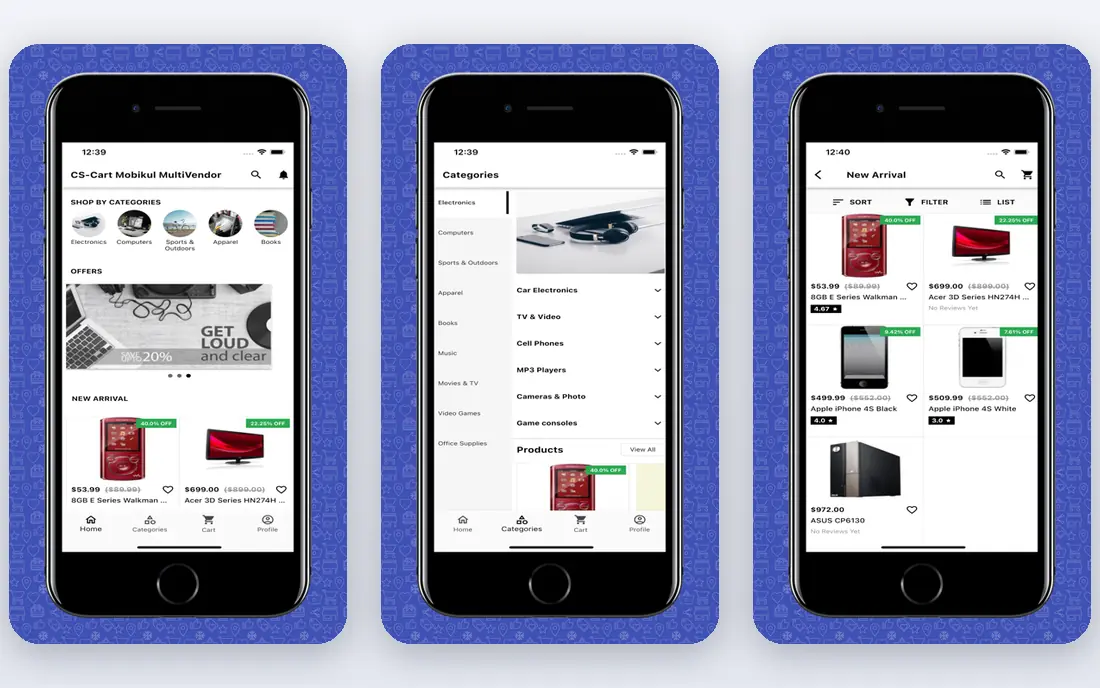
CS-Cart Multi-Vendor suits product marketplaces where catalog depth matters. Vendors manage their own products and orders, while the operator controls commissions, payouts, and the storefront. Source code ownership means a founder can customize deeply and is not tied to a monthly platform fee for the license itself.
Self-hosting is the cost of that freedom. You need hosting, updates, backups, and security care, or a hosting plan that covers them. For a product marketplace with many SKUs and vendors, that trade is often worth it. For a simple service marketplace, a hosted tool will launch faster.
- Full multi-vendor catalog, vendor admin, and payouts
- Source code ownership
- Large add-on range
- Needs hosting and setup skill
- Design and custom work may need a developer
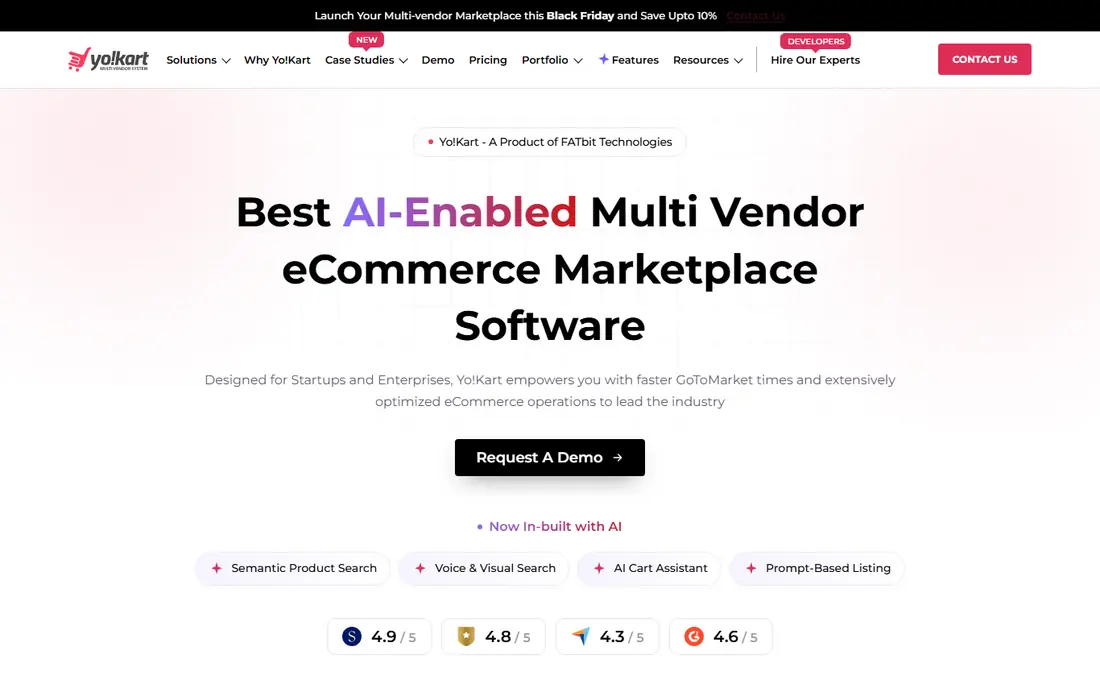
YoKart fits founders who want to own their marketplace code outright. A one-time license model avoids a growing monthly platform fee, and the system supports unlimited vendors and products on your own hosting. Ready-made buyer and seller apps also help a mobile-first launch.
Ownership does not remove running costs. Hosting, updates, and support still need budget, and custom features need a developer. YoKart suits founders who plan to grow a product marketplace for years and want cost control over that period.
- One-time license with full source code
- Unlimited vendors and products in principle
- Buyer and seller mobile apps included
- One-time license still needs hosting and maintenance
- Custom work needs developer skill
Mirakl is the enterprise pick on this list. Large retailers use it to add third-party sellers to an existing store, with onboarding, catalog management, order handling, and payouts designed for high volume. It integrates with major commerce and enterprise systems, which matters when a marketplace must fit an existing retail stack.
Small founders should not start here. Mirakl pricing and implementation suit retailers with existing traffic and revenue, not a new marketplace testing an idea. For that early stage, Arcadier or Kreezalid will launch faster and cheaper.
- Built for large retailers and brands
- Seller onboarding, catalog, and payout tools at scale
- Strong enterprise integrations
- Enterprise pricing is quoted
- Too large and costly for a small startup marketplace
Marketplacer suits retailers and enterprises that want to run a marketplace as a serious sales channel, not as a side experiment. It covers seller onboarding, product data, orders, and marketplace operations, with support for complex retail workflows. That depth helps when many sellers and large catalogs must stay consistent.
As with Mirakl, the enterprise scope is the catch. Pricing is quoted, and a new founder without existing traffic will find the cost and setup heavy. Established retailers, by contrast, may find Marketplacer a cleaner fit than building marketplace features into a standard store.
- Enterprise marketplace tools for retailers
- Seller and product management at scale
- Marketplace operations support
- Pricing is quoted
- Implementation needs enterprise planning and resources
Kreezalid fits founders who want a hosted marketplace without the complexity of a large enterprise platform. Templates cover common marketplace types, and the hosted model removes server management from the founder workload. Vendor onboarding, listings, and orders are handled in one admin area.
The limit is flexibility. A hosted template will not match a fully custom build, and unusual workflows may need workarounds. For a standard product, service, or rental marketplace, Kreezalid is a practical, fast launch option.
- Hosted marketplace with ready templates
- No server management
- Straightforward vendor and listing tools
- Less flexible than a self-hosted license
- Pricing is subscription-based
Webkul suits store owners who already run a shop and want to add multi-vendor features to it. Instead of rebuilding on a new platform, you add a marketplace extension to Magento, WooCommerce, or another supported system. Vendor dashboards, commissions, and product management then sit on top of a store you already know.
The catch is fit. Each extension is tied to its platform, so features and quality vary, and setup still needs care. If you have no store yet, a dedicated marketplace builder will launch faster. If you have a working store with traffic, Webkul can be the lowest-disruption path.
- Marketplace extensions for Magento, WooCommerce, Shopify, and other platforms
- Vendor and commission tools
- Large extension catalog
- Quality and fit vary by platform extension
- Needs an existing store and some setup skill
Dokan fits WordPress site owners who want a marketplace without leaving WooCommerce. The plugin adds vendor registration, vendor dashboards, product management, and commission settings to a WooCommerce store. A free version covers basic use, which makes it easy to test the idea.
WordPress care is the trade-off. Hosting, updates, plugin conflicts, and security all sit with the site owner. A founder who already manages WordPress will find Dokan natural. A founder who wants a fully hosted service should choose Arcadier or Kreezalid instead.
- Turns WooCommerce into a multi-vendor marketplace
- Free version for basic use
- Vendor dashboards and commission controls
- Needs WordPress and WooCommerce skill
- Performance and security depend on your hosting and plugins
How we picked these
We compared official product pages, pricing pages, and documentation, plus public comparison guides, and we kept only marketplace builders that are live in October 2026 and that support multi-vendor selling. We favored tools with a clear marketplace focus, vendor and payout features, and a reachable official site. Prices are shown as See website where vendors quote or vary pricing by plan and scale, because we do not invent numbers.
How to choose the right Sharetribe replacement
Start with your marketplace type. A service booking marketplace needs calendars, availability, and messaging. A product marketplace needs catalog depth, variants, and shipping logic. A rental marketplace needs dates, deposits, and availability rules. A tool that is strong for products may be weak for bookings, so type comes before price.
Test vendor onboarding end to end
Sign up as a vendor, list a product or service, and complete a test order during the trial. Vendor friction is where marketplaces fail, since sellers will leave if onboarding is confusing. Check commission settings, payout flow, and admin approval steps before you judge design.
Model total cost, not just the platform fee
Add payment processing fees, hosting where needed, apps or extensions, and any developer time for custom work. A low monthly fee with high custom costs can beat a higher fee with built-in features, or the reverse, depending on your needs. Run the numbers for year one and year three, not just month one.
Launch small, then expand
Start with one category, a small vendor group, and a simple transaction flow. A marketplace with ten happy vendors teaches more than a marketplace with a hundred half-finished listings. Once the core flow works, add categories, features, and vendors in stages.
Frequently asked questions
What are alternatives to sharetribe?
Alternatives to Sharetribe are marketplace builders such as Arcadier, CS-Cart Multi-Vendor, YoKart, Mirakl, Marketplacer, Kreezalid, Webkul Marketplace, and Dokan. Some are hosted services, some are self-hosted licenses, and some are plugins for an existing store, so the right choice depends on your marketplace type and technical resources.
Which Sharetribe alternative is best for a product marketplace?
For a product marketplace, CS-Cart Multi-Vendor and YoKart are strong picks, thanks to catalog depth and source code ownership. Arcadier and Kreezalid also handle product marketplaces well as hosted options, while Dokan suits WordPress and WooCommerce stores that want to add vendors.
Which Sharetribe alternative is best for services or rentals?
Arcadier and Kreezalid are the closest hosted replacements for service and rental marketplaces, with booking and template support. Sharetribe itself is strong here, so test Arcadier templates for calendars, availability, and messaging before switching, since those features decide the fit.
Is there a free alternative to Sharetribe?
Dokan offers a free version for basic WordPress marketplaces, and Arcadier, CS-Cart Multi-Vendor, and Kreezalid offer free trials. A lasting free marketplace with full vendor, payment, and payout features is rare, so plan for a paid plan or license once you launch.
Should I choose hosted or self-hosted marketplace software?
Choose hosted if you want fast launch and no server work, and choose self-hosted if you want source code ownership, deep customization, and long-term cost control. Hosted tools charge a subscription, while self-hosted tools need hosting, updates, and security care in return for that freedom.
How much does marketplace software cost?
Costs vary widely. Hosted tools charge monthly subscriptions, self-hosted tools charge one-time licenses plus hosting, and enterprise tools such as Mirakl and Marketplacer are quoted per deal. Add payment processing fees on top of platform fees in every case, and confirm the full figure before launch.
Sources
See where you really rank - block by block
ProMapRanker scans Google Maps across a grid of your service area. Simple monthly plans from $19, white-label on every plan.
Start freeKeep reading
 wpforms alternatives
Best WPForms Alternatives in 2026
We compare 9 wpforms alternatives for WordPress forms, with free and paid options, current pricing notes, and honest limits for small business sites in 2026.
Read → windows task scheduler alternatives
Best Windows Task Scheduler Alternatives in 2026
Looking for Windows Task Scheduler alternatives? We compare 9 schedulers for Windows and cross-platform work, from free tools to enterprise automation.
Read → which ai video service is best
Which AI Video Service Is Best in 2026
which ai video service is best? We compare 10 legitimate AI video services on price, avatars, editing and output quality to help you pick the right tool.
Read →