 ProMapRanker
Best Ruby on Rails Alternatives in 2026

Key takeaways
- Django is the closest full-featured match for Rails teams, with batteries included for admin, auth, and data handling in Python.
- Laravel is the best pick for PHP teams that want Rails-style elegance, scaffolding, and a large ecosystem.
- Express.js, Flask, and FastAPI suit teams that prefer small, flexible cores and want to choose each piece themselves.
- Spring Boot and ASP.NET Core fit enterprise and .NET or Java shops where long-term support and hiring depth matter most.
- All nine frameworks here are free and open source, so the real cost is developer time, hosting, and maintenance, not licenses.
Quick comparison
| Pick | Great for | Pricing starts at | Free tier | |
|---|---|---|---|---|
 Django | Full-featured Python web apps | Free | Yes | Visit |
 Laravel | Elegant PHP web apps | Free | Yes | Visit |
 Express.js | Minimal Node.js apps and APIs | Free | Yes | Visit |
 Spring Boot | Enterprise Java applications | Free | Yes | Visit |
 ASP.NET Core | Enterprise .NET web apps | Free | Yes | Visit |
 Flask | Small Python apps and APIs | Free | Yes | Visit |
 FastAPI | Fast, typed Python APIs | Free | Yes | Visit |
 Phoenix | Real-time Elixir applications | Free | Yes | Visit |
 NestJS | Structured TypeScript applications | Free | Yes | Visit |
The best ruby on rails alternatives
Ruby on Rails earned its fans by making common web work fast: routing, database models, forms, and background jobs with sensible defaults. The frameworks below offer a similar promise in other languages, or a different trade that may suit your team better. Our pick for most teams leaving Rails is Django, because it is the most complete out-of-the-box replacement in a widely hired language.
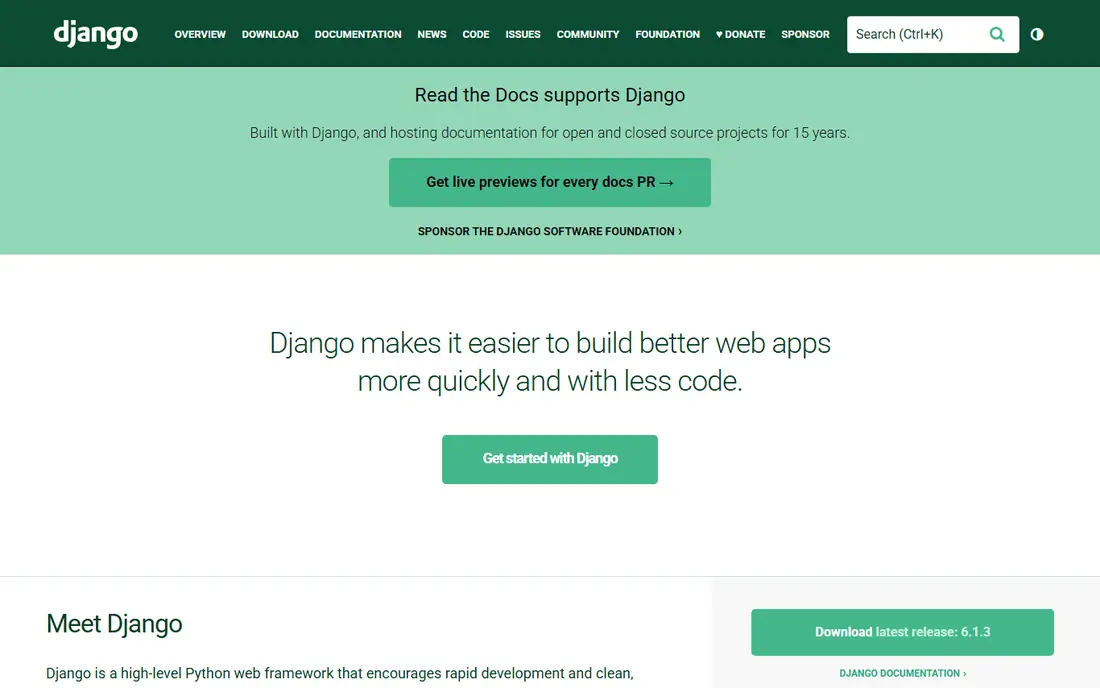
Django takes care of user authentication, content administration, site maps, and feeds without extra packages, much like Rails does for Ruby. Its object-relational mapper keeps database work in Python, and its security defaults help developers avoid common mistakes such as cross-site scripting and injection flaws. For a team moving from Rails, that completeness is comforting.
The catch is flexibility. Django leans toward a single large application with its own conventions, which can feel heavy for a tiny API or a microservice. Python hiring is broad, which helps, but teams that want a minimal core may prefer Flask or FastAPI. Still, for a full product with an admin panel and many models, Django is hard to beat.
- Built-in admin, auth, and ORM
- Strong security defaults
- Large Python ecosystem
- Monolith-first design can feel heavy for tiny APIs
- Templating style divides opinion
- Async support is newer
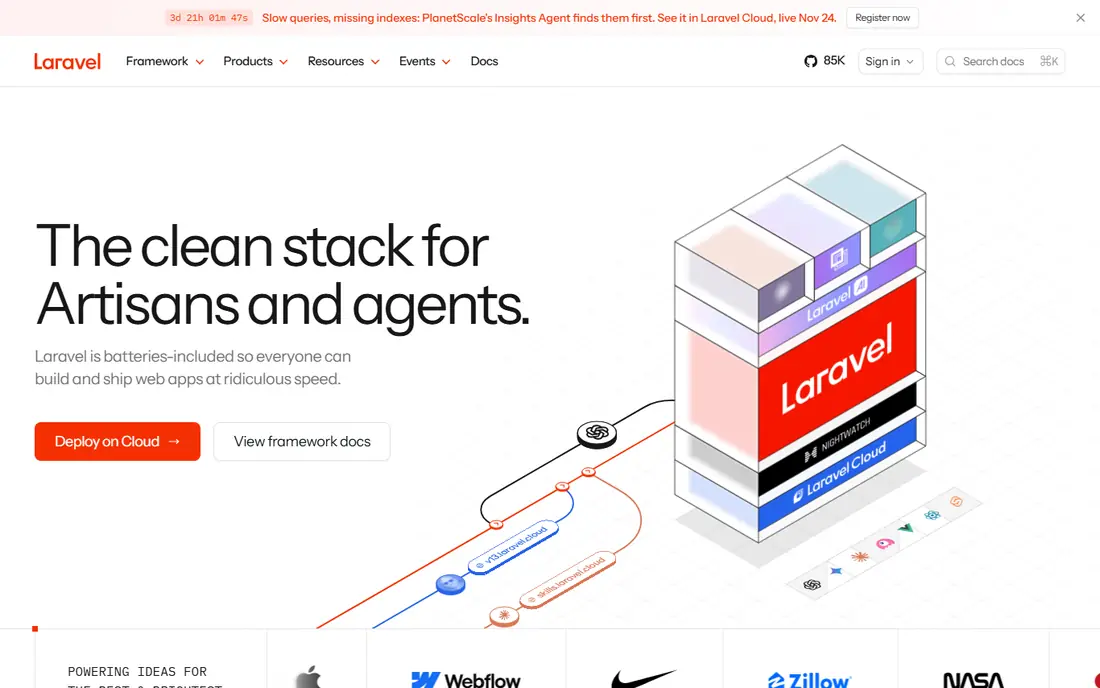
Laravel is the framework most PHP developers reach for when they want a Rails-like experience. It provides routing, an ORM called Eloquent, background jobs, authentication scaffolding, and testing helpers in one coherent package. The documentation is clear, and the surrounding ecosystem covers billing, admin panels, and deployment tools.
The honest trade is language and scale. PHP has a huge hosting base and many developers, but some teams still associate it with older codebases, which can affect hiring in certain markets. Larger Laravel apps also need care to avoid tangled controllers. If your team knows PHP or wants cheap, widely available hosting, Laravel is an excellent Rails replacement.
- Expressive syntax and scaffolding
- Built-in queues, auth, and testing tools
- Huge community
- PHP hosting habits vary
- Larger apps need discipline
- Some official tools are paid
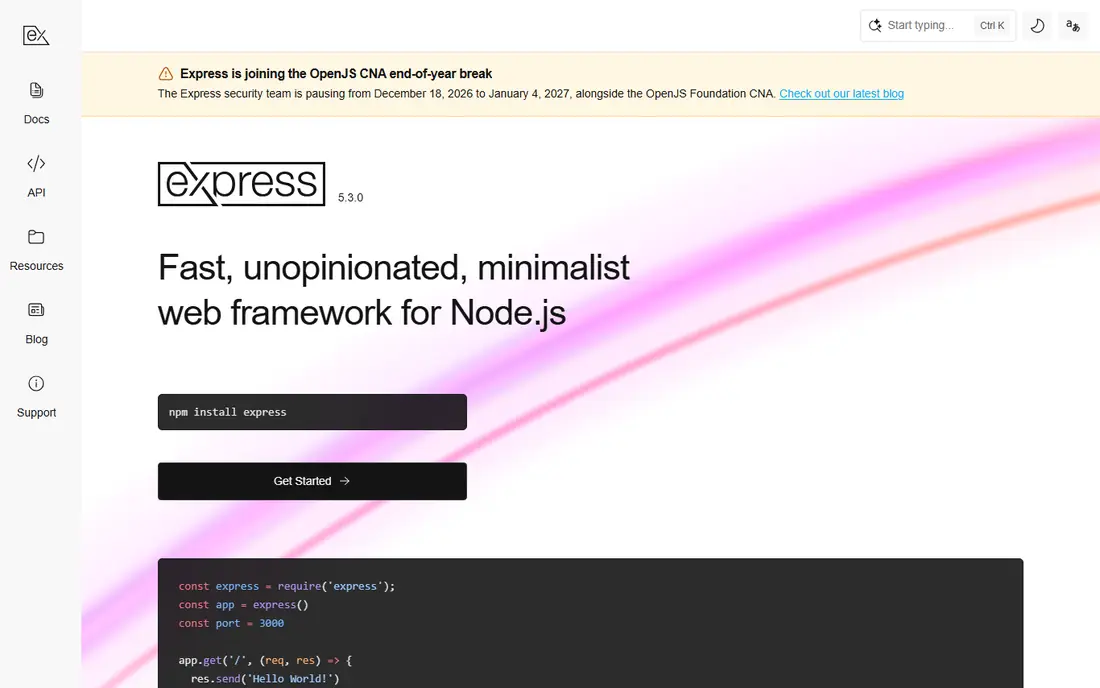
Express.js is a minimal framework for Node.js, and that minimalism is both its appeal and its cost. You get routing and middleware, then you choose your database layer, auth, validation, and structure. For an API or a small service, that freedom keeps things light and fast to start.
Rails teams may miss the defaults. There is no built-in ORM, admin panel, or job system, so each project must assemble those pieces and keep them consistent. Teams with strong JavaScript skills and a taste for small services will enjoy Express. Teams that want Rails-style guidance should look at NestJS or Django instead.
- Tiny, fast core
- Huge Node.js package ecosystem
- Same language on front and back end
- Very little built in
- Choices fall on the developer
- Codebases can drift without discipline
Spring Boot makes Java development quicker by providing sensible defaults over the Spring Framework, with embedded servers and opinionated starters for web, data, and security work. It is trusted in banks, retailers, and large firms where uptime, integration, and long-term maintenance matter more than speed of first prototype.
The cost is weight. A Spring Boot project carries more ceremony than a Rails app, and new developers may need time to learn its configuration model. For a small startup product, that weight may slow you down. For a large system that must last for years and integrate with many enterprise tools, Spring Boot is a safe, well-supported choice.
- Huge enterprise ecosystem
- Strong tooling and long-term support
- Good for large, complex systems
- Heavier setup and memory use
- Configuration can be dense
- Slower to start than Rails for small apps
ASP.NET Core is Microsoft's cross-platform web framework, running on Windows, macOS, and Linux with strong performance. It covers MVC apps, APIs, real-time features, and background work, with tooling in Visual Studio and Visual Studio Code. Teams already invested in Azure, SQL Server, or Microsoft identity will find the integration smooth.
The trade is ecosystem flavor. While ASP.NET Core is open source, many surrounding tools and habits are Microsoft-shaped, which suits some firms and frustrates others. Hiring is strong in enterprise markets but thinner in startup-heavy ones. If your firm is a .NET shop, this is the natural Rails replacement. Otherwise, Django or Laravel may feel more open.
- High performance
- Cross-platform
- Strong Microsoft tooling and support
- Microsoft-centric ecosystem
- Smaller open-source package pool than Node or Python
- Learning curve for newcomers
Flask is a microframework that gives you routing and templating, then steps aside. That simplicity makes it a favorite for learning, prototypes, and small APIs, and its documentation is famously clear. Python developers can add an ORM, auth, and background jobs from well-known packages as needed.
For a full Rails replacement, Flask asks more of the team. You must choose and maintain each piece, and a growing app needs deliberate structure to stay readable. If your project is small, or you want to learn web development piece by piece, Flask is ideal. If you want a complete product scaffold on day one, Django is the better Python pick.
- Minimal and easy to learn
- Clear documentation
- Easy to add only what you need
- Almost nothing built in
- Larger apps need structure discipline
- No built-in admin or ORM
FastAPI has become the default Python choice for building APIs, thanks to automatic interactive documentation, request validation from type hints, and strong performance. Developers can define an endpoint and get docs, validation, and serialization almost for free. That makes it a strong pick for services that feed a mobile app or a JavaScript front end.
The limit is scope. FastAPI does not try to be a full product framework with admin panels, templating, and auth scaffolding. You will add those pieces yourself or pair it with a front-end framework. For an API-first replacement for Rails, especially in a microservice design, FastAPI is excellent. For a classic server-rendered product, Django fits better.
- Automatic API docs
- Type-based validation
- High performance for Python APIs
- API-focused, not a full product framework
- No built-in admin
- Newer ecosystem than Django
Phoenix borrows Rails-style productivity and pairs it with Elixir and the Erlang runtime, which is built for concurrent, fault-tolerant systems. Its Channels feature makes live updates, chat, and dashboards straightforward, and LiveView lets developers build interactive pages with less JavaScript. For real-time products, that combination is distinctive.
The honest catch is hiring and ecosystem size. Elixir developers are fewer than Python or JavaScript developers, and some packages you take for granted elsewhere may need building. Teams willing to learn Elixir often love Phoenix for its reliability under load. Teams that need to hire quickly may prefer a larger ecosystem.
- Excellent real-time channels
- Fault-tolerant Elixir runtime
- Productive, Rails-inspired design
- Smaller hiring pool
- Elixir learning curve
- Fewer ready-made packages than Python or PHP
NestJS brings structure to Node.js, with modules, controllers, and providers inspired by enterprise frameworks. TypeScript is first-class, which helps large teams catch errors early and refactor with confidence. It also supports HTTP, WebSockets, and microservice transports in one design, so a growing system can stay coherent.
Compared with Express, NestJS asks for more upfront structure, which can feel heavy for a tiny API. Developers who dislike Angular-style patterns may also resist its style. For a Node.js team that outgrew Express and wants Rails-like organization without leaving TypeScript, NestJS is a strong, disciplined choice.
- TypeScript throughout
- Modular architecture
- Good for large Node.js teams
- More ceremony than Express
- Angular-style patterns divide opinion
- Learning curve for beginners
How we picked these
We compared official documentation, feature pages, and public project pages for each framework, focusing on how each handles routing, data, auth, background work, and real-time features. We favored frameworks that are actively maintained in October 2026, free and open source, and used in production by real teams. We did not claim hands-on testing, and we treated hosting and developer time as the real costs, since none of these frameworks charge a license fee.
How to choose a Ruby alternative
Start with your team, not the language ranking. If your developers know Python, Django or FastAPI will move faster than a technically better framework in an unfamiliar language. If they know PHP or JavaScript, Laravel, NestJS, or Express will pay off sooner. A framework your team can debug at 2 a.m. beats a fashionable one they are still learning.
Next, match the framework to the product shape. A classic product with admin pages, forms, and reports fits Django, Laravel, or ASP.NET Core. An API feeding mobile apps fits FastAPI or Express. A real-time dashboard or chat product fits Phoenix. A large enterprise system with many integrations fits Spring Boot. Write down the product shape before you compare feature lists, or every framework will look plausible.
Finally, plan for hiring and hosting. Check job availability in your market, hosting costs for your expected traffic, and how easy it is to find libraries for payments, email, and auth in that ecosystem. A small ecosystem can still work if your needs are simple, but it will cost time when you need an uncommon integration. Choose the option that keeps both your current team and your next hire productive.
Frequently asked questions
What is the closest ruby alternative to Rails?
Django is the closest ruby alternative in spirit, because it ships with admin, auth, and an ORM in one package, much like Rails does. Laravel is the closest match in the PHP world, with similar scaffolding and an expressive style. Both reduce the assembly work that minimal frameworks leave to you.
Are ruby alternatives free?
Yes, all nine frameworks in this guide are free and open source, so there is no license fee for Django, Laravel, Express, Spring Boot, ASP.NET Core, Flask, FastAPI, Phoenix, or NestJS. You still pay for hosting, developer time, and any paid add-ons or services you choose. That distinction matters when budgeting a migration.
Should I choose Django or Laravel?
Choose Django if your team prefers Python, needs strong data and machine learning libraries, or wants a built-in admin panel. Choose Laravel if your team prefers PHP, wants widely available hosting, or values its ecosystem of billing and admin tools. Both are full-featured, so team skill is usually the deciding factor.
Is Express.js a good replacement for Rails?
Express.js is a good replacement only if you want a minimal API core and are comfortable choosing your own database, auth, and structure. It is fast to start and flexible, but it does not provide Rails-style defaults. Teams that want more guidance in Node.js should consider NestJS instead.
Which framework is best for beginners?
Flask is the easiest to learn for a first web project, because its core is small and its docs are clear. Django is better for beginners who want to build a complete product without assembling many packages. Either way, pick one framework and build a real small project before judging it.
Sources
See where you really rank - block by block
ProMapRanker scans Google Maps across a grid of your service area. Simple monthly plans from $19, white-label on every plan.
Start freeKeep reading
 wpforms alternatives
Best WPForms Alternatives in 2026
We compare 9 wpforms alternatives for WordPress forms, with free and paid options, current pricing notes, and honest limits for small business sites in 2026.
Read → windows task scheduler alternatives
Best Windows Task Scheduler Alternatives in 2026
Looking for Windows Task Scheduler alternatives? We compare 9 schedulers for Windows and cross-platform work, from free tools to enterprise automation.
Read → which ai video service is best
Which AI Video Service Is Best in 2026
which ai video service is best? We compare 10 legitimate AI video services on price, avatars, editing and output quality to help you pick the right tool.
Read →