 ProMapRanker
Best React Alternatives in 2026

Key takeaways
- Vue is the easiest move for teams that want a gentler learning curve and a complete framework.
- Svelte and Solid suit performance focused apps where small bundles and fast updates matter most.
- Angular remains the best fit for large enterprise teams that want strict structure and built-in tools.
- Preact is the closest drop-in style replacement when bundle size is the main problem.
- Astro suits content heavy sites that should ship little JavaScript by default.
Quick comparison
| Pick | Great for | Pricing starts at | Free tier | |
|---|---|---|---|---|
 Vue.js | Balanced apps with a gentle learning curve | Free | Yes | Visit |
 Svelte | Fast, lightweight interfaces with less code | Free | Yes | Visit |
 Angular | Large enterprise applications | Free | Yes | Visit |
 SolidJS | Highly interactive apps with top performance | Free | Yes | Visit |
 Preact | Lightweight React-like projects | Free | Yes | Visit |
 Astro | Content sites that ship little JavaScript | Free | Yes | Visit |
 Qwik | Instant load apps with resumability | Free | Yes | Visit |
 Lit | Web components and design systems | Free | Yes | Visit |
 Alpine.js | Light interactivity on server rendered pages | Free | Yes | Visit |
The best react alternatives
We compared these frameworks on learning curve, bundle size, ecosystem, hiring pool, rendering model, and suitability for new projects in 2026. All of them are free and open source. We did not list React itself, and we treat Create React App as a tooling question covered in the buying guide, because its replacement is a build tool, not a UI framework.
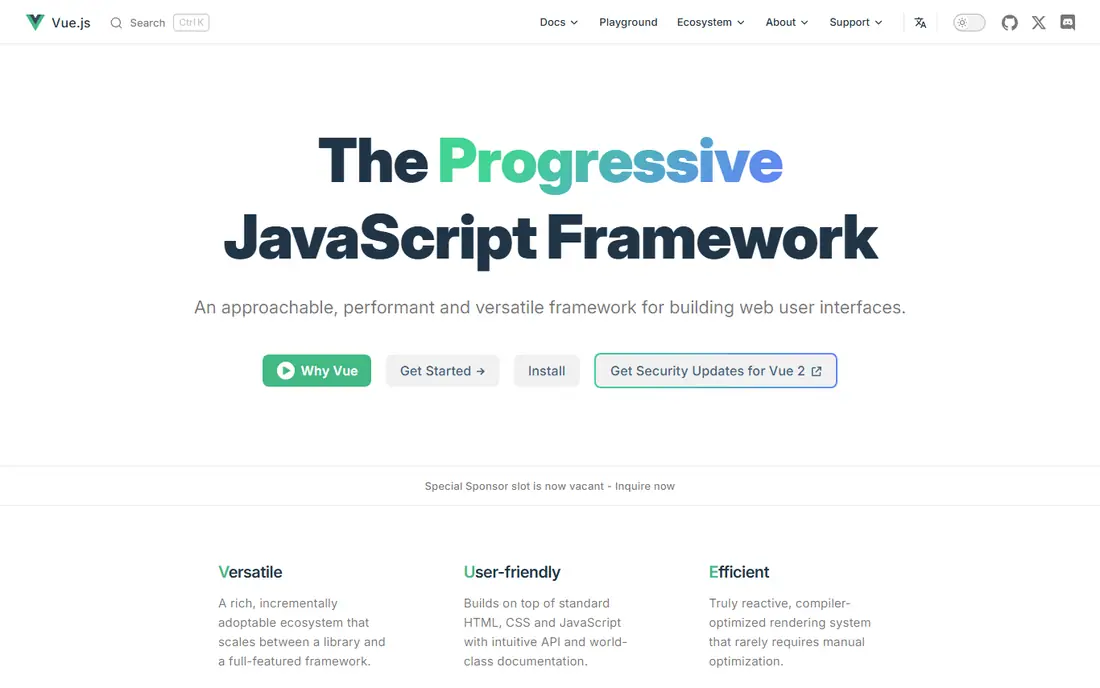
Vue is the most balanced alternative on this list. The template syntax reads clearly, the docs explain concepts in order, and the Composition API gives larger apps a structured way to share logic. For a team that wants to ship a single page app, a dashboard, or a marketing site with interactive parts, Vue rarely gets in the way.
Nuxt extends Vue with routing, server rendering, and data fetching conventions, which answers the question that Create React App left open for many teams. The ecosystem is smaller than React, so some niche libraries may need a Vue specific version or a custom build. For product teams that value developer experience and a steady learning curve, Vue is our first recommendation.
- Clear docs and template syntax
- Composition API for larger apps
- Nuxt for server rendering and routing
- Smaller hiring pool than React in the US
- Large teams need discipline to keep conventions consistent
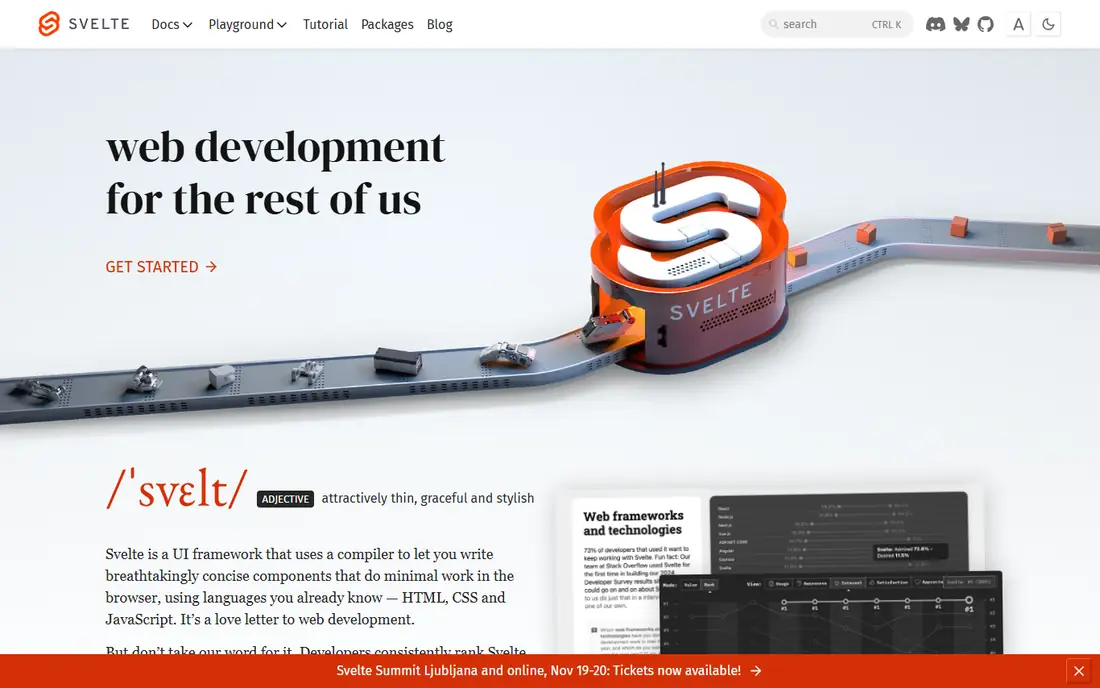
Svelte takes a different path: it compiles components into plain JavaScript at build time, so the browser downloads less framework code. Svelte 5 adds runes for reactivity, which give predictable state updates without a virtual DOM. The result is code that often reads shorter than the equivalent React component, with fast initial loads.
SvelteKit provides the full app framework layer, with routing, server rendering, and adapters for common hosts. The trade-off is ecosystem size. You will find fewer ready-made component libraries than in React or Vue, and hiring Svelte developers takes more effort. For performance critical products, embedded widgets, and content sites with interactive parts, Svelte is a strong pick.
- Compiler removes much of the framework runtime
- Small bundles
- SvelteKit for routing and server rendering
- Smaller ecosystem than Vue or Angular
- Hiring pool is smaller in many markets
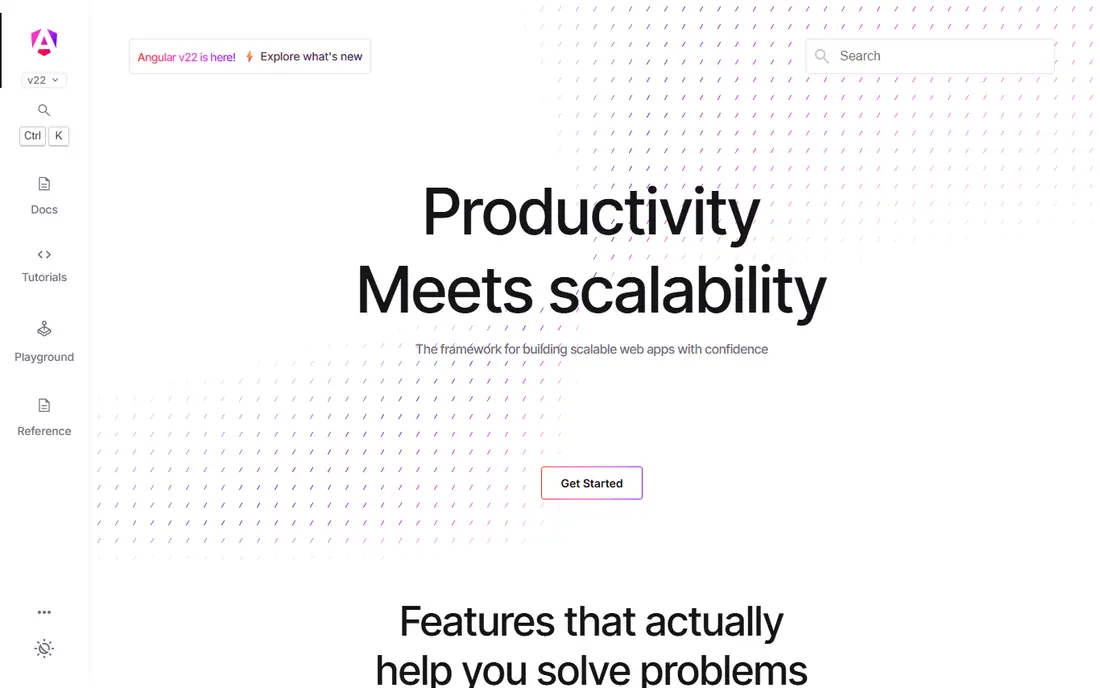
Angular suits large teams that need conventions more than flexibility. Routing, forms, dependency injection, and HTTP arrive as part of the framework, so teams spend less time choosing and wiring libraries. TypeScript is the default language, and the CLI scaffolds projects, components, and tests in a consistent way.
That structure comes with a learning curve. Angular asks developers to learn its module, component, and signal concepts before they feel productive, and small apps can feel heavy compared with Vue or Svelte. For regulated industries, internal platforms, and multi-year enterprise apps, that upfront cost pays back in consistency. For a quick landing page, Angular is more framework than you need.
- Full framework with routing, forms, and HTTP built in
- TypeScript by default
- Strong tooling and long term support
- Steep learning curve
- Larger bundles than Svelte or Vue for small apps
SolidJS will feel familiar to React developers at first glance, because it uses JSX and components, but its rendering model is different. Instead of re-rendering components, Solid updates only the DOM nodes that depend on changed state. That gives excellent performance on dashboards, data tables, and other interaction heavy interfaces.
The cost is ecosystem maturity. Solid has solid routing and state tools, but the library choice is narrower than React, and experienced Solid developers are harder to hire. If your team already knows JSX and your app is limited by rendering performance, Solid is a compelling alternative. If you need a large component catalog on day one, Vue or Angular may serve you better.
- JSX syntax familiar to React developers
- Fine-grained reactivity updates only changed DOM nodes
- Very small runtime
- Ecosystem is younger than Vue or Angular
- Fewer ready-made libraries and hiring candidates
Preact is the closest thing to a direct swap in this list. It offers a React-like component API in a much smaller package, which makes it ideal for widgets, embedded apps, and mobile web pages where every kilobyte matters. A compatibility layer lets many React libraries run under Preact, though edge cases exist and should be tested.
Preact does not try to be a full framework. Routing, state, and data fetching come from separate libraries, so you still make tooling choices. For teams that like React patterns but need a smaller bundle, or for a project that embeds into another site, Preact gives most of the React experience at a fraction of the size.
- Very small size, around 3 KB
- React-like API and JSX
- Compatibility layer for many React libraries
- Some React specific packages need the compatibility layer
- Smaller community than React
Astro fits a different kind of project from the rest of this list. It is a content-first framework that renders pages on the server and only sends JavaScript for interactive parts, called islands. That makes it ideal for docs, blogs, marketing sites, and portfolios, where speed and search visibility matter more than app-like interaction.
Astro can host components from Vue, Svelte, Solid, and other frameworks, so a team can mix tools where needed. For a full single page app with constant interaction, a framework like Vue or Svelte is a better core choice, with Astro as the shell for content pages. For content heavy sites, Astro is the most efficient alternative here.
- Ships near zero JavaScript by default
- Works with Vue, Svelte, React, and other components
- Strong for docs and marketing sites
- Not built for highly interactive single page apps
- Interactive islands need a UI framework choice
Qwik addresses startup time in a distinct way. Instead of downloading and running a large JavaScript bundle to make a server rendered page interactive, Qwik serializes state and resumes in the browser, loading code only when a user interacts. That can make large pages feel instant, even on slower connections.
The trade-off is maturity. Qwik has a smaller ecosystem and fewer developers than Vue or Angular, and its resumability model needs learning before a team can use it well. For large e-commerce or content sites where time to interactive is a business metric, Qwik is worth evaluating. For most new apps, Vue or Svelte will be easier to staff.
- Resumable design avoids large hydration downloads
- Lazy loads code on interaction
- Good for large e-commerce pages
- Smaller ecosystem
- Concepts take time to learn
- Hiring pool is small
Lit is the right alternative when the goal is a shared component library rather than a single app. It builds standard web components with a small runtime, so the same button, card, or form control can run inside a Vue app, an Angular app, or a plain HTML page. That portability matters for design systems and for teams that maintain several front ends.
Lit is not a full app framework. It does not ship routing, state management, or server rendering conventions, so an app team must add those pieces. If you need one app, choose Vue, Svelte, or Angular. If you need components that outlive any one framework, Lit is the most standards based choice here.
- Built on web standards
- Small runtime
- Components work in any framework or plain HTML
- Less app level tooling than full frameworks
- Routing and state need separate choices
Alpine.js suits pages that are mostly server rendered HTML with a few interactive parts: dropdowns, modals, tabs, and small forms. You add directives directly in HTML, and Alpine handles state and events without a build step for basic use. That makes it a good partner for traditional server frameworks and for teams that do not want a full JavaScript app.
The limit is scale. As state grows and components interact, Alpine code becomes harder to organize than a Vue or Svelte app. Use Alpine when interactivity is light and the page is server rendered. When the page becomes an app, move to a full framework rather than stretching Alpine past its design.
- Tiny footprint
- Declarative directives in HTML
- No build step required for basic use
- Not suited to large single page apps
- Complex state logic becomes hard to manage
How we picked these
We compared official docs, release activity, and 2026 framework usage data for frameworks that are actively maintained and usable for new production projects. We favored frameworks with clear docs, a routing or meta-framework path, and a real hiring or community base. We left out experimental projects and tools that only replace the build step, because those are not UI framework alternatives.
We did not run benchmark tests ourselves. Bundle and usage figures come from published surveys and docs, and they shift with each release, so check the current docs for the version you plan to use.
Replacing Create React App and choosing a stack
Create React App was a starter and build setup, not the React library itself, so its replacement depends on what you are replacing. If you keep React, Vite is the standard modern build tool, with fast development and a simple config. If you move away from React, the framework on this list usually brings its own starter: Nuxt for Vue, SvelteKit for Svelte, Angular CLI for Angular, and Astro for content sites.
Choose by project shape first. Content sites go to Astro. Small interactive widgets go to Preact or Alpine. Product apps with a team go to Vue or Svelte. Large enterprise platforms go to Angular. Performance critical dashboards go to Solid. Then check hiring, component libraries, and hosting support for that choice, because those practical factors decide whether a good framework stays good in production.
Frequently asked questions
What is the best alternative to React?
Vue is the best general alternative for most teams, because it balances learning curve, docs, ecosystem, and hiring. Svelte is best for performance, Angular is best for large enterprises, and Preact is best when bundle size is the main concern.
What replaces Create React App?
Vite replaces the Create React App build tooling if you stay with React. If you switch frameworks, use that framework starter instead: Nuxt, SvelteKit, Angular CLI, or Astro, depending on your choice.
Is Vue easier than React?
For most beginners, yes. Vue templates read clearly, the docs guide you in order, and common features need less setup. React remains stronger for hiring and for the largest library ecosystem, so ease of learning is only one factor.
Should I use Svelte or Solid for a new app?
Choose Svelte if you want a compiler based framework with a full app kit in SvelteKit and a growing community. Choose Solid if you already know JSX and your app is limited by rendering speed on highly interactive views.
Can I use Astro with React components?
Yes. Astro supports components from several frameworks, including React, Vue, and Svelte, as interactive islands on otherwise static pages. That makes Astro a useful shell even when a team keeps some React components.
Sources
See where you really rank - block by block
ProMapRanker scans Google Maps across a grid of your service area. Simple monthly plans from $19, white-label on every plan.
Start freeKeep reading
 free alternatives to grok imagine
Free Alternatives to Grok Imagine in 2026
We compared the best free alternatives to grok imagine for image generation, from fast daily credits to design tools, so you can create without paying.
Read → best tools for instagram content creation
Best Tools for Instagram Content Creation in 2026
Compare the best tools for Instagram content creation, from Canva and CapCut to Later and Buffer, on design, video, planning, scheduling, and price in 2026.
Read → best tool to split pdf files
Best Tool to Split PDF Files in 2026
We compared the best tool to split pdf files on split modes, file limits, privacy and price, so you can split a PDF cleanly and keep every page in one go.
Read →