 ProMapRanker
Best Profound Alternatives in 2026

Key takeaways
- Profound is aimed at large enterprise programs, so most smaller teams get better value from a focused tracker such as Otterly AI or Peec AI.
- Scrunch AI stands out when you also need to check how AI crawlers read your own site, not just how answers mention your brand.
- AthenaHQ is the only tool here with a free ongoing plan, but its paid plan starts much higher than the budget options.
- Semrush and Ahrefs make sense only if you already pay for those suites, since their AI visibility features sit inside a wider SEO product.
- Prices in this market change often, so confirm prompt limits, engine lists, and credit rules on the vendor page before you buy.
Quick comparison
| Pick | Great for | Pricing starts at | Free tier | |
|---|---|---|---|---|
 Scrunch AI | Enterprise brands and agencies | $250 per month | Free trial | Visit |
 Peec AI | Mid-market marketing teams | $95 per month | Free trial | Visit |
 Otterly AI | Small teams on a tight budget | $29 per month | Free trial | Visit |
 AthenaHQ | Teams that want to test before paying | Free | Yes | Visit |
 Rankscale | GEO audits and frequent tracking | See website | Free trial | Visit |
 Semrush AI Visibility Toolkit | Teams already using Semrush | $99 per month | Free trial | Visit |
 Ahrefs Brand Radar | Teams already using Ahrefs | See website | No | Visit |
 ZipTie | Google AI Overviews and shopping tracking | $69 per month | Free trial | Visit |
The best profound alternatives
Profound tracks how brands appear in AI answers, and these alternatives cover the same job in different ways. Some focus on low cost, some on deep enterprise reporting, and some sit inside a suite you may already use. We compared official feature pages, pricing pages, and public reviews to put this list together.
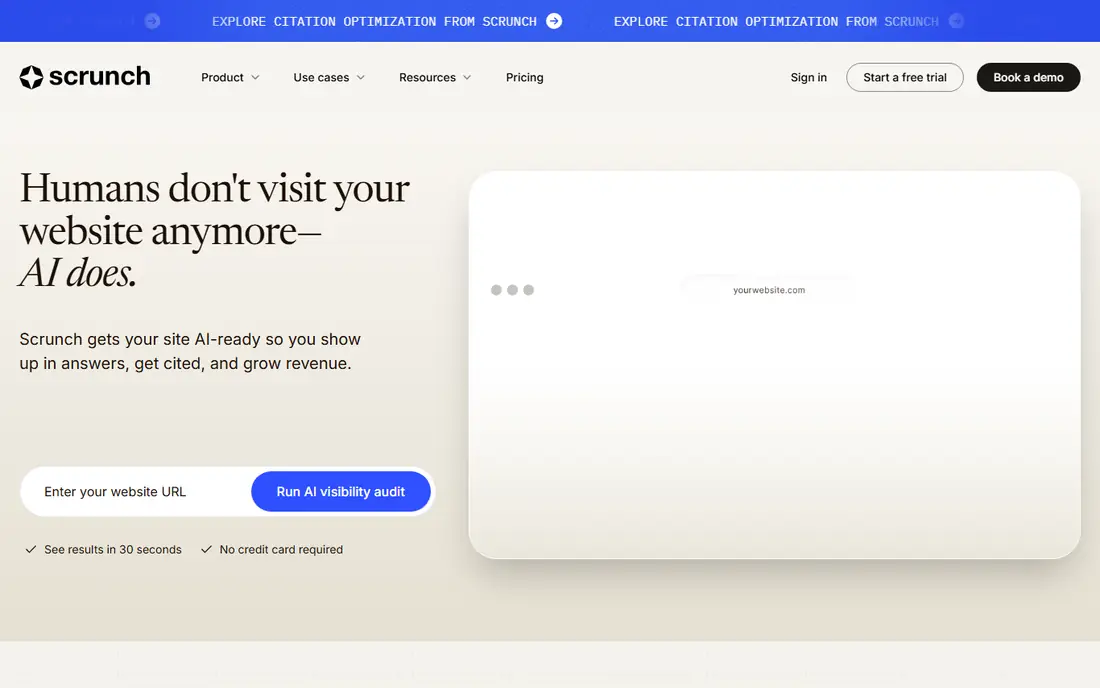
Scrunch AI suits a brand that worries about what AI answers say, and about what AI systems can read on its own site. It tracks brand mentions across ChatGPT, Gemini, Perplexity, Claude, Google AI Overviews, AI Mode, and Meta AI, and it breaks results down by persona, topic, and stage of the buying journey. That split matters when different kinds of customers get different answers to the same kind of question.
The second half of the product is the part most rivals do not offer in the same form. Scrunch monitors AI bot traffic to your site and helps create a machine-readable content layer alongside your normal pages, so AI agents can parse your content more cleanly. The trade-off is price. At $250 per month to start, it is a serious commitment, and smaller teams should test a cheaper tracker first unless brand safety or misinformation is a real, ongoing problem.
- Tracks mentions, sentiment, citations, and share of voice
- Checks AI bot traffic and crawler access
- Includes an agent experience layer for site content
- High starting price for small teams
- Prompt and plan limits need careful checking before purchase
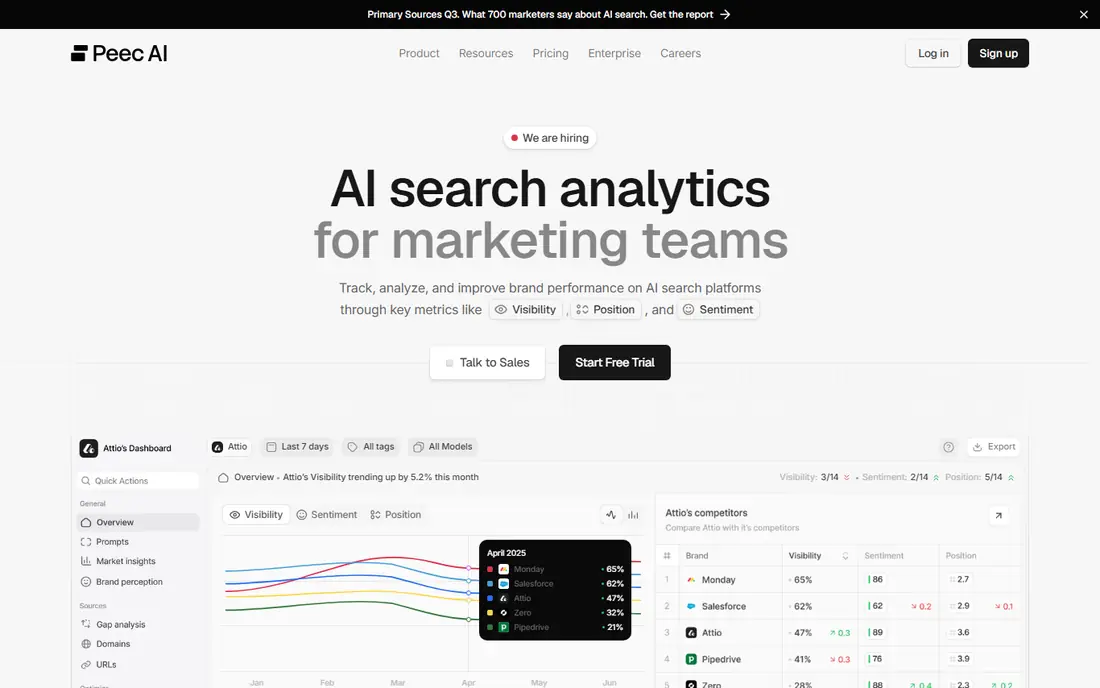
Peec AI is a focused AI search analytics tool, and that focus is its strength. You pick the prompts that matter to your brand, watch how AI models answer them, and compare your visibility with rivals over time. The dashboard centers on visibility, position, and sentiment, which keeps weekly reporting simple for a marketing team that does not want to learn a whole new SEO suite.
For brand and PR teams, the citation view is the most useful part. It shows which sources shape the answers, so you can see when a review site, a news story, or a competitor page is doing the talking instead of your own content. Peec AI is less suited to a team that wants one tool to also rewrite pages or fix technical site problems, since the work of acting on the findings still happens elsewhere.
- Clear prompt, visibility, sentiment, and citation trends
- Side-by-side competitor tracking
- API and reporting on most plans
- Engine choice varies by plan
- Full coverage across many models can push costs up
Otterly AI is the easiest place to start if you have never tracked AI search before. The entry price is low, setup is close to entering your brand and your competitors, and the tool runs prompts across the main AI search surfaces and reports mentions, citations, and share of voice. It also audits pages for crawlability and AI readiness, which gives a small team a concrete next step after seeing a gap.
The catch is scope. More engines, including Claude and Google AI Mode, sit behind add-ons on some plans, so the headline price is not always the full price for the coverage you want. Check the plan page for the engines you actually care about, and confirm how often your prompts refresh. For a first tracker, though, Otterly AI gives a fair amount of signal for the money.
- Lowest paid starting price in this list
- Covers ChatGPT, Perplexity, Google AI Overviews, and Copilot
- Includes content audits and briefs
- Some engines are paid add-ons
- Data refresh timing and prompt limits vary by plan
AthenaHQ works on credits, where one credit equals one AI response, so your cost depends directly on how many prompts you track and across how many models. The free Essential plan gives a monthly credit allowance across five models, which is enough to test whether AI visibility tracking is useful for your brand before spending anything. Starter adds 11 models, integrations, and content optimization help.
That credit model is both the appeal and the warning. A team tracking 100 prompts across six engines every day will burn through credits fast, so you need to map your prompt list against the allowance before choosing a plan. If your list is small and focused, AthenaHQ is a strong test bed. If your list is large, compare its credit math with a flat-tier rival before you commit.
- Free Essential plan with credits each month
- Starter covers 11 models
- Includes content recommendations and competitor insights
- Starter costs $295 per month, a large jump from free
- Credit use needs planning for large prompt lists
Rankscale is built for teams that want to connect measurement to page-level fixes. Its audits score how ready a page is for AI citation and break that score down by priority factors, which helps a content team decide what to fix first instead of staring at a single visibility number. Tracking frequency is flexible too, from hourly to monthly, which suits teams watching fast-moving shopping or news topics.
The wider engine list is another plus, with ChatGPT, Perplexity, Claude, Gemini, Google AI Overviews, Google AI Mode, DeepSeek, Grok, and Copilot among those named. The downside is pricing clarity. Rankscale uses credits, and the entry plan price has differed between readings, so treat any figure you see in a roundup as a prompt to check the vendor page on the day you buy.
- Page audits with an AI readiness score
- Tracking can run hourly to monthly
- Covers many engines including DeepSeek and Grok
- Credit-based pricing can be hard to compare at a glance
- Entry plan pricing has varied between readings
Semrush AI Visibility Toolkit is the practical choice if your SEO team already lives in Semrush. It tracks how your brand appears in AI answers from ChatGPT, Google AI, Gemini, and Perplexity, and it sits next to the keyword, backlink, and site audit data your team already checks. That context helps, because a drop in AI visibility is easier to read when you can also see ranking and technical changes in the same place.
The toolkit also audits whether AI crawlers can reach your site, which is a common and fixable reason for missing citations. The honest drawback is packaging. As a per-domain add-on, it adds up if you track many sites, and a team that does not use the rest of Semrush will get better value from a dedicated tracker on this list.
- AI answer tracking beside traditional SEO data
- Includes a technical crawl-access audit
- Large prompt database behind it
- Priced per domain as an add-on, so costs stack across sites
- Not a standalone specialist tool
Ahrefs Brand Radar suits an SEO team that already trusts Ahrefs data and wants AI visibility without adding another vendor. It tracks brand mentions across AI surfaces and ties them to the search data Ahrefs is known for, which helps when you need to show how AI answers relate to the queries people actually type. Competitor and citation views round out the picture for a team doing regular reporting.
Where it falls short is action guidance. Brand Radar tells you where you stand and what sources appear, but it is less direct than some specialists about the exact page change to make next. If you already pay for Ahrefs, that trade is easy to accept. If you do not, a dedicated tracker will usually cost less for the same core job.
- Built on a very large set of real search-backed prompts
- Shows brand mentions, competitors, and citations
- Fits an existing Ahrefs workflow
- AI visibility sits inside a larger Ahrefs subscription
- Less prescriptive about which page to change
ZipTie is a good fit when Google AI Overviews matter most to your traffic, which is true for many content and commerce sites. It tracks how your brand and pages appear in AI Overviews, ChatGPT, and Perplexity, and it also follows AI shopping cards and ads, which matter when a buyer sees a product summary before ever visiting a site. That shopping angle is one reason to pick ZipTie over a generic tracker.
The tool is lighter than the enterprise options here, and that shows in reporting depth for very large programs. For a small or mid-size team with a focused prompt list, though, the lower starting price and the Overviews focus make it a sensible alternative to Profound. Confirm which engines and features sit on your chosen plan before you sign up.
- Strong focus on Google AI Overviews, ChatGPT, and Perplexity
- Tracks AI shopping results and ads in some plans
- Pay-per-check options suit small lists
- Less depth than enterprise specialists for large multi-brand programs
- Check engine coverage on your plan
How we picked these
We compared official feature and pricing pages, plus public roundups and reviews, and kept only tools that exist and work now, in October 2026, and that track brand visibility in AI answers. We favored a mix of budget trackers, mid-market tools, enterprise options, and suite add-ons, so readers at different budgets can find a fit. We did not count a tool as a Profound alternative just because it does traditional SEO, and we left out tools whose pricing or engine coverage we could not verify at all.
What to check before you switch
A tracker is only useful if it watches the prompts your customers actually ask, so start there and work outward.
Match the engine list to your traffic
List the AI surfaces that send you traffic or shape buying decisions in your market, then check each tool against that list. A cheap plan that skips the engine your customers use most is not a bargain. Ask for a trial run on your real prompts before you pay for a year.
Count prompts, models, and credits together
Flat tiers, per-domain add-ons, and credit systems price the same work in very different ways. Write down your prompt count, your model count, and how often you need fresh data, then work out the monthly cost for that exact shape. This step alone often changes which tool looks cheapest.
Plan who acts on the findings
Some tools stop at measurement, while others add audits, briefs, or content suggestions. If no one on your team owns the fixes, pick a tool with clear next steps, or pair a simple tracker with a content owner who can act weekly. A dashboard no one acts on is just another subscription.
Frequently asked questions
What is Profound?
Profound is an AI search visibility platform that tracks how brands appear in answers from AI models and AI search surfaces, with prompt-level analytics and competitive benchmarking. It is aimed mainly at enterprise teams, which is why many smaller teams look for alternatives with lower starting prices.
What is the cheapest Profound alternative?
Otterly AI has the lowest paid starting price in this list, at $29 per month, and AthenaHQ offers a free plan with a monthly credit allowance. The cheapest option for you still depends on how many prompts and models you track, since credit-based plans can cost more for large lists.
Do these tools replace traditional SEO tools?
No, not on their own. AI visibility trackers show how AI answers mention and cite your brand, while traditional SEO tools track rankings, links, and technical site health. Many teams run both, or pick a suite add-on such as Semrush or Ahrefs when they already use that suite.
How many prompts should I track to start?
Start with the questions your customers ask most, plus a handful of comparison and buying questions, and add competitor prompts for context. A focused list of 20 to 50 prompts usually gives a clearer picture than a long list no one reviews, and you can expand once the routine is working.
Can a tracker improve my AI visibility by itself?
No. A tracker shows where you are mentioned, where you are missing, and which sources AI answers cite. Improving visibility still takes content work, such as clearer pages, better structure, and coverage on the sources AI systems trust in your market.
Sources
- https://scrunch.com
- https://peec.ai
- https://otterly.ai
- https://athenahq.ai
- https://rankscale.com
- https://www.semrush.com
- https://ahrefs.com
- https://ziptie.ai
- https://visible.seranking.com/blog/searchable-alternatives/
- https://brandmentions.com/blog/best-geo-tools/
- https://www.hyperank.ai/blog/athenahq-review/
See where you really rank - block by block
ProMapRanker scans Google Maps across a grid of your service area. Simple monthly plans from $19, white-label on every plan.
Start freeKeep reading
 which software is best for pdf page removal
Which Software Is Best for PDF Page Removal in 2026
Find which software is best for pdf page removal, from free online tools to desktop editors, with page controls, privacy, safety, and pricing compared.
Read → when i work alternatives
Best When I Work Alternatives in 2026
Looking for when i work alternatives? We compare 8 scheduling apps for hourly teams, covering pricing, free plans, time clocks and the best fit for business.
Read → the best tool for keyword analysis
The Best Tool for Keyword Analysis in 2026
Find the best tool for keyword analysis with our 2026 comparison of 10 keyword analysis software tools on data depth, difficulty scores and price today.
Read →