 ProMapRanker
Best Palantir Alternatives in 2026

Key takeaways
- Palantir Foundry combines pipelines, modeling, and operational apps, so no single tool below copies it exactly; most teams will combine two tools.
- Databricks and Snowflake are the closest large-scale replacements for data engineering and analytics work.
- Microsoft Fabric suits Microsoft shops that want data, analytics, and Power BI in one capacity-based service.
- Dataiku, Alteryx, and Domo suit teams that need more analyst-friendly workflows and dashboards without a large engineering team.
- Our pick for most organizations is Databricks for engineering-heavy work, or Snowflake plus a business intelligence tool for analytics-led teams.
Quick comparison
| Pick | Great for | Pricing starts at | Free tier | |
|---|---|---|---|---|
 Databricks | Unified engineering and AI work | See website | Free trial | Visit |
 Snowflake | Cloud data warehousing | See website | Free trial | Visit |
 Microsoft Fabric | Microsoft-centered data platform | See website | Free trial | Visit |
 Google BigQuery | Serverless analytics at scale | See website | Yes | Visit |
 Dataiku | Analyst-friendly data workflows | See website | Free trial | Visit |
 Alteryx | Data preparation and analytics | See website | Free trial | Visit |
 Domo | Dashboards and business apps | See website | Free trial | Visit |
 Qlik | Associative analytics and dashboards | See website | Free trial | Visit |
 ThoughtSpot | Search-driven analytics | See website | Free trial | Visit |
The best palantir alternatives
Palantir is known for Foundry, which ties data pipelines, a shared business model, and operational applications together, and for Gotham, used in government and defense work. The tools below cover different parts of that picture. Read each one for the part it actually replaces, rather than expecting a one-to-one copy.
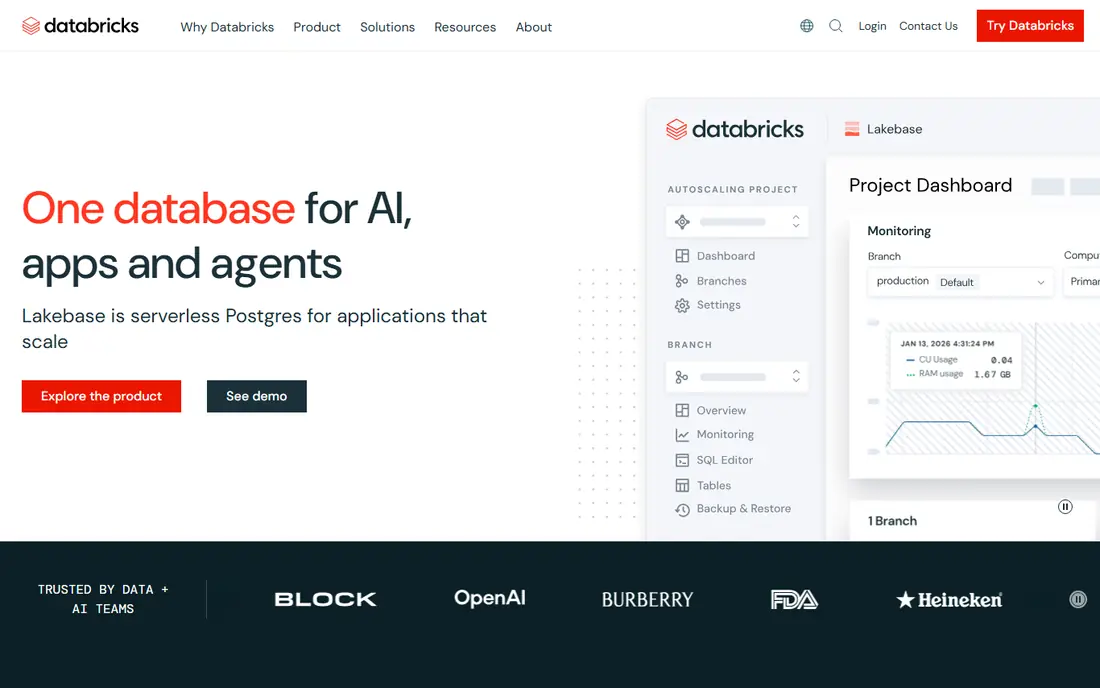
Databricks is the closest match for teams that build pipelines, transform data at scale, and train models on the same platform. Its lakehouse approach keeps raw and refined data in one place, and Delta Lake adds versioning and governance to tables that would otherwise be loose files. For an organization leaving Foundry for engineering reasons, Databricks is often the first serious test.
The trade-off is that Databricks is a platform for builders, not a ready-made operational app layer. Non-technical users will still need dashboards or apps built on top of it. Budget owners should also set cost alerts early, since cluster sprawl is a known risk.
- Strong Spark-based engineering and machine learning
- Delta Lake for governed tables
- Large open source community
- Usage costs need active governance
- Teams need engineering skill to get full value
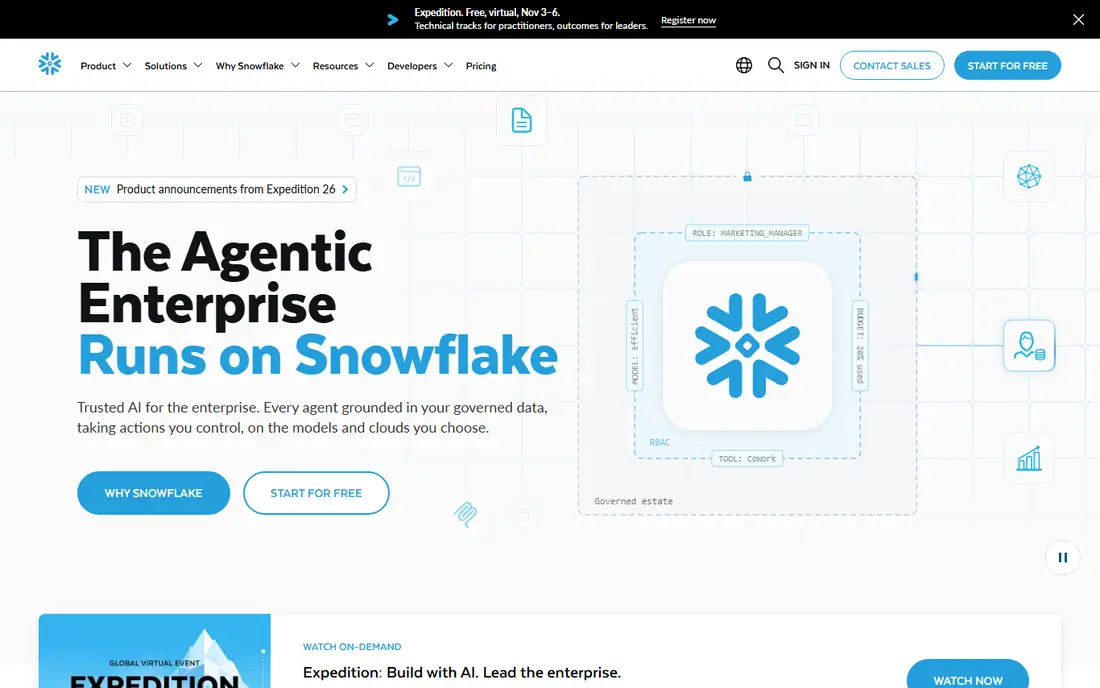
Snowflake fits analytics-led organizations that want a clean, governed warehouse for reporting and analysis. Storage and compute scale separately, so a reporting workload does not have to pay for idle capacity in the same way a fixed cluster would. Its partner ecosystem also means most business intelligence tools connect to it without friction.
Snowflake does not replace Foundry operational apps on its own. Teams usually pair it with a transformation tool such as dbt and a dashboard tool such as Tableau, Power BI, or ThoughtSpot. That combination is flexible, but it needs someone to own the full stack.
- Separation of storage and compute
- Easy scaling for analytics workloads
- Broad partner and business intelligence ecosystem
- Usage-based costs can surprise teams without governance
- Operational app features need other tools
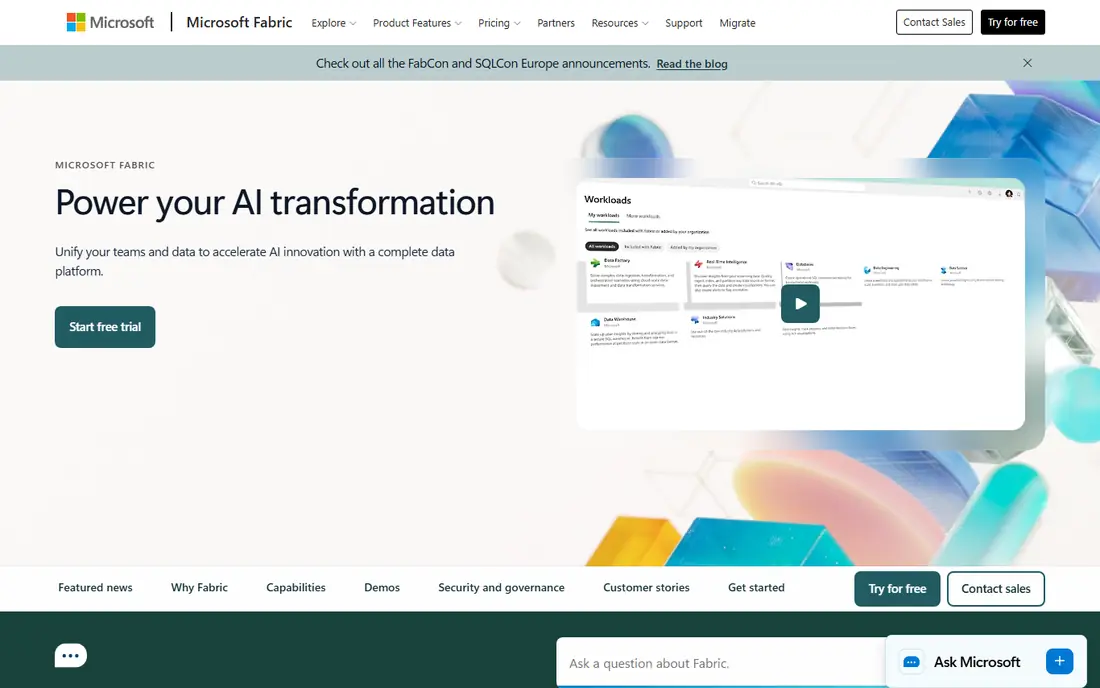
Microsoft Fabric suits organizations that already live in Microsoft 365, Azure, and Power BI. It brings data engineering, a data warehouse, real-time analytics, and Power BI reports under one capacity model, so teams do not have to stitch together as many separate services. For a Microsoft shop, that consolidation is the main appeal.
The catch is sizing. Capacity units, storage, and Power BI licensing interact in ways that take time to model. Teams outside the Microsoft ecosystem will get less value here, and should compare Databricks or Snowflake first.
- Data engineering, warehousing, and Power BI in one service
- Capacity-based pricing
- Deep Microsoft 365 integration
- Capacity sizing can confuse new buyers
- Best value stays inside Microsoft shops
BigQuery fits teams that want analytics without managing infrastructure. There are no clusters to size, and queries run over large datasets quickly when tables are partitioned and queries are written with care. Google Cloud shops, and teams with large event or log datasets, often find it the simplest warehouse option.
Cost control is the discipline here. Unpartitioned tables and broad scans can raise bills fast, so teams need query habits and cost alerts from day one. BigQuery is an analytics engine, not a Foundry replacement for operational workflows.
- Serverless design with no clusters to manage
- Fast queries over very large datasets
- Strong Google Cloud integration
- On-demand scan pricing can grow with careless queries
- Operational apps need separate tools
Dataiku fits the middle ground that Foundry often serves: analysts and data scientists who need to build pipelines without handing every step to engineers. Visual recipes make a workflow readable, while code notebooks stay available when a step needs custom logic. Governance features help teams track who built what and which model is in production.
The platform is enterprise-priced, so small teams should test the trial and confirm fit before assuming it is affordable. For mid-sized teams with mixed technical skill, Dataiku can reduce the bottleneck that forms when only engineers can change a pipeline.
- Visual workflows that analysts can build and audit
- Code options for engineers
- Governance and model tracking
- Enterprise pricing is quoted
- Very large engineering teams may prefer code-first platforms
Alteryx suits analyst teams that spend most of their time cleaning, joining, and preparing data for reports. Its visual workflow tools let an analyst build a repeatable preparation step without writing a pipeline in code. That speed matters when business questions change weekly and engineering time is scarce.
Alteryx is less of a full data platform than Databricks or Snowflake. It prepares and analyzes data well, but large-scale warehousing and operational apps still need other systems. Treat it as a strong preparation layer, not as a complete Foundry copy.
- Drag-and-drop preparation and blending
- Strong for analyst-led analytics
- Wide connector range
- Desktop roots can complicate cloud-native plans
- Pricing is quoted for many teams
Domo fits business teams that want to see data quickly and act on it. It connects to common business systems, builds dashboards, and supports simple apps and alerts without a long engineering project. For a team that left Foundry because business users could not see or use the data, Domo addresses that exact frustration.
The limit is depth. Domo is not a replacement for a warehouse or a full engineering platform, and complex transformations belong upstream. Use it as the visible layer on top of a governed warehouse, and it performs well.
- Connectors, dashboards, and lightweight apps in one place
- Fast time to a visible result
- Mobile-friendly reporting
- Quoted pricing
- Heavy data engineering still needs a warehouse underneath
Qlik suits teams that want analysts and managers to explore data without writing a query for every question. Its associative model lets users click through related values and see what is included and excluded, which can surface patterns that a fixed report would hide. That exploration style is useful for operational reviews and planning work.
The trade-off is learning curve. Qlik modeling rewards teams that invest in clean data models, and a rushed model will frustrate users. It also sits on the analytics side of a Foundry replacement, so pipelines and warehousing still need a home elsewhere.
- Associative engine for exploring data freely
- Strong dashboard and reporting tools
- Cloud and on-premises options
- Pricing is tiered and quoted for larger plans
- Learning the modeling approach takes time
ThoughtSpot fits organizations where business users ask ad hoc questions all day. Instead of waiting for a report, a manager can search in plain language and get a chart from governed data. That self-service model reduces the queue of small reporting requests that slows down analytics teams.
The catch is data modeling. ThoughtSpot answers are only as good as the underlying models and definitions, so a team must invest in that groundwork. It is a strong front end for a warehouse, not a pipeline or warehouse replacement on its own.
- Natural-language search over governed data
- Fast answers for business users
- Liveboards for shared metrics
- Needs well-modeled data to work well
- Enterprise pricing is quoted
How we picked these
We compared official product pages, pricing pages, and documentation, plus public comparison guides, and we kept only platforms that are live in October 2026 and that replace a real part of Palantir work: engineering, warehousing, preparation, or business analytics. We did not list Palantir itself, and we did not list narrow dashboard tools with no data platform role. Prices are shown as See website where vendors quote or use usage-based models, because a single figure would mislead buyers.
How to replace Foundry without losing the operational layer
Foundry value often sits in the operational apps that business users open every day, not just in the pipelines behind them. Before choosing a replacement, list those apps and the decisions they support. A warehouse alone will not replace a workflow app, and a dashboard alone will not replace a write-back process. That list decides whether you need a second tool for apps, such as a low-code builder or a business intelligence app layer.
Separate the warehouse decision from the app decision
Choose the warehouse or lakehouse first, based on your engineering skill and cloud home. Then choose the analytics and app layer based on who will use it daily. This split keeps each purchase honest. A team that buys one platform to solve both problems often ends up with a compromise on both.
Test with a real business question
Run a pilot around one real question, from raw source data to a decision a manager can act on. Measure time to answer, data freshness, and how much engineering help the business user still needs. A pilot that only loads data proves nothing. A pilot that answers a real question shows whether the replacement actually works.
Plan governance from the start
Foundry buyers often value its shared business model and access controls. Any replacement stack needs the same care: defined metrics, access rules, and owners for each dataset. Without that work, a cheaper stack can still produce conflicting numbers, and conflicting numbers will send users back to spreadsheets.
Frequently asked questions
What are the best palantir alternatives?
The best palantir alternatives depend on the part of Palantir you need to replace. Databricks and Snowflake lead for large-scale engineering and warehousing, Microsoft Fabric leads for Microsoft shops, and Dataiku, Domo, Qlik, and ThoughtSpot lead for analyst and business-user analytics. Most teams combine a warehouse with an analytics tool rather than buying one direct copy.
Is there a free alternative to Palantir?
There is no free tool that copies Foundry in full. BigQuery offers a free tier, and several tools on this list offer free trials. Open source tools such as Apache Spark, Airflow, and dbt can form a free engineering stack, but they need engineering time to build and maintain, which is a real cost.
Which alternative is closest to Palantir Foundry?
Databricks is often the closest for engineering and AI work, while Microsoft Fabric is close for organizations that want pipelines, warehousing, and reporting in one Microsoft service. Neither copies Foundry operational apps exactly, so teams that rely on those apps should plan for a separate app layer.
Why is Palantir so expensive compared with these tools?
Palantir pricing is negotiated and enterprise-focused, and it bundles platform, implementation, and support in a way that usage-based tools do not. Usage-based tools such as Snowflake and BigQuery charge for what you run, which can be cheaper for a defined workload but needs governance to stay controlled. Compare total cost, including engineering time, not just license figures.
Can Snowflake replace Palantir on its own?
Snowflake can replace the warehousing and analytics core for many teams, especially when paired with a transformation tool and a dashboard tool. It does not replace Foundry operational apps or write-back workflows on its own. If your team depends on those apps, add an app or low-code layer to the plan.
Should small teams use these enterprise platforms?
Small teams should start with the simplest tool that answers their question, which may be BigQuery, a smaller warehouse, or a business intelligence tool on top of existing data. Enterprise platforms pay off when data volume, team size, or governance needs grow past what a simple stack can manage cleanly.
Sources
See where you really rank - block by block
ProMapRanker scans Google Maps across a grid of your service area. Simple monthly plans from $19, white-label on every plan.
Start freeKeep reading
 wpforms alternatives
Best WPForms Alternatives in 2026
We compare 9 wpforms alternatives for WordPress forms, with free and paid options, current pricing notes, and honest limits for small business sites in 2026.
Read → windows task scheduler alternatives
Best Windows Task Scheduler Alternatives in 2026
Looking for Windows Task Scheduler alternatives? We compare 9 schedulers for Windows and cross-platform work, from free tools to enterprise automation.
Read → which ai video service is best
Which AI Video Service Is Best in 2026
which ai video service is best? We compare 10 legitimate AI video services on price, avatars, editing and output quality to help you pick the right tool.
Read →