 ProMapRanker
Best Odoo Alternatives in 2026

Key takeaways
- ERPNext is the clear pick for teams that want open source software and no per-seat fee, while Dynamics 365 Business Central is the clear pick for Microsoft 365 shops.
- Most enterprise ERP vendors still do not publish prices, so NetSuite, Sage Intacct, Acumatica, and SAP Business One all require a sales conversation and a custom quote.
- Zoho One and QuickBooks Online suit smaller teams that need breadth without a long implementation, but neither replaces a full manufacturing ERP on its own.
- Budget for implementation and training, not just the subscription, since that work often costs more than the first year of licences.
Quick comparison
| Pick | Great for | Pricing starts at | Free tier | |
|---|---|---|---|---|
 ERPNext | Open source ERP without per-seat fees | Free | Yes | Visit |
 Zoho One | Small teams wanting one suite | See website | Free trial | Visit |
 Oracle NetSuite | Growing multi-subsidiary companies | See website | No | Visit |
 Microsoft Dynamics 365 Business Central | Microsoft 365 businesses | $80 per user per month | Free trial | Visit |
 Sage Intacct | Multi-entity finance teams | See website | No | Visit |
 Acumatica | Companies with many users | See website | No | Visit |
 SAP Business One | Small manufacturers and distributors | See website | No | Visit |
 QuickBooks Online | Small businesses outgrowing spreadsheets | See website | Free trial | Visit |
 Cin7 Core | Inventory-led product businesses | See website | Free trial | Visit |
 Katana | Small manufacturers needing production control | See website | Free trial | Visit |
The best odoo alternatives
We compared open source ERP, midmarket suites, and enterprise platforms on published pricing, module depth, and how much help a smaller team needs to get live. These ten cover most of the reasons teams leave Odoo, from cost to complexity to a need for stronger finance or manufacturing tools.
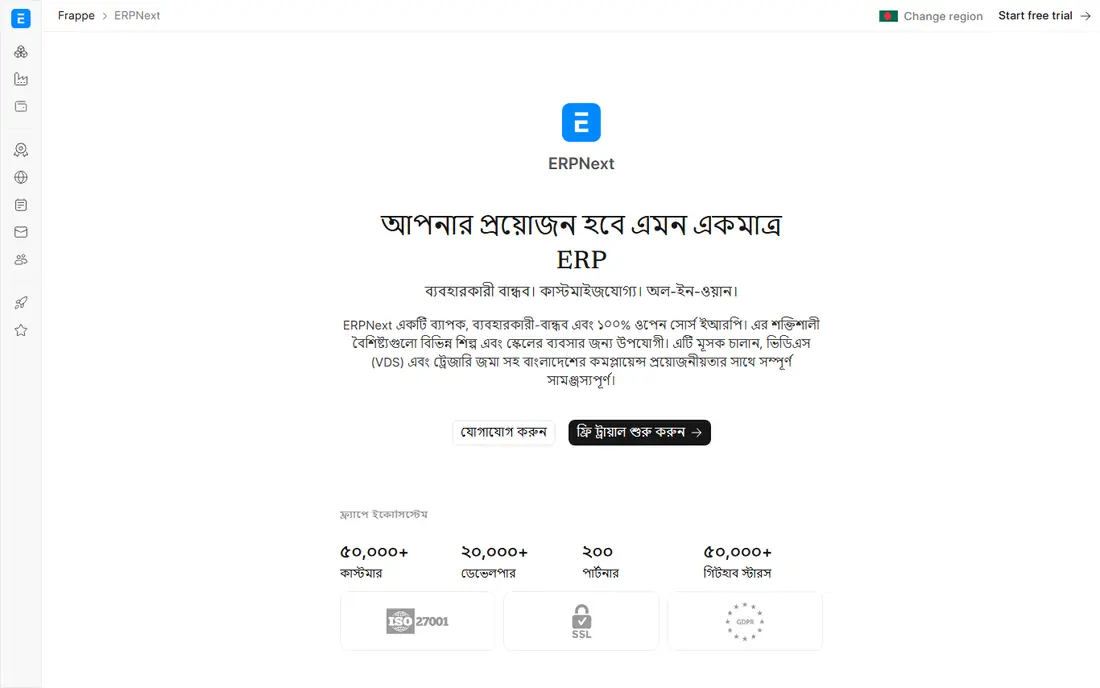
ERPNext is the closest thing to Odoo's open source spirit, and it is the one we would shortlist first for a cost-conscious team with some technical confidence. It covers accounting, stock, manufacturing, selling, buying, projects, and human resources in one system, and the code is open source, so a team can self-host it without paying a licence fee per user. That pricing shape matters as headcount grows, since adding staff does not automatically raise the software bill in the way per-seat ERP pricing does.
The honest catch is that free software is not a free project. Hosting, upgrades, data migration, and training still take time or paid help, and teams without an in-house developer will usually need a partner. Frappe Cloud hosting gives a simpler path for teams that want managed hosting without running servers, and prices there are quoted by site size rather than by seat. If your team can handle that trade, ERPNext gives a lot of ERP for very little licence cost.
- Full ERP modules included
- No charge per user for self-hosted use
- Active open source community
- Needs technical skill to host and maintain
- Partner help adds cost
- Smaller partner network in the US
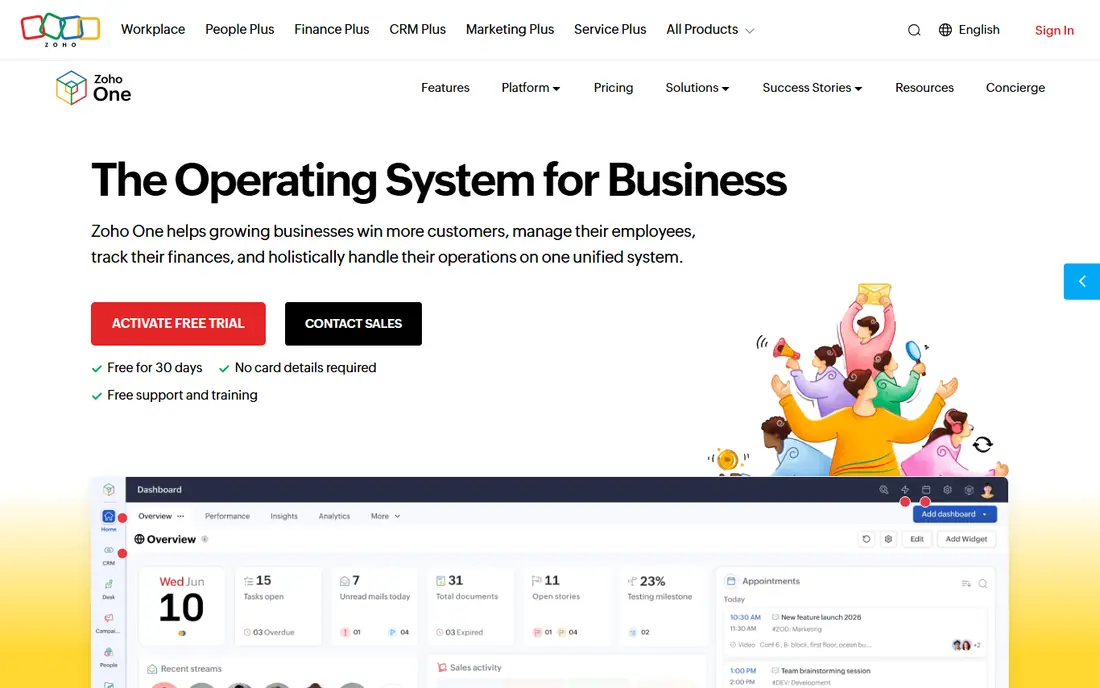
Zoho One suits a small business that wants one login for CRM, email, accounting, projects, and HR, rather than a heavyweight ERP project. The bundle approach keeps the monthly bill simple and gives a growing team room to add apps as needs change, without buying a new system for each job. For service businesses and light product businesses, that breadth often matters more than deep manufacturing logic.
The limit shows up when operations get complex. Zoho's inventory and production tools are useful, but they do not match a dedicated ERP for multi-plant manufacturing, advanced warehouse work, or complex cost accounting. Teams that start in Zoho and later outgrow it should plan an exit path for their data early.
- Dozens of business apps in one bundle
- Simple per-employee pricing model
- Strong CRM and finance apps
- ERP depth is lighter than dedicated ERP
- Some apps feel uneven in quality
- Advanced manufacturing is limited
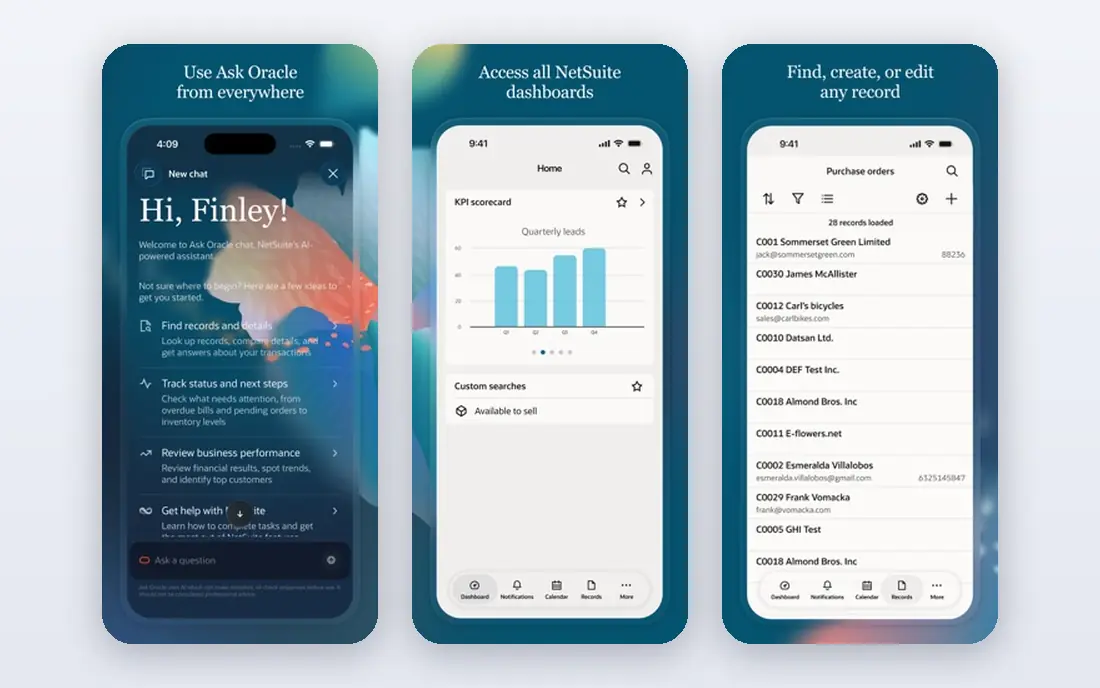
NetSuite is the upgrade many midmarket companies choose when spreadsheets and entry-level accounting stop holding the business together. It brings finance, inventory, order management, CRM, and human resources into one cloud system, and its multi-subsidiary tools are a genuine strength for companies with several entities or currencies. That breadth is why it shows up in so many shortlists for companies planning to grow across borders.
The price of that breadth is a sales-led buying process and an implementation measured in months, not days. NetSuite does not publish a list price, and the final figure depends on the base platform, modules, user count, and implementation help. Small teams should be honest about whether they need that much system yet. For a company already juggling subsidiaries and complex reporting, NetSuite is a serious, proven choice.
- Strong multi-subsidiary and multi-currency finance
- Large module range
- Proven at scale
- No published price
- Implementation takes months
- Ongoing costs rise with modules and users
Business Central is the natural alternative for any team already living in Outlook, Excel, and Teams. It shares Microsoft's identity and security model, and documents move between Office apps and the ERP with less friction than a third-party system usually manages. Finance, sales, purchasing, inventory, and project tools are all present, and the Essentials plan at $80 per user per month on annual billing gives a clear starting figure that most rivals will not publish.
Premium, at $110 per user per month, adds manufacturing and service management, so manufacturers should price that tier rather than Essentials. A partner normally handles setup, data migration, and training, which adds to the first-year cost. For Microsoft shops, though, the fit is hard to beat, and the published pricing makes budgeting far simpler than with quote-only rivals.
- Published per-user pricing
- Deep Office and Teams integration
- Strong finance and supply chain modules
- Premium features cost more
- Partner implementation is usually needed
- Interface can feel dense
Sage Intacct is a finance-first choice, and finance teams tend to love it for a reason. Its dimensional reporting lets a team slice results by department, location, project, or any other dimension without building a maze of separate charts of accounts. Multi-entity consolidation, approvals, and audit trails are built in, which matters for companies reporting across several businesses at once.
The trade is that Intacct is not a full operations system in the way Odoo or NetSuite is. Inventory and manufacturing depth is thinner, so product companies often pair it with a separate operations tool. Pricing is also quote-only, which means a demo and a sales conversation before any firm number appears. If finance control is the main reason for leaving Odoo, Intacct deserves a close look. If shop-floor control is the priority, look elsewhere first.
- Strong multi-entity and dimensional reporting
- Cloud-native finance
- Good audit trail
- Quote-only pricing
- Finance-led, not a full operations ERP
- Needs care on inventory needs
Acumatica takes a different approach to pricing, and for some companies that difference alone justifies a look. Instead of charging per user, it prices by the computing resources a business consumes, with unlimited users included. A company with a large seasonal workforce, many warehouse staff, or occasional users can therefore avoid the per-seat bill that grows with every hire.
The editions cover finance, distribution, manufacturing, construction, and field service, so the fit is broader than a finance-only tool. Deployment can be cloud or on-premise, which suits companies with specific hosting rules. The catch is that resource-based pricing is harder to compare at a glance, and the final quote still comes through a partner. Teams should model their usage honestly and ask what happens to the bill when transaction volume jumps.
- Unlimited users on resource-based pricing
- Flexible cloud or on-premise deployment
- Strong distribution and manufacturing editions
- Quote-only pricing
- Resource tiers can be hard to compare
- Partner-led implementation
SAP Business One has served small manufacturers and distributors for years, and its strength is discipline: finance, sales, purchasing, inventory, and production are tied together in one system with the controls a growing manufacturer needs. Companies that value SAP's reporting and audit habits, but do not need the scale or cost of S/4HANA, often land here.
Buying runs through SAP partners, who quote the licence and implementation together, so there is no simple published price to compare. Implementation is a real project, and smaller teams should expect several months of work. The interface will also feel less modern than newer cloud tools. For a manufacturer that wants SAP rigour at a smaller scale, those trade-offs are worth accepting.
- Strong finance, inventory, and production control
- SAP partner network
- Long track record with small manufacturers
- Sold and priced through partners
- Implementation can be heavy
- Interface feels dated in places
QuickBooks Online is not a like-for-like ERP replacement, and we include it because many teams leaving Odoo do not actually need a full ERP. They need solid accounting, invoicing, expense tracking, and payroll, with an accountant who already knows the system. QuickBooks delivers that with a gentler learning curve and a large marketplace of add-ons for inventory, time tracking, and payments.
The limit is scope. Multi-warehouse inventory, production planning, and complex manufacturing are outside its comfort zone, and teams that push it there usually end up with a patchwork of add-ons. Pricing also climbs as payroll, advanced inventory, and extra users are added, so the headline plan is rarely the whole bill. For a small service or retail business, though, it is often the simplest and cheapest honest alternative.
- Familiar to accountants and bookkeepers
- Easy invoicing and bank feeds
- Large app ecosystem
- Not a full ERP
- Inventory and manufacturing are limited
- Costs rise with payroll and add-ons
Cin7 Core, formerly DEAR Inventory, is built around the job many product businesses care about most: knowing what stock they hold, what it cost, and what is on its way. Purchasing, sales orders, warehouse transfers, and production runs feed one inventory picture, and connections to accounting systems and online sales channels keep that picture in step with the rest of the business. For a brand selling through several channels, that focus is a real advantage over a generic ERP.
Finance depth is lighter than a full ERP, so most teams pair Cin7 Core with an accounting system rather than replacing one. Plan names and pricing also vary, so a team should confirm the current plan and price for its region before budgeting. If inventory accuracy is the main pain that pushed a team away from Odoo, Cin7 Core is a focused and practical answer.
- Strong inventory, purchasing, and order management
- Built for product businesses
- Integrates with accounting and sales channels
- Quote and plan details vary by region
- Finance is lighter than a full ERP
- Setup takes care with stock data
Katana is a manufacturing tool first, and small makers tend to grasp it quickly. Production orders, materials, and stock levels sit in one visual view, so a team can see what can be built, what is missing, and what is already promised to customers. That clarity is the whole point for a small workshop that found Odoo's manufacturing module heavier than it needed.
Katana does not try to be a full ERP. Accounting, payroll, and CRM live elsewhere, usually in a connected tool, so the total system is Katana plus accounting rather than one suite. Higher plans add the more advanced planning and automation features, so a growing manufacturer should check which plan covers its batch and traceability needs.
- Clear visual production planning
- Real-time stock linked to orders
- Easy to learn for small teams
- Smaller scope than a full ERP
- Finance lives in a connected accounting tool
- Advanced features sit on higher plans
How we picked these
We compared official product pages, pricing pages, and public documentation for each system, and we checked which vendors publish prices and which require a quote. We favoured systems that genuinely cover the core of Odoo, namely finance, sales, purchasing, and inventory, or that honestly cover one of those areas better than a general suite. We left out tools that only handle one small job, such as invoicing alone, and we did not list Odoo itself, since this is a list of alternatives to it.
What to check before you switch ERP
Start with the two or three jobs that hurt most today, and score each system on those jobs alone. A vendor demo will show the best version of every module, so ask to see your own data in the system, including a real sales order, a purchase order, and a month-end report. That exercise surfaces gaps faster than any feature checklist.
Next, price the whole first year, not just the subscription. Ask each vendor or partner for implementation, migration, training, and support as separate lines, and ask what happens to the price when you add users, entities, or transaction volume. For open source options such as ERPNext, ask the same questions about hosting and support, since those are the real costs there.
Finally, plan the migration as its own project. Clean up customer, supplier, and stock records before moving them, run the old and new systems side by side for at least one reporting period, and keep the old data accessible after go-live. A careful switch costs more patience up front and saves far more trouble later.
Frequently asked questions
What is the best alternative to Odoo for a small business?
For most small businesses, the answer depends on the main job. ERPNext suits teams with technical help that want low licence costs, Zoho One suits teams that want one simple suite, and QuickBooks Online suits teams that mainly need accounting. Start from the job that hurts most, then shortlist two systems and trial them with real data.
Is there a free alternative to Odoo?
Yes, ERPNext can be self-hosted without a licence fee, since its code is open source. Hosting, maintenance, and training still cost time or money, so the honest comparison is total cost, not licence cost alone. Several other tools on this list offer free trials, but not a free ongoing plan.
Which Odoo alternative is best for manufacturing?
Dynamics 365 Business Central Premium, Acumatica Manufacturing Edition, SAP Business One, and Katana all serve manufacturers, at very different scales. Katana suits small workshops, Business Central and Acumatica suit midsize manufacturers, and SAP Business One suits small manufacturers that want SAP discipline.
Do these alternatives to Odoo include a CRM?
Most do, in some form. NetSuite, Dynamics 365, Zoho One, and Acumatica all include CRM tools, while ERPNext includes selling and customer tools as part of its suite. QuickBooks Online and Katana rely more on connected apps for full CRM, so check that gap if CRM matters to your team.
How long does it take to switch from Odoo to another ERP?
Small moves, such as to QuickBooks Online or Katana, can take weeks. Midmarket ERP moves to NetSuite, Business Central, or Acumatica usually take several months, including data cleanup, testing, and training. The biggest predictor of delay is messy master data, so cleaning records before migration is the best way to shorten the project.
Sources
- https://erpnext.com
- https://www.zoho.com/one/
- https://www.netsuite.com
- https://www.microsoft.com/en-us/dynamics-365/products/business-central
- https://www.sageintacct.com
- https://www.acumatica.com
- https://www.sap.com/products/erp/business-one.html
- https://quickbooks.intuit.com/online/
- https://www.cin7.com
- https://katanamrp.com
- https://prospeo.io/s/odoo-alternatives
- https://www.inovexa-erp.com/blog-best-erp-software.html
See where you really rank - block by block
ProMapRanker scans Google Maps across a grid of your service area. Simple monthly plans from $19, white-label on every plan.
Start freeKeep reading
 which software is best for pdf page removal
Which Software Is Best for PDF Page Removal in 2026
Find which software is best for pdf page removal, from free online tools to desktop editors, with page controls, privacy, safety, and pricing compared.
Read → when i work alternatives
Best When I Work Alternatives in 2026
Looking for when i work alternatives? We compare 8 scheduling apps for hourly teams, covering pricing, free plans, time clocks and the best fit for business.
Read → the best tool for keyword analysis
The Best Tool for Keyword Analysis in 2026
Find the best tool for keyword analysis with our 2026 comparison of 10 keyword analysis software tools on data depth, difficulty scores and price today.
Read →