 ProMapRanker
Best Node.js and Go Alternatives for Pandas and NumPy in 2026

Key takeaways
- Danfo.js is the closest Node.js match to pandas, with DataFrames, series, grouping, and file reading in one library.
- Gota is the closest Go match to pandas for data frames, while Gonum is the closest Go match to NumPy for matrices and statistics.
- All eight libraries here are free and open source, so the cost is engineering time, not licence fees.
- No single library matches pandas plus NumPy feature for feature, so most teams pair a data frame library with a numerical library.
- For large data, Polars.js and Arquero deserve a close look, because they are built for speed and larger-than-memory patterns that Danfo.js handles less well.
Quick comparison
| Pick | Great for | Pricing starts at | Free tier | |
|---|---|---|---|---|
 Danfo.js | Pandas-style work in Node.js | Free | Yes | Visit |
 Gota | Data frames in Go | Free | Yes | Visit |
 Gonum | Numerical work in Go | Free | Yes | Visit |
 DataFrame-Go | Lightweight Go data frames | Free | Yes | Visit |
 mathjs | Numerical math in JavaScript | Free | Yes | Visit |
 numjs | NumPy-style arrays in JavaScript | Free | Yes | Visit |
 Arquero | Fast data wrangling in JavaScript | Free | Yes | Visit |
 Polars.js | High-speed data frames in Node.js | Free | Yes | Visit |
The best node.js and go alternatives for pandas and numpy
Python's pandas and NumPy are a strong pair: pandas for labelled tables, NumPy for fast arrays and math. Node.js and Go do not have one library that copies both exactly, but the libraries below cover the same jobs in each language. We list only libraries that exist and work today.
Danfo.js is the first library most Node.js developers try when they miss pandas. It offers DataFrames and Series, filtering, grouping, merging, missing-value handling, and plotting helpers, plus functions to read CSV, JSON, and Excel files. Because it is built on TensorFlow.js, you can also convert Danfo structures to tensors for machine learning work.
The honest catch is scale and maturity. Danfo.js does not have the full pandas API, and very large tables will be slower than a columnar engine like Polars. For small and medium data, dashboards, and Node services that need pandas-style wrangling without a Python service, it is the most direct fit.
- DataFrame and Series APIs that feel familiar to pandas users
- Reads CSV, JSON, and Excel
- Built on TensorFlow.js for tensor support
- Performance can lag on very large data
- Browser and Node packages differ, so check which one you install
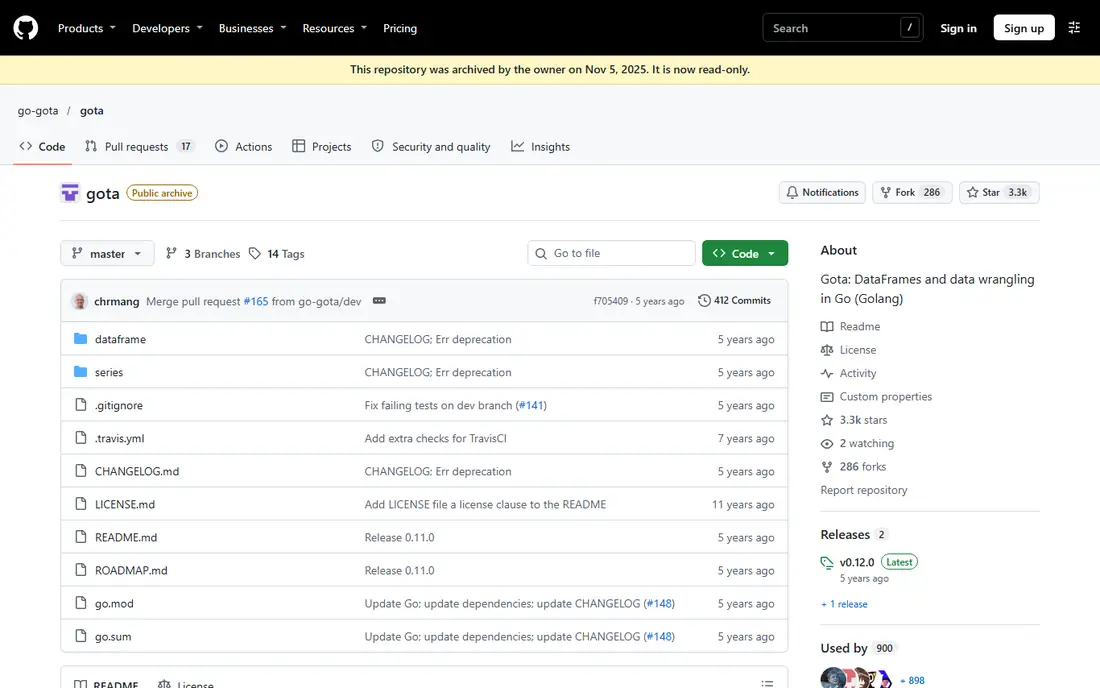
Gota, also written as go-gota, is the Go library that most closely mirrors pandas for tabular data. It provides DataFrames and Series, selection, filtering, sorting, grouping, and joins, and it can load CSV and JSON data. A Go service that needs to clean and shape tabular data before serving an API can do that work in the same language, without calling out to Python.
Gota does not try to replace NumPy, so numerical work such as linear algebra still needs a companion library like Gonum. Its function set is also narrower than pandas, so expect to write a little more code for advanced reshaping. For straightforward data frame work in Go, it is a solid and well-known choice.
- DataFrame, Series, filtering, grouping, and joins in Go
- Reads CSV and JSON
- Clear, simple API
- Smaller ecosystem than pandas
- Fewer statistical functions built in
Gonum is the Go answer to NumPy's numerical side. Its packages cover matrices, linear algebra, statistics, optimisation, and numerical integration, with careful documentation. If you are building a Go service that needs matrix math, regression, or statistical distributions, Gonum is the library to reach for first.
Gonum is not a data frame library, so pairing it with Gota is the natural pattern: Gota shapes the table, Gonum does the math. Beginners may also find its API more mathematical than pandas-style code. For serious numerical work in Go, that trade is worth it.
- Matrices, linear algebra, statistics, and optimisation
- Well documented
- Used in scientific Go projects
- No pandas-style labelled DataFrame
- Steeper learning curve for beginners
DataFrame-Go, from RocketLaunchr, is a smaller Go data frame library that focuses on the core jobs: loading tabular data, filtering rows, ordering, grouping, and aggregation. It suits services that need a simple table abstraction without pulling in a large dependency tree. The project also offers import helpers for common formats.
Its smaller community is the main drawback. You will find fewer tutorials and examples than for Gota, and edge cases may need more of your own code. If you want a lean dependency and your table work is straightforward, DataFrame-Go is a fair alternative to Gota.
- Lightweight and focused on data frames
- Supports filtering, ordering, and aggregation
- Import from CSV
- Less widely used than Gota
- Narrower feature set and community
mathjs is a general math library for JavaScript, covering matrices, complex numbers, units, statistics functions, and an expression parser. It is a good NumPy stand-in when your problem is math rather than labelled tables: matrix multiplication, solving equations, or unit-aware calculations. It runs in both Node.js and the browser, which helps if you share code between server and client.
mathjs does not give you pandas-style DataFrames, so pair it with Danfo.js or Arquero when you need both tables and math. Its full build is also large, so use the modular imports if bundle size matters. For numerical work in JavaScript, it is one of the most complete options.
- Matrices, units, complex numbers, and expression parsing
- Works in Node and the browser
- Large function library
- Not a data frame library
- Large bundle size if you import everything
numjs aims to bring NumPy-style array operations to JavaScript, with functions for creating arrays, reshaping, slicing, and element-wise math. For a developer who knows NumPy and wants the same mental model in Node.js, the API feels familiar quickly. It is a small, focused library rather than a full data science platform.
The main caution is maintenance. numjs has a smaller maintainer base than Danfo.js or mathjs, so check the repository's recent activity before building a long-lived project on it. It also covers arrays only, not labelled tables. For NumPy-style array code in JavaScript, it remains a real and usable option.
- API deliberately modelled on NumPy
- Ndarray-style operations
- Simple to learn for NumPy users
- Less actively maintained than larger libraries
- Not a data frame library
Arquero, from the University of Washington Interactive Data Lab, is a JavaScript library for query processing and transformation of array-backed data tables. It uses a columnar layout and a set of verbs for filtering, grouping, joining, pivoting, and deriving columns. That design makes it fast for wrangling data before visualisation or analysis.
Arquero's API is its own thing, not a pandas clone, so pandas users will need to learn its verbs. It also does not include plotting or machine learning, so pair it with a charting or math library for a full pipeline. If speed and a clean transformation API matter more than pandas familiarity, Arquero is a strong pick.
- Fast, columnar data wrangling
- Verbs for filter, group, join, and pivot
- Works well for visual analysis pipelines
- API differs from pandas, so there is a learning curve
- No built-in machine learning tools
Polars.js brings the Polars data frame engine to Node.js through native bindings. Polars is known for speed, lazy query planning, and efficient handling of larger data, and the Node.js package exposes DataFrame and LazyFrame concepts to JavaScript developers. For pipelines where Danfo.js feels slow, Polars.js is the upgrade path worth testing.
Native bindings mean installation can be fussier than a pure JavaScript package, especially across platforms and Node versions. The Node.js API also trails the Python Polars API in places, so check that the functions you need are available. For performance-sensitive Node.js data work, it is the most promising option here.
- Very fast, columnar DataFrame engine
- Lazy evaluation for larger-than-memory patterns
- Familiar DataFrame concepts
- Native bindings add install complexity
- API and maturity differ from the Python Polars library
How we picked these
We compared official project pages, documentation, and repositories for Node.js and Go libraries that provide data frames or numerical arrays, and we kept only libraries that exist and work today. We weighed pandas and NumPy coverage, documentation quality, maintenance activity, and whether a library could be used in a real Node or Go project without a Python runtime. We did not claim hands-on testing we did not do; this comparison reflects published documentation and repository state.
How to choose between them
Match the library to the job, not to the language alone. If you need labelled tables in Node.js, start with Danfo.js for familiarity or Polars.js for speed. If you need labelled tables in Go, start with Gota, and add Gonum when the work turns numerical. If you need arrays and math, mathjs covers JavaScript broadly, numjs covers NumPy-style arrays, and Gonum covers Go.
Test with your own data shape before you commit. Run a grouping, a join, and a missing-value pass on a sample that matches your real tables, and time it. Check how the library reads your file formats, how it handles nulls, and whether its output converts cleanly to JSON for an API response. A library that looks good in a tutorial can still disappoint on messy, real-world data.
For Node.js teams
Danfo.js plus mathjs covers most pandas and NumPy jobs in pure JavaScript. Switch to Polars.js or Arquero when speed or larger data becomes the bottleneck.
For Go teams
Gota plus Gonum is the standard pairing: one for tables, one for math. DataFrame-Go is worth a look if you want a lighter table library and your needs are simple.
For mixed or migrating teams
Keep the Python service only where its ecosystem is truly needed, such as a specific statistical model, and move straightforward wrangling into Node or Go with the libraries above. That keeps most of the stack in one language without forcing a full rewrite.
Frequently asked questions
Can Node.js or Go fully replace pandas and NumPy?
For many jobs, yes, especially data loading, cleaning, grouping, and basic statistics. For specialised scientific work, Python still has a wider ecosystem of domain libraries, so a full replacement depends on how specialised your analysis is.
Which library is closest to pandas in JavaScript?
Danfo.js is the closest, because its DataFrame and Series APIs are modelled on pandas. Polars.js is faster for larger data, but its API follows Polars rather than pandas.
Which library is closest to pandas in Go?
Gota is the closest for data frames, with Series, filtering, grouping, and joins. Pair it with Gonum for the numerical side that NumPy provides in Python.
Do these libraries work in the browser as well as Node.js?
Danfo.js, mathjs, and Arquero work in the browser as well as Node.js, with some package differences. Gota, Gonum, and DataFrame-Go are Go libraries for server and command-line programs, not browser code.
Are these libraries free for commercial use?
Yes, all eight are open source with permissive licences, but licence terms differ by project, so check the licence file in each repository before shipping a commercial product. The cost is engineering time and maintenance, not a licence fee.
What about performance compared with Python?
Polars.js and Arquero can beat pandas on some workloads thanks to columnar layouts and lazy evaluation, while Danfo.js is usually slower on very large tables. Go libraries benefit from compiled performance, but the right choice still depends on your data size and operations.
Sources
See where you really rank - block by block
ProMapRanker scans Google Maps across a grid of your service area. Simple monthly plans from $19, white-label on every plan.
Start freeKeep reading
 free alternatives to grok imagine
Free Alternatives to Grok Imagine in 2026
We compared the best free alternatives to grok imagine for image generation, from fast daily credits to design tools, so you can create without paying.
Read → best tools for instagram content creation
Best Tools for Instagram Content Creation in 2026
Compare the best tools for Instagram content creation, from Canva and CapCut to Later and Buffer, on design, video, planning, scheduling, and price in 2026.
Read → best tool to split pdf files
Best Tool to Split PDF Files in 2026
We compared the best tool to split pdf files on split modes, file limits, privacy and price, so you can split a PDF cleanly and keep every page in one go.
Read →