 ProMapRanker
Best Microsoft Premier Support Alternatives in 2026


Direct replacement for enterprise support · Pricing starts at: See website
Key takeaways
- US Cloud is the most direct third-party replacement, with support across the full Microsoft stack and published response-time claims.
- Large Microsoft partners such as Insight, CDW, and SHI suit buyers who want licensing, cloud, and support from one account team.
- Managed providers such as Rackspace and DXC suit teams that want day-to-day operations handled, not just break-fix help.
- Ask who owns an escalation at 2 a.m., what severity response times are in writing, and whether senior engineers answer first.
Quick comparison
| Pick | Great for | Pricing starts at | Free tier | |
|---|---|---|---|---|
| US Cloud | Direct replacement for enterprise support | See website | No | Visit |
 Insight Enterprises | Licensing plus support in one place | See website | No | Visit |
 CDW | Large-scale Microsoft estates | See website | No | Visit |
 SHI International | Procurement and support at scale | See website | No | Visit |
 Softchoice | Mid-market Microsoft support | See website | No | Visit |
 Rackspace Technology | Managed Microsoft cloud operations | See website | No | Visit |
 DXC Technology | Large enterprise managed support | See website | No | Visit |
 Cognizant | Microsoft support with wider IT services | See website | No | Visit |
The best Microsoft Premier Support alternatives
Microsoft Premier Support is now part of Microsoft Unified Support, and many buyers look elsewhere when renewal pricing rises or when they want faster access to senior engineers. The providers below offer third-party Microsoft support, partner-delivered support, or managed services that cover Azure, Microsoft 365, Dynamics, and security products. We compared official service pages and public provider descriptions, and we did not list Microsoft itself, since this guide is about alternatives to its support offer.
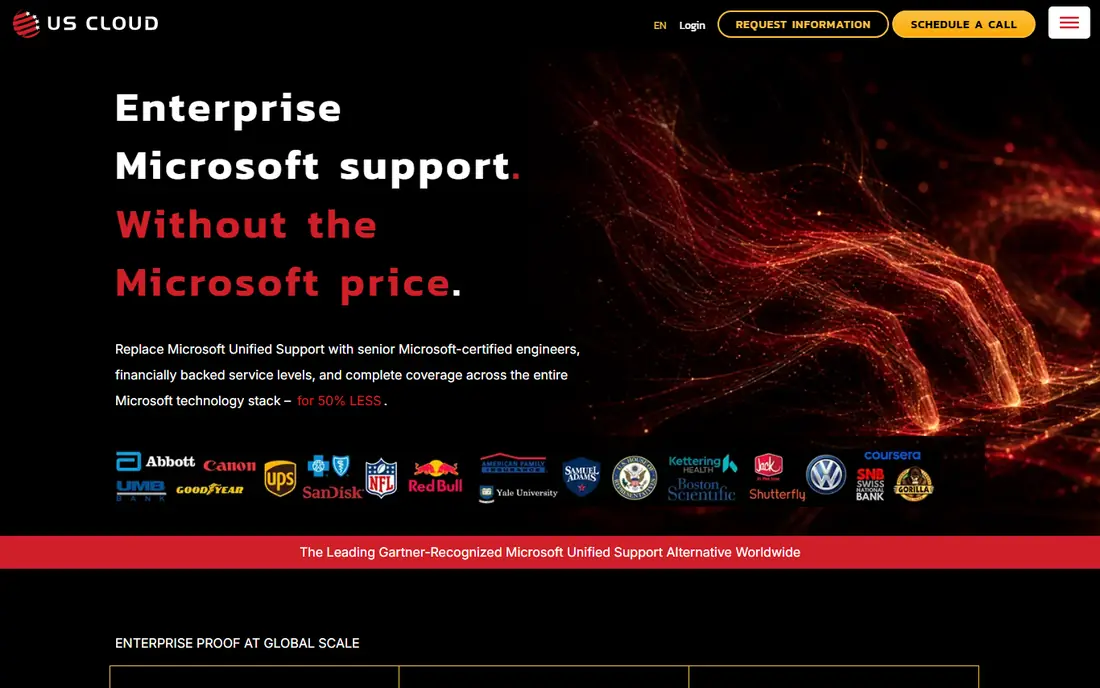
US Cloud is the provider most often named as a direct replacement for Unified Support, because Microsoft support is its whole business rather than one service among many. Its engineers cover the full Microsoft stack, and it offers round-the-clock support with severity-based response times. For a buyer entering a renewal, that focus makes comparison easier, since you are not also buying hardware or unrelated services.
The trade-off is that no third party can fix a Microsoft product defect on its own. US Cloud still needs an escalation path to Microsoft for bugs that require a code fix, so ask in writing how that handoff works and who tracks it. Pricing is also custom, so use a side-by-side quote against your current contract before you judge the saving.
- Focused only on Microsoft support
- Covers Azure, Microsoft 365, Dynamics, and security
- Published fast response claims
- Pricing is quoted, not published
- Still needs Microsoft escalation for some product defects
- Fit is mainly enterprise and mid-market

Insight suits a buyer who wants licensing, cloud migration, and support under one roof. Its teams handle Microsoft agreements, Azure planning, and device estates as well as ongoing support, which reduces the number of vendors a busy IT team must manage. For a company already buying through Insight, adding support can simplify procurement and reporting.
The catch is focus. Because Insight sells so much else, the quality of support can depend on the specific contract and team assigned to you. Ask for named contacts, severity definitions, and reporting samples, and check that Microsoft support is staffed by certified engineers rather than general helpdesk staff.
- Large Microsoft partner with licensing expertise
- Managed and professional services alongside support
- Broad geographic coverage
- Support is one part of a much larger business
- Service levels vary by contract
- Smaller buyers may get less senior attention
CDW is a practical choice for organisations with a large Microsoft estate that already buys devices, software, and cloud through a reseller. Its managed services can cover monitoring, patching, and user support for Microsoft 365 and Azure, alongside helpdesk support for incidents. That breadth helps when a problem spans licensing, devices, and cloud settings.
As with other large partners, the experience depends on the contract tier. A basic support add-on is not the same as a dedicated managed service with senior engineers. Clarify response times, escalation ownership, and whether proactive reviews are included, rather than assuming they come with any CDW agreement.
- Very large Microsoft partner
- Strong in licensing, hardware, and cloud
- Managed services for Microsoft 365 and Azure
- Quoted pricing only
- Support depth varies by engagement
- Enterprise scale can mean slower onboarding for small teams
SHI works well for buyers who want procurement discipline plus ongoing Microsoft support. Its scale helps with complex licensing agreements, multi-country estates, and standardised reporting, and its services teams can support Azure and Microsoft 365 estates day to day. For a procurement-led buyer, that combination is attractive.
The risk is vagueness. SHI offers many service models, so two buyers can have very different experiences under the same brand name. Get the severity matrix, the escalation process, and the engineer certification levels in the contract, and test the support line during a trial or pilot period if one is offered.
- Large Microsoft licensing partner
- Global coverage
- Managed and professional services for Microsoft platforms
- Support models vary widely by contract
- Pricing is custom
- Small teams may need to push for senior engineer access
Softchoice fits mid-market teams that want a partner who understands both licensing and operations. Its managed services can handle Microsoft 365 administration, Azure monitoring, and security basics, while its assessments help a team find unused licences and misconfigured settings before they become incidents. That practical focus suits IT teams of modest size.
Global buyers should check coverage first. Softchoice is strongest in North America, so a company with large teams in other regions may need a partner with deeper local staffing there. Confirm time-zone coverage and language support for every region you operate in.
- Strong Microsoft partner for mid-market buyers
- Managed services for Azure and Microsoft 365
- Assessment and optimisation services
- Quoted pricing
- Coverage is strongest in North America
- Enterprise buyers may need a larger global partner
Rackspace suits teams that want someone else to run the platform, not just answer tickets. Its managed Azure and Microsoft 365 services cover monitoring, patching, backup, and incident response, with operations staff available around the clock. For a team short on cloud engineers, that hands-on model can prevent more incidents than a ticket queue alone.
The cost model differs from a support contract. Managed services are usually priced by workload and scope, so a like-for-like saving against Unified Support is harder to prove without a detailed scope. Define what is included, what counts as a project, and how changes are charged before you sign.
- Managed Azure and Microsoft 365 operations
- Round-the-clock operations centres
- Security and backup services alongside support
- Managed service pricing can be higher than break-fix support
- Onboarding takes planning
- Not a pure support-only replacement for every buyer
DXC is built for large enterprises that outsource workplace and cloud operations at scale. Its Microsoft services cover end-user support, Azure operations, and application support, with global delivery centres and formal governance. For a company consolidating many vendors into one managed provider, DXC offers the scale to do it.
That scale is also the drawback for smaller buyers. Onboarding, governance, and change processes are designed for large contracts, and a mid-market team may find the model slower than a focused support provider. If your estate is modest, US Cloud or a mid-market partner will usually move faster.
- Large-scale managed workplace and cloud services
- Microsoft partnership across Azure, Microsoft 365, and Dynamics
- Global delivery
- Best suited to large contracts
- Smaller buyers may find it heavy
- Service levels depend heavily on the specific deal
Cognizant suits a buyer that already uses a large systems integrator and wants Microsoft support inside a wider transformation or managed services deal. Its teams support Azure, Microsoft 365, and Dynamics estates, and can also handle application development and data work that sits on top of those platforms. For a large programme, that breadth reduces handoffs.
For a buyer who only needs support, Cognizant may be more than required. Ask whether you will get a dedicated Microsoft support team or a shared pool, and insist on severity response times and escalation ownership in writing. A large brand name alone does not guarantee fast access to a senior Microsoft engineer.
- Broad IT services with Microsoft expertise
- Managed Azure and Microsoft 365 support
- Application and data services alongside support
- Support is part of a large services portfolio
- Pricing is custom
- Account quality varies by region and team
How we picked these
We compared official provider pages and public descriptions for companies that offer Microsoft support, partner-delivered support, or managed Microsoft services, and we kept only providers that are live and working in October 2026. We favoured providers with clear Microsoft coverage across Azure, Microsoft 365, and related products, and we noted where pricing is quoted rather than published. We did not claim hands-on testing, and we did not list Microsoft itself.
What to check before you switch
Start with escalation ownership. Ask each provider, in writing, who resolves a critical incident at night, who opens a ticket with Microsoft when a product defect is involved, and how you track that ticket. The answer matters more than any marketing claim about savings, because a slow escalation can cost more than the contract saves.
Next, compare severity definitions and response times line by line. One provider may promise a 15-minute response for a critical outage, while another promises the same response only for a narrower definition of critical. Align the definitions with your own incident levels, and check whether response means a human engineer or an automated acknowledgement.
Finally, run a pilot if you can. Move a defined set of users or workloads first, measure response times and first-contact resolution, and check reporting quality. A provider that performs well on a pilot is a safer bet for a full renewal switch than one chosen on price alone.
Questions to ask every provider
Ask for engineer certification levels, time-zone coverage, and the exact Microsoft products covered. Ask how proactive reviews, health checks, and licence optimisation are handled, and whether they are included or charged as projects. Ask for two reference customers in your sector and of similar size.
When to stay with Microsoft
Staying with Microsoft may still make sense if you need direct access to product teams, if your estate includes preview products, or if your contract includes proactive services you actually use. In that case, use a third-party quote as bargaining help in renewal talks, and compare the total value rather than the headline price alone.
Frequently asked questions
What is the best alternative to Microsoft Premier Support?
US Cloud is the most direct third-party replacement for most enterprise buyers, because Microsoft support is its core business. Large partners such as Insight, CDW, and SHI suit buyers who also want licensing and managed services from the same provider. The best choice depends on your estate size, regions, and whether you want support only or full managed operations.
Can a third party fully replace Microsoft Unified Support?
A third party can replace most day-to-day support, incident response, and guidance, but it cannot fix Microsoft product defects on its own. Product bugs still need an escalation path to Microsoft, so ask how that path works and who owns it. For most operational incidents, a good third party resolves the issue without Microsoft involvement.
How much can I save by switching from Microsoft support?
Savings vary widely by estate size, contract scope, and current pricing, and most providers quote rather than publish prices. Some providers publish saving claims of 30 to 50 percent against Unified Support, but those figures depend on the comparison scope. Get a side-by-side quote on the same severity levels and coverage before you trust a saving figure.
Do these providers support Azure and Microsoft 365?
Yes, the providers in this guide cover Azure and Microsoft 365, and most also cover Dynamics and Microsoft security products. Coverage depth varies, so confirm each product and workload you run, including Copilot, Defender, and Teams, before you sign. A provider that covers email well may be thinner on Azure networking or Dynamics.
What should I ask before a Microsoft support renewal?
Ask for severity response times in writing, escalation ownership, engineer certification, time-zone coverage, and reporting samples. Ask when to evaluate alternatives, ideally months before renewal, so you have time to run a pilot and negotiate. Waiting until the final weeks of a renewal limits your bargaining position and your testing time.
Is partner-delivered Microsoft support safe for regulated sectors?
It can be, if the provider meets your security, data handling, and compliance needs. Ask for security certifications, data residency, background checks for engineers, and audit reporting. Healthcare, finance, and government buyers should also check whether the provider has experience in their sector and can meet sector-specific reporting rules.
Sources
See where you really rank - block by block
ProMapRanker scans Google Maps across a grid of your service area. Simple monthly plans from $19, white-label on every plan.
Start freeKeep reading
 wpforms alternatives
Best WPForms Alternatives in 2026
We compare 9 wpforms alternatives for WordPress forms, with free and paid options, current pricing notes, and honest limits for small business sites in 2026.
Read → windows task scheduler alternatives
Best Windows Task Scheduler Alternatives in 2026
Looking for Windows Task Scheduler alternatives? We compare 9 schedulers for Windows and cross-platform work, from free tools to enterprise automation.
Read → which ai video service is best
Which AI Video Service Is Best in 2026
which ai video service is best? We compare 10 legitimate AI video services on price, avatars, editing and output quality to help you pick the right tool.
Read →