 ProMapRanker
Local Data Aggregators: A Complete Guide

As the founder of ProMapRanker, a geo-grid local rank tracker and Google Business Profile audit tool, I frequently encounter questions about the foundational elements of local SEO. Among the most critical, yet often misunderstood, are local data aggregators. A local data aggregator is a company that collects, verifies, and distributes business information, primarily Name, Address, and Phone number (NAP), to a vast network of online directories, mapping services, GPS systems, and other platforms. Their primary purpose is to standardize and disseminate accurate local business data across the digital ecosystem, ensuring consistency and helping search engines like Google confidently display your business information to local searchers.
What is a Local Data Aggregator?
A local data aggregator is a centralized repository that gathers business data, such as your business name, address, phone number, website, and business category, from various sources. These aggregators then act as primary data providers, distributing this information to hundreds, sometimes thousands, of online directories, mapping applications, and other digital platforms. Their role is crucial for establishing foundational NAP consistency across the web, which is a key signal for local search engine ranking.
Think of local data aggregators as the backbone of online local business information. They collect raw data from public records, business registrations, direct submissions, and even user contributions. Once verified, this data is then licensed and fed into a massive network that includes everything from niche industry directories to major mapping services like Apple Maps and even in-car navigation systems. Without these aggregators, businesses would need to manually submit and update their information on hundreds of individual platforms, a task that would be virtually impossible to maintain with precision.
Why Are Local Data Aggregators Critical for Local SEO?
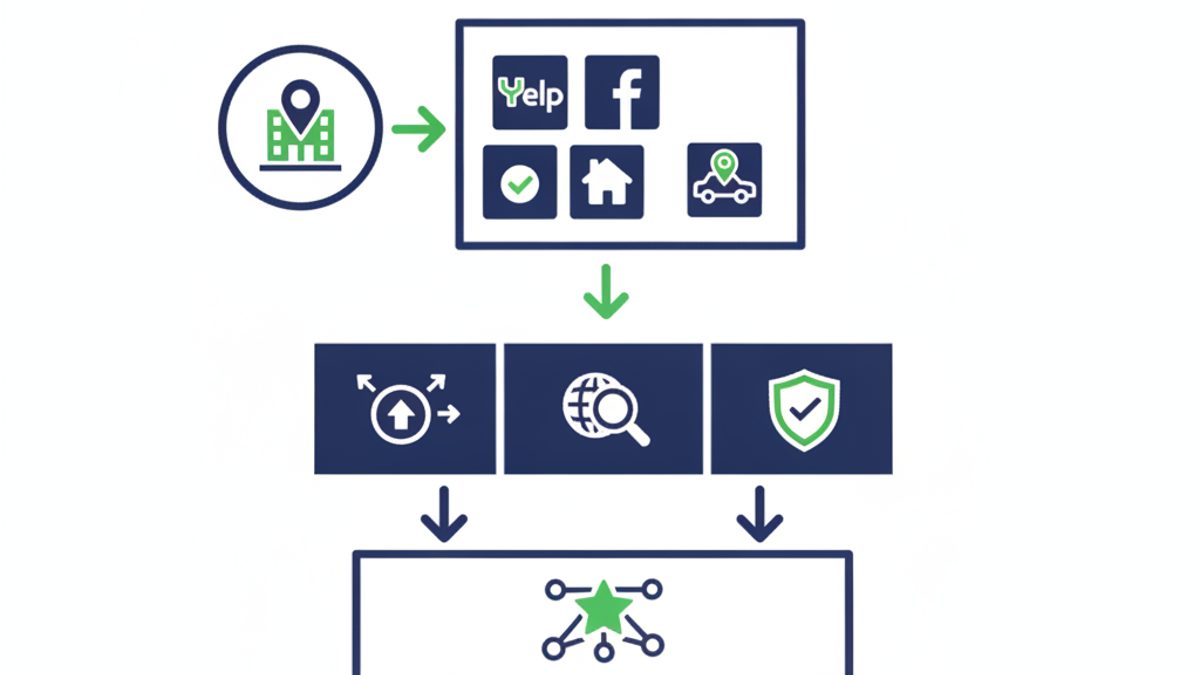
Local data aggregators are fundamental to your local SEO success because they build trust and authority for your business across the internet. By ensuring your Name, Address, and Phone (NAP) are consistent everywhere, they reinforce the accuracy of your information to search engines. This consistency is a primary factor in how search engines validate your business, directly influencing your visibility in the Google Local Pack and Google Maps.
Here’s a breakdown of their critical importance:
- NAP Consistency: This is paramount. Google and other search engines heavily rely on consistent NAP data across the web to confirm your business's legitimacy and location. Discrepancies (even minor ones like "St." vs. "Street" or different phone number formats) can confuse search engines, leading to lower rankings or even preventing your business from appearing in local search results. Aggregators help standardize this data at scale. Learn more about its importance in our guide on NAP Consistency for Local SEO.
- Foundational Citations: Aggregators create a broad base of "unstructured citations" (mentions of your business name, address, or phone number) across numerous directories. While not as powerful as high-authority structured citations from industry-specific sites, these foundational citations build a crucial layer of credibility. You can read more about this in our article, Do Citations Still Matter for Local SEO?
- Improved Local Search Visibility: The data aggregators supply is used by a wide array of platforms beyond just Google. This includes Apple Maps, Yelp, Facebook, in-car GPS systems, voice assistants (Siri, Alexa), and countless smaller directories. By ensuring your data is accurate and widely distributed through aggregators, you increase your chances of being found no matter where a potential customer is searching.
- Building Trust and Authority: When Google sees your business information consistently replicated across many reputable sources, it builds confidence in your business's existence and details. This consistency acts as a strong signal of legitimacy, which can positively impact your local search rankings.
- Mitigating Incorrect Information: Without proactive management through aggregators (or direct submissions), outdated or incorrect information can proliferate. This can be due to old business listings, data entry errors, or changes in business details. Aggregators provide a powerful channel to push corrected data to a vast network, helping to overwrite inaccuracies.
Who Are the Major Local Data Aggregators?
The landscape of major local data aggregators has evolved significantly, with consolidation and re-branding being common. Historically, the "big four" were Acxiom, Localeze (now Neustar/TransUnion), Infogroup (now Data Axle), and Factual (now Foursquare Places). Today, these entities continue to be primary sources, often under new ownership, feeding data into the local search ecosystem.
Here are the key players and what you should know:
- Neustar (formerly Localeze): Acquired by TransUnion in 2021, Neustar Localeze is a critical data aggregator. They distribute business information to a vast network including major search engines, mapping services (like Apple Maps), and GPS providers. Many major platforms license their data directly from Neustar, making it a foundational source for consistent business information.
- Data Axle (formerly Infogroup): Data Axle is another powerhouse in local data aggregation, providing business data to thousands of partners, including search engines, mapping applications, and sales/marketing platforms. They maintain a massive database of businesses, which is continuously updated and verified.
- Foursquare (formerly Factual): Factual was a prominent data aggregator that focused on location data and points of interest. In 2020, Factual merged with Foursquare, creating a combined entity with a robust dataset of places. Foursquare now provides location data and context to developers and businesses, influencing a wide array of apps and services.
- Acxiom (now part of Neustar/TransUnion): Acxiom was a major player in data aggregation, particularly for consumer data, but also supplied business information. With Neustar's acquisition by TransUnion, much of Acxiom's business data aggregation role is now integrated within the broader Neustar/TransUnion ecosystem. They historically distributed data to a wide range of directories and platforms.
It's important to differentiate these core aggregators from services like Yext. Yext is a "location data management" platform that helps businesses push their data to a network of publishers, including many directories that *consume* data from aggregators. While Yext provides a powerful, simplified way to manage your local presence, it acts more as a syndication platform and less as a raw data aggregator in the traditional sense, though it often includes submissions to the underlying aggregators as part of its service.
How Do Local Data Aggregators Work?
Local data aggregators operate through a multi-faceted process of data collection, verification, and distribution to build and maintain their extensive business databases. Their goal is to create a reliable and comprehensive source of local business information that can be licensed by other platforms.
- Data Collection: Aggregators gather information from numerous sources. This includes public records (business registrations, government filings), utility records, phone company listings, chamber of commerce data, and direct feeds from businesses or data providers. They also often crawl the web, scrape existing directories, and use crowd-sourced information to identify new businesses or updates.
- Data Verification and Cleansing: Once collected, the data undergoes rigorous verification processes. This might involve cross-referencing information from multiple sources, making phone calls to businesses, using postal verification, and employing advanced algorithms to detect inconsistencies or inaccuracies. The goal is to standardize data formats (e.g., ensuring all addresses follow a specific structure, phone numbers are consistent) and eliminate duplicates or outdated entries. This step is crucial for maintaining a high level of data quality.
- Database Maintenance: Aggregators continuously update their databases. This isn't a one-time process; businesses change addresses, phone numbers, or even names. Aggregators monitor these changes through various feeds and re-verification cycles, typically updating their full databases quarterly or semi-annually.
- Data Distribution and Licensing: The refined and verified data is then licensed to a vast network of clients. These clients include:
- Major search engines (though Google primarily relies on Google Business Profile, aggregators provide supporting data).
- Mapping applications (Apple Maps, HERE Technologies).
- GPS navigation systems (Garmin, TomTom).
- Voice assistants (Siri, Alexa).
- Social media platforms (Facebook, Instagram).
- Online directories and review sites (Yelp, Yellow Pages).
- Data analytics companies and marketing platforms.
This intricate ecosystem ensures that your business information, once accurately captured by a major aggregator, has the potential to proliferate across a significant portion of the online and offline digital landscape, forming a critical foundation for your local online presence.
The Difference Between Data Aggregators and Citation Services/Direct Submissions
While all three contribute to your business's online presence, understanding the distinct roles of data aggregators, citation services, and direct submissions is key to a holistic local SEO strategy. Each offers different levels of control, speed, and breadth of distribution.
Data Aggregators: The Foundation
Data aggregators are the bedrock. They collect, verify, and broadly distribute core business information (NAP) to thousands of downstream publishers, often without direct input from the business owner. Their distribution is wide, but updates can be slow (weeks to months). You have less direct control over individual listings, as your data flows through their network.
Citation Services: Strategic Expansion
Citation services (or submission services) are tools or agencies that manually or programmatically submit your business information to a curated list of high-value online directories. They focus on building structured citations on specific, relevant platforms that are known to influence local search rankings. This approach offers faster updates to those specific sites compared to aggregators, and you have more control over the accuracy of each individual listing. Many citation services will also ensure your data is accurate with the major aggregators as part of their offering.
Direct Submissions: Ultimate Control
Direct submissions involve manually creating or claiming your business listing on individual directories (e.g., Yelp, Facebook, Yellow Pages, and critically, your Google Business Profile). This method offers the highest level of control over your listing, allowing for detailed descriptions, photos, and direct interaction with reviews. While time-consuming, direct submissions to top-tier directories are essential, as they often override data from aggregators on those specific platforms and allow for immediate updates.
Comparison Table: Aggregators vs. Citation Services vs. Direct Submissions
| Feature | Data Aggregators | Citation Services | Direct Submissions |
|---|---|---|---|
| Control | Low (indirect influence) | Medium (over chosen sites) | High (over individual listings) |
| Speed of Update | Slow (weeks to months) | Medium (days to weeks) | Fast (instant to days) |
| Distribution Breadth | Very Wide (thousands of downstream sites) | Moderate (curated list of sites) | Specific (one site at a time) |
| Effort | Low (once submitted to aggregator) | Medium (service does the work) | High (manual, per site) |
| Cost | Often free (via submission) or part of a service | Varies (one-time or subscription) | Free (time investment) |
| Primary Benefit | Foundational data consistency, broad reach | Targeted citation building, faster updates | Full listing optimization, direct engagement |
Best Practices for Managing Your Data with Aggregators
Effective management of your business data with aggregators is an ongoing process that requires diligence. My experience at ProMapRanker, especially with our Google Business Profile audit capabilities, shows that proactive data management yields significant local SEO benefits.
- Conduct a Comprehensive Data Audit: Start by understanding your current data landscape. Use a tool like ProMapRanker to scan for existing listings across the web, identify inconsistencies, and pinpoint outdated information. This initial audit should cover your Name, Address, Phone (NAP), website, business categories, and hours of operation. Aim for a NAP consistency score of 90% or higher across your top 20-30 directories.
- Claim and Verify Your Google Business Profile: Your GBP is the single most important local listing. Ensure it's claimed, verified, and fully optimized with accurate, up-to-date information, photos, services, and posts. Google often uses GBP as its primary source of truth, but consistent data elsewhere reinforces its accuracy.
- Standardize Your Business Information: Before submitting to any aggregator or directory, create a master spreadsheet with your exact, preferred NAP details. This includes consistent formatting for street names (e.g., "Street" vs. "St."), suite numbers, phone numbers (e.g., (123) 456-7890 vs. 123-456-7890), and business name (e.g., "ProMapRanker" vs. "ProMapRanker Inc."). Stick to this exact format everywhere.
- Submit to Major Aggregators (or Use a Service): You can often submit your business directly to the major aggregators (Data Axle, Neustar/TransUnion, Foursquare) through their respective business portals. Alternatively, a reputable citation service can manage these submissions for you efficiently. The goal is to get your standardized data into their systems.
- Utilize Schema Markup on Your Website: Implement LocalBusiness schema markup on your website. This structured data explicitly tells search engines your business's NAP, hours, and other details in a machine-readable format. It complements aggregator data by providing an authoritative source directly from your domain.
- Monitor and Update Regularly: Data consistency is not a one-time task. Businesses change, and aggregator databases are constantly updated. Schedule quarterly or semi-annual checks to ensure your information remains accurate across key platforms. Tools like ProMapRanker can help you monitor your local rankings and identify potential data discrepancies that might be impacting your visibility through geo-grid local rank tracking. If you find errors, submit corrections to the source (aggregator or directory) and re-verify.
- Address Duplicates: Duplicate listings are common and can severely harm your local SEO. Identify and suppress or merge any duplicate listings found during your audit. This often requires direct contact with the directory or aggregator.
The Impact of Aggregators on Google Business Profile (GBP) and Google Maps
While Google Business Profile (GBP) is unequivocally the most important single source of truth for Google Maps and local search, local data aggregators play a crucial supporting role. Google's algorithms analyze a multitude of signals to determine business legitimacy and ranking, and consistent data from aggregators acts as a powerful reinforcement.
Google primarily trusts the information you provide and verify directly through your GBP dashboard. However, when Google crawls the web and finds your business information consistently replicated across hundreds of other reputable sources (many of which are fed by data aggregators), it builds a stronger confidence signal. This consistency helps Google confirm that the information on your GBP is accurate and trustworthy. Conversely, if Google finds conflicting NAP data from aggregators or other directories, it can introduce doubt, potentially hindering your visibility in the Local Pack and Google Maps.
Think of it this way: your GBP is your official declaration, and aggregator data provides hundreds of secondary witnesses corroborating that declaration. The more consistent the witnesses, the stronger your case for local prominence. This indirect influence is significant, as it contributes to Google's overall understanding of your business's authority and relevance within its local ecosystem.
Monitoring your local rankings, including your position in the Local Pack across different geo-grid points, is essential to see how these foundational efforts translate into real-world visibility. ProMapRanker's local rank tracker provides precise geo-grid scans, helping you understand your performance and identify areas for improvement.
Measuring Success and Ongoing Optimization
Once you’ve established strong data consistency through aggregators and direct submissions, the next step is to continuously monitor your performance and optimize your strategy. Effective local SEO is an ongoing process, not a one-time fix.
Here’s how to measure success and keep optimizing:
- Geo-Grid Local Rank Tracking: This is non-negotiable for local businesses. Traditional rank tracking only shows your average position. ProMapRanker's geo-grid local rank tracking allows you to see your ranking for specific keywords from multiple points on a map (e.g., a 5x5 grid at 1-mile intervals). This reveals how your data consistency and other SEO efforts translate into actual visibility across your service area. Look for upward trends and expanding areas of high ranking.
- Google Business Profile Insights: Regularly review your GBP insights for key metrics like searches, map views, website clicks, calls, and direction requests. A healthy trend in these metrics indicates improved local visibility, partly driven by accurate and consistent data.
- Citation Audit Recurrence: Periodically re-audit your citations (e.g., every 3-6 months) to catch any new inconsistencies that might have crept in. Tools can automate this, flagging discrepancies for you to address. Aim to maintain a high level of NAP accuracy across your top 20-30 citations.
- Competitor Analysis: Understand what your local competitors are doing. Analyze their citation profiles, GBP optimization, and local ranking performance. ProMapRanker offers local competitor analysis features like Share of Local Voice (SoLV) and Average Rank Position (ARP) to benchmark your performance against rivals and identify opportunities.
- Review Management: While not directly related to data aggregators, consistent positive reviews on your GBP and other platforms significantly impact local rankings. Encourage customers to leave reviews and respond professionally to all feedback. Our guide on how to get more Google reviews can help.
- Website Optimization: Ensure your website is fast, mobile-friendly, and optimized with local keywords. Core Web Vitals (LCP, FID/INP, CLS) are important ranking factors. A site with an INP under 200ms provides a better user experience, which Google rewards.
- Local Link Building: Acquire high-quality local backlinks from relevant local businesses, community organizations, and news sites. This builds domain authority, which indirectly boosts local rankings.
By integrating data aggregation management with comprehensive rank tracking and GBP optimization, you create a robust local SEO strategy. ProMapRanker simplifies this process by providing the geo-grid insights and GBP audit tools you need to stay ahead. Start your free trial today or request a free GBP audit to see how we can help your business dominate local search.
Step-by-Step Guide: Ensuring Data Consistency Across Aggregators
Achieving and maintaining data consistency across local data aggregators is a critical, yet manageable, task. Follow this practical checklist to streamline the process:
- Compile Your Master Business Information:
- Business Name: Use your exact, legal business name.
- Address: Your primary physical address, formatted consistently (e.g., "123 Main St, Suite 100" - avoid variations like "Street" or "#100").
- Phone Number: Your main local phone number, formatted consistently (e.g., "(123) 456-7890" - use parentheses and hyphens consistently).
- Website URL: Your main website URL (e.g., "https://www.yourbusiness.com/").
- Business Categories: A precise list of your primary and secondary categories.
- Hours of Operation: Your standard opening and closing times.
- Description/Slogan: A consistent, concise business description.
- Conduct an Initial Data Audit:
- Use a local SEO tool (like ProMapRanker's audit feature) to scan existing listings across major directories and aggregators.
- Identify all instances of your business information, noting any discrepancies or duplicate listings.
- Prioritize fixing errors on high-authority sites and the major data aggregators first.
- Claim and Optimize Your Google Business Profile:
- Ensure your GBP is claimed, verified, and its information precisely matches your master sheet.
- Fully optimize your GBP with accurate categories, services, photos, and regular posts.
- Submit to Key Data Aggregators:
- Manually submit your standardized information to the primary aggregators (Data Axle, Neustar/TransUnion, Foursquare) through their business portals, if available.
- Consider using a reputable citation service or local SEO platform that includes aggregator submissions as part of its service to ensure broad distribution.
- Address Discrepancies and Duplicates:
- For each discrepancy identified in your audit, directly edit the listing on the respective platform if you have access.
- For listings you cannot directly edit, submit a correction request to the platform or aggregator.
- Actively work to suppress or merge any duplicate listings you find.
- Implement Schema Markup:
- Add LocalBusiness schema markup to your website's footer or contact page, ensuring the NAP information here also matches your master sheet precisely.
- Monitor and Maintain:
- Schedule regular checks (quarterly is ideal) using your local SEO tool to monitor for new inconsistencies or changes.
- Stay vigilant for new duplicate listings that may appear over time.
- Update your master sheet and resubmit to aggregators/directories whenever your business information changes (e.g., new hours, phone number, address).
Frequently Asked Questions
What is a local data aggregator?
A local data aggregator is a company that collects, verifies, and distributes foundational business information, such as Name, Address, and Phone number (NAP), to a vast network of online directories, mapping services, GPS systems, and other digital platforms. They act as a centralized source to ensure consistent local business data across the internet.
What is an example of a data aggregator?
Prominent examples of local data aggregators include Data Axle (formerly Infogroup), Neustar (which acquired Localeze and integrates Acxiom's business data), and Foursquare (which merged with Factual). These companies gather, verify, and license business data to hundreds of downstream partners like Apple Maps and various online directories.
Who are the largest data aggregators?
The largest and most influential local data aggregators currently operating are Data Axle, Neustar (encompassing Localeze and elements of Acxiom's business data), and Foursquare (following its merger with Factual). These entities form the core infrastructure for distributing business information across the local search ecosystem.
How often should I update my data with aggregators?
While aggregators continuously update their databases, it's a good practice to review and, if necessary, resubmit your core business information to them at least once a year, or immediately whenever your business details (like address, phone number, or hours) change significantly. Regularly auditing your live listings (e.g., quarterly) helps catch any new inconsistencies.
Do data aggregators still matter for local SEO?
Yes, data aggregators absolutely still matter for local SEO. While Google Business Profile is paramount, consistent data from aggregators reinforces the accuracy and legitimacy of your business information across the wider web. This consistency builds trust with search engines, indirectly supporting your local rankings and ensuring visibility on non-Google platforms like Apple Maps and GPS systems.
Can I submit my business directly to aggregators?
Yes, you can often submit your business information directly to the major data aggregators through their respective business submission portals. This typically involves creating an account and providing your standardized business details. Many businesses also choose to use local SEO software or citation building services that streamline this process by submitting to multiple aggregators and directories on their behalf.
See where you really rank - block by block
ProMapRanker scans Google Maps across a grid of your service area. Simple monthly plans from $19, white-label on every plan.
Start free