 ProMapRanker
Local Rank Tracker Tool Buyer's Guide: 7 Must-Have Features

Navigating the competitive landscape of local search requires precise tools, and a local rank tracker tool is indispensable for businesses and SEO professionals alike. A local rank tracker tool is specialized software designed to monitor and report on a business's search engine rankings for specific keywords within a defined geographic area, typically focusing on Google Maps (Local Pack) and local organic results. It provides critical insights into how visible a business is to nearby customers, allowing for data-driven optimization strategies. This type of tool helps identify ranking fluctuations, assess competitor performance, and measure the effectiveness of local SEO efforts, ultimately contributing to increased local search visibility and customer acquisition.
What is a Local Rank Tracker Tool and Why Do You Need One?
A local rank tracker tool is a specialized software solution that monitors your business's search engine rankings for specific keywords across various geographic points. It provides precise data on your visibility within local search results, including Google Maps and the Local Pack. You need one to accurately measure your local SEO performance, understand your competitive landscape, and make informed decisions to improve your online presence and attract more local customers.
For any business aiming to capture local clientele, simply ranking nationally isn't enough. Local search is fundamentally different, relying heavily on a user's proximity, the relevance of your Google Business Profile (GBP), and your business's prominence. A robust local rank tracking software offers a granular view that general SEO tools cannot, showing you exactly where you stand in specific neighborhoods or cities.
Consider the difference: a national rank tracker might tell you you're ranking #5 for "plumber," but a local rank tracker reveals you're #1 in your immediate borough, #7 two miles away, and not even in the top 20 five miles out. This level of detail is crucial for optimizing your GBP, refining your service area targeting, and understanding where your marketing efforts are most effective. According to Google's own data, local searches lead many users to visit businesses in person, making local visibility a direct driver of foot traffic and sales.
Without a local rank tracker, you're essentially guessing. You won't know if your GBP updates are improving visibility, if a competitor has surged ahead, or if you're losing ground in key service areas. It's the only way to truly understand your local search performance and ensure your business is discoverable by the customers who matter most.
Here's a quick look at why automated tracking beats manual checks:
| Feature | Manual Rank Tracking | Automated Local Rank Tracker |
|---|---|---|
| Accuracy | Prone to human error, influenced by personal search history. | Precise, unbiased data from specific geo-coordinates. |
| Granularity | Difficult to check multiple locations/keywords/grid points. | Effortlessly tracks hundreds of keywords across geo-grids. |
| Time Efficiency | Extremely time-consuming for even a few keywords. | Automated daily/weekly scans, saving hours. |
| Historical Data | Requires meticulous record-keeping. | Automatically stores and visualizes historical performance. |
| Competitor Insights | Limited to manual checks for a few competitors. | Tracks multiple competitors' rankings and GBP performance. |
| Reporting | Manual report generation, often basic. | Professional, customizable, white-label reports with visuals. |
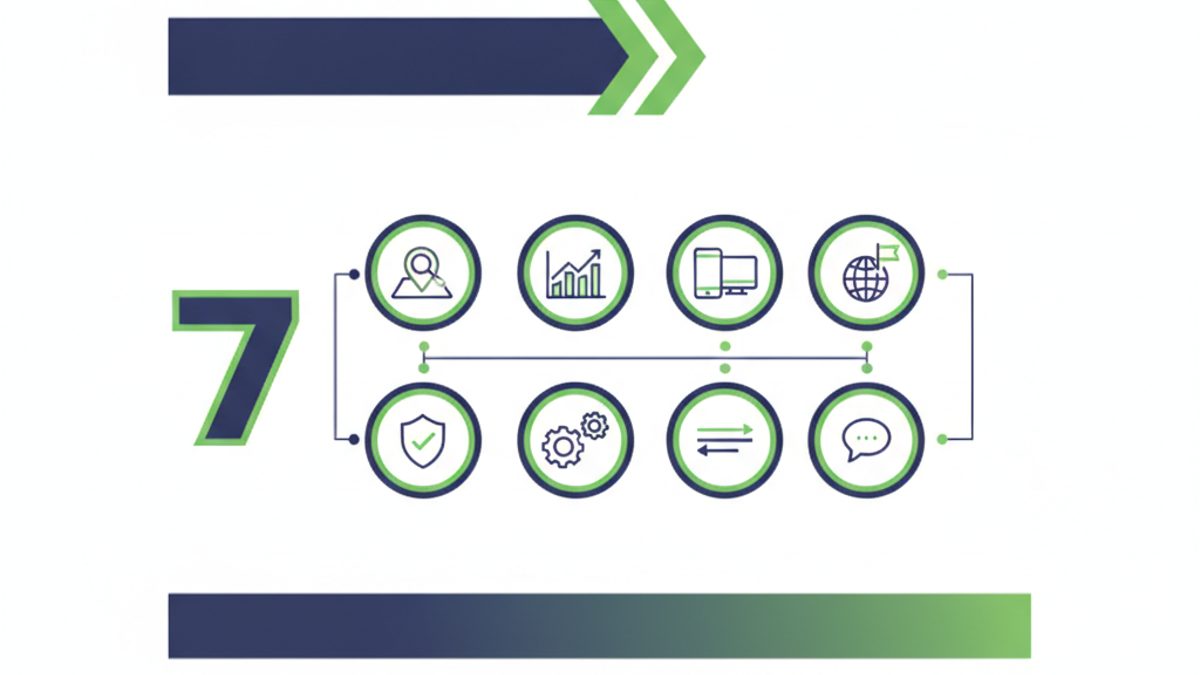
What Are the 7 Must-Have Features in a Local Rank Tracker Tool?
1. Granular Geo-Grid Rank Tracking
Granular geo-grid rank tracking is a feature that visualizes your business's local search performance across a specific geographic area using a grid of data points. Instead of just a single ranking, it shows your position for a keyword from multiple precise coordinates, often displayed as a color-coded map. This is a must-have because it reveals the exact areas where your business is strong, weak, or completely absent in local search, providing unparalleled accuracy and actionable insights beyond a single point ranking.
Traditional rank trackers often provide a single ranking for a city or zip code. However, Google's local algorithm is highly sensitive to proximity. What ranks #1 in one block might be #15 just a mile away. Geo-grid tracking, like that offered by ProMapRanker, creates a "heat map" of your visibility. You can define a grid size (e.g., 3x3, 5x5, 7x7) and the distance between points (e.g., 0.5 miles, 1 mile, 2 miles) to match your service area. This visual representation instantly highlights "blind spots" where you need to improve your Google Maps SEO.
For example, if you're a plumber in Miami, a 5x5 grid with 1-mile spacing can show you exactly which neighborhoods you dominate for "emergency plumber" and which ones are being captured by competitors. This level of detail is critical for optimizing your GBP service areas, targeting specific review generation, and even informing local ad campaigns. Without geo-grid tracking, you're missing the true picture of your local presence.
Learn more about the power of this feature in our article on geo-grid rank tracking.
2. Comprehensive Google Business Profile (GBP) Auditing and Monitoring
A comprehensive Google Business Profile (GBP) auditing and monitoring feature helps you analyze and track all critical aspects of your GBP listing for optimization. This is essential because your GBP is the cornerstone of local SEO, directly influencing your visibility in Google Maps and the Local Pack. A good tool will identify incomplete fields, inconsistent NAP (Name, Address, Phone) data, category issues, missing photos, and review management opportunities, ensuring your profile is fully optimized and always up-to-date.
Your GBP acts as your digital storefront in local search. An incomplete or poorly optimized profile can severely limit your reach, even if your website SEO is strong. A robust rank tracker should include a dedicated GBP audit module that checks for adherence to Google's guidelines and best practices. This includes:
- NAP Consistency: Verifying your Name, Address, and Phone number are consistent across your GBP and other online directories.
- Category Optimization: Ensuring you're using the most relevant primary and secondary categories.
- Review Management: Tracking new reviews, response rates, and sentiment analysis.
- Post Performance: Monitoring the engagement and visibility of your GBP posts.
- Photo Quality and Quantity: Assessing whether your photos meet Google's recommendations and provide a compelling visual experience.
- Service/Product Listings: Checking for completeness and accuracy.
- Q&A Monitoring: Tracking new questions and ensuring timely, accurate answers.
ProMapRanker's GBP audit capabilities provide a clear checklist and actionable recommendations, making it easy to keep your profile in top shape. Regular monitoring helps you catch any unexpected changes or issues that could impact your rankings. Dive deeper into our Google Business Profile audit checklist for more insights.
3. Robust Competitor Analysis
Robust competitor analysis within a local rank tracker allows you to identify your top local rivals and monitor their performance across keywords and geographic areas. This feature is crucial because understanding your competitors' strengths and weaknesses helps you identify opportunities, refine your own local SEO strategy, and benchmark your progress. It provides insights into their ranking patterns, GBP optimization tactics, and even their service area dominance, enabling you to compete more effectively.
Knowing who your real local competitors are and how they're performing is half the battle in local SEO. A quality tool won't just tell you your own rankings; it will overlay competitor data onto your geo-grid maps. Imagine seeing your 5x5 grid for "best pizza near me" and then seeing another map showing your top competitor's performance for the same term. This immediately highlights where they are outranking you and gives you a target to aim for.
Key aspects of competitor analysis include:
- Competitor Identification: Automatically suggesting or allowing you to add local competitors.
- Ranking Comparison: Side-by-side ranking data for shared keywords.
- GBP Insights: Analyzing their GBP categories, review count, average rating, and post activity.
- Geo-Grid Overlays: Visualizing competitor performance on your geo-grid maps.
- Historical Performance: Tracking how competitor rankings have changed over time.
By understanding your rivals' strategies, you can make informed decisions about your own GBP optimization, keyword targeting, and even service offerings. This proactive approach is vital for maintaining a competitive edge.
4. Intuitive Keyword Research and Management
Intuitive keyword research and management features enable you to discover relevant local keywords, organize them effectively, and track their performance over time. This is a must-have because successful local SEO starts with targeting the right terms that potential customers are actually using to find businesses like yours. A good tool helps you identify high-intent local keywords, group them for strategic tracking, and monitor their impact on your rankings, ensuring your efforts are focused on attracting qualified local leads.
Local keyword research has unique considerations. It's not just about "plumber"; it's about "plumber near me," "emergency plumber [city name]," "24 hour plumbing service [zip code]," or even "burst pipe repair [neighborhood]." A good local rank tracker will help you:
- Discover Local Keywords: Suggesting relevant terms based on your business category, location, and competitor analysis.
- Track Keyword Variations: Allowing you to monitor multiple long-tail and geo-modified keywords.
- Group Keywords: Organizing keywords into logical categories (e.g., "service keywords," "branded keywords," "problem keywords") for easier analysis.
- Monitor Search Volume (Local Estimates): Providing estimates of how often local users search for specific terms, though this data is often less precise than national volumes.
Effective keyword management ensures you're not just tracking random terms, but focusing on those that directly impact your local search visibility and drive conversions. ProMapRanker allows you to set up keyword groups and track their performance across your chosen geo-grids, providing a comprehensive view of your market penetration.
5. Actionable Reporting and Alerts
Actionable reporting and alerts provide clear, customizable reports on your ranking performance and notify you of significant changes. This feature is crucial for communicating value to clients, making quick adjustments to your strategy, and staying on top of your local SEO efforts. Comprehensive reports, often white-label, allow you to demonstrate ROI, while automated alerts ensure you're immediately aware of ranking drops, gains, or GBP listing issues, enabling prompt action.
For agencies managing multiple clients, or businesses with several locations, the ability to generate professional, easy-to-understand reports is paramount. These reports should:
- Be Customizable: Allowing you to select specific data points, date ranges, and branding.
- Offer White-Labeling: So you can present them as your own, enhancing client trust.
- Include Visualizations: Charts, graphs, and geo-grid heat maps that clearly illustrate performance trends.
- Provide Context: Explanations of what the data means and what actions might be taken.
Beyond reports, automated alerts are vital for proactive management. Imagine an alert notifying you that your primary keyword has dropped out of the Local Pack in a key service area, or that a competitor has launched a new GBP post series. This allows you to investigate and react immediately, minimizing potential damage or capitalizing on new opportunities. ProMapRanker offers robust reporting features and customizable alerts to keep you informed.
6. Scalable Multi-Location and Client Management
Scalable multi-location and client management capabilities allow agencies and businesses with numerous physical locations to efficiently track, analyze, and manage local SEO performance from a single dashboard. This is a must-have for efficiency, as it streamlines workflows, enables bulk actions, and provides a consolidated view of all properties or clients. Without it, managing local SEO for multiple entities becomes a time-consuming and error-prone logistical nightmare.
If you're an agency working with dozens of local businesses, or a franchise with hundreds of locations, individual logins and manual data compilation are simply not feasible. A top-tier local rank tracker should offer:
- Centralized Dashboard: A single interface to view and manage all clients or locations.
- User Permissions: Assigning different access levels for team members or clients.
- Bulk Actions: The ability to apply settings, add keywords, or schedule reports across multiple profiles simultaneously.
- Client/Location Grouping: Organizing properties into logical groups for easier management and reporting.
- API Access: For integrating data into other tools or custom dashboards.
This scalability ensures that as your business or client base grows, your local SEO tracking remains efficient and manageable. ProMapRanker is built to support multi-location local SEO, offering robust features for agencies and enterprises alike. Start scaling your local SEO efforts today with ProMapRanker.
7. Advanced AI-Powered Insights and Performance Metrics (e.g., SoLV/ARP)
Advanced AI-powered insights and performance metrics, such as Share of Local Voice (SoLV) or Actual Ranked Positions (ARP), go beyond raw ranking numbers to provide a deeper understanding of your market presence. These are crucial because they offer a more holistic view of your visibility relative to competitors, considering not just your rank, but also the search volume and prominence of keywords. This helps you identify true market share, understand the overall impact of your local SEO efforts, and uncover strategic opportunities often missed by basic rank tracking.
While a #1 ranking is great, what if that keyword has very low search volume? Or what if you're #1 for a specific term, but a competitor consistently ranks #2-5 for dozens of high-volume terms? Traditional rank tracking can sometimes be misleading. This is where advanced metrics, often powered by AI, come into play.
- Share of Local Voice (SoLV): This metric estimates your overall market share within local search for a defined set of keywords, considering both your ranking and the relative search volume/importance of those keywords. It gives you a percentage of the total local search visibility for your industry in your area.
- Actual Ranked Positions (ARP): This metric provides a more nuanced view of your ranking distribution across the entire geo-grid. It might show you that while your average rank is good, you have significant "holes" in specific areas.
- AI-Driven Opportunity Spotting: Advanced tools use AI to analyze large datasets (rankings, GBP data, competitor performance) to suggest specific, actionable optimization opportunities that might not be obvious from raw data alone.
ProMapRanker specifically leverages these types of AI-driven insights to give you a competitive edge. Our SoLV metric helps you understand your true local market share, enabling more strategic decision-making. These features move beyond simply reporting data to providing genuine intelligence.
How to Choose the Best Local Rank Tracker for Your Needs?
Choosing the best local rank tracker involves evaluating several factors beyond just features. It's about finding a tool that aligns with your specific budget, operational needs, and strategic goals. Consider the following checklist to make an informed decision:
Local Rank Tracker Buyer's Checklist:
- Define Your Needs:
- Are you a small local business, an agency managing multiple clients, or an enterprise with many locations?
- What's your budget for local SEO tools?
- What level of reporting do you need (basic vs. white-label, custom)?
- How many locations and keywords do you need to track?
- Evaluate Core Features:
- Geo-Grid Tracking: Ensure it offers customizable grid sizes and distances. This is non-negotiable for accurate local insights.
- GBP Integration: Does it allow for direct GBP auditing and monitoring (reviews, posts, info)?
- Competitor Analysis: Can you easily add and compare your performance against local competitors?
- Keyword Management: Is it easy to add, organize, and track relevant local keywords?
- Reporting: Are the reports clear, actionable, customizable, and white-label?
- Advanced Metrics: Does it offer AI-powered insights like SoLV or ARP for deeper analysis?
- Assess Data Accuracy and Reliability:
- Look for tools that pull data directly from Google APIs or simulate real user searches with precision.
- Read reviews and case studies to understand other users' experiences with data accuracy.
- Consider User Experience (UX) and Interface:
- Is the dashboard intuitive and easy to navigate?
- Can you quickly find the data you need without a steep learning curve?
- Are the visualizations (like geo-grids) clear and easy to interpret?
- Check for Scalability:
- If you plan to grow, ensure the tool can handle more locations, keywords, and users without significant overhead.
- Look for multi-client/multi-location management features if applicable.
- Review Support and Documentation:
- What kind of customer support is available (email, chat, phone)?
- Is there a comprehensive knowledge base or tutorials to help you use the tool effectively?
- Pricing Model:
- Understand how pricing is structured (per location, per keyword, per scan).
- Compare the cost against the value and features offered. Be wary of hidden fees.
By systematically evaluating these points, you can select a local rank tracker that not only meets your current needs but also supports your long-term local SEO success. ProMapRanker is designed to tick all these boxes, providing a comprehensive, accurate, and user-friendly solution for all your local rank tracking and GBP audit needs.
Frequently asked questions
What is the best local rank tracker?
The "best" local rank tracker depends on your specific needs, budget, and desired feature set. For comprehensive geo-grid tracking, detailed Google Business Profile audits, and advanced AI-powered insights like Share of Local Voice (SoLV), tools like ProMapRanker are highly effective. When choosing, prioritize features such as granular geo-grid scanning, robust competitor analysis, and actionable reporting to ensure the tool provides the most value for your local SEO strategy.
What is a local ranking tool?
A local ranking tool, also known as a local rank tracker, is a software application designed to monitor and report on a business's performance in local search results across search engines like Google. It helps businesses and SEO professionals track their visibility for specific keywords within defined geographic areas, typically focusing on Google Maps (Local Pack) and local organic listings, to optimize their local online presence.
How can I track local rankings for free?
You can track local rankings for free using manual methods, though they have significant limitations. This involves using incognito mode on Google to search for your keywords from different locations, or utilizing free browser extensions that simulate local searches. Google Search Console also provides some localized performance data. However, these methods lack the accuracy, granularity (like geo-grids), and automation needed for serious local SEO, making paid tools essential for comprehensive tracking.
Are there any completely free local rank trackers?
Completely free local rank trackers with robust features are rare. Most "free" options are either basic rank checkers for a single keyword/location, limited trials of paid software, or manual methods that are time-consuming and prone to inaccuracy. For professional-grade geo-grid tracking, Google Business Profile auditing, and competitor analysis, investing in a dedicated local rank tracking software is necessary to get reliable and actionable data.
How often should I check my local rankings?
For active local SEO campaigns, you should check your local rankings at least once a week to monitor performance and identify any significant fluctuations promptly. For highly competitive industries or during aggressive optimization efforts, daily tracking can provide invaluable real-time insights. Automated local rank trackers can perform these checks consistently without manual intervention, ensuring you always have up-to-date data.
What is the difference between local pack and organic rankings?
Local Pack rankings refer to the prominent list of 3-4 businesses displayed directly below the map in Google search results, often triggered by "near me" or localized searches. These rankings are heavily influenced by your Google Business Profile. Organic rankings, conversely, refer to the traditional website listings that appear further down the search results, primarily influenced by traditional SEO factors like content, backlinks, and technical SEO. A comprehensive local rank tracker will monitor both types of rankings.
See where you really rank - block by block
ProMapRanker scans Google Maps across a grid of your service area. Simple monthly plans from $19, white-label on every plan.
Start free