 ProMapRanker
Best Kobiton Alternatives in 2026

Key takeaways
- BrowserStack and Sauce Labs offer the broadest real device clouds for teams that need scale and enterprise controls.
- TestMu AI, formerly LambdaTest, is the lowest cost entry point here for manual testing, with automation at a higher tier.
- AWS Device Farm and Firebase Test Lab suit pay as you go use, though Firebase Test Lab is deprecated and set to shut down in September 2027.
- Perfecto, Bitbar, HeadSpin and TestingBot fill specialist gaps such as private devices, performance under real networks and smaller budgets.
- Price by parallel sessions, not by team size, since most device clouds charge for concurrency.
Quick comparison
| Pick | Great for | Pricing starts at | Free tier | |
|---|---|---|---|---|
 BrowserStack | Largest real device fleet | $39 per month | Free trial | Visit |
 Sauce Labs | Enterprise device testing | $39 per month | Free trial | Visit |
 TestMu AI | Low cost manual testing | $15 per month | Yes | Visit |
 Perfecto | Enterprise mobile quality | See website | Free trial | Visit |
 Bitbar | Flexible device cloud | See website | Free trial | Visit |
 AWS Device Farm | Pay as you go AWS testing | See website | Free trial | Visit |
 Firebase Test Lab | Android smoke testing | Free | Yes | Visit |
 HeadSpin | Real network performance | See website | No | Visit |
 TestingBot | Smaller team device testing | See website | Free trial | Visit |
The best kobiton alternatives
Kobiton focuses on real mobile devices for manual and automated testing. The platforms below cover the same job in different ways, from large public clouds to pay as you go device farms and specialist performance testing. The right pick depends on whether you test manually, run automated suites in CI, or need devices in specific locations.
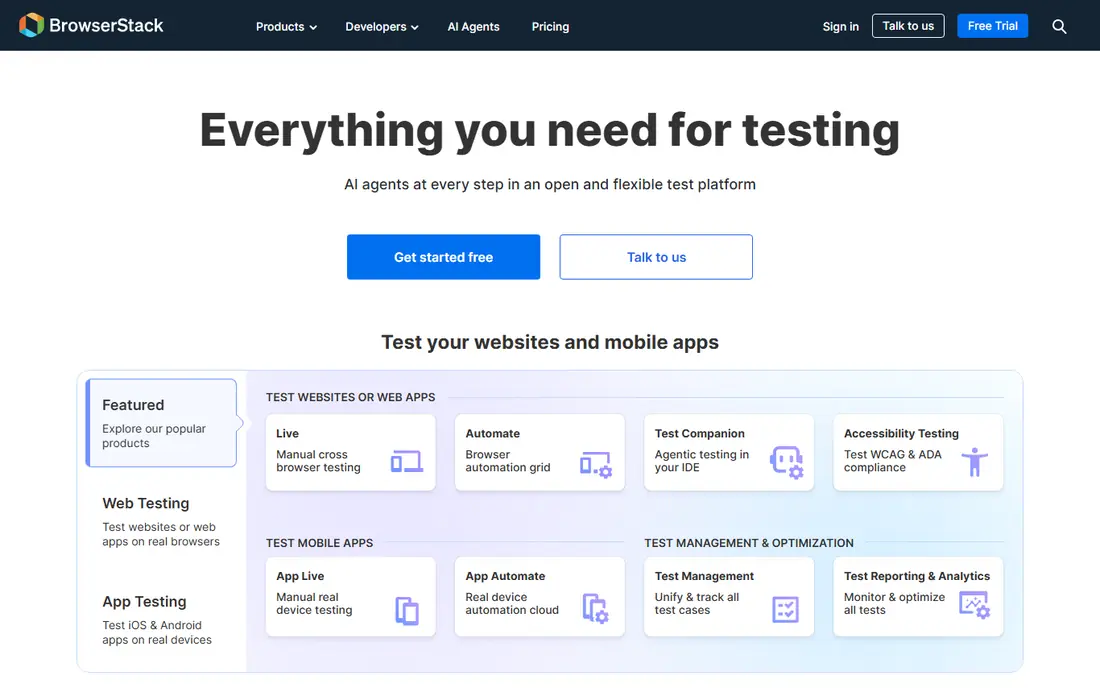
BrowserStack is the default shortlist entry for most mobile teams because its real device fleet is the largest among public clouds, and its tooling covers manual checks, automated Appium, Espresso and XCUITest suites, and integrations with major CI tools. App Live, starting at $39 per month in recent pricing summaries, lets a tester pick up a real phone in a browser and reproduce a bug without owning the device.
The cost trap is comparing manual and automation prices. App Automate, for CI runs, starts at a much higher rate per parallel, reported at $199 per month per parallel on annual billing. If you run a large suite nightly, budget for parallels, not just for one licence, and use manual plans for exploratory work.
- Very large real device fleet
- App Live for manual testing
- App Automate for CI suites
- Automation pricing rises with parallels
- Entry plans cover manual testing only
Sauce Labs is a close rival to BrowserStack, with a real device cloud, virtual devices, and support for Appium, Espresso and XCUITest. Live Testing starts at $39 per month for manual work, while Real Device Cloud automation is reported at $199 per month per parallel on annual billing. Enterprise features such as single sign on, private clouds and analytics make it a strong fit for regulated teams.
Sauce Labs suits teams that already run a mature automation suite and need governed execution at scale. Smaller teams that only need occasional manual checks may find the live plan enough, and should avoid paying for automation parallels until the suite is stable and runs often.
- Real devices plus emulators
- Strong enterprise controls
- Detailed logs and analytics
- Real device automation is a higher tier
- Setup needs care for large suites
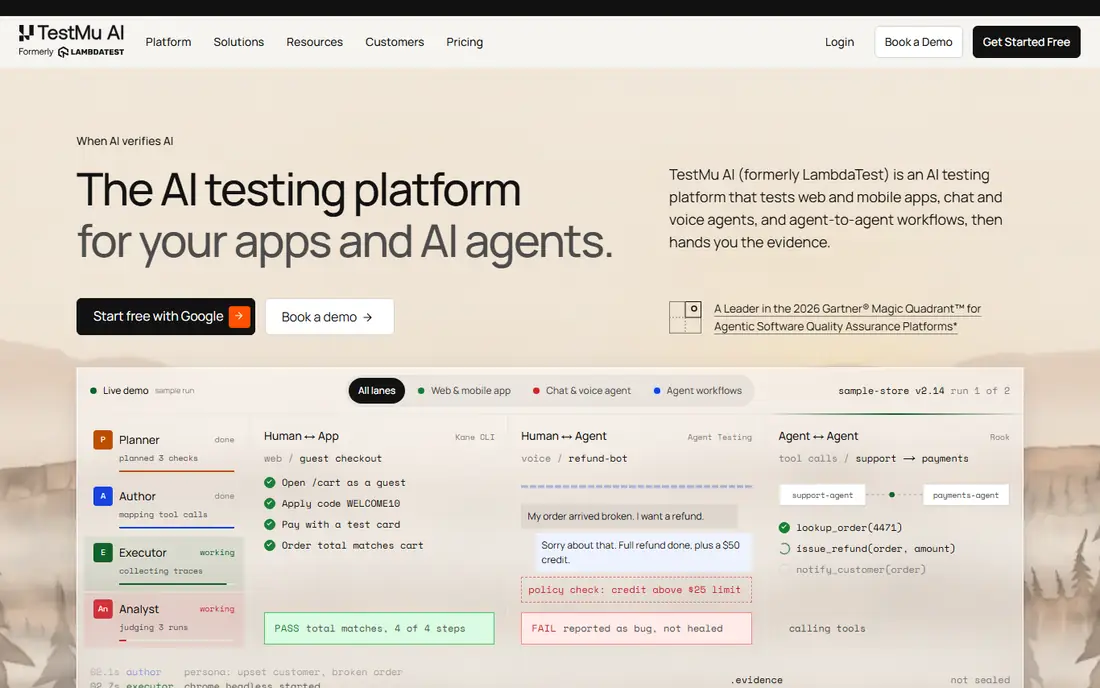
TestMu AI is the new name for LambdaTest, which rebranded in January 2026. It offers a free tier, live testing from $15 per month, and real device automation at a higher parallel based price, reported at $199 per month per parallel. That structure makes it a good entry point for a small team that wants to test on real devices without a large upfront commitment.
The trade off is scale. Its fleet is broad, but not as large as BrowserStack, and some device and OS combinations may be harder to find. For most small and mid sized apps, the coverage is enough, and the lower manual price is a clear advantage. Check device availability for your top markets before you commit.
- Free tier for basic use
- Low cost live testing
- Broad CI integrations
- Real device automation is a higher tier
- Fleet is smaller than BrowserStack
Perfecto, part of Perforce, is aimed at enterprise QA teams that need more than a device rental. It combines real devices with test execution, reporting and integrations for web and mobile, and it supports private devices for teams that need a dedicated fleet. That package suits banks, retailers and other large app owners with strict quality gates.
Pricing is quote based, so a small team should request a clear quote for its device count and parallel needs before comparing it with BrowserStack or Sauce Labs. Perfecto is best when reporting, audit trails and private devices matter as much as the test run itself.
- Real devices with enterprise test management
- Strong reporting
- Cloud and private device options
- Quote based pricing
- Heavier setup than a light device cloud
Bitbar, part of SmartBear, offers a real device cloud for manual and automated mobile testing, with support for common frameworks and CI tools. It also offers private devices for teams that need consistent hardware or data control. That flexibility makes it a useful middle option between a large public cloud and a self hosted lab.
Because pricing is not as widely published as BrowserStack or Sauce Labs, request a quote that states device minutes or parallels, device access and support level. Bitbar suits teams that want a focused device cloud without the full enterprise suite that Perfecto or Sauce Labs sell.
- Real Android and iOS devices
- Appium and other framework support
- Cloud and private options
- Pricing varies by plan
- Smaller public profile than the largest clouds
AWS Device Farm is the natural pick for teams already on AWS. You can run tests on real Android and iOS devices, pay $0.17 per device minute on the metered model in recent summaries, or buy an unmetered slot at $250 per month for heavy use. A free trial with 1,000 minutes is also reported, which is enough to test setup and a small suite.
The metered model is cheap for occasional runs and expensive for a large nightly suite, so model your minutes before you choose it over a flat parallel plan. AWS integration, IAM controls and S3 and CloudWatch links are the main advantage, especially for teams that already manage infrastructure in AWS.
- Pay per device minute
- Unmetered slot option
- Strong AWS integration
- Per minute costs add up for large suites
- Less hand holding than a managed cloud
Firebase Test Lab is still useful in October 2026, but buyers must plan around its future. Google has deprecated the service and set a shutdown date of 30 September 2027, pointing users to its Developer Device Platform on Google Cloud. Until then, the Spark plan offers a free daily quota, with paid use at $5 per physical device hour and $1 per virtual device hour in recent summaries.
That makes it a low cost smoke layer for Android teams, especially for Espresso suites and Robo crawls that need no test code. Do not start a new long term pipeline on Test Lab alone. Use it alongside a device cloud that will still exist after 2027, and plan migration early.
- Free daily quota on Spark plan
- Easy for Android Espresso suites
- Robo tests for apps without a suite
- Deprecated, with shutdown set for 30 September 2027
- No Appium support
- IOS runs only on physical devices
HeadSpin is different from a standard device cloud. It places real devices in many global locations and measures how an app performs under real network conditions, which matters for streaming, telecom and global apps where a lab network hides real problems. That data helps teams find issues that only appear on a slow or congested connection in a specific city.
Pricing is enterprise and quote based, so HeadSpin is not a budget pick. It suits teams that already have functional coverage and now need to prove performance in the real world. For a small app with a simple test suite, BrowserStack, TestMu AI or AWS Device Farm will be cheaper and simpler.
- Real devices in many global locations
- Real network conditions
- Performance and experience data
- Enterprise pricing
- Overkill for simple functional checks
TestingBot offers live and automated testing across browsers and real mobile devices, with plans aimed at smaller teams. Live testing is reported from EUR 20 per month, and automated testing from EUR 50 per month for one parallel, though you should confirm current pricing on the vendor site, since currency and plan details change. That simplicity appeals to teams that want a single vendor for web and mobile checks.
The fleet is smaller than BrowserStack or Sauce Labs, so check that your key devices are available. For a team with a focused device list and a modest suite, TestingBot can be a cost effective alternative, especially when web and mobile testing sit in the same budget.
- Live and automated testing on real devices and browsers
- Simpler pricing tiers
- Good for small teams
- Smaller fleet than the largest clouds
- Pricing in euros on some plans
How we picked these
We compared official product pages, pricing summaries checked in August and September 2026, and device cloud comparisons for mobile testing. We kept platforms that are live in October 2026, that offer real Android or iOS devices or a clear path to them, and that support manual testing, automated testing or both. We excluded Kobiton itself, since this is an alternatives list, and we excluded pure emulators with no real device option. Where pricing is quote based or varies by parallel, we wrote See website rather than inventing a figure.
How to choose the right Kobiton alternative
Start with how you test. Manual testers need a simple live device picker and good video and logs. CI teams need framework support, parallel runs and stable device availability at the time their pipeline runs. Performance teams need real networks and locations, not just a device in a data centre.
Count parallels, not seats
Most device clouds charge per parallel session, which is how many tests run at the same time. A team of 20 testers who rarely run tests together may need only two parallels. A CI pipeline that must finish in ten minutes may need six. Map your peak concurrency first, then compare prices, since a cheap per seat plan with one parallel can be slower and more costly in pipeline time than a higher parallel plan.
Pick devices from real usage data
Do not buy coverage for every phone on the market. Use your analytics to list the top 10 devices and OS versions your users actually run, plus one low end Android device for performance checks. A cloud that covers those devices well is better than a larger cloud that misses your top market.
Test the failure experience
A device cloud is judged when a test fails. Check logs, video, screenshots, network capture and device logs before you commit. A platform that makes it hard to reproduce a failure will cost your team hours, even if its headline price is low.
Frequently asked questions
What is the best Kobiton alternative for a small team?
TestMu AI is a strong low cost starting point for manual testing, with a free tier and live plans from $15 per month. AWS Device Farm suits occasional automated runs on a pay per minute basis. BrowserStack App Live is also practical if you want the largest device choice for manual checks.
Do I need real devices, or are emulators enough?
Emulators and simulators are enough for many functional checks and for early development. Real devices are needed for camera, biometric login, push notifications, low memory behaviour, and performance on real hardware and networks. Most teams use emulators for fast feedback and real devices for release checks.
How much does mobile device testing cost?
It depends on parallels and minutes. Manual live plans start around $15 to $39 per month on the tools here, while real device automation is often around $199 per month per parallel on annual billing for the large clouds. Pay as you go options such as AWS Device Farm charge per device minute, which can be cheaper for occasional use.
Is Firebase Test Lab still available?
Yes, in October 2026, but Google has deprecated it and set a shutdown date of 30 September 2027. You can use it for Android smoke testing now, but plan migration to another device platform well before that date, and do not build a new long term pipeline on it alone.
Can these tools test both Android and iOS?
Yes, all nine platforms here cover Android and iOS in some form, though the depth differs. Check that your specific OS versions, device models and frameworks, such as Appium, Espresso or XCUITest, are supported on the plan you intend to buy, not just on the vendor homepage.
Sources
See where you really rank - block by block
ProMapRanker scans Google Maps across a grid of your service area. Simple monthly plans from $19, white-label on every plan.
Start freeKeep reading
 wpforms alternatives
Best WPForms Alternatives in 2026
We compare 9 wpforms alternatives for WordPress forms, with free and paid options, current pricing notes, and honest limits for small business sites in 2026.
Read → windows task scheduler alternatives
Best Windows Task Scheduler Alternatives in 2026
Looking for Windows Task Scheduler alternatives? We compare 9 schedulers for Windows and cross-platform work, from free tools to enterprise automation.
Read → which ai video service is best
Which AI Video Service Is Best in 2026
which ai video service is best? We compare 10 legitimate AI video services on price, avatars, editing and output quality to help you pick the right tool.
Read →