 ProMapRanker
Gumroad Alternatives in 2026

Key takeaways
- Payhip and Lemon Squeezy let you start with no monthly fee, but each sale carries a platform fee, so volume decides which is cheaper.
- Sellfy suits sellers who want zero platform fees and print-on-demand in one store, once monthly sales justify the subscription.
- Podia and Teachable suit course sellers who need lessons, community and email in one place.
- Shopify and WooCommerce suit sellers who want a full store and full control, with more setup in return.
- If you sell worldwide, a merchant-of-record platform that handles sales tax can save a large amount of admin time.
Quick comparison
| Pick | Great for | Pricing starts at | Free tier | |
|---|---|---|---|---|
 Payhip | Low-fee digital sales with a free plan | Free | Yes | Visit |
 Lemon Squeezy | Software and SaaS with tax handled | Free | Yes | Visit |
 Sellfy | Zero-fee storefront plus print-on-demand | $22 per month | Free trial | Visit |
 Podia | Courses, downloads and community in one place | $42 per month | Free trial | Visit |
 Shopify | A full ecommerce store that can scale | $29 per month | Free trial | Visit |
 Ko-fi | Tips, memberships and small shops | Free | Yes | Visit |
 Stan Store | Selling from a link in bio | $29 per month | No | Visit |
 WooCommerce | Full control for WordPress users | Free | Yes | Visit |
The best Gumroad alternatives
Gumroad made it easy to sell a digital product with no monthly fee, but its per-sale fee can grow quickly as sales rise. The alternatives below cover the main reasons people leave: lower fees at scale, better course tools, stronger tax handling, or a full store. We compared official pricing pages and feature lists for each platform in October 2026, and Gumroad itself is not listed as a product here.
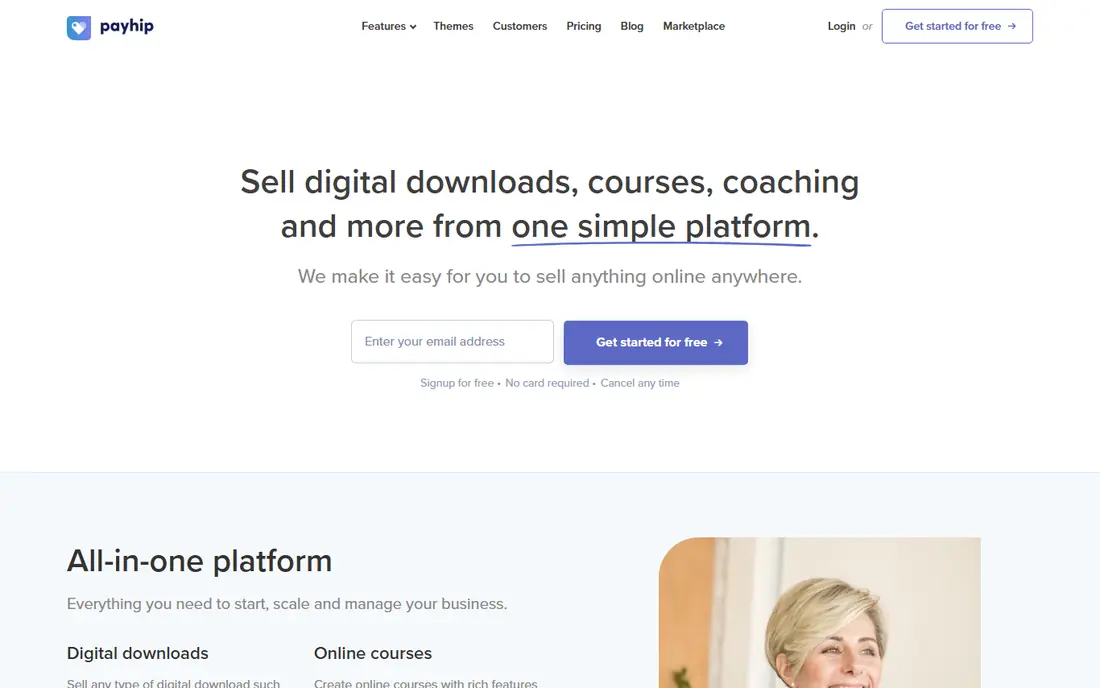
Payhip is the closest free-start replacement for a simple digital store. The free plan includes all features and unlimited products, and you pay 5% per sale plus payment processing fees. Paid plans lower that fee to 2% on Plus at $29 per month, or remove it on Pro at $99 per month. That ladder makes it easy to start free and upgrade only when sales justify it.
Tax handling is a genuine strength. Payhip handles EU and UK digital VAT and, on the terms we found, collects and pays US sales tax for sellers. For a solo creator selling ebooks, templates or a small course, that removes a common headache. The storefront itself is plain rather than highly customisable, so brands that need a heavily designed site may prefer Shopify or WooCommerce.
- Free plan with all features and unlimited products
- Handles EU and UK digital VAT and US sales tax on published terms
- Fast payouts
- 5% platform fee on the free plan
- Payment processing fees apply on top
- Storefront design is simpler than a full website builder

Lemon Squeezy acts as the merchant of record, which means it handles sales tax, VAT and related compliance for you. That is a major benefit for software and SaaS sellers with customers in many countries, since registering for tax in each place is slow and costly. There is no monthly fee, and the base fee is 5% plus $0.50 per sale, including card processing on published terms.
The fee structure cuts both ways. On a $5 template, $0.50 plus 5% is a large share of the sale, so low-priced products may do better on Payhip or Sellfy. On higher-priced software and subscriptions, the tax handling often outweighs the fee. If your main product is code, a plugin or a subscription tool, Lemon Squeezy deserves a place near the top of your shortlist.
- Merchant-of-record checkout handles global sales tax
- No monthly fee
- Built for software licences and subscriptions
- 5% plus $0.50 per sale, which is costly on low-priced items
- Extra fees can apply for international and PayPal payments
- Less suited to physical goods
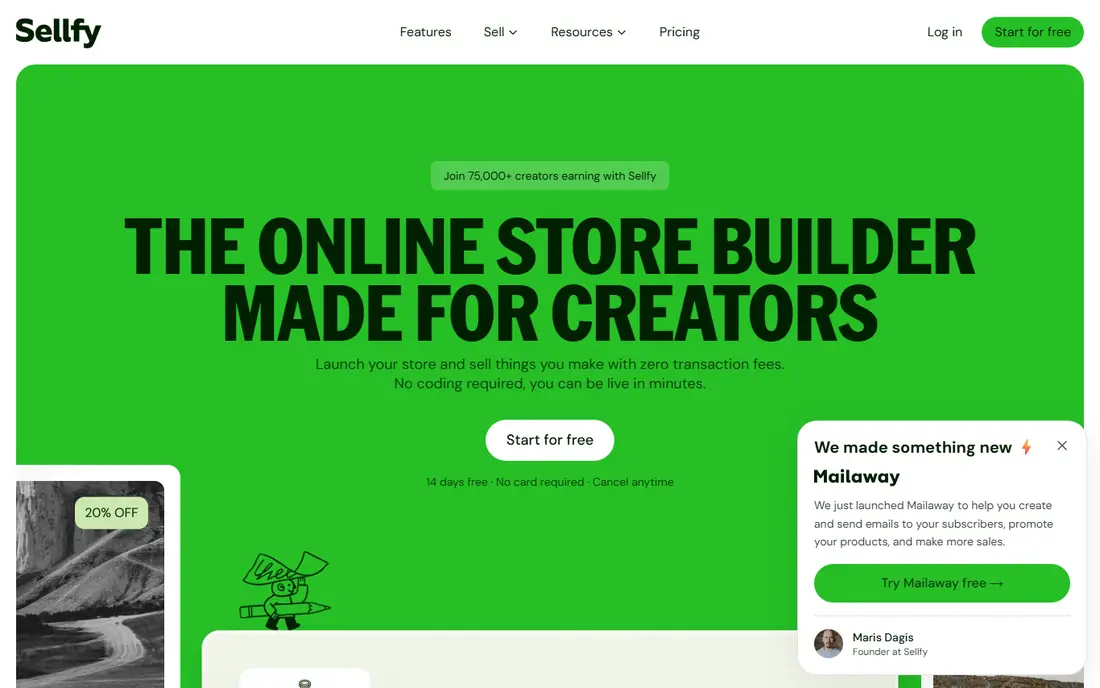
Sellfy charges a monthly subscription and takes 0% in platform transaction fees, which flips the maths compared with free-start platforms. The Starter plan is $22 per month billed annually, with higher plans for larger sales volumes. Payment processing fees still apply, but the platform itself does not take a cut of each sale, so high-volume sellers can save money quickly.
Print-on-demand is the other reason to pick Sellfy. You can sell digital downloads alongside printed merch from the same storefront, without holding stock. The Starter sales cap means fast-growing sellers should check which plan fits their yearly volume. If you sell steadily and want predictable costs, Sellfy is one of the cleanest alternatives in this list.
- 0% platform transaction fees on paid plans
- Print-on-demand built in
- Email marketing and discount tools included
- No free plan, only a trial
- Starter plan has an annual sales cap
- Monthly cost needs steady sales to justify it
Podia suits creators whose main product is a course, a membership or a bundle of downloads. It combines a course player, community spaces, email marketing and a storefront, so you do not need four separate tools. The Mover plan is $42 per month billed annually, with Shaker and higher plans removing the platform fee and adding more features.
The entry fee is worth noting. On Mover, Podia takes 5% on sales in addition to payment processing, so course sellers should compare the total cost with Teachable and Sellfy at their expected price point. For creators who want students, community discussion and email in one place without technical setup, Podia keeps the whole operation simple and coherent.
- Courses, community, email and downloads in one account
- No platform fee on higher plans
- Clean student experience
- Entry Mover plan carries a 5% fee on published terms
- No free plan
- Site design is simpler than a full builder
Shopify is the full-store alternative for sellers who have outgrown a simple link checkout. Basic is $29 per month billed annually, with higher plans for growing stores, and card processing fees apply on top. The app store covers digital delivery, memberships, subscriptions, email and analytics, and you can sell on your site, on social channels and in person from one catalogue.
That power comes with setup time and cost. A simple ebook seller may find Shopify heavier than needed, and digital delivery apps add a monthly fee. Shopify makes sense when you sell many products, mix physical and digital goods, or plan to grow into a brand with a full website. For that seller, the checkout quality and app choice are hard to match.
- Huge app ecosystem
- Strong checkout and multichannel selling
- Handles physical and digital products at scale
- Monthly cost plus apps can add up
- Digital delivery usually needs an app
- Heavier setup than a simple creator checkout
Ko-fi started as a tipping tool and now covers memberships, commissions and a simple shop. Donations carry 0% platform fee, while shop sales and memberships carry 5% unless you pay $12 per month for Ko-fi Gold, which removes that fee. Payment processing fees still apply. That structure suits artists, writers and small creators whose income leans toward fan support rather than high-volume product sales.
Ko-fi is not a course platform and not a full store. There is no deep course player or complex storefront builder, so creators who need structured lessons should pick Podia or Teachable instead. For a creator who wants a friendly page where fans can tip, join and buy a few items, Ko-fi is one of the cheapest and simplest options available.
- Free to start
- 0% platform fee on donations
- Gold at $12 per month removes the shop fee
- Simple for fans to use
- 5% fee on shop sales and memberships without Gold
- No full course builder
- Store design is basic
Stan Store is built for creators who sell from Instagram, TikTok or YouTube. You set up a mobile-first store behind a single link, list digital products, courses, memberships and bookings, and buyers check out without leaving the flow for long. Creator is $29 per month, with a Pro plan at $99 per month, and Stan takes 0% in platform fees, though payment processing fees still apply.
The limit is scope. Stan is not a full website builder, and customisation is narrower than Shopify or WooCommerce. It works best when you already have social traffic and want to convert it fast, rather than when you need search traffic to a full store. For link-in-bio sellers, the speed and simplicity are the main selling points.
- 0% platform fees
- Mobile-first store built for social traffic
- Fast setup from a bio link
- No free plan
- Limited customisation compared with a full store
- Best for creators with an existing audience
WooCommerce is the self-hosted alternative for sellers who want full control. The plugin itself is free, and WooCommerce takes no platform fee, though payment processing fees and hosting costs apply. On WordPress, you can build any storefront, sell digital or physical products, and choose extensions for subscriptions, memberships, licences and tax.
Control brings responsibility. You handle hosting, updates, backups and security, or you pay someone to do it. Tax handling is not automatic in the same way as a merchant-of-record platform, so worldwide sellers need an extension or a tax service. If you already run WordPress and value ownership over convenience, WooCommerce gives the most freedom in this list for the lowest platform cost.
- Free plugin with no platform sales fee
- Full ownership of your store and data
- Huge extension library
- You pay for hosting and maintenance
- Setup and security are your job
- Tax handling needs extensions or services
How we picked these
We compared official pricing pages and feature lists for platforms that sell digital products, courses, software or memberships in October 2026. We favoured platforms that are open to new sellers, state their fees clearly, and fit a clear reason to leave Gumroad, such as lower fees at scale, course tools, tax handling or a full store. We excluded Gumroad itself from the list, as this article covers alternatives only.
What to check before you switch
Work out your real fee at your real price and volume. A free plan with a 5% fee beats a $29 monthly plan until sales pass a clear point, and a monthly plan with 0% fees wins once volume grows. Run the numbers for 10, 100 and 1,000 sales a month before you choose, and include payment processing fees in every case.
Tax, payouts and migration
Check who handles sales tax, how fast payouts arrive, and whether you can export your customer list. If you sell worldwide, merchant-of-record handling can save hours each month. Before you move, test the new checkout with a real purchase, confirm that download links and licence keys work, and tell existing customers where to find their purchases.
Course and community needs
If you sell courses, compare the student experience, not just the fee. Look at lesson types, quizzes, certificates, community tools and email options. A platform that charges slightly more but keeps students engaged and buying again can be cheaper in the long run than a bare checkout that loses repeat sales.
Frequently asked questions
What are the best Gumroad alternatives?
Payhip and Lemon Squeezy are strong free-start alternatives, Sellfy suits sellers who want zero platform fees, and Podia suits course sellers. Shopify and WooCommerce suit sellers who want a full store. The best choice depends on your product type, price, sales volume and whether you need tax handling.
What is the cheapest Gumroad alternative?
Payhip, Lemon Squeezy, Ko-fi and WooCommerce all let you start without a monthly platform fee, though each takes a fee per sale or charges for hosting and processing. For very low sales, a free plan is cheapest. Once sales grow, a monthly plan with 0% platform fees, such as Sellfy, can become cheaper overall.
Do Gumroad alternatives handle sales tax?
Some do. Lemon Squeezy acts as merchant of record and handles global sales tax for you. Payhip handles EU and UK digital VAT and US sales tax on published terms. Shopify, WooCommerce and Podia calculate tax in various ways but do not always file it for you, so check the exact service before you sell worldwide.
Can I sell courses on these platforms?
Yes, with different depth. Podia and Teachable-style course tools give structured lessons, student progress and community. Payhip and Sellfy can sell a course as a downloadable or hosted product, but with simpler lesson tools. Shopify and WooCommerce can sell courses through apps and extensions, with more setup.
Is Shopify better than Gumroad for digital products?
Shopify is better if you want a full store, many products, physical goods and multichannel selling. Gumroad-style checkouts are simpler and cheaper for a single digital product. If digital sales are a side line to a growing brand, Shopify gives more room to grow. If you sell one or two downloads, a simple creator platform is usually enough.
How do I move from Gumroad to another platform?
Export your product files and customer list where the platform allows it, rebuild product pages on the new platform, and test checkout, delivery and emails with a real purchase. Tell customers where to find past purchases, and keep the old product pages live until buyers have moved across. Check licence and tax settings before you switch off the old store.
Sources
See where you really rank - block by block
ProMapRanker scans Google Maps across a grid of your service area. Simple monthly plans from $19, white-label on every plan.
Start freeKeep reading
 free alternatives to grok imagine
Free Alternatives to Grok Imagine in 2026
We compared the best free alternatives to grok imagine for image generation, from fast daily credits to design tools, so you can create without paying.
Read → best tools for instagram content creation
Best Tools for Instagram Content Creation in 2026
Compare the best tools for Instagram content creation, from Canva and CapCut to Later and Buffer, on design, video, planning, scheduling, and price in 2026.
Read → best tool to split pdf files
Best Tool to Split PDF Files in 2026
We compared the best tool to split pdf files on split modes, file limits, privacy and price, so you can split a PDF cleanly and keep every page in one go.
Read →