 ProMapRanker
Best FastSpring Alternatives in 2026

Key takeaways
- Paddle, Lemon Squeezy, Dodo Payments, and Creem act as merchant of record, so they handle sales tax and VAT collection on your behalf.
- Stripe gives the most control for engineering-led teams, but you keep more tax and compliance work unless you add its managed payments option.
- Chargebee and Cleverbridge suit larger or more complex billing needs, where subscription logic and enterprise contracts matter more than a low headline fee.
- This is not financial advice. Model fees at your real volume, because a small percentage gap grows fast as revenue grows.
Quick comparison
| Pick | Great for | Pricing starts at | Free tier | |
|---|---|---|---|---|
 Paddle | Established global SaaS | 5% + $0.50 per transaction | No | Visit |
 Stripe | Developer control and scale | 2.9% + $0.30 per transaction | No | Visit |
 Lemon Squeezy | Indie SaaS and digital products | 5% + $0.50 per transaction | No | Visit |
 Dodo Payments | Lower-fee global SaaS | 4% + $0.40 per transaction | No | Visit |
 Creem | Indie SaaS and AI tools | 3.9% + $0.40 per transaction | No | Visit |
 PayPro Global | Cross-border software sales | See website | No | Visit |
 Chargebee | Complex subscription billing | See website | Free trial | Visit |
 Cleverbridge | Enterprise software commerce | See website | No | Visit |
The best fastspring alternatives
FastSpring sells software worldwide as a merchant of record, handling tax, compliance, and subscription billing. The alternatives below split into two groups: merchant of record platforms that take on tax and seller liability, and billing or payment platforms that give you more control but leave more work with you. That distinction matters more than the headline fee alone.
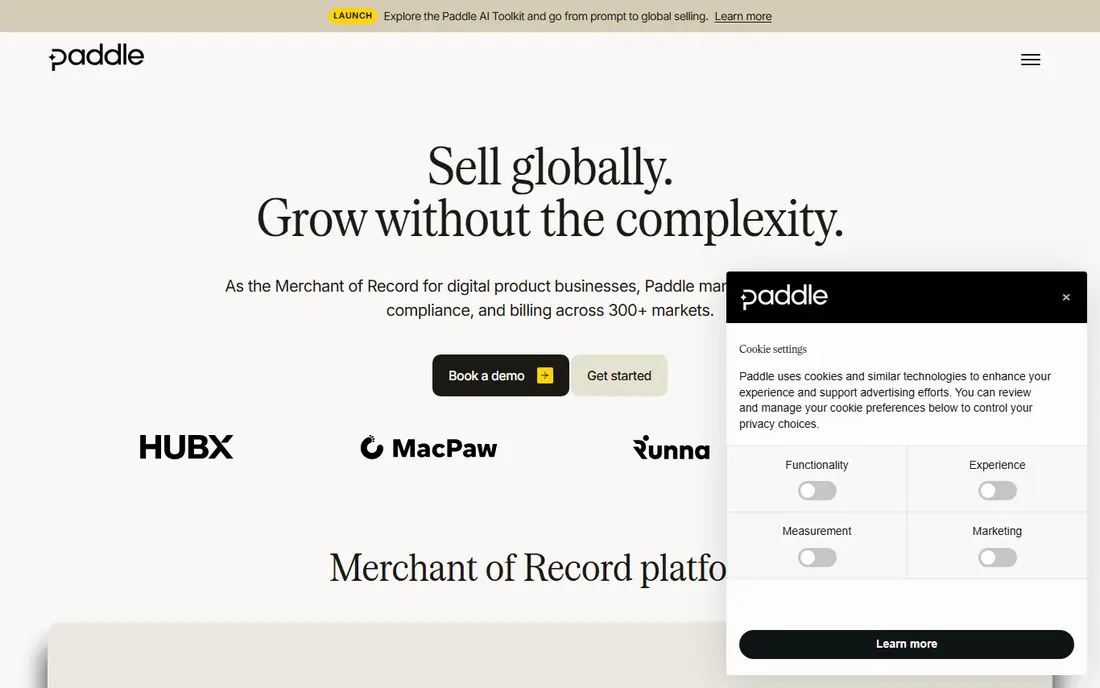
Paddle is the most established merchant of record alternative for SaaS teams selling worldwide. It acts as the seller, handles sales tax and VAT, and manages subscriptions, proration, and invoicing in one system. For a team that wants to remove tax registration and filing from its roadmap, that coverage is the main draw.
The trade is cost and flexibility. A 5% fee plus a per-transaction charge is easy at low volume and expensive at high volume, and custom billing logic can be harder to build than on Stripe. Model the fee at $10,000 and $100,000 in monthly revenue before you choose, since the answer changes with scale.
- Merchant of record across many markets
- Subscriptions and invoicing
- No monthly fee on standard plan
- Checkout and billing logic can feel rigid
- Percentage fee grows with revenue

Stripe suits engineering-led teams that want full control over checkout, billing, and customer data. Its APIs, payment methods, and Billing product cover one-time payments, subscriptions, usage billing, and invoicing, and thousands of tools integrate with it. The headline US card rate of 2.9% plus $0.30 is lower than most merchant of record fees.
Control brings responsibility. Stripe does not act as merchant of record on its standard product, so your company remains the seller and must handle tax collection and remittance, with Stripe Tax as a paid aid in many cases. Its managed payments option adds merchant of record coverage for an extra fee, which changes the comparison. Choose Stripe for control, not for hands-off tax handling.
- Deep APIs and payment methods
- Strong billing tools
- Huge ecosystem of integrations
- Not a merchant of record by default
- Tax and compliance work stays with you unless you add options

Lemon Squeezy is popular with indie developers and small SaaS teams because setup is fast and the product feels modern. It acts as merchant of record, handles tax calculation and filing, and covers subscriptions, licenses, and digital downloads. For a solo founder selling a small product worldwide, that simplicity saves weeks of setup.
Watch the add-ons. International payments, PayPal, and subscriptions can each add a surcharge on top of the base rate, so the effective fee is higher than 5% for many sellers. Lemon Squeezy is now part of Stripe, which some founders see as stability and others see as a reason to watch its long-term direction.
- Merchant of record with simple setup
- Good for subscriptions and digital downloads
- Clean checkout
- International and subscription surcharges add up
- Smaller ecosystem than Paddle or Stripe
Dodo Payments positions itself as a lower-cost merchant of record for global SaaS, with a 4% plus $0.40 US rate and added fees for international payments and subscriptions. It covers subscriptions, usage metering, credits, and one-time purchases, which suits AI and SaaS products with metered pricing. For a team optimizing margin, the one-point saving over Paddle is real at scale.
The trade is maturity. Dodo is newer than Paddle, Stripe, or FastSpring, so its integration library and track record are smaller. That may not matter for a straightforward SaaS checkout, but larger teams should check support, migration help, and payout terms before moving renewals.
- Merchant of record at a lower headline rate
- Usage and credit billing
- Global coverage
- Newer than Paddle and Stripe
- Ecosystem and integrations still growing
Creem offers one of the lowest headline merchant of record rates in this group, at 3.9% plus $0.40 per successful payment, with no monthly or setup fee on its standard plan. It handles VAT, GST, and sales tax from calculation through filing, and it covers subscriptions, seats, usage meters, and prepaid credits. That mix suits indie SaaS and AI tools with global customers.
As with other newer platforms, check the extras. Affiliate payouts, recovered carts, and some payout methods carry added fees, and the platform is younger than Paddle or Stripe. For a small team that wants low fees and hands-off tax, Creem is worth a close look alongside Dodo Payments.
- Merchant of record at a low headline rate
- Tax handled across many countries
- Subscriptions and credits
- Newer platform
- Affiliate and recovery features add extra fees
PayPro Global is a long-standing merchant of record for software sellers, with global tax and VAT handling, subscription management, and invoicing. It suits companies that sell downloadable software and subscriptions across borders and want a partner to handle compliance and customer support processes.
Pricing is negotiated rather than published as a simple rate, so you will need a sales conversation and a volume estimate to compare it fairly. Self-serve founders may find that slower than Paddle or Lemon Squeezy, but established software companies often value the hands-on service.
- Merchant of record for software worldwide
- Subscription and invoice management
- High-touch support
- Quote-based pricing
- Less self-serve than newer platforms
Chargebee is a billing platform, not a merchant of record. It excels at complex subscriptions: trials, upgrades, proration, usage, coupons, and dunning for failed payments. Finance teams also value its revenue recognition tools, which matter once subscriptions grow beyond simple monthly plans.
The limit is scope. Chargebee does not take on seller liability or file your taxes, so you still need a payment gateway and a tax solution. It fits teams that want billing depth and are comfortable owning compliance, often alongside Stripe. If hands-off tax is the priority, a merchant of record above is a better fit.
- Strong subscription logic
- Dunning and revenue recognition
- Many integrations
- Not a merchant of record
- You keep tax and seller liability
- Pricing suits mid-market teams
Cleverbridge serves enterprise software and digital commerce clients with merchant of record services, global tax handling, and B2B features. It suits companies with complex contracts, reseller channels, or high-touch sales processes that need a commerce partner rather than a simple checkout link.
That enterprise focus means slower, heavier onboarding than indie tools. Pricing is custom, and small teams may find the process out of proportion to their needs. For mid-market and enterprise software sellers, though, Cleverbridge is a credible FastSpring alternative with a long track record.
- Enterprise digital commerce experience
- Global tax and compliance
- B2B and channel support
- Quote-based enterprise pricing
- Heavier onboarding than self-serve tools
How we picked these
We compared official pricing pages and recent merchant of record comparisons for platforms that sell software and SaaS worldwide in October 2026. We separated merchant of record platforms from billing-only platforms, because that difference changes who handles tax. We used published percentage fees where vendors publish them and See website where pricing is quote-based or volume-dependent.
What to model before you move
Start with your effective fee, not the headline rate. Add international surcharges, PayPal fees, subscription add-ons, and any billing or tax product fees. Then run the total at your current monthly revenue and at three times that revenue, since a percentage fee scales with you while a monthly billing platform may not.
Next, check migration risk. Renewals, trials, coupons, and license entitlements must move without breaking customer access. Ask each vendor how it handles migration, failed-payment recovery, and prorations, and test with a small group before moving your full subscriber base.
Finally, confirm who is the seller on the invoice. If the platform is merchant of record, it appears as the seller and handles tax. If it is not, your company is the seller, and you need a tax plan. That single answer often narrows the list faster than any feature comparison.
Frequently asked questions
What are good alternatives to fastspring for SaaS?
Paddle is the most established merchant of record pick, while Lemon Squeezy, Dodo Payments, and Creem offer simpler or lower-fee options for smaller teams. Stripe suits teams that want control, and Chargebee suits teams that need complex billing.
Which fastspring alternative is cheapest?
On headline rates, Creem at 3.9% plus $0.40 and Dodo Payments at 4% plus $0.40 undercut Paddle and Lemon Squeezy at 5% plus $0.50. Effective cost depends on international, PayPal, and subscription surcharges, so model your own mix.
Is Stripe a merchant of record like FastSpring?
Not on its standard product. Stripe is a payment processor, and your company remains the seller. Its managed payments option adds merchant of record coverage for an extra fee, so confirm which Stripe product you are comparing.
Can I keep my subscribers when I switch?
In most cases, yes, but migration needs care. Ask the new vendor about importing subscriptions, payment methods, trials, and entitlements, and test renewals with a small group before a full move.
Do I still need to handle tax with a merchant of record?
No, in the markets the platform covers. The merchant of record calculates, collects, files, and pays indirect tax on your behalf. You should still confirm coverage for your specific countries and product types.
Sources
See where you really rank - block by block
ProMapRanker scans Google Maps across a grid of your service area. Simple monthly plans from $19, white-label on every plan.
Start freeKeep reading
 wpforms alternatives
Best WPForms Alternatives in 2026
We compare 9 wpforms alternatives for WordPress forms, with free and paid options, current pricing notes, and honest limits for small business sites in 2026.
Read → windows task scheduler alternatives
Best Windows Task Scheduler Alternatives in 2026
Looking for Windows Task Scheduler alternatives? We compare 9 schedulers for Windows and cross-platform work, from free tools to enterprise automation.
Read → which ai video service is best
Which AI Video Service Is Best in 2026
which ai video service is best? We compare 10 legitimate AI video services on price, avatars, editing and output quality to help you pick the right tool.
Read →