 ProMapRanker
Best CoreWeave Alternatives in 2026

Key takeaways
- Lambda and RunPod suit most self-serve training and inference work, while Vast.ai and TensorDock suit budget experiments.
- Modal suits variable inference traffic that should scale to zero, while Nebius and Crusoe suit teams with compliance or scale needs.
- GPU prices change with availability, so compare the exact card, billing unit and egress terms for your workload, not only a headline hourly rate.
- Marketplace hosts can be cheaper but vary in reliability, so check host ratings and checkpoint often for long runs.
Quick comparison
| Pick | Great for | Pricing starts at | Free tier | |
|---|---|---|---|---|
 Lambda | Training throughput | See website | No | Visit |
 RunPod | Flexible pods and serverless | See website | No | Visit |
 Vast.ai | Lowest cost experiments | See website | No | Visit |
 Paperspace | Notebooks and ease of use | See website | No | Visit |
 Nebius | European compliance and scale | See website | No | Visit |
 Modal | Serverless inference | See website | Free trial | Visit |
 TensorDock | Marketplace value | See website | No | Visit |
 Hyperstack | Large multi-GPU clusters | See website | No | Visit |
 Crusoe | Scale with lower carbon energy | See website | No | Visit |
The best coreweave alternatives
We compared official product pages and published GPU pricing for cloud GPU providers that are live in October 2026 and offer training or inference capacity as a real alternative to large scale GPU clouds. CoreWeave itself is not listed here, since this article covers alternatives to it.
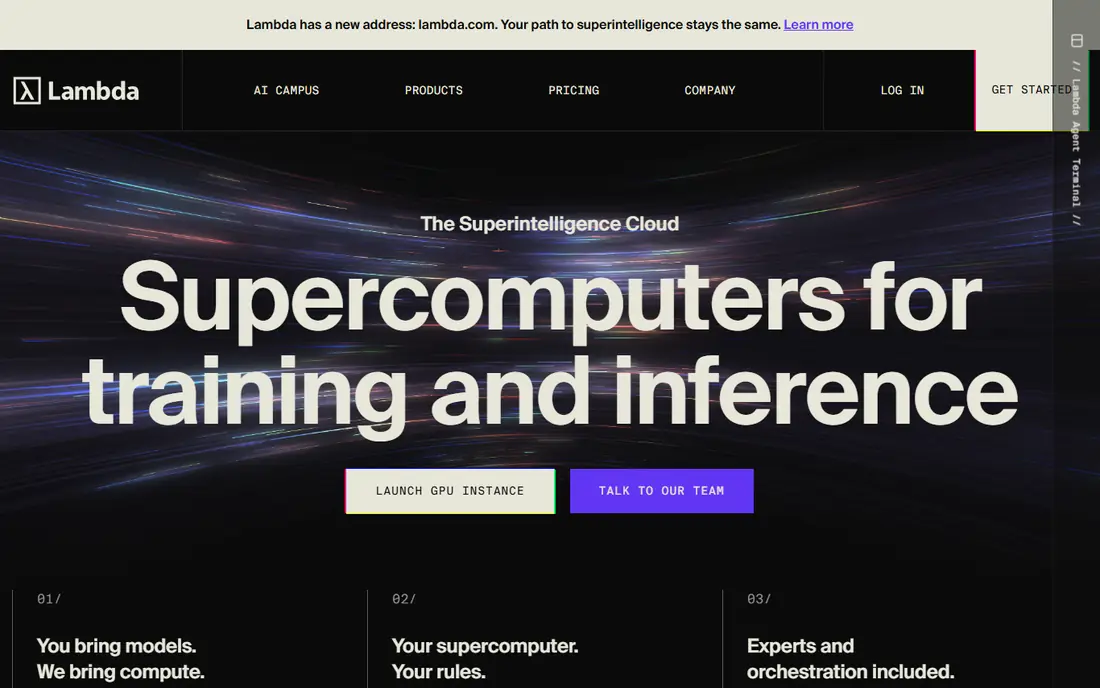
Lambda is a popular self-serve GPU cloud for researchers and startups that train models. Instances come with deep learning software ready to use, which shortens setup, and cluster options support multi-GPU training with fast interconnects. Free egress also helps teams that move large datasets and checkpoints often, since egress fees can add up on other clouds.
Lambda is not the best choice for spiky inference traffic, because it lacks a true serverless tier that scales to zero. Availability for the newest cards can also vary, so check stock for your exact GPU before planning a run. For steady training work where throughput per dollar matters, Lambda is a strong first alternative.
- Transparent instance pricing
- Deep learning images ready to use
- Cluster options for larger runs
- No serverless scale to zero tier
- Some cards need reservation or wait for stock
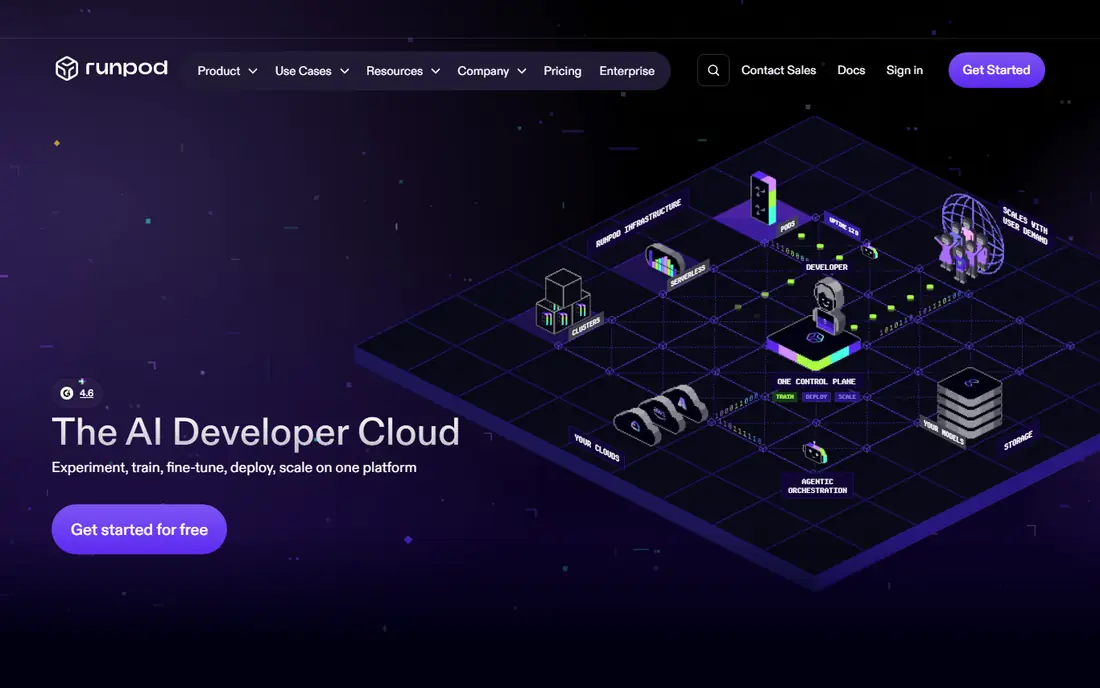
RunPod covers more workload types than most rivals in one account. You can rent a pod for interactive work, use serverless endpoints for inference that scales with traffic, or build clusters for training. Per second billing helps short jobs, and the GPU range spans consumer cards through data center cards, which lets small models run on cheaper hardware.
The community cloud side adds choice but also variance. Host reliability differs, so read host ratings and use checkpoints for long training runs. Secure cloud options cost more but suit production work. For teams that want one platform for experiments, training and inference, RunPod offers the widest practical mix.
- Pods, serverless and clusters in one platform
- Per second billing
- Wide GPU range
- Community cloud hosts vary in reliability
- Pricing varies by GPU and region
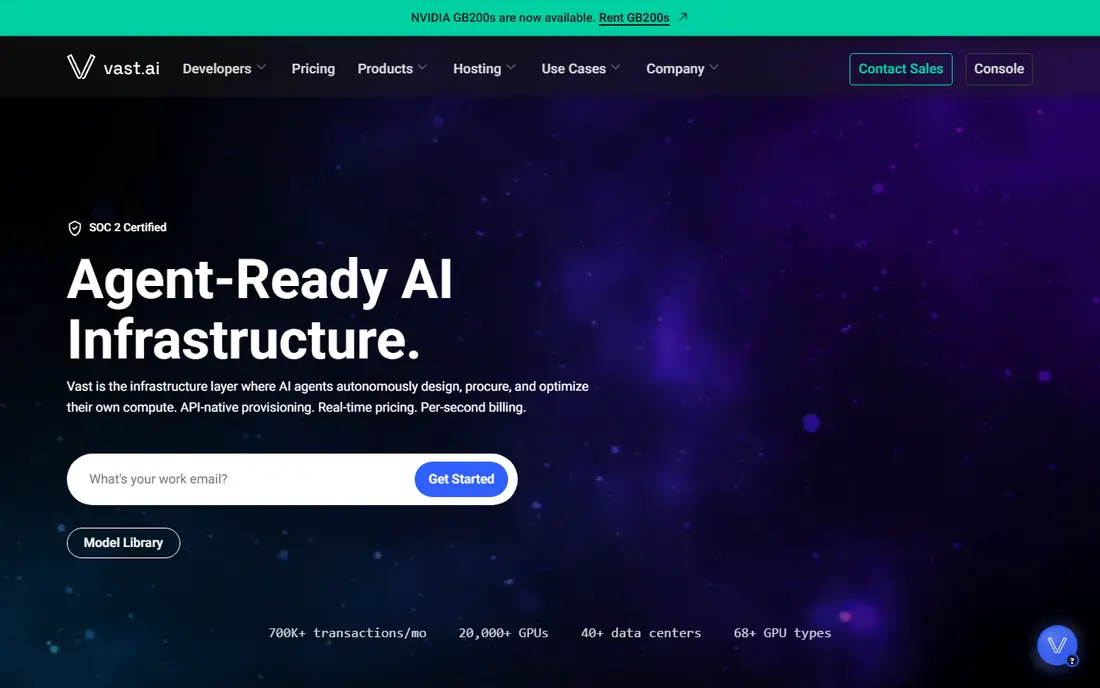
Vast.ai is a marketplace where independent hosts rent GPU capacity, and that model often produces the lowest prices in the market. It suits hyperparameter sweeps, short experiments and student or researcher work where a failed run is annoying but not costly. The range of cards, from consumer GPUs to data center models, also helps teams match hardware to model size.
The trade-off is variance. Host quality, uptime and support differ, and a cheap host can disappear or underperform mid-run. Use checkpoints, pick verified hosts, and do not run a customer facing service on an unverified host without a fallback. For budget experiments, Vast.ai is hard to beat on price. For production, pair it with a more managed provider.
- Very low headline prices
- Large host marketplace
- Wide GPU choice
- Reliability varies by host
- Support and uptime vary
- Less suited to strict production SLAs
Paperspace, by DigitalOcean, suits individuals and small teams who want to start quickly. The notebook centered workflow feels familiar to researchers, and fine-tuning or evaluation jobs can start without building a cluster platform first. That ease of use matters for students, indie developers and small teams with limited operations time.
For very large multi-node training, Paperspace is less specialized than Lambda, Hyperstack or Crusoe, and its GPU range and cluster depth should be checked for your exact workload. If your work is fine-tuning, prototyping and small inference jobs, its simplicity outweighs that limit. If you need hundreds of GPUs, look at the larger cluster providers in this list.
- Approachable notebook workflow
- Simple setup for fine-tuning
- DigitalOcean backing
- Less depth for very large clusters
- Pricing needs checking for newer cards
Nebius is an AI cloud built for larger training and inference workloads, with European data centers that suit teams with data residency needs. It offers modern GPU capacity, managed Kubernetes options and scale for teams moving beyond single instances. Free egress on some plans also helps teams that move data often.
Nebius is less of a casual experiment tool than Vast.ai or RunPod community cloud, and larger deals often involve quoted pricing rather than a simple self-serve card. Small teams can still use it, but they should check the entry path and minimums first. For European teams or mid-size companies that need scale with compliance features, Nebius is a serious alternative.
- European data centers
- Enterprise scale options
- Free egress on some plans
- Pricing is often quoted for larger deals
- Less suited to tiny one-off experiments
Modal suits developers who want to run a model as a function without managing servers. Traffic can scale up when requests arrive and scale to zero when idle, so you do not pay for idle GPUs during quiet hours. That model fits inference APIs, batch jobs and prototypes that see uneven use, and the Python workflow feels natural to many ML developers.
Modal is not the best fit for a long, reserved multi-GPU training run that needs a fixed cluster for weeks. For that work, a reserved instance or cluster provider will be cheaper and more predictable. Use Modal when traffic varies and server management is a burden, and use a cluster provider when training is steady and long running.
- Serverless scale to zero
- Per second billing
- Python friendly deployment for models
- Less suited to long reserved training clusters
- Costs depend on traffic patterns
TensorDock is another host marketplace that competes on price, with a prepaid balance model and a wide range of GPU models across many locations. It suits budget training, sweeps and experiments where cost matters more than a managed service layer. Teams that can handle their own setup and checkpointing can save a lot compared with hyperscaler rates.
Like Vast.ai, TensorDock trades managed reliability for price. Host quality varies, and there is no serverless scale to zero tier for inference. Check host ratings, test a short run first, and keep checkpoints current. For cost sensitive work with some engineering tolerance, TensorDock is a useful alternative to keep in the mix.
- Low marketplace prices
- Prepaid balance model
- Wide GPU choice
- Reliability varies by host
- No true serverless tier
- Support varies
Hyperstack focuses on high performance GPU clusters for training, with an emphasis on multi-GPU scaling and fast interconnects. Teams that need 8, 16 or many more GPUs working together for a large model run will find that focus useful, and reservation options help secure capacity for planned work. That specialization sets it apart from general purpose clouds.
For a single GPU experiment, Hyperstack is more than most users need, and smaller providers will be cheaper and simpler. It earns its place for teams whose bottleneck is inter-GPU bandwidth and cluster scale, not single instance price. Check capacity, region and interconnect details for your exact cluster size before committing.
- Focus on high performance multi-GPU clusters
- SXM and NVLink style scaling
- Reservation options
- Geared to larger runs
- Less suited to single GPU experiments
Crusoe operates a GPU cloud built for larger AI workloads, with modern NVIDIA and AMD capacity and an emphasis on energy efficient infrastructure. It suits organizations that need scale, uptime and support, and that also want to report on the energy profile of their compute. Its operations posture appeals to teams moving from experiments to production at scale.
Crusoe is enterprise oriented, so small one-off users may find the sales led path slower than self-serve rivals. Pricing for large capacity often requires a conversation rather than a simple checkout. For mid-size and larger teams that need reliable scale, Crusoe is a credible alternative to the largest GPU clouds.
- Modern GPU capacity at scale
- Strong operations posture
- Energy focused infrastructure
- Enterprise oriented
- Pricing often requires a sales conversation for large capacity
How we picked these
We compared official product pages, published GPU pricing and provider documentation in October 2026, and kept only providers that offer live GPU capacity for training or inference. We favored a mix of self-serve, serverless, marketplace and enterprise options, and we noted where pricing varies by card, region and availability. GPU hourly rates change often, so all prices here are shown as See website and should be checked on the vendor page for your exact card.
How to choose a GPU cloud without overpaying
Start with the workload, not the card name. A small fine-tuning job, a large training run and a spiky inference API need different billing models, even if they use the same GPU. Match billing to use: reserved or hourly instances for steady work, per second or serverless for variable work, and marketplace hosts for experiments you can restart.
Check the full cost, not only the hourly rate
Compare egress fees, storage, interconnect and minimum billing, and check whether the card you need is actually in stock in your region. Test a short run on two providers with the same model and data, and measure wall clock time, not only the advertised price. A cheaper hourly rate on slower interconnects can cost more for a multi-GPU job.
Frequently asked questions
What is the best CoreWeave alternative for most teams?
Lambda and RunPod are the best starting points for most self-serve teams. Lambda suits steady training, while RunPod suits a mix of pods, serverless inference and clusters. Vast.ai suits budget experiments, and Modal suits variable inference traffic.
Is there a cheap CoreWeave alternative?
Yes. Vast.ai and TensorDock marketplaces often list the lowest headline rates, and RunPod community cloud can also be cheap. Cheap hosts vary in reliability, so use checkpoints and verified hosts for longer runs, and do not rely on a single cheap host for production.
Can I use these providers for inference as well as training?
Yes, with different strengths. RunPod serverless and Modal suit variable inference, while Lambda, Nebius, Hyperstack and Crusoe suit steady inference on reserved capacity. Paperspace suits small inference and prototyping work.
Do GPU prices stay stable?
No. GPU prices change with card availability, region and demand, and marketplace prices move fastest. Always check the vendor pricing page for your exact GPU, billing unit and region on the day you plan to run, and confirm egress and storage costs.
Which alternative is best for large multi-GPU training?
Hyperstack, Nebius and Crusoe suit large multi-GPU training, with Lambda clusters also a strong option. Check interconnect type, cluster size limits and reservation terms, since those factors matter more than single GPU price at scale.
What is the main risk with marketplace GPU providers?
Reliability varies by host. A host can go offline, underperform or offer limited support, which can interrupt a long run. Mitigate that risk with frequent checkpoints, verified hosts and a fallback provider for production work.
Sources
See where you really rank - block by block
ProMapRanker scans Google Maps across a grid of your service area. Simple monthly plans from $19, white-label on every plan.
Start freeKeep reading
 wpforms alternatives
Best WPForms Alternatives in 2026
We compare 9 wpforms alternatives for WordPress forms, with free and paid options, current pricing notes, and honest limits for small business sites in 2026.
Read → windows task scheduler alternatives
Best Windows Task Scheduler Alternatives in 2026
Looking for Windows Task Scheduler alternatives? We compare 9 schedulers for Windows and cross-platform work, from free tools to enterprise automation.
Read → which ai video service is best
Which AI Video Service Is Best in 2026
which ai video service is best? We compare 10 legitimate AI video services on price, avatars, editing and output quality to help you pick the right tool.
Read →