 ProMapRanker
Citation Building: A Complete Guide

As Md Shihab Mia, founder of ProMapRanker, I've seen firsthand how crucial foundational elements are to local SEO success. Citation building isn't just about listing your business; it's about establishing digital trust and visibility. Here's your complete guide.
Citation building in local SEO is the process of creating consistent online mentions of a business's Name, Address, and Phone Number (NAP) across various websites and directories. These mentions, known as citations, act as trust signals for search engines like Google, helping them verify your business's existence, legitimacy, and physical location. By ensuring accurate and uniform NAP information across dozens or hundreds of platforms, businesses can significantly improve their local search rankings, appear more frequently in local pack results, and build authority within their service areas.
What Exactly is Citation Building in Local SEO?
Citation building in local SEO refers to the strategic process of creating and maintaining consistent online mentions of your business's core information, primarily its Name, Address, and Phone Number (NAP). These digital references, even without a direct link to your website, help search engines confirm your business's legitimacy and location, bolstering its visibility in local search results and map packs.
At its heart, citation building is about establishing digital footprints across the web. Think of it as leaving breadcrumbs for Google to follow, each one confirming that your business is real, where it says it is, and can be contacted. This consistency across various online platforms, from major data aggregators to local niche directories, reinforces your business's authority and relevance for specific geographic searches.
Citations come in two main forms:
- Structured Citations: These are listings on dedicated business directories and review sites where your NAP information is presented in a structured format (e.g., Yelp, Yellow Pages, TripAdvisor).
- Unstructured Citations: These are mentions of your business on websites, blogs, news articles, or social media platforms where your NAP might appear within the content, not necessarily in a dedicated listing format.
Both types contribute to your local SEO efforts by providing search engines with diverse signals about your business's presence and credibility.
Why Are Local Citations So Crucial for Your Business?
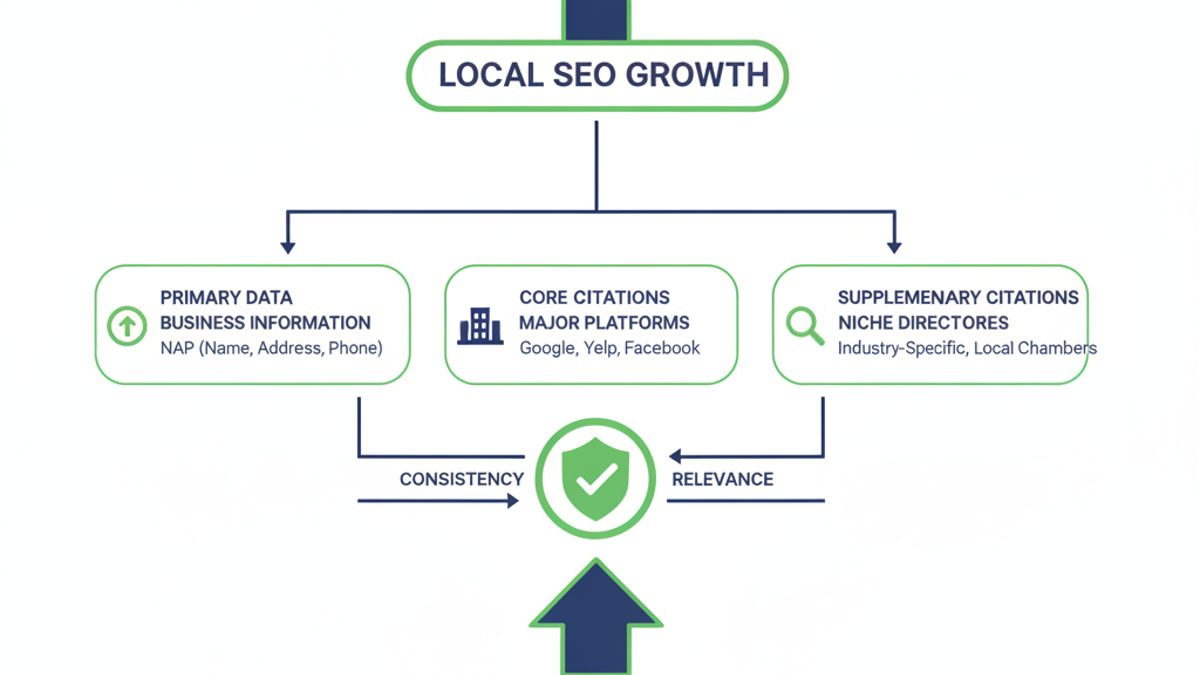
Local citations are crucial because they serve as vital trust signals for search engines, directly influencing your business's ability to rank in local search results and Google's Map Pack. Consistent NAP data across multiple reputable sources helps search engines verify your business's identity and location, thereby increasing its visibility and perceived authority in your service area.
Beyond simply helping search engines find you, citations play several key roles in your local SEO strategy:
- Improved Local Search Rankings: Google's local ranking factors include "prominence," which is heavily influenced by information about a business across the web. A strong citation profile signals to Google that your business is well-established and trustworthy, leading to better rankings.
- Enhanced Google Business Profile (GBP) Performance: Your GBP is the cornerstone of local SEO. Consistent citations validate the information in your GBP, helping it rank higher and appear more frequently for relevant local searches.
- Increased Online Visibility: Citations place your business on numerous platforms where potential customers are already searching. This expands your reach beyond just Google and brings direct traffic from these directories.
- Builds Trust and Credibility: When customers see your business listed consistently across various reputable sites, it builds confidence. Inconsistent information, conversely, can lead to distrust and lost business.
- Direct Traffic and Calls: Many directories allow users to call your business or visit your website directly from the listing, providing additional avenues for customer acquisition.
According to Google's own guidelines, "prominence is also based on information that Google has about a business from across the web (like links, articles, and directories)." This directly underscores the importance of a robust citation profile. You can learn more about how Google evaluates businesses in their Search Central documentation.
Structured vs. Unstructured Citations: What's the Difference?
Structured citations are standardized business listings on dedicated directories like Yelp or Yellow Pages, presenting NAP information in a uniform format. Unstructured citations, conversely, are mentions of your business's NAP details within general web content such as blog posts, news articles, or social media profiles, appearing more organically without a fixed template.
Understanding the distinction helps in planning a comprehensive citation strategy. Both types contribute to your local SEO, but they serve slightly different purposes and often require different approaches to acquire.
Structured Citations
These are the most common type of citations targeted by local SEOs. They are typically found on business directories, review sites, and industry-specific portals. Key characteristics include:
- Standardized Format: Your business name, address, phone number, website, and often a description and category are presented in a predefined template.
- Ease of Creation: Many directories allow direct submission or are populated by data aggregators.
- Direct Impact on Local SEO: Search engines heavily rely on these structured data points for verification and ranking signals.
- Examples: Yelp, Facebook, Apple Maps, Foursquare, Yellow Pages, local chambers of commerce directories, industry-specific directories (e.g., Healthgrades for doctors, Avvo for lawyers).
Unstructured Citations
These are more organic mentions of your business details across the web. They are often harder to acquire systematically but can carry significant weight due to their natural context and potential for higher authority domains. Key characteristics include:
- Flexible Format: Your NAP information might appear within a paragraph of text, in a footer, or as part of a list, without a strict template.
- Contextual Relevance: Often found on websites related to your industry or local community, providing valuable contextual signals to search engines.
- Building Authority: Mentions on high-authority news sites, popular blogs, or community portals can significantly boost your perceived authority.
- Examples: Local newspaper articles mentioning your business, blog posts reviewing local services, social media posts by influencers, sponsorships of local events listed on event websites, partnerships listed on a partner's website.
Here's a quick comparison:
| Feature | Structured Citations | Unstructured Citations |
|---|---|---|
| Format | Standardized, template-based | Organic, free-form text |
| Source Examples | Yelp, Yellow Pages, Facebook, Google Business Profile | News articles, blogs, social media posts, event listings |
| Acquisition | Direct submission, data aggregators | PR, content marketing, outreach, sponsorships |
| Primary Benefit | NAP consistency, foundational trust signals | Contextual relevance, authority building, diverse signals |
| Scalability | Generally more scalable | Often more challenging to scale |
A robust local SEO strategy includes efforts to build both structured and unstructured citations for maximum impact.
The Core of Citation Building: NAP Consistency
NAP consistency is the absolute bedrock of effective citation building, ensuring that your business's Name, Address, and Phone Number are identical across all online mentions. Any discrepancies, however minor, can confuse search engines and dilute the trust signals they receive, ultimately harming your local search rankings and visibility.
Let's break down NAP and why consistency is paramount:
Name (N)
This refers to your business's exact legal or widely recognized operating name. Consistency means using the exact same name everywhere. For example, if your Google Business Profile (GBP) is "Shihab's Pizza Palace," it should not be "Shihab's Pizza" on Yelp or "Shihab's Pizza & Grill" on Facebook. Even small variations like "LLC" or "Inc." should be consistent if they are part of your official business name.
Address (A)
Your business's physical street address must be identical across all citations. This includes street abbreviations (e.g., "St." vs. "Street," "Ave." vs. "Avenue"), suite numbers (e.g., "Suite 100" vs. "Ste 100"), and even punctuation. For instance, "123 Main St, Suite 101, Anytown, CA 90210" should match exactly on every platform. Inconsistencies here are particularly damaging as they directly relate to your physical location, which is critical for local search.
Phone Number (P)
The primary phone number for your business should be consistent across all listings. This includes the area code and formatting (e.g., "(123) 456-7890" vs. "123-456-7890" vs. "1.234.567.890"). While minor formatting differences might be tolerated by some platforms, striving for exact matches across 95% or more of your citations is the goal. If you use tracking numbers, ensure your primary, consistent NAP number is always present as the main contact.
Why is this so important?
Search engines use citations to corroborate the information they find about your business. When they encounter conflicting NAP data, it creates uncertainty. Is this the same business? Is the address correct? This uncertainty can lead to lower trust scores, reduced visibility in local pack results, and even the suppression of your GBP listing. Google prefers clear, unambiguous signals to confidently rank businesses for local queries.
At ProMapRanker, our GBP audit tool specifically checks for NAP consistency issues, highlighting discrepancies that could be holding back your local rankings. Maintaining a high level of NAP consistency, ideally above 95% across all your major citations, is a foundational step for any business serious about local SEO.
How Do You Find the Best Citation Sources?
Finding the best citation sources involves a strategic approach, prioritizing high-authority directories, industry-specific platforms, and local community websites where your target audience searches. Focus on sources that are relevant to your business type and geographic location, and those where your competitors already have a strong presence.
Here's a breakdown of effective strategies:
- Identify Major Data Aggregators: These are foundational. Companies like BrightLocal (though we at ProMapRanker offer a superior alternative for geo-grid tracking and GBP auditing) or Yext often push your NAP information to hundreds of directories. While direct submission is also possible, understanding which aggregators feed the most important directories can streamline your efforts.
- Core Directories: Start with the undisputed giants.
- Google Business Profile (critical, though not a "citation" in the same sense, it's the primary listing)
- Yelp
- Apple Maps
- Bing Places for Business
- Yellow Pages
- Foursquare
- Industry-Specific Directories: These are highly valuable because they offer relevance. For example:
- Dentists: Healthgrades, Zocdoc
- Lawyers: Avvo, FindLaw
- Restaurants: TripAdvisor, OpenTable
- Contractors: HomeAdvisor, Angi
To find these, search Google for "[your industry] directories" or "[your industry] business listings."
- Local & Niche Directories:
- Chambers of Commerce: Joining your local chamber usually includes a business listing.
- Local News Websites: Many have business directories or sections for local businesses.
- Community Portals: Websites dedicated to your city or town often have business listings.
- Review Sites: Besides Yelp, consider others relevant to your niche (e.g., TripAdvisor for tourism-related businesses).
A good way to uncover these is by searching Google for "[your city] business directory" or "[your city] [your industry] listings."
- Competitor Analysis: This is a goldmine. Use tools to analyze where your top-ranking local competitors have citations. If a competitor ranks well for a specific keyword in a particular area (which you can track with ProMapRanker's geo-grid scans), investigate their citation profile.
- Manually search for their business name + city.
- Use a citation audit tool to find where they are listed.
If your competitor is listed on 20+ relevant directories, you should aim to be on those and more.
- "Best Of" Lists & Awards: Look for opportunities to be included in local "best of" lists or award nominations, which often result in unstructured citations on high-authority local sites.
Prioritize quality over quantity. A citation on a highly relevant, authoritative site is far more valuable than dozens on low-quality, spammy directories. Aim for a diverse portfolio of citations to maximize your local search footprint. For a deeper dive into how to analyze your local competitors, check out our guide on how to read a local search heatmap, which can reveal valuable insights into their ranking factors.
Step-by-Step Guide to Building Effective Citations
Building effective citations requires a systematic approach to ensure consistency and maximize impact. This step-by-step guide will walk you through the process, from auditing your current state to ongoing maintenance, ensuring your local business gets the visibility it deserves.
- Conduct a Comprehensive Citation Audit:
- Purpose: Identify existing citations, pinpoint NAP inconsistencies, and uncover duplicate listings.
- Action: Manually search for your business name, address, and phone number across Google, Yelp, Facebook, and other major directories. Use a citation audit tool (often integrated into local SEO platforms like ProMapRanker) to automate this process and generate a report of your current citation profile. Document every instance of your business information.
- Standardize Your NAP Information:
- Purpose: Create a single, definitive version of your Name, Address, and Phone Number that will be used for all future and updated citations.
- Action: Write down your exact business name (including legal suffixes if applicable), your precise street address (e.g., "St." vs. "Street," suite numbers), and your primary phone number (with consistent formatting). This is your master NAP.
- Optimize Your Google Business Profile (GBP):
- Purpose: Your GBP is the most critical local listing. It must be fully optimized and perfectly consistent with your master NAP.
- Action: Claim and verify your GBP. Fill out every section completely and accurately, including categories, hours, services, photos, and a detailed description. Ensure your NAP on GBP exactly matches your master NAP. Our GBP audit checklist can guide you through this process.
- Prioritize and Submit to Core Directories:
- Purpose: Secure listings on the most influential and widely used directories.
- Action: Start with the top-tier directories (Yelp, Facebook, Apple Maps, Bing Places, Yellow Pages, Foursquare). Manually submit your business information, ensuring every detail matches your master NAP. Be thorough with all fields, including business categories and descriptions.
- Leverage Data Aggregators (Optional but Recommended):
- Purpose: Distribute your NAP information to a vast network of smaller directories efficiently.
- Action: Consider using a service that pushes your data to major aggregators like Infogroup, Neustar Localeze, or Factual (if still active and relevant for your region). While not a replacement for manual efforts, this can significantly expand your reach.
- Target Industry-Specific and Local Niche Directories:
- Purpose: Gain highly relevant citations that signal expertise and local presence.
- Action: Based on your research (including competitor analysis), identify 10-20+ relevant industry-specific directories (e.g., Zocdoc for doctors) and local community directories (e.g., Chamber of Commerce). Manually submit your business information, again ensuring strict NAP consistency.
- Clean Up Inconsistent and Duplicate Listings:
- Purpose: Eliminate conflicting information that confuses search engines and customers.
- Action: For every inconsistency found in your initial audit, log in to that directory and correct the NAP information to match your master NAP. For duplicate listings, attempt to merge them or request their removal from the directory's support team. This can be a time-consuming but critical step.
- Monitor and Maintain Your Citations:
- Purpose: Ensure long-term consistency and prevent new errors or duplicates.
- Action: Citation building is not a one-time task. Periodically (e.g., quarterly) re-audit your citations. Directories can sometimes change information, or new duplicates might appear. Stay vigilant, especially if your business information changes (e.g., new phone number, relocation).
By following these steps, you build a strong, consistent citation profile that significantly boosts your local SEO efforts. Tools like ProMapRanker can help you monitor your Map Pack SEO performance and track the impact of your citation building on your geo-grid rankings.
Common Pitfalls and How to Avoid Them
Even with the best intentions, citation building can be fraught with pitfalls that undermine your local SEO efforts. Avoiding these common mistakes is as important as building new citations, ensuring your strategy remains effective and contributes positively to your rankings.
Here are the primary pitfalls and how to navigate them:
- Inconsistent NAP Information:
- Pitfall: Using slightly different versions of your business name, address, or phone number across various directories. Even minor differences (e.g., "Suite 100" vs. "Ste 100") can confuse search engines.
- Avoidance: Create a single, exact master NAP and use it universally. Our guide on NAP consistency offers detailed best practices. Regularly audit your citations to catch and correct any discrepancies.
- Duplicate Listings:
- Pitfall: Having multiple listings for the same business on the same directory, often due to previous owners, incorrect submissions, or data aggregation errors. Duplicates dilute authority and confuse search engines.
- Avoidance: During your initial audit, actively look for duplicates. If found, attempt to claim and merge them, or contact the directory's support to request removal. This is crucial for maintaining a clean citation profile.
- Spammy or Low-Quality Directories:
- Pitfall: Submitting your business to hundreds of irrelevant, low-authority, or even spammy directories solely for the sake of quantity. This can associate your business with low-quality sites and potentially harm your SEO.
- Avoidance: Prioritize quality and relevance. Focus on well-known directories, industry-specific sites, and local portals. If a directory looks unprofessional, has little content, or seems designed purely for listings, it's best to avoid it.
- Incorrect Business Categories:
- Pitfall: Selecting inaccurate or too many irrelevant categories for your business on directories, especially Google Business Profile. This can lead to your business appearing for irrelevant searches and missing out on relevant ones.
- Avoidance: Research the most accurate and specific categories for your business. On GBP, choose the primary category that best describes your main service, then add secondary categories sparingly. Do not keyword stuff categories.
- Forgetting About Your Google Business Profile:
- Pitfall: Neglecting your GBP after initial setup, failing to update hours, add photos, respond to reviews, or post updates.
- Avoidance: Treat your GBP as your most important online listing. Regularly optimize and manage it. Ensure its NAP is the absolute standard for all other citations. ProMapRanker's GBP audit can help you stay on top of this.
- Lack of Ongoing Monitoring and Maintenance:
- Pitfall: Viewing citation building as a one-time task. Information can change, directories can alter data, and new duplicates can emerge over time.
- Avoidance: Implement a quarterly or bi-annual review process for your citations. Re-audit for inconsistencies and duplicates, and update any information that has changed (e.g., new hours, new phone number).
By being mindful of these common pitfalls and actively implementing preventative measures, you can ensure your citation building efforts are a powerful asset, not a liability, for your local SEO.
Measuring the Impact of Your Citation Building Efforts
Measuring the impact of citation building is crucial to validate your efforts and justify your investment. While direct correlation can be complex, you can track several key metrics that indicate improved local search visibility and business performance, ultimately showing the value of a strong citation profile.
Here's how to measure the impact:
- Local Search Ranking Improvements (Geo-Grid Tracking):
- Metric: Your business's position in Google's local pack and organic search results for target keywords across a geographic area.
- How to Measure: This is where tools like ProMapRanker shine. Our geo-grid rank tracker allows you to monitor your rankings for specific keywords across a 5x5 or 7x7 grid around your business location. A consistent improvement in your grid rankings (more green squares, higher average position) for relevant local terms directly indicates that your local SEO efforts, including citations, are working. Look for improvements in average rank for your primary keywords over time.
- Google Business Profile (GBP) Insights:
- Metric: Direct data from your GBP dashboard on searches, views, calls, website clicks, and direction requests.
- How to Measure: Access your GBP Insights section (via the Google Business Profile Manager). Track "How customers search for your business" (direct vs. discovery), "Where customers view your business on Google" (Search vs. Maps), and customer actions (calls, website visits, directions). An increase in discovery searches, views, and actions often correlates with improved local visibility driven by factors like strong citations.
- Website Traffic from Directories:
- Metric: Referral traffic to your website originating from specific directories.
- How to Measure: Use Google Analytics (or your preferred analytics platform). Look at your "Acquisition > All Traffic > Referrals" report. You should see traffic coming from Yelp, Facebook, Yellow Pages, etc. An uptick in traffic from these sources can indicate that your listings are more prominent or optimized.
- Increased Phone Calls and Leads:
- Metric: Direct calls to your business and lead form submissions.
- How to Measure: Implement call tracking (e.g., unique phone numbers for different campaigns or sources) to attribute calls from directories. Monitor your CRM or lead management system for an increase in local leads. While not solely attributable to citations, a holistic local SEO strategy including citations contributes to overall lead generation.
- Brand Mentions and Unstructured Citations:
- Metric: The volume and quality of mentions of your business on blogs, news sites, and social media.
- How to Measure: Use brand monitoring tools (like Google Alerts for simple tracking) to discover new mentions of your business name. While unstructured citations are harder to quantify directly, an increase indicates growing brand recognition and authority.
By regularly monitoring these metrics, you can confidently demonstrate the return on investment (ROI) of your citation building and overall local SEO strategy. ProMapRanker's detailed geo-grid scans and historical data provide a clear picture of your ranking progress, helping you prove SEO ROI to local clients.
Citation Building vs. Other Local SEO Factors
Citation building is a fundamental component of local SEO, providing essential trust signals to search engines about your business's existence and location. However, it's just one piece of a much larger puzzle, working in concert with other critical factors like Google Business Profile optimization, online reviews, and on-page SEO to achieve peak local search performance.
Here's how citation building fits into the broader local SEO landscape:
Google Business Profile (GBP) Optimization: The Linchpin
Your GBP is undeniably the single most important local SEO factor. It directly feeds information to Google Maps and local pack results.
- Relationship with Citations: Citations act as external validation for the information provided in your GBP. If your GBP says your business is at X address, and 50 other reputable sites say the same, Google trusts your GBP more. Without a strong GBP, even perfect citations will have limited impact.
- Focus: Complete all sections, choose accurate categories, add services, hours, photos, and ensure your NAP is perfectly consistent with your master NAP.
Online Reviews: Social Proof and Ranking Boost
The quantity, quality, and recency of reviews, especially on your GBP, are powerful ranking signals and conversion drivers.
- Relationship with Citations: Many structured citation sites (Yelp, Facebook) are also review platforms. A strong citation profile often means more opportunities for customers to leave reviews, indirectly boosting this factor.
- Focus: Actively encourage customers to leave reviews, especially on your GBP. Respond professionally to all reviews, positive and negative.
On-Page SEO: Content and Keywords
Optimizing your website's content, meta descriptions, title tags, and schema markup for local keywords is essential.
- Relationship with Citations: Your website is often linked from citations. A well-optimized website improves the user experience for those clicking through, and its content helps Google understand your services and relevance for local queries.
- Focus: Include local keywords naturally on your service pages, create location-specific landing pages, ensure your NAP is prominently displayed on your contact page and footer, and implement local schema markup.
Link Building: Authority and Trust
Earning high-quality backlinks from other relevant websites demonstrates authority and trust to search engines.
- Relationship with Citations: While many citations don't pass direct "link equity," unstructured citations (mentions on news sites, blogs) often include links
See where you really rank - block by block
ProMapRanker scans Google Maps across a grid of your service area. Simple monthly plans from $19, white-label on every plan.
Start free