 ProMapRanker
Best Chainguard Competitors and Alternatives in 2026

Key takeaways
- Chainguard starts from hardened, low-vulnerability container images, while most tools on this list start by scanning images you already build.
- Snyk and Docker Scout fit developer-led teams best, because their advice shows up close to code and build steps.
- Wiz, Sysdig, and Prisma Cloud fit larger cloud estates, because they add runtime and exposure context to scan results.
- Trivy and Anchore give teams a free, open source floor for scanning and software bills of materials, before any paid platform is bought.
- Our pick for most teams is Snyk for developer workflows, with Trivy added in continuous integration for low-cost coverage.
Quick comparison
| Pick | Great for | Pricing starts at | Free tier | |
|---|---|---|---|---|
 Snyk | Developer-led vulnerability fixing | See website | Yes | Visit |
 Wiz | Ranking cloud and container risk by exposure | See website | No | Visit |
 Aqua Security | Policy control from build to runtime | See website | No | Visit |
 Sysdig | Prioritizing vulnerabilities that are actually in use | See website | Free trial | Visit |
 Anchore | SBOM-first container scanning | See website | Yes | Visit |
 JFrog Xray | Teams already using Artifactory | See website | Free trial | Visit |
 Prisma Cloud | One platform for cloud and container security | See website | Free trial | Visit |
 Docker Scout | Teams building with Docker every day | See website | Yes | Visit |
 Trivy | Free, fast scanning in pipelines | Free | Yes | Visit |
The best chainguard competitors and alternatives
Chainguard tries to remove vulnerabilities at the source by shipping minimal, hardened images. The tools below take different routes to a similar goal, and the right choice depends on where your team feels the most pain.
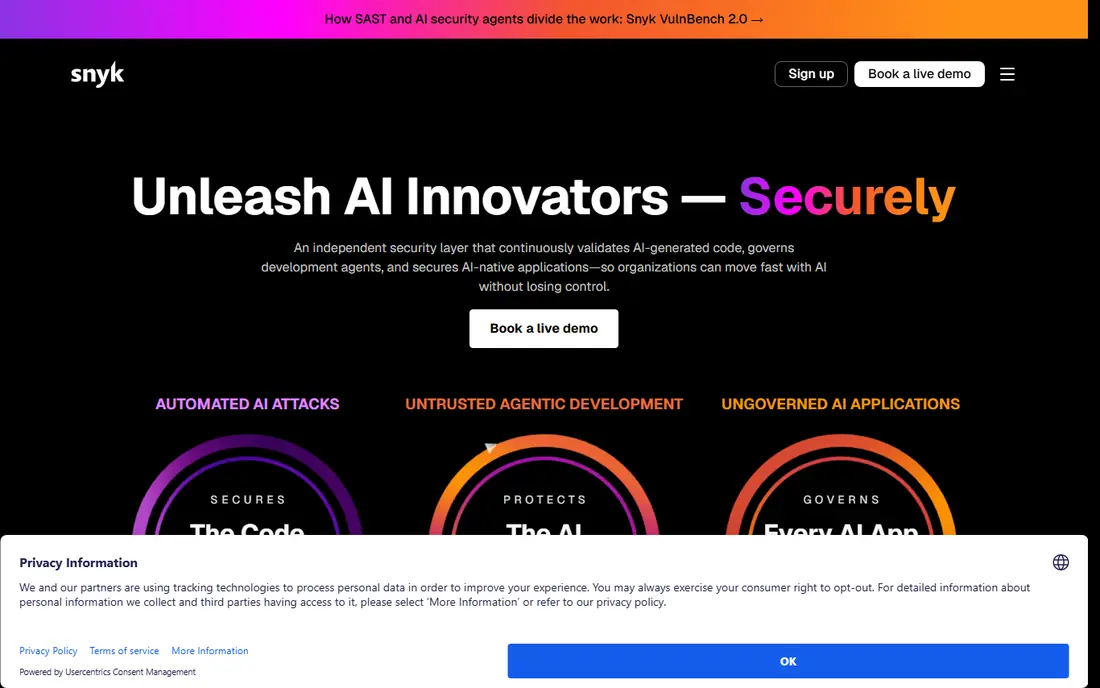
Snyk fits teams that want security advice inside the developer workflow rather than in a separate report that arrives days later. Its container scanning points to the base image or package that causes a finding, and it often suggests a newer, safer version. That matters because a long list of vulnerabilities is less useful than a short list of fixes a developer can act on in the same pull request.
The trade-off is scope. Snyk is strong on finding and fixing, but it is not a full cloud security platform on its own. Teams with large cloud estates may still need a tool that maps runtime exposure. For a team moving away from Chainguard because it wants more developer control, though, Snyk is a natural first test.
- Free tier for small projects
- Clear fix advice, including base image upgrades
- Covers code, dependencies, containers, and infrastructure as code
- Costs can grow with team size
- Some enterprise controls sit on higher tiers
Wiz suits organizations that already run a lot in the cloud and struggle to tell urgent findings from noise. Its graph approach links a container vulnerability to the workload, network path, and identity that could expose it. A critical flaw in an isolated internal service therefore looks different from the same flaw in a public-facing workload.
That breadth is also the catch. Wiz is built for teams that want one cloud security view, and its pricing reflects that enterprise scope. If you only need container scanning, start with a narrower tool and keep Wiz for a later, broader purchase.
- Connects cloud, containers, and identity into one risk view
- Highlights issues that are actually reachable
- Broad cloud coverage
- Pricing is quoted, so budgeting needs a sales conversation
- Smaller teams may find it more platform than they need
Aqua fits teams that want to enforce rules, not just report problems. It can block a non-compliant image from deployment and watch for drift once a workload is running. That enforcement step is where many scanning-only setups fall short, since a report alone does not stop a bad image from reaching production.
The platform does take time to configure well. Policies need owners, and teams should budget for tuning during the first weeks. For regulated or larger environments, that effort is often worth it. Smaller teams may prefer a lighter scanner first.
- Covers the full container lifecycle
- Includes the open source Trivy scanner
- Admission and drift controls for running workloads
- Platform breadth can mean a longer setup
- Pricing is not published as a simple list
Sysdig earns its place when vulnerability lists are too long to work through in order. By checking which packages are loaded at runtime, it can push unused findings down the queue and surface the ones that matter in a live workload. That single idea can cut triage time sharply for busy platform teams.
The honest catch is complexity. Sysdig is a serious platform, and teams that only run a handful of containers may not need its full depth. It shines most in Kubernetes environments where runtime context changes the priority of every finding.
- Runtime insight filters out unused packages
- Strong Kubernetes and container visibility
- Combines security with runtime monitoring
- Quoted pricing
- Depth can feel heavy for very small teams
Anchore fits teams that care about knowing exactly what is inside an image. Syft builds a software bill of materials, and Grype scans that inventory for known vulnerabilities. That pair is widely used in pipelines, and it gives teams a clear, portable record of each image they ship.
The enterprise product adds policy enforcement and reporting on top of those tools. Teams that are happy building their own pipeline can stay on the open source pair and pay nothing for the scanner itself. Teams that want managed policy and support should price the enterprise tier before committing.
- Open source Grype and Syft tools are free to use
- Strong software bill of materials support
- Policy checks for images
- The enterprise platform is quoted
- The open source tools need integration work
JFrog Xray makes most sense when Artifactory is already the center of your artifact flow. Scanning at the repository means a bad artifact can be blocked before it spreads to other teams or environments. It also keeps security close to the release process, rather than in a separate tool that developers rarely open.
If your team does not use JFrog, this is a harder sell. A standalone scanner will be simpler to adopt. Inside a JFrog shop, though, Xray is often the lowest-friction way to add security gates.
- Scans artifacts where developers already store them
- Covers binaries, containers, and dependencies
- Policy gates at the repository level
- Value drops outside the JFrog ecosystem
- Enterprise pricing needs a quote
Prisma Cloud, from Palo Alto Networks, fits organizations that want container security inside a wider cloud security program. It can tie image findings to cloud posture, network exposure, and compliance controls in one place. That view helps security leaders report risk to the wider business, not just to engineers.
The platform is enterprise in scope and price. Small teams looking only for image scanning should look at Trivy, Docker Scout, or Snyk first. Larger teams that already buy Palo Alto products may find Prisma Cloud the simplest consolidation choice.
- Broad coverage across cloud, containers, and code
- Compliance and posture reporting
- Backed by a large security vendor
- Quoted pricing
- Breadth can be more than a small team needs
Docker Scout is the lowest-friction option for a team that lives in Docker Desktop and Docker Hub. It analyzes images, lists vulnerabilities, and suggests safer base images without asking developers to learn a new platform. For a small team, that closeness to daily work is a real advantage.
Its limits show up at scale. Scout does not replace a cloud security platform, and it does not add runtime context the way Sysdig or Wiz do. Treat it as a strong daily scanner, and add a broader tool only if your estate grows past what Scout can explain.
- Built into Docker workflows
- Free tier for basic use
- Clear base image and package advice
- Best value stays inside Docker-centric work
- Deeper cloud context needs another tool
Trivy, maintained by Aqua Security, is the free floor we recommend to almost every team on this list. It runs quickly in a pipeline, finds known vulnerabilities and misconfigurations, and produces a software bill of materials. For a team with no container scanning at all, adding Trivy is a large step for zero license cost.
Trivy does not decide policy for you, and it does not rank findings by runtime exposure. Pair it with a platform from this list when triage volume or compliance reporting grows. On its own, it is still far better than shipping unscanned images.
- Free and open source
- Scans containers, filesystems, and infrastructure as code
- Easy to add to continuous integration
- No managed policy platform on its own
- Results need triage by your team
How we picked these
We compared official product pages, pricing pages, and documentation, plus public reviews and comparison guides, and we kept only tools that are live and relevant in October 2026. We favored tools that cover a clear part of the Chainguard problem: hardened images, scanning, software bills of materials, runtime context, or policy enforcement. We left out tools that only scan code, since they do not replace container image security. Prices are shown as listed by vendors where published, and as See website where pricing is quoted, because we do not invent numbers.
What to decide before you switch
Start with the problem you actually have. If your vulnerability backlog is the pain, a scanner with fix advice, such as Snyk or Docker Scout, will help fastest. If your backlog is already scanned but nobody knows what matters, runtime context from Sysdig or Wiz will help more than another scanner. If compliance and audit records matter most, put software bills of materials first and pick Anchore or Trivy as the base.
Check your base images first
Before buying a platform, list the base images your services use and how often they are updated. A team on a few current, minimal bases will get less value from a hardened-image replacement than a team on old, bloated bases. This check also tells you whether a scanner alone can close the gap, or whether you need a new base image strategy.
Run a pilot on one service
Pick one real service, run two tools against it, and compare the fix lists, not just the finding counts. Count how many findings each tool turns into a clear action, and how long that action takes. A tool that finds more but explains less will slow your team down. A pilot also reveals setup effort before you commit to a platform-wide rollout.
Plan for the ongoing work
Scanning is a weekly habit, not a one-time purchase. Someone needs to own policy updates, base image upgrades, and exception reviews. If no one owns that work, even the best tool will drift back into a long, ignored report. Assign the owner before you sign, and review the queue in a regular team meeting.
Frequently asked questions
What are chainguard competitors and alternatives?
Chainguard competitors and alternatives are tools that help teams ship safer container images, either by scanning images for known vulnerabilities, by building a software bill of materials, by adding runtime context, or by enforcing policy before deployment. Chainguard itself focuses on hardened, low-vulnerability base images, while most alternatives focus on finding and fixing problems in images you already build.
Is there a free alternative to Chainguard?
Yes. Trivy is free and open source, and Anchore offers free open source tools in Grype and Syft. Docker Scout and Snyk also offer free tiers. These tools scan and report, but they do not ship hardened replacement images in the same way Chainguard does, so expect more fixing work from your own team.
Which alternative is best for small teams?
For small teams, we suggest starting with Trivy in your pipeline and Docker Scout or Snyk for developer-friendly fix advice. That combination is low cost and low friction. Add a broader platform only when triage volume, compliance needs, or cloud size make the free tools hard to manage.
Do these tools replace hardened base images?
Not directly. Scanners find problems in the images you have, while hardened images try to remove problems before scanning starts. Many teams use both ideas: a minimal base image, plus scanning and policy checks on every build. If you drop Chainguard, keep a base image review in your process so old, bloated bases do not return.
How is Snyk different from Wiz?
Snyk is built around developer workflows and fix advice for code, dependencies, and containers. Wiz is built around a cloud-wide risk graph that ranks findings by exposure across cloud, containers, and identity. A developer-led team often starts with Snyk, while a cloud-heavy organization often starts with Wiz.
Should we buy one platform or combine tools?
Combining a free scanner with one paid platform is common and often wise. Use Trivy or Grype as a pipeline floor, then add the platform that solves your main gap, whether that is developer fixing, runtime context, or policy enforcement. Avoid buying two broad platforms that overlap, since that doubles cost without doubling insight.
Sources
See where you really rank - block by block
ProMapRanker scans Google Maps across a grid of your service area. Simple monthly plans from $19, white-label on every plan.
Start freeKeep reading
 wpforms alternatives
Best WPForms Alternatives in 2026
We compare 9 wpforms alternatives for WordPress forms, with free and paid options, current pricing notes, and honest limits for small business sites in 2026.
Read → windows task scheduler alternatives
Best Windows Task Scheduler Alternatives in 2026
Looking for Windows Task Scheduler alternatives? We compare 9 schedulers for Windows and cross-platform work, from free tools to enterprise automation.
Read → which ai video service is best
Which AI Video Service Is Best in 2026
which ai video service is best? We compare 10 legitimate AI video services on price, avatars, editing and output quality to help you pick the right tool.
Read →