 ProMapRanker
Best CentOS Alternatives in 2026


Strict RHEL compatibility for production · Pricing starts at: Free
Key takeaways
- Rocky Linux and AlmaLinux are the closest free replacements for CentOS Linux, with RHEL compatibility and in-place migration tools for many servers.
- Oracle Linux suits teams running Oracle workloads, with free use and optional paid support, plus a choice of kernels.
- Red Hat Enterprise Linux is the original paid option, with full vendor support for teams that need a support contract for compliance or audits.
- Debian and Ubuntu Server suit teams willing to leave the RHEL family for larger package ecosystems and different release models.
- CentOS Stream is not the same as CentOS Linux, since it tracks ahead of RHEL, so treat it as a development preview rather than a stable production rebuild.
Quick comparison
| Pick | Great for | Pricing starts at | Free tier | |
|---|---|---|---|---|
| Rocky Linux | Strict RHEL compatibility for production | Free | Yes | Visit |
 AlmaLinux | Foundation governed RHEL compatible servers | Free | Yes | Visit |
 Oracle Linux | Oracle workloads with optional paid support | Free | Yes | Visit |
 Red Hat Enterprise Linux | Vendor supported enterprise Linux | See website | Free trial | Visit |
 Debian | Stable, community run servers | Free | Yes | Visit |
 Ubuntu Server | Broad ecosystem with long term support | Free | Yes | Visit |
 SUSE Linux Enterprise Server | SUSE ecosystem enterprise support | See website | Free trial | Visit |
The best CentOS alternatives
CentOS Linux reached end of life in December 2021, and CentOS 8 support ended earlier than many teams expected. The distributions below replace it in different ways: free RHEL rebuilds, the paid original, community distributions outside the RHEL family, and cloud specific options. All are free to download unless noted, with paid support as the main cost difference.
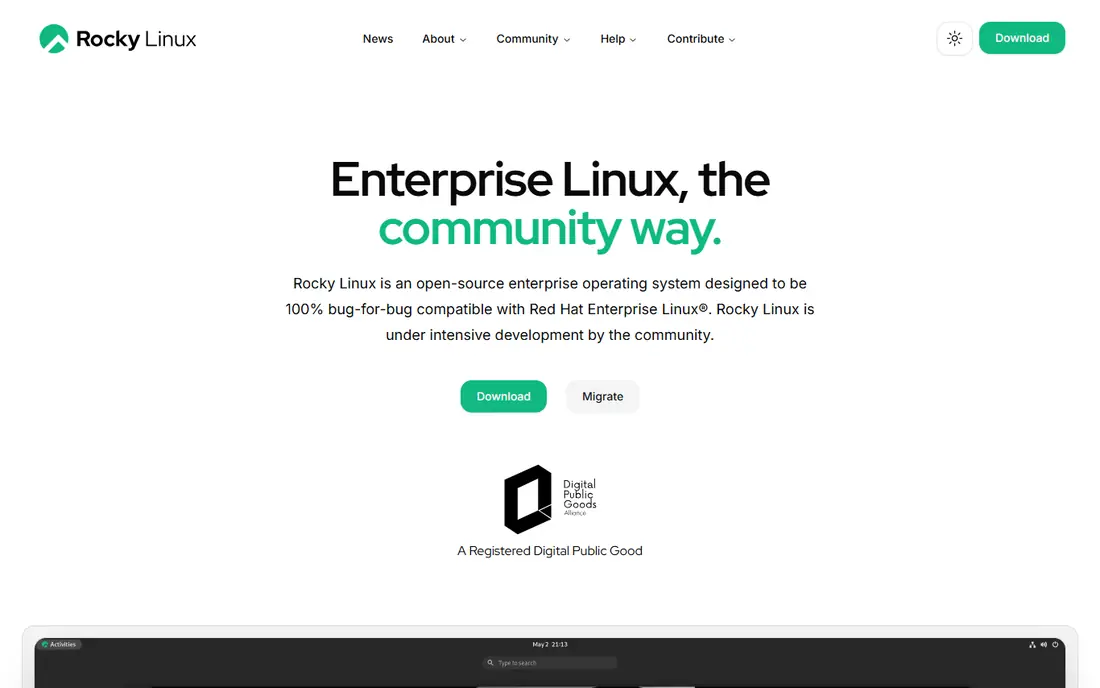
Rocky Linux was founded by a CentOS co-founder after CentOS Linux changed direction, and it has become one of the two main free RHEL rebuilds. It aims for close compatibility with RHEL, which matters for teams running vendor software certified for RHEL, or for compliance work where parity with RHEL is part of the requirement. Its migrate tool helps move supported systems in place within the same major version, which lowers the risk of a rebuild for many servers. Recent releases track RHEL 10 and 9 lines, so teams can choose a current major version with a long support window.
The honest limit is support. Rocky Linux itself does not sell a direct commercial support contract in the way Red Hat or Oracle do, so organizations that need a vendor to call must buy third-party support. Major version moves, such as from version 9 to version 10, also need a planned upgrade path rather than a simple in-place switch in every case. If strict RHEL parity matters most to your team, Rocky Linux is a strong first pick. If a direct vendor support contract matters more, compare it with Oracle Linux and RHEL before deciding.
- Aims for bug-for-bug compatibility with RHEL
- Community project with foundation governance
- In-place migration tool for supported systems
- No direct commercial support from the project itself, so support comes from third parties
- Major version upgrades still need planning
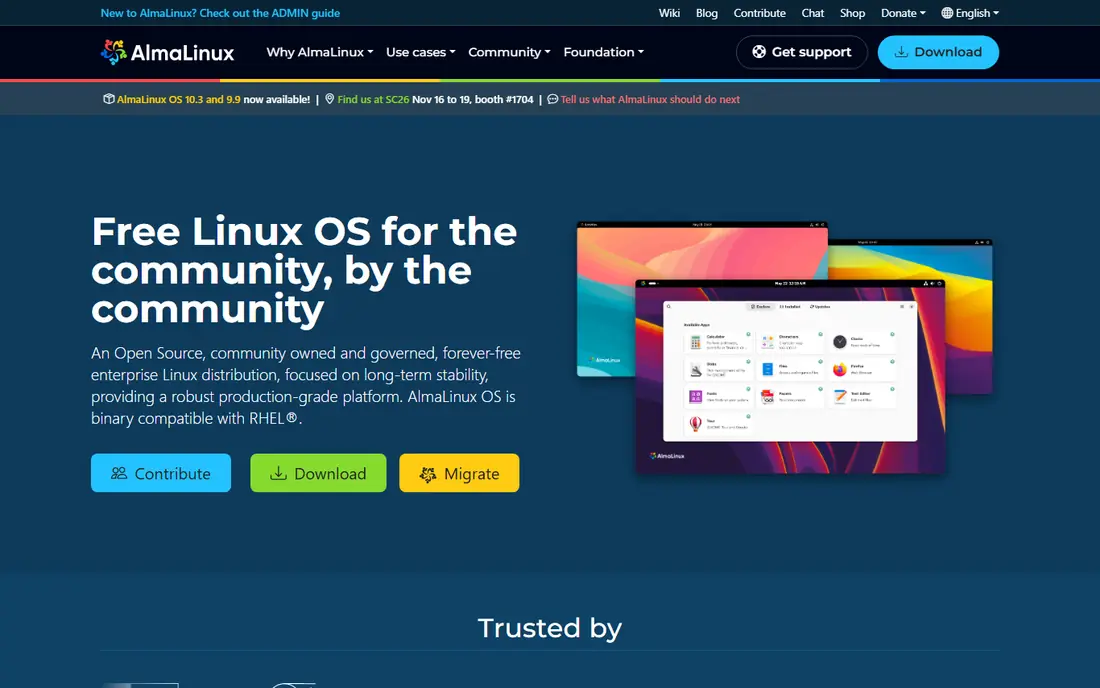
AlmaLinux is the other main free RHEL rebuild, governed by a non-profit foundation and backed in its early years by CloudLinux. It aims for ABI compatibility with RHEL, which in practice means most RHEL software runs as expected, and it offers an in-place migration tool for supported systems. Hosting providers, research institutions, and cloud teams use it widely, which gives it a large real world install base and plenty of public guides. Recent releases also track RHEL 10 and 9 lines, so the choice between AlmaLinux and Rocky Linux is rarely about version availability.
The difference is governance and emphasis. AlmaLinux leans on a foundation model, while Rocky Linux leans on strict bug-for-bug parity wording, and some teams choose based on which governance story they trust more, or which project their hosting provider already supports. Like Rocky Linux, AlmaLinux does not sell direct commercial support itself, so support comes from third parties such as TuxCare or CloudLinux. For most production servers, either rebuild works well. Pick the one your team, host, or support vendor already knows, and test your key workloads on it before migrating at scale.
- RHEL compatible with a foundation led model
- In-place migration tool for supported systems
- Widely used by hosting providers and research institutions
- No direct commercial support from the project itself
- Compatibility goal differs slightly from Rocky Linux in wording, so check vendor certification needs
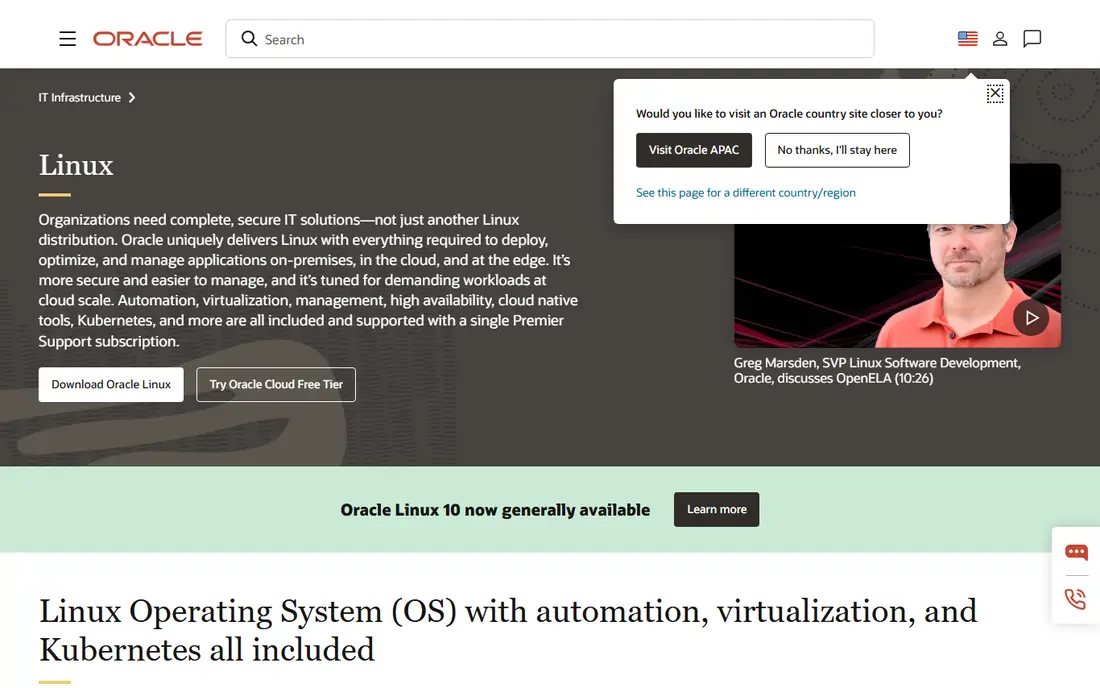
Oracle Linux is a free RHEL compatible distribution with an optional paid support contract from Oracle, which makes it a middle path between a free community rebuild and full RHEL. Teams running Oracle Database or Oracle applications get a natural fit, since Oracle tests and supports those workloads on its own distribution. It also offers a choice of kernels, including the Red Hat Compatible Kernel and the Unbreakable Enterprise Kernel, which Oracle pitches for performance and security features. That kernel choice is a real difference from the community rebuilds, not just branding.
The trade-off is governance and fit. Oracle Linux is vendor governed, so teams that prefer a community foundation may favor Rocky Linux or AlmaLinux instead. Support pricing also needs a quote for larger estates, so the free download price is not the whole cost story for a team that wants a contract. If you run Oracle workloads, or if you want a free RHEL compatible system with a direct vendor support option, Oracle Linux is a strong pick. If you want a community project, the rebuilds above fit better.
- Free to download and use, with optional paid support from Oracle
- RHEL compatible
- Choice of kernels including the Unbreakable Enterprise Kernel
- Oracle branding and support terms suit Oracle shops best
- Some teams prefer a community governed project over a vendor governed one
Red Hat Enterprise Linux is the distribution that CentOS Linux rebuilt, and it remains the reference for teams that need a vendor support contract. It offers a long lifecycle, security updates, certifications for hardware and software vendors, and support that auditors and enterprise customers recognize. For regulated industries, government contracts, or vendor software that is certified only for RHEL, that support contract can be a requirement rather than a preference. Developer subscriptions have offered free use for small deployments in past programs, so small teams should check current terms before assuming a price.
The cost is the clear downside. RHEL is a paid subscription product, and the price scales with the number of servers and support level, which can be a large change for a team that ran CentOS for free. Some teams therefore run RHEL only where certification or support demands it, and run Rocky Linux or AlmaLinux elsewhere. That mixed approach is common and practical. If support and certification drive your choice, RHEL is the safe pick. If budget drives it, a free rebuild covers most of the same technical ground.
- The original RHEL with full vendor support
- Long lifecycle and certification ecosystem
- Free developer subscriptions for small deployments in past programs
- Paid subscription model, so cost scales with servers
- Subscription terms need checking for your deployment size
Debian suits teams willing to leave the RHEL family for a stable, community run system with a huge package ecosystem. Its stable releases are conservative, which means fewer surprises in production, and its package repository covers a wide range of server software without third-party repositories for many common tools. Debian runs well on servers, containers, and older hardware, and it has no vendor subscription or licensing cost. For web servers, file servers, and internal services that do not need RHEL certification, Debian is a dependable choice.
The cost of leaving RHEL is rework. Package names, service files, and some admin tools differ from RHEL, and software certified only for RHEL may need testing or a different support path on Debian. Release pace is also slower, so teams that want the newest features quickly may prefer Ubuntu or Fedora. If stability, community governance, and a free system matter most, and your workloads are not tied to RHEL, Debian is a strong long term pick.
- Free, community governed, and famously stable
- Huge package repository
- Long support for stable releases
- Outside the RHEL family, so RHEL specific packages and workflows need rework
- Release pace is slower than Fedora or Ubuntu for new features
Ubuntu Server is the most widely used Linux server distribution in cloud and container work, and it suits CentOS teams that are ready to move to a different family for a larger ecosystem. Long term support releases give five years of standard support, with extended support available through Ubuntu Pro, and cloud images are available on every major provider. The package ecosystem is large, documentation is plentiful, and many modern tools publish Ubuntu packages first. For new projects, containers, and cloud servers, Ubuntu Server is often the path of least resistance.
The migration cost is real. Ubuntu uses Debian style packaging, different service management details, and a different release model from RHEL, so a CentOS admin team will need to relearn parts of its workflow. Some admins also dislike Snap packaging for certain software, though traditional packages remain available for most server work. If your team values ecosystem size, cloud support, and long term support with an optional vendor contract, Ubuntu Server is a strong CentOS alternative. If RHEL compatibility is a hard requirement, stay with a rebuild instead.
- Free with long term support releases
- Huge ecosystem and cloud images
- Paid Ubuntu Pro support available from Canonical
- Outside the RHEL family, so migration needs rework
- Snap packaging and release choices divide some admins
SUSE Linux Enterprise Server is the enterprise option for teams already in the SUSE world, or for teams running SAP workloads where SUSE has a strong certification story. It offers vendor support, a long lifecycle, and YaST, its admin toolset, which some teams prefer for system configuration. It also has a related community distribution, openSUSE, for teams that want a free SUSE family system to test with before buying a subscription. For enterprises that standardize on SUSE, it is a natural CentOS alternative with a support contract.
The limit is family change. SUSE is not RHEL compatible in the same way Rocky Linux or AlmaLinux are, so a CentOS migration to SUSE needs package, config, and workflow rework. Pricing is subscription based and needs a quote, so cost comparison takes a sales conversation. If your organization already uses SUSE, or runs SAP workloads certified for SUSE, it is a strong pick. If you want the closest technical match to CentOS, a RHEL rebuild is closer.
- Enterprise Linux with vendor support from SUSE
- YaST admin tools
- Long lifecycle and SAP workload certifications in its pitch
- Outside the RHEL family, so migration needs rework
- Pricing is subscription based and needs a quote
How we picked these
We compared official project and vendor pages, release documentation, and recent comparisons of CentOS replacements that are live in October 2026. We kept distributions that are actively maintained, that run production servers, and that offer a clear migration path or a clear reason to switch families. We left out dormant rebuilds, desktop only distributions, and CentOS Stream as a standalone pick, since Stream tracks ahead of RHEL and is better described as a development preview in this guide.
How to migrate without downtime surprises
Start with an inventory, not with a reinstall. List every server, its CentOS version, its workloads, and any vendor software that claims RHEL certification. Servers on CentOS 8 need a different plan from servers still on CentOS 7, since major version upgrades need more work than same-version migrations. Note which servers can use an in-place migration tool, and which need a fresh install because of age, custom packages, or hardware changes. That inventory decides whether Rocky Linux, AlmaLinux, or a fresh build is the right path for each machine.
Next, test one representative server of each workload type before migrating at scale. Migrate or rebuild it, run your application tests, check backups, monitoring, and security updates, and confirm vendor software still works. Pay attention to package differences, SELinux policies, and firewall rules, since those are the details that cause quiet failures after a migration that looks clean. Keep the old server or a snapshot until the new one has run a full business cycle, so a rollback is possible without rebuilding from scratch.
Finally, plan support and lifecycle together. A free rebuild saves subscription cost, but you still need a support path, whether that is an internal team, a third-party vendor, or a paid contract for critical servers. Note each distribution end of support date, and set a calendar reminder a year before it, so the next migration is planned rather than rushed. A CentOS replacement is not a one-time fix. It is a lifecycle choice, and the best choice is the one your team can maintain for the full support window.
Frequently asked questions
What are the best CentOS alternatives?
Rocky Linux and AlmaLinux are the best free CentOS alternatives for most production servers, since they are RHEL compatible and offer migration tools. Oracle Linux suits Oracle workloads, RHEL suits teams that need a vendor contract, and Ubuntu Server and Debian suit teams leaving the RHEL family.
What is the best CentOS 8 alternative?
For CentOS 8, Rocky Linux and AlmaLinux are the most direct replacements, since they offer RHEL 8 compatible systems and in-place migration tools for supported servers. Test your workloads on one of them first, and plan a fresh install for servers where in-place migration is not supported.
Is CentOS Stream a good CentOS alternative?
CentOS Stream is useful for development and for previewing upcoming RHEL changes, but it is not a stable rebuild of RHEL, since it tracks ahead of RHEL releases. For production servers that need stability, a rebuild such as Rocky Linux or AlmaLinux is a better fit.
Is Rocky Linux or AlmaLinux better?
Both are strong, and the choice often comes down to governance, hosting provider support, and vendor certification needs. Rocky Linux emphasizes strict RHEL parity, while AlmaLinux emphasizes a foundation governed model. Test your key workloads on both if you are unsure, since most servers run well on either.
Can I migrate from CentOS without reinstalling?
In many cases, yes, within the same major version, using the migration tools from Rocky Linux, AlmaLinux, or Oracle Linux. CentOS 7 to a newer major version usually needs a larger upgrade or a fresh install. Always back up and test on a non-production server first.
Is there a free enterprise Linux with paid support available?
Yes. Oracle Linux is free to use with optional paid support from Oracle, and Rocky Linux and AlmaLinux are free with third-party support available from vendors. Red Hat Enterprise Linux and SUSE Linux Enterprise Server sell direct vendor support, but require a subscription.
Sources
See where you really rank - block by block
ProMapRanker scans Google Maps across a grid of your service area. Simple monthly plans from $19, white-label on every plan.
Start freeKeep reading
 wpforms alternatives
Best WPForms Alternatives in 2026
We compare 9 wpforms alternatives for WordPress forms, with free and paid options, current pricing notes, and honest limits for small business sites in 2026.
Read → windows task scheduler alternatives
Best Windows Task Scheduler Alternatives in 2026
Looking for Windows Task Scheduler alternatives? We compare 9 schedulers for Windows and cross-platform work, from free tools to enterprise automation.
Read → which ai video service is best
Which AI Video Service Is Best in 2026
which ai video service is best? We compare 10 legitimate AI video services on price, avatars, editing and output quality to help you pick the right tool.
Read →