 ProMapRanker
Best Wedding Website Platforms in 2026

Key takeaways
- Zola and Joy are the best free starting points, with Zola stronger for registry and Joy stronger for free RSVP and travel features.
- The Knot suits couples already using its vendor marketplace, while Minted suits couples who want stationery and a website in one look.
- Most core wedding websites are free, so pay only for a custom domain, premium templates, or a design-led builder.
- Check RSVP export, guest privacy, and password protection before inviting guests, since those details matter more than a template.
- Launch eight to twelve months before the wedding for destination events, and open RSVP with the formal invitation.
Quick comparison
| Pick | Great for | Pricing starts at | Free tier | |
|---|---|---|---|---|
 Zola | All-in-one registry and website | Free | Yes | Visit |
 Joy | Free RSVP and travel tools | Free | Yes | Visit |
 The Knot | Vendor marketplace couples | Free | Yes | Visit |
 Minted | Matching stationery | Free | Yes | Visit |
 Squarespace | Full design control | See website | No | Visit |
 Wix | Flexible general builder | Free | Yes | Visit |
 Riley & Grey | Luxury editorial design | See website | No | Visit |
 WedSites | Simple one-time-fee site | See website | No | Visit |
The best wedding website platforms
We compared platforms that let couples publish a wedding website with event details, RSVP collection, and registry links. Core wedding websites on Zola, Joy, The Knot, and Minted are free, while general builders and premium design platforms charge a subscription or one-time fee.
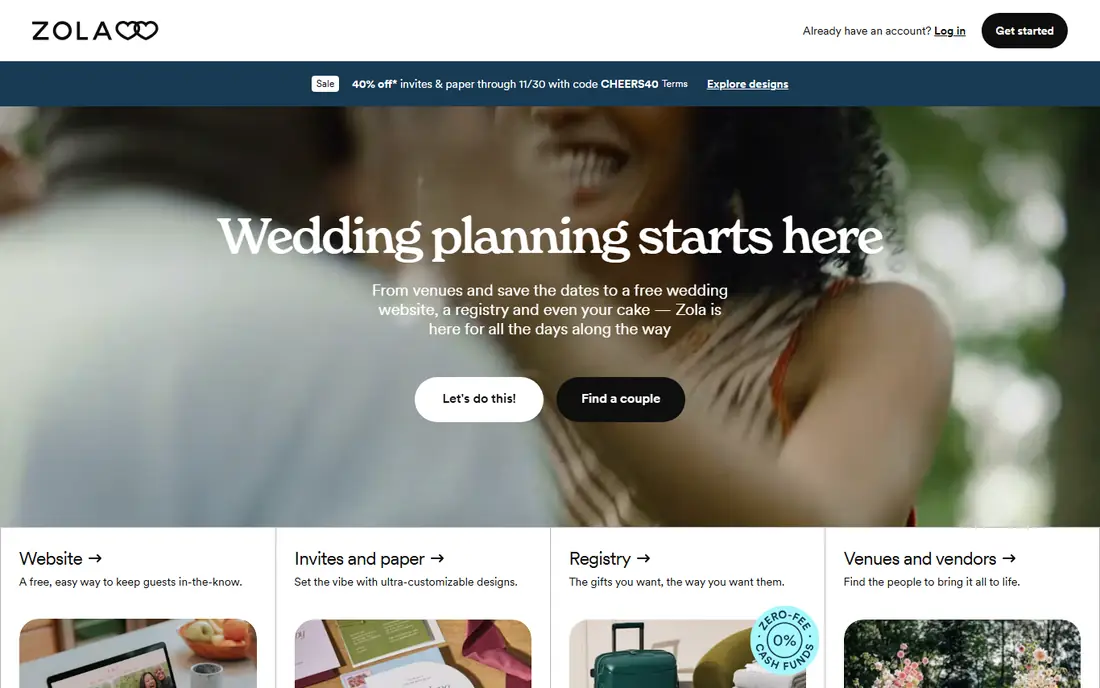
Zola is our pick for most couples, because registry, website, invitations, and planning tools live in one account. The template library is large, RSVP collection is built for weddings with meal choices and guest management, and the registry can include store items, cash funds, and experiences. That cohesion saves time when a couple is already managing vendors, guests, and a registry at once.
The free tier is genuinely useful, but not every template or advanced feature is free, and a custom domain is an extra yearly cost. If registry is your priority, start with Zola and check the paid template options only after the free designs feel too plain for your invitations.
- Large template library
- Strong registry in the same account
- Wedding planning tools included
- Some templates and features require paid upgrades
- Custom domain costs extra
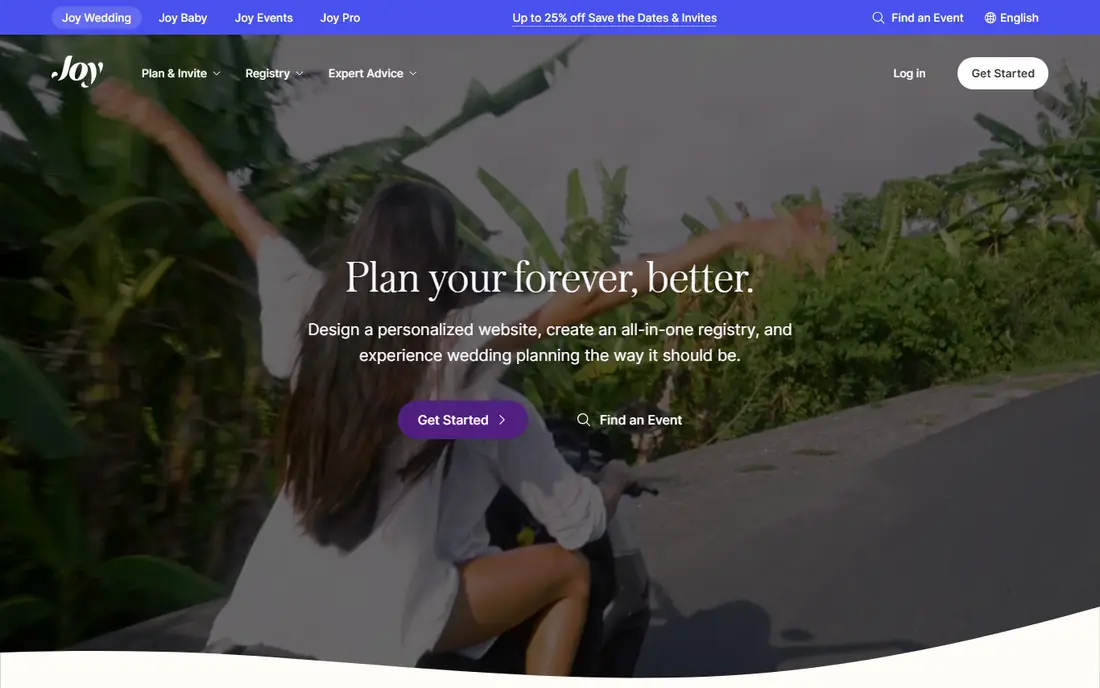
Joy, formerly WithJoy, offers one of the strongest free wedding website plans, with RSVP, meal selection, password protection, guest-specific content, and a universal registry that can link to outside stores and cash funds. Travel pages, schedules, and multi-event support make Joy especially useful for destination weddings, where guests need hotel, transport, and weekend event details in one place.
The main gap is vendor discovery. Joy does not match The Knot for finding local vendors, so couples who want a marketplace and a website in one place may prefer The Knot or Zola. If your vendors are already booked and you want the best free website and RSVP tools, Joy is hard to beat.
- Strong free RSVP with meal selection
- Universal registry with cash funds
- Travel and schedule pages
- Smaller vendor marketplace than The Knot
- Custom domain costs extra
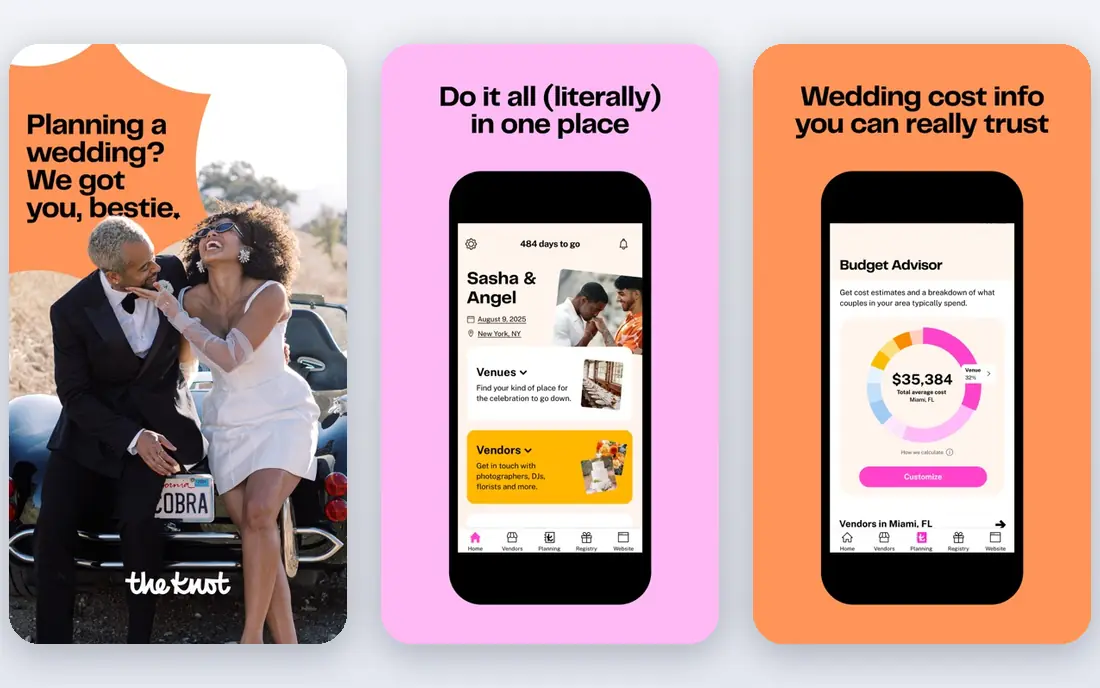
The Knot is the classic choice for couples who start planning by searching for vendors. Its marketplace covers venues, photographers, florists, and planners, and the free website builder sits inside the same account, with templates, RSVP collection, and guest management. Older or less tech-savvy guests often trust a Knot link at once, which can help RSVP response rates.
The trade-off is sponsored content. Vendor suggestions and ads appear throughout the planning experience, which some couples find distracting, and premium templates may cost extra. If you are already using The Knot for vendors, the website is a natural add-on, but if you want a cleaner free site, Joy or Zola may feel less cluttered.
- Large vendor marketplace
- Familiar brand for guests
- Free templates and RSVP
- Sponsored vendor content appears in planning tools
- Some premium templates cost extra
Minted suits couples who care most about a matched look across paper and screen. Its artist-designed templates pair with printed invitations, save-the-dates, and menus, so the website can carry the same design as the invitation suite. The core website is free, and Minted has offered stationery credit for building a site at times, which helps if paper is already in the budget.
Planning tools are lighter than Zola or Joy, with less depth in guest management and multi-event scheduling. If paper design is the priority and RSVP needs are simple, Minted is an excellent choice, but couples with complex guest lists or destination travel should check Joy or Zola first.
- Artist-designed templates that match paper invitations
- Free core website
- Stationery credit offers at times
- Planning and guest tools are lighter than Zola or Joy
- Website is secondary to paper
Squarespace is a general website builder, not a wedding-specific platform, and that is both its strength and its limit. You get full control over page structure, photo layouts, and design, and the site can live on after the wedding as a photo archive or family site. For a couple with a strong design vision, that control is worth the subscription cost.
The cost is effort. RSVP collection, meal choices, and guest list management must be built with forms and manual tracking, since Squarespace has no wedding-native RSVP system. Choose Squarespace only if design control matters more than ready-made wedding tools, and budget time to build the RSVP flow yourself.
- Full control over pages and design
- Site can live on after the wedding
- Strong photo layouts
- No free plan
- RSVP and guest tools must be built with forms
Wix is another general builder with wedding templates, a drag-and-drop editor, and a free plan for starting a site. It suits couples who want a flexible layout, a blog or photo pages, and a site that can change after the wedding, without committing to a wedding-specific platform at once. Paid plans remove branding and allow a custom domain.
Like Squarespace, Wix lacks wedding-native RSVP depth, so meal choices and guest management rely on forms and manual lists. The free plan also shows Wix branding, which some couples dislike on an invitation link. Wix is a good fallback if you already use it for another site, but Zola or Joy are better for RSVP-heavy weddings.
- Free plan to start
- Flexible drag-and-drop builder
- Wedding templates available
- Free plan shows Wix branding
- Wedding RSVP tools are generic forms
Riley & Grey is the premium design pick, with editorial, magazine-style templates that look closer to a printed wedding suite than a standard builder. RSVP collection is wedding-native and included, password protection is available, and the designs suit couples who want a polished, high-end site as part of the wedding experience. For a luxury wedding, the design quality can justify the price.
The drawback is cost over time. Riley & Grey charges a monthly or yearly subscription with no free plan, so a long engagement can make the total much higher than a free platform plus a custom domain. If design is the top priority and the budget allows it, Riley & Grey is excellent, but most couples will get what they need free from Zola or Joy.
- Editorial, magazine-style designs
- Wedding-native RSVP included
- Password protection
- Paid subscription with no free plan
- Cost adds up over a long engagement
WedSites offers a simpler model: a one-time fee for a wedding website, rather than a monthly subscription that runs through a long engagement. Pages cover the story, schedule, travel, photos, and RSVP, with guest management built in, which suits couples who want a straightforward site without a large template library to sort through.
The design range is narrower than Zola or Joy, and the company is smaller, so support and template updates are less extensive than the market leaders. For a small or simple wedding where a clean site and a single payment matter more than hundreds of templates, WedSites is a practical, budget-friendly option.
- One-time fee rather than monthly billing
- Simple wedding pages
- RSVP tools included
- Design range is narrower than free leaders
- Smaller team and support footprint
How we picked these
We compared official pricing, template libraries, RSVP tools, registry options, guest management, password protection, and custom domain terms, along with 2026 wedding website guides. We kept platforms that are live in October 2026, let couples publish a public or password-protected wedding site, and collect RSVPs, and we left out invitation-only tools with no website builder. We did not claim hands-on testing, and prices are shown as See website where a current vendor price could not be confirmed.
How to choose a wedding website without overpaying
Start with RSVP, not templates. Decide how many guests you have, whether you need meal choices, plus-one controls, and multi-event RSVPs, then check which free platform handles those needs without a paid upgrade. A beautiful template that cannot collect a meal choice will create manual work for every guest, while a plain template with good RSVP tools will save hours.
Next, check privacy and export. Turn on password protection if the site lists a private venue or home address, and confirm that you can export the guest list and RSVP answers before the wedding. Some platforms make export easy, while others keep data harder to retrieve, which matters when you hand a final count to a caterer.
Finally, decide on a domain early. A custom domain costs a small yearly fee on most platforms and is easier to print on a save-the-date than a long platform subdomain. Put the site address and password, if used, on the invitation itself, since guests will not search for a site they have never seen.
Frequently asked questions
What is the best wedding website platform?
Zola is the best all-in-one choice for most couples, because registry, website, and planning tools share one account. Joy is the best free option for RSVP and travel features, while The Knot suits couples already using its vendor marketplace.
Are wedding websites free?
Yes, core wedding websites on Zola, Joy, The Knot, and Minted are free, with paid extras for custom domains, premium templates, and some advanced features. General builders such as Squarespace and premium platforms such as Riley & Grey charge a subscription instead.
When should I create a wedding website?
Create the site eight to twelve months before the wedding, alongside save-the-dates, and earlier for destination weddings so guests can book travel. Open RSVP six to eight weeks before the wedding, with the formal invitation, and close it in time to give final counts to vendors.
Can I password protect a wedding website?
Yes, most platforms in this list offer password protection, including Zola, Joy, The Knot, Minted, Riley & Grey, and WedSites. Password protection keeps the site out of search results, which helps if the site lists a private venue, but put the password on the invitation so guests can find it.
Can I link a registry from another store to my wedding website?
Yes, Joy offers a universal registry that links to outside stores and cash funds, while Zola, The Knot, and Minted also allow registry links, with varying limits. Check whether cash funds carry a fee, and confirm that guests can find the registry from the website homepage without extra clicks.
Sources
See where you really rank - block by block
ProMapRanker scans Google Maps across a grid of your service area. Simple monthly plans from $19, white-label on every plan.
Start freeKeep reading
 wpforms alternatives
Best WPForms Alternatives in 2026
We compare 9 wpforms alternatives for WordPress forms, with free and paid options, current pricing notes, and honest limits for small business sites in 2026.
Read → windows task scheduler alternatives
Best Windows Task Scheduler Alternatives in 2026
Looking for Windows Task Scheduler alternatives? We compare 9 schedulers for Windows and cross-platform work, from free tools to enterprise automation.
Read → which ai video service is best
Which AI Video Service Is Best in 2026
which ai video service is best? We compare 10 legitimate AI video services on price, avatars, editing and output quality to help you pick the right tool.
Read →