 ProMapRanker
Best Web Data Extraction Companies in 2026

Key takeaways
- Bright Data and Oxylabs suit large, enterprise-scale collection, while ScrapingBee and ScraperAPI suit developers who want a simple API.
- Apify stands out for ready-made scrapers, and Octoparse suits non-developers who prefer a visual workflow.
- Zyte and Diffbot sit in the middle: managed extraction and structured data rather than raw page downloads.
- Only collect data lawfully, respecting site terms, robots rules where applicable, privacy law and any login or paywall restrictions.
Quick comparison
| Pick | Great for | Pricing starts at | Free tier | |
|---|---|---|---|---|
 Bright Data | Enterprise scale and datasets | See website | Free trial | Visit |
 Oxylabs | Enterprise proxies and scraping APIs | $49 per month | Free trial | Visit |
 Apify | Ready-made scrapers marketplace | See website | Yes | Visit |
 ScrapingBee | Simple API for developers | $49 per month | Free trial | Visit |
 Zyte | Managed scraping API at scale | See website | Free trial | Visit |
 ScraperAPI | Beginner-friendly scraping API | $49 per month | Free trial | Visit |
 Octoparse | No-code visual scraping | See website | Yes | Visit |
 Diffbot | Structured data and knowledge graph | See website | Yes | Visit |
The best web data extraction companies
Web data extraction covers a wide range, from a developer calling one API to a company outsourcing its whole data pipeline. The providers below cover that range, and they differ mainly in how much work they do for you. Before you choose, confirm that your planned collection is lawful: respect site terms, avoid bypassing logins or paywalls, do not collect personal data you have no basis to hold, and follow applicable privacy law.
Bright Data is the largest name on this list for enterprise web data work. It offers proxy networks, scraping APIs and ready-made datasets, plus managed collection for companies that want data delivered rather than building scrapers themselves. That breadth suits large teams with many sources, strict compliance needs and high volumes, since one vendor can cover several data jobs.
The downside is complexity. Pricing varies by product and by usage model, so a small team can easily overbuy or misjudge the cost of a project. Bright Data suits buyers who will price a real workload first, test with a trial, and use its compliance documentation in their own legal review. Smaller projects will usually be cheaper elsewhere.
- Very large proxy and dataset offering
- Enterprise compliance focus
- Pay-as-you-go options
- Pricing is complex across products
- Overkill and costly for small projects
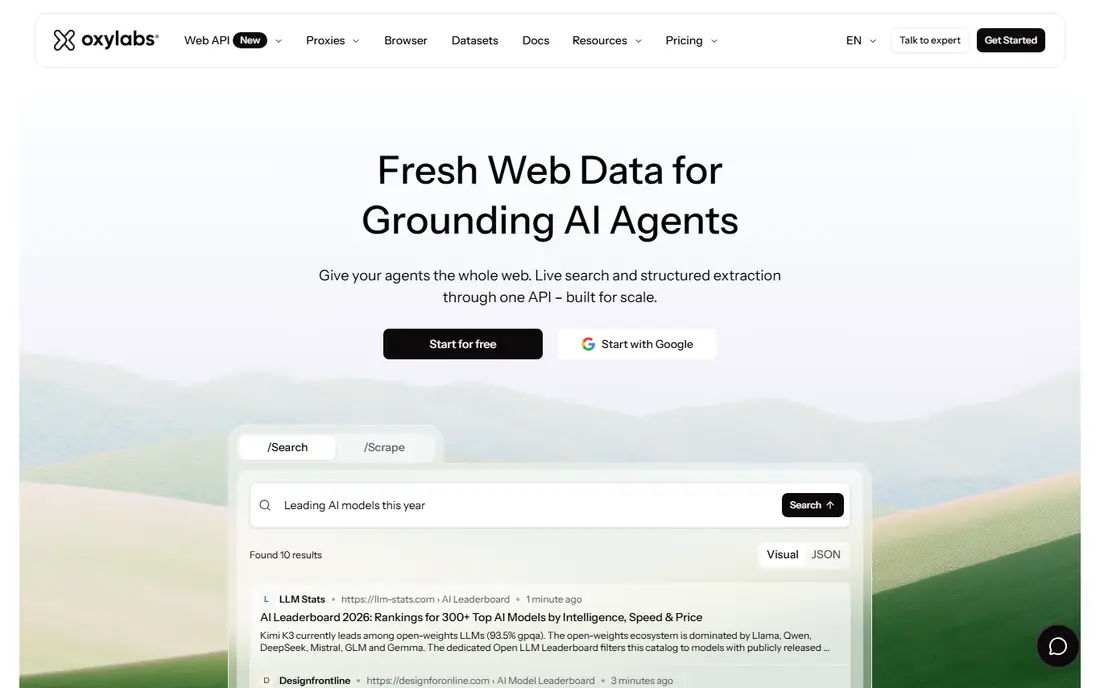
Oxylabs is a direct enterprise rival to Bright Data, with proxy networks and scraping APIs aimed at companies collecting data at scale. Its product range covers residential, datacenter and mobile proxies alongside APIs for search results, e-commerce and general web pages. For teams with ongoing, high-volume needs, that combination reduces the number of vendors they must manage.
Oxylabs is less appealing for a one-off scrape. Even its entry pricing points at regular users rather than occasional ones, and getting the most from its proxy options takes technical setup. It is a strong pick for a data team with a steady pipeline, and a weaker pick for a single small project.
- Strong enterprise proxy coverage
- Dedicated scraping APIs
- Compliance documentation
- Entry plans still suit larger budgets
- Setup takes more effort than a simple API
Apify is a platform where developers run and share scrapers, called Actors, for common sites and data jobs. That marketplace is its main advantage: for a popular source, you may find a working scraper in minutes instead of building one from scratch. It also handles scheduling, proxies and data storage in the cloud, so a small team can run a regular collection job without its own servers.
Quality is the catch, since community-built scrapers vary and a site change can break one without warning. Apify's own maintained Actors tend to be more reliable, so check who built the Actor you plan to use. Usage-based billing also needs watching, since a misconfigured schedule can run more often than intended.
- Large marketplace of ready-made scrapers
- Cloud scheduling and storage
- Free tier for testing
- Quality varies across community scrapers
- Usage billing needs careful monitoring
ScrapingBee suits developers who want to send a URL and get back a page, without managing proxies, browsers or anti-bot handling themselves. It renders JavaScript, handles proxies and returns HTML or extracted data, which covers most small and mid-size scraping jobs. Its documentation is clear, and its credit model is easier to reason about than some enterprise price lists.
For very large or heavily protected sources, a larger enterprise platform may offer more control and support. ScrapingBee is also priced per month rather than as a free ongoing tier, so occasional users should check the trial and the smallest plan against their real volume. For a typical developer project, it is one of the easiest starts on this list.
- Simple API with JavaScript rendering
- Clear credit model
- Good documentation
- Less suited to very large enterprise pipelines
- Advanced proxy control is limited
Zyte, formerly Scrapinghub, has a long history in web extraction, and its managed API handles proxies, browsers and retries behind one endpoint. That managed approach suits teams that want reliable delivery without maintaining their own scraping infrastructure. Zyte also offers data services for companies that want extraction fully handled, from source selection to delivery format.
Pricing is the main uncertainty, since larger use is quote-based and small users may not see a simple entry price. Teams should request a quote based on a defined set of sources and volumes, and compare it with a simple API on the same workload. For a business that treats web data as a core input, Zyte's reliability is worth that extra step.
- Managed API with automatic retries
- Long track record in extraction
- Data quality tooling
- Pricing is quote-based for larger use
- Smaller users may find simpler APIs cheaper
ScraperAPI is built for developers who want proxy rotation, geotargeting and JavaScript rendering without building that stack themselves. You send a request with the target URL, and ScraperAPI returns the page content, which keeps integration to a few lines of code. That simplicity makes it popular with solo developers and small teams starting their first extraction project.
Heavily protected sites remain a challenge for any simple API, and ScraperAPI is no exception, so test it on your actual targets during the trial. Its monthly plans also suit regular users better than one-off jobs. For steady, moderate-volume collection from ordinary sites, it is a dependable and affordable choice.
- Easy API setup
- Proxy rotation handled for you
- Structured data options
- Success rates vary on heavily protected sites
- Monthly plans suit regular users
Octoparse is the pick for non-developers. Its visual tool lets you click the data you want on a page and build a scraping task without writing code, and its templates cover common sites such as e-commerce listings and directories. That makes it useful for analysts, marketers and researchers who need structured data but do not have engineering support.
The trade-off is flexibility. Sites with heavy JavaScript, login walls or unusual layouts may need manual tuning, and a desktop-based workflow fits some teams less well than a cloud API. Octoparse still deserves its place here, because it opens web extraction to people who would otherwise have to hire a developer for every small job.
- Visual point-and-click workflow
- Templates for common sites
- No coding needed
- Desktop-based workflow suits some teams less well
- Complex sites still need manual tuning
Diffbot takes a different approach from most providers here. Instead of returning raw pages, it analyzes a URL and returns structured data, such as an article, product or organization record, and it maintains a knowledge graph of entities across the web. That suits AI, research and enrichment projects where clean, structured records matter more than raw HTML.
Diffbot is less useful when you need a very specific, custom field from one unusual site, since its automatic extraction follows general patterns. Its pricing also points at commercial users rather than hobbyists. If your goal is structured data at scale, though, Diffbot can save a large amount of parsing and cleaning work.
- Automatic structuring of articles, products and people
- Knowledge graph for entity data
- API-first design
- Less suited to custom, site-specific extraction
- Pricing suits regular commercial users
How we picked these
We compared official product and pricing pages, documentation and public reviews for providers that actively offer web data extraction in October 2026. We kept only providers with a live product and a clear extraction offer, and we favored a mix of enterprise platforms, developer APIs, a no-code tool and a structured-data provider. Where pricing was quote-based or unclear, we wrote See website rather than guessing.
Choosing the right model for your project
Start by deciding how much work you want to do yourself. A simple API suits a developer with one or two sources, a marketplace platform suits a team with many common sources, and a managed service suits a business that wants data delivered on a schedule. Always test on your real target sites during a trial, since success rates differ by site and by protection level. Finally, keep a written record of your legal basis for collection, the sources used and any personal data handling, since that record matters if a source or regulator asks questions later.
Frequently asked questions
What are the best companies for web data extraction?
For enterprise scale, Bright Data and Oxylabs are the usual starting points, while ScrapingBee and ScraperAPI suit developers who want a simple API. Apify suits teams that want ready-made scrapers, and Octoparse suits non-developers. The best pick depends on volume, technical skill and how much management you want outsourced.
Is web scraping legal?
It depends on the source, the data and your location, so there is no single yes or no answer. Respect site terms, do not bypass logins or paywalls, avoid personal data you have no basis to collect, and get legal advice for commercial projects. This article is general information, not legal advice.
How much does web data extraction cost?
Costs range from free tiers for small tests to monthly API plans starting around $49 per month, up to quote-based enterprise contracts. Price your actual workload, including retries and JavaScript rendering, rather than comparing headline plans. A trial on your real targets gives the most honest cost estimate.
Do I need to code to extract web data?
Not always. Octoparse offers a visual workflow for non-developers, and Apify offers ready-made scrapers for common sites. Coding still helps for custom sources, scheduling and data cleaning, but many small projects can be done without it.
What is the difference between a scraping API and a managed service?
A scraping API returns pages or data when you call it, and you handle scheduling and storage. A managed service runs the whole pipeline for you and delivers finished data on a schedule. Managed services cost more, but they suit businesses that need data without building a data team.
Sources
See where you really rank - block by block
ProMapRanker scans Google Maps across a grid of your service area. Simple monthly plans from $19, white-label on every plan.
Start freeKeep reading
 wpforms alternatives
Best WPForms Alternatives in 2026
We compare 9 wpforms alternatives for WordPress forms, with free and paid options, current pricing notes, and honest limits for small business sites in 2026.
Read → windows task scheduler alternatives
Best Windows Task Scheduler Alternatives in 2026
Looking for Windows Task Scheduler alternatives? We compare 9 schedulers for Windows and cross-platform work, from free tools to enterprise automation.
Read → which ai video service is best
Which AI Video Service Is Best in 2026
which ai video service is best? We compare 10 legitimate AI video services on price, avatars, editing and output quality to help you pick the right tool.
Read →