 ProMapRanker
Best Visibility Tracking Tools in 2026


Enterprise teams tracking AI search at scale · Pricing starts at: See website
Key takeaways
- The best visibility tracking tool for most teams depends on where your buyers ask questions, in classic search results or in AI answers.
- AI-first tools track prompts across ChatGPT, Gemini, Perplexity, and Google AI surfaces, while classic rank trackers still cover traditional search positions.
- Prompt limits matter more than headline prices, so check how many prompts, engines, and brands are included before you buy.
- A free trial is the safest first step, because AI answers change from day to day and a single week of data can mislead.
Quick comparison
| Pick | Great for | Pricing starts at | Free tier | |
|---|---|---|---|---|
| Profound | Enterprise teams tracking AI search at scale | See website | Free trial | Visit |
 Peec AI | Simple daily AI visibility tracking | $95 per month | Free trial | Visit |
 Otterly.AI | Small budgets and first-time AI tracking | $29 per month | Free trial | Visit |
 Semrush | Teams already using Semrush for SEO | $99 per month | Free trial | Visit |
 Ahrefs Brand Radar | SEO teams that want AI data on top of Ahrefs | $199 per month | No | Visit |
 SE Ranking | Agencies and SEO teams adding AI tracking | See website | Free trial | Visit |
 Scrunch | Brands that need presence checks and site readiness | $250 per month | Free trial | Visit |
 ZipTie | Simple AI tracking priced per engine | See website | Free trial | Visit |
The best visibility tracking tools
We compared tools that track how a brand shows up in search and AI answers, using vendor pricing pages, feature pages, and public comparisons. These eight cover a wide range of budgets and team sizes.
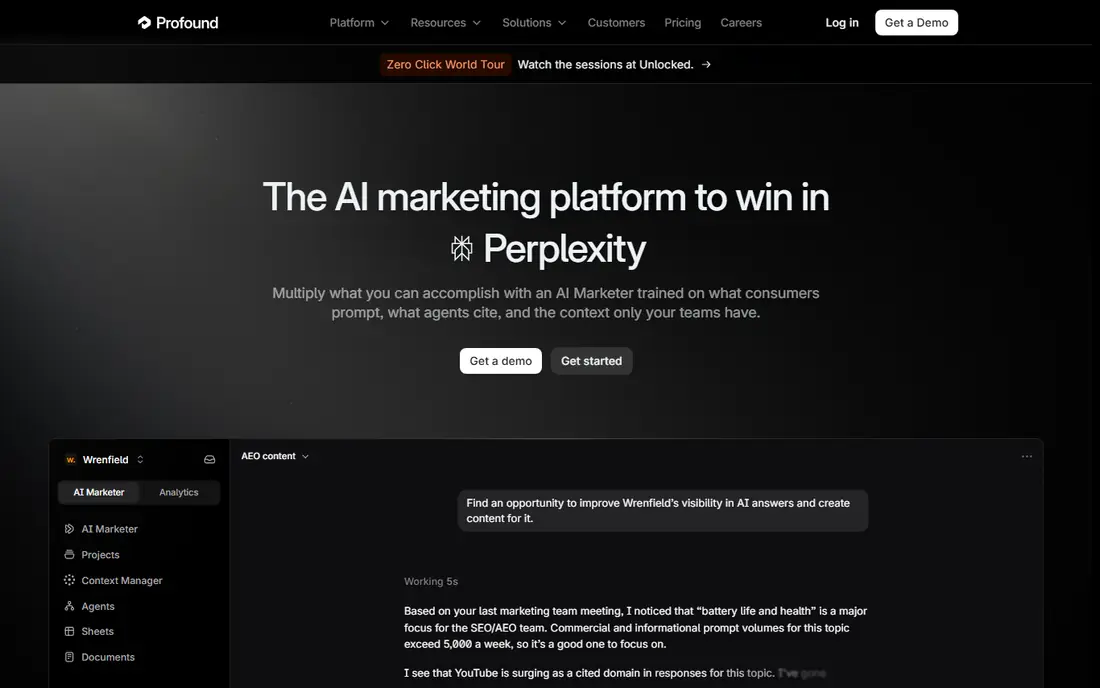
Profound is built for brands that want a deep view of how AI assistants talk about them. It tracks mentions, citations, and sentiment across major AI platforms, and it helps teams find prompts they had not thought to track. For a large brand with many products and competitors, that breadth is the main draw, because a narrow prompt list can miss the questions buyers actually ask. The reporting is also suited to sharing results with senior leaders, who often want trends rather than a single daily score.
The catch is cost and complexity. Profound does not publish a simple starter price, so a small business will need a sales conversation to learn the full cost. Setup also takes more care than a budget tracker, since prompt lists, competitors, and regions need to be chosen well at the start. If you only track a handful of prompts, a cheaper tool will give you most of the same headline answers. Profound makes more sense when AI visibility is a core marketing metric, not a side curiosity.
- Broad AI engine coverage
- Prompt discovery and trend views
- Agency and enterprise reporting options
- Pricing is not published as a simple entry plan
- May be more than a small team needs
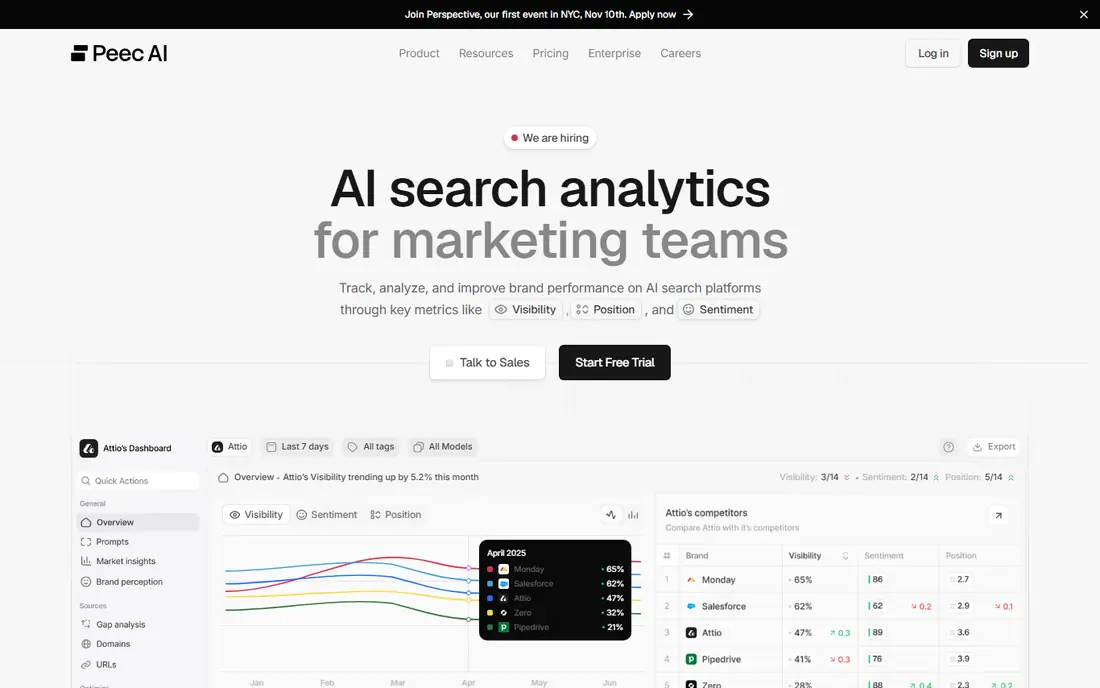
Peec AI keeps the daily job simple: pick your prompts, add competitors, and watch how often your brand appears and where it sits in AI answers. That clarity is useful for content teams, because they can link a drop in visibility to a specific prompt or competitor rather than guessing. The tool also shows sentiment, which helps when a brand is mentioned but not in a helpful way. For a team that wants one clean number per prompt, Peec AI is easy to explain in a weekly meeting.
The limits are worth noting before purchase. The entry plan covers a set number of prompts and a subset of models, so a team tracking many products or regions will move to a higher tier quickly. Peec AI is also focused on AI visibility rather than classic rank tracking, so teams that still rely on traditional search data may need a second tool. Still, for AI-first tracking on a mid-range budget, it is a strong and readable choice.
- Clear prompt, position, and sentiment views
- Supports several AI models
- Easy to read dashboards
- Entry plan covers a limited set of prompts and models
- Larger teams may need a higher plan
Otterly.AI is the easiest way to start tracking AI visibility without a large contract. At a low monthly price, it covers major AI surfaces and gives a daily view of mentions, which is enough for a small business to spot whether its brand appears at all. Setup is fast, and the prompt list can stay focused on the questions that matter most, such as product comparisons and local service queries. For owners who want proof before spending more, that low entry point matters.
The trade-off is scale. The entry plan allows only a small number of prompts, so a business with many services or locations will need to prioritise or upgrade. The analysis is also less deep than enterprise platforms, with fewer options for custom segments and large-scale reporting. That is a fair trade for the price, and many small teams will never hit those limits. Start here if you want a cheap, honest first look at AI visibility.
- Low entry price
- Covers several AI engines
- Quick setup for small prompt lists
- Entry plan has a small prompt allowance
- Reporting is lighter than enterprise tools
Semrush adds an AI Visibility Toolkit to its well-known SEO platform, which makes it a natural pick for teams already paying for Semrush. You can see AI mentions beside keyword rankings, backlinks, and site health, so AI visibility becomes part of a wider search picture rather than a separate report. The toolkit tracks a set of prompts per domain and shows which competitors appear in AI answers, which helps content teams decide what to publish next. For an SEO team, that context is more useful than a standalone score.
The main limit is pricing structure. The toolkit is priced per domain, so tracking several brands or client sites adds up. It also assumes some comfort with Semrush itself, which has a large feature set that can feel busy for a newcomer. If you do not already use Semrush, a dedicated AI tracker may be cheaper. If you do, adding the toolkit is often simpler than learning a second platform.
- AI visibility sits beside classic SEO data
- Per-domain tracking is clear
- Strong competitor views
- The toolkit is priced per domain
- It is not a standalone cheap tracker
Ahrefs Brand Radar is built for teams that already trust Ahrefs for search data and now want to see how brands appear in AI answers and AI Overviews. Its strength is discovery: large indexes of prompts and mentions can surface questions you did not know buyers were asking. That matters, because a tracker that only follows prompts you wrote yourself will miss new demand. The tool also connects AI visibility to the search data Ahrefs is known for, which helps teams judge whether an AI mention is likely to drive real traffic.
The downside is price and packaging. Brand Radar is an add-on style product with platform-level pricing, and custom prompt options can add further cost. Small teams may find the entry point steep, especially if they only need a few dozen prompts. It is best for SEO teams that will use the wider Ahrefs platform daily, not for a business that wants a single AI score and nothing else.
- Large prompt and mention indexes
- Strong search data behind the AI views
- Useful for finding new prompts
- Higher entry cost and needs an Ahrefs plan context
- Custom prompt pricing adds complexity
SE Ranking appeals to teams that do not want to pay for two separate tools. Its AI visibility tracker sits beside rank tracking, competitor research, and site audits, so a team can check classic positions and AI mentions in one place. The prompt allowance on its AI plans is generous compared with some rivals at a similar price, which helps agencies tracking several clients. Reporting options also suit client work, where a clear monthly summary matters more than a complex dashboard.
The catch is that AI tracking is part of a broader suite, so buyers need to check exactly which plan and add-on they are buying. A team that only wants AI tracking may pay for SEO features it never opens. The interface also carries a lot of options, which can slow down a first-time user. For an agency or an SEO team that will use the full suite, SE Ranking is a practical middle ground between budget AI trackers and enterprise platforms.
- Combines classic rank tracking with AI visibility
- Good prompt volume for the price band
- Agency-friendly reporting
- AI features sit inside a larger SEO suite
- Pricing depends on the plan and add-ons chosen
Scrunch focuses on two linked questions: does an AI assistant mention your brand, and can it actually find and use your content? That second question is easy to overlook, yet it decides whether a well-written page ever becomes a citation. Scrunch checks site readiness for AI agents alongside brand presence, which gives content and technical teams a shared to-do list. For a mid-size brand with a content team, that mix of tracking and action steps is more useful than a score alone.
The entry price puts Scrunch out of reach for many small businesses, and the value depends on acting on the findings. If no one updates pages, fixes crawl access, or adds clear facts, the tracker will simply report the same gaps each month. Teams with a content owner and a regular publishing rhythm will get the most from it. Teams without that rhythm should start cheaper and return when they can act on the data.
- Tracks brand presence across AI platforms
- Checks whether AI agents can find and use site content
- Team seats included on higher plans
- Entry price is high for small businesses
- Setup benefits from a clear content plan
ZipTie takes a simpler approach to AI visibility pricing, with plans tied to the AI search engines you choose to track. That can suit a business that only cares about one or two engines, such as ChatGPT and Google AI surfaces, rather than paying for broad coverage it will not use. Setup is direct, and the trial gives a chance to see whether the tracked prompts produce useful answers. For a solo marketer or a small agency, that focus keeps the monthly bill and the dashboard manageable.
The limit is the same as the strength. Adding more engines, prompts, or brands raises the cost, and the analysis tools are less deep than enterprise platforms. ZipTie is also less suited to a team that wants classic rank tracking, content optimisation, and AI tracking in one suite. As a focused AI tracker, though, it is a clear option for buyers who want to pay only for the engines they actually watch.
- Per-engine pricing can suit narrow tracking needs
- Straightforward setup
- Trial lets you test before committing
- Costs rise as you add engines
- Feature depth is lighter than full suites
How we picked these
We compared vendor pricing pages, feature pages, and public 2026 comparisons for AI and search visibility tools, and we kept only tools that track real prompts or mentions in live AI or search results. We favoured tools with published prompt limits, clear engine coverage, and a trial or free check, because those details let a buyer judge value before signing a contract. We left out content writers and generic SEO scores that never query an AI assistant, since they do not measure visibility in the same way.
What to check before you buy
Start with your prompt list, not the price page. Write down the questions buyers ask before they choose you, including comparison questions, price questions, and local questions, then check how many of those prompts each plan covers. A tool that tracks 15 prompts well beats a tool that tracks 200 prompts you do not care about. Also check which engines are included, because ChatGPT, Gemini, Perplexity, and Google AI surfaces can give very different answers for the same question.
Classic search or AI answers
If most of your traffic still comes from classic search results, a suite with rank tracking plus AI features, such as Semrush or SE Ranking, will serve you better than an AI-only tracker. If buyers now discover you through AI answers, an AI-first tool such as Peec AI, Otterly.AI, or Profound gives a clearer picture. Many teams need both views for a few months, then keep the one that matches where new enquiries actually come from.
Prompt quality and reporting
AI answers vary from day to day, so look for trend views, citation sources, and competitor comparisons rather than a single snapshot. Ask who will read the report each week and what action they will take from it. A tool that names the source pages behind a mention helps a content team fix gaps, while a tool that only gives a percentage leaves the team guessing. Finally, test the trial with your real prompts, not the demo prompts, because demo data always looks good.
Frequently asked questions
What is the best visibility tracking tool for a small business?
For a small business, a low-cost AI tracker such as Otterly.AI or Peec AI is often the best starting point, because both give daily mention data without an enterprise contract. Add classic rank tracking only if classic search still drives most of your enquiries. Start with a trial and a short prompt list, then upgrade only when you can name the prompts you need to add.
What is the difference between visibility tracking software and a rank tracker?
A classic rank tracker shows where a page sits in search results for a keyword. Visibility tracking software for AI search shows whether and how a brand appears inside AI-generated answers, including mentions, citations, and competitors in the same answer. Many modern suites now offer both, but the data and the actions they suggest are different.
How many prompts should I track?
Start with 20 to 50 prompts that cover your main products, comparison questions, and local queries, then expand to topics that show real buyer intent. Tracking too many prompts early spreads your attention and raises the price without adding decisions. Review the list each quarter and drop prompts that never lead to a content or product action.
Can AI visibility tools replace classic SEO tools?
No, not yet, because classic search still sends a large share of traffic for many businesses, and AI tools do not replace keyword research, technical audits, or backlink analysis. Use AI visibility tracking beside classic SEO data, and judge each tool by the decisions it helps you make. If AI answers become your main discovery channel, the balance may shift over time.
How often do AI answers change?
AI answers can change daily, because models, source pages, and prompt wording all affect the result. That is why trend views matter more than a single day of data, and why a trial should run for at least a week with your real prompts. Treat a sudden change as a prompt to check the cited sources, not as proof that your whole strategy has failed.
Sources
See where you really rank - block by block
ProMapRanker scans Google Maps across a grid of your service area. Simple monthly plans from $19, white-label on every plan.
Start freeKeep reading
 free alternatives to grok imagine
Free Alternatives to Grok Imagine in 2026
We compared the best free alternatives to grok imagine for image generation, from fast daily credits to design tools, so you can create without paying.
Read → best tools for instagram content creation
Best Tools for Instagram Content Creation in 2026
Compare the best tools for Instagram content creation, from Canva and CapCut to Later and Buffer, on design, video, planning, scheduling, and price in 2026.
Read → best tool to split pdf files
Best Tool to Split PDF Files in 2026
We compared the best tool to split pdf files on split modes, file limits, privacy and price, so you can split a PDF cleanly and keep every page in one go.
Read →