 ProMapRanker
Best Visibility Checking Software in 2026

Key takeaways
- These tools track how your brand shows up in AI answers, not just where you rank in classic blue-link results.
- Peec AI and Otterly offer the clearest entry prices for small teams, while Profound and Scrunch suit larger firms.
- Prompt choice matters more than prompt count, so track the questions buyers actually ask, not generic brand queries.
- Raw answers and citations matter: a score without the answer text behind it is hard to act on.
Quick comparison
| Pick | Great for | Pricing starts at | Free tier | |
|---|---|---|---|---|
 Profound | Enterprise AI answer tracking | See website | Free trial | Visit |
 Peec AI | Competitive positioning for marketing teams | $95 per month | Free trial | Visit |
 Otterly.AI | Low-cost AI and search surface monitoring | $29 per month | Free trial | Visit |
 Scrunch | Brand presence and crawler checks | $300 per month | Free trial | Visit |
 AthenaHQ | Broad engine coverage with a free tier | $295 per month | Yes | Visit |
 Semrush AI Visibility Toolkit | Teams already using Semrush | $99 per month | No | Visit |
 Ahrefs Brand Radar | AI data on top of Ahrefs | $199 per month | No | Visit |
 Rankscale | Credit-based tracking for agencies | $99 per month | Free trial | Visit |
The best visibility checking software
Classic rank trackers tell you where a page sits in search results. These tools answer a newer question: when someone asks an AI engine about your product, does it mention you, cite you, or recommend a rival instead. That is a distinct job, and it needs prompts, answers, and citations, not just positions.
Profound is the enterprise end of this category, built to track how a brand appears across major AI engines and to turn those answers into reports for large teams. It stores answers and citations, tracks competitors on the same prompts, and supports the access controls and integrations that big firms expect. A short trial lets you test a small prompt set before a sales conversation.
The trade-off is price and fit. With custom pricing, small businesses cannot budget from a public rate card, and the platform is more than a solo marketer needs. For a brand with serious AI search exposure and many stakeholders, though, Profound gives the depth and governance that cheaper tools skip.
- Wide engine coverage on enterprise plans
- Answer-level data with citations
- Reporting built for large teams
- Custom enterprise pricing
- Smaller teams may not need its depth
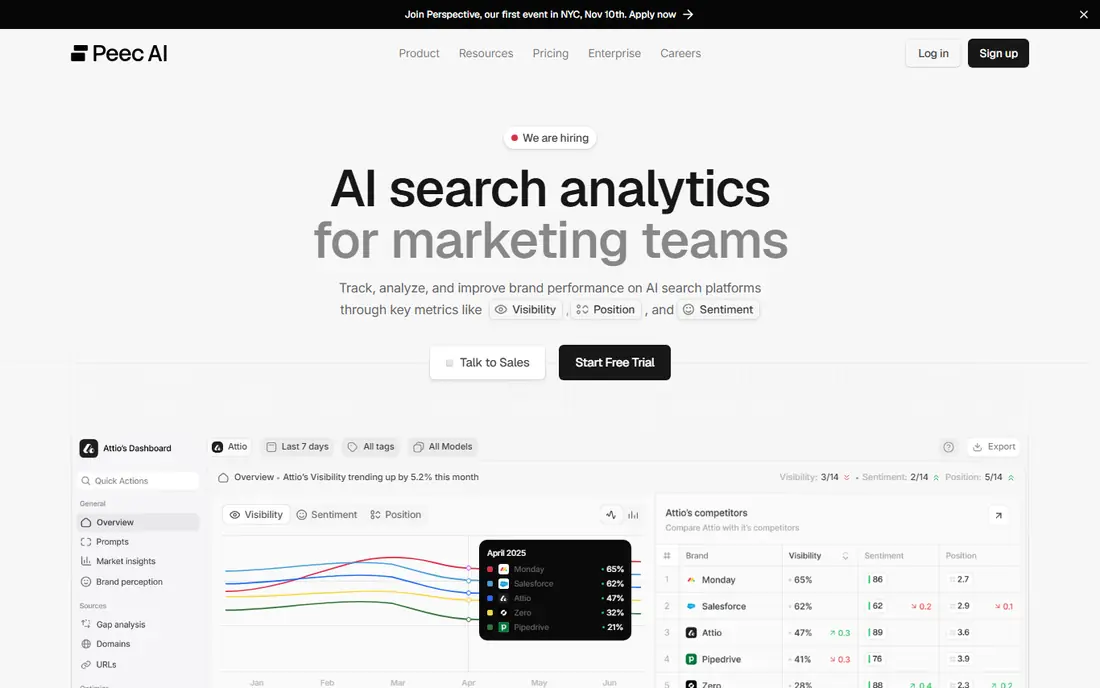
Peec AI is a strong default for marketing teams that want a clear, usable view of AI visibility. You set prompts, pick models, and see where your brand is mentioned, cited, or left out, next to competitors on the same questions. A demand score helps you weight prompts by how much buyers care about each question, which keeps the report focused on revenue, not vanity queries.
The Starter plan at $95 per month covers 50 prompts and one project, which suits a single brand. Agencies and multi-brand teams will need a higher tier for more projects. Peec AI earns its place here because it is easy to read, easy to explain to a client, and priced for teams that are not enterprises.
- Prompt-level visibility and citation tracking
- Demand scores to weight prompts
- Clean project separation
- Entry plan covers 50 prompts and one project
- API and full model set sit on higher tiers
Otterly is the cheapest credible way to start checking AI visibility. The Lite plan at $29 per month tracks 15 prompts daily across ChatGPT, Google AI Overviews, Perplexity, and Copilot, which covers the surfaces most buyers meet first. Setup is quick, and a 7-day trial lets you see real answers before paying.
Limits are plain. Fifteen prompts will not cover a large product range, and adding Claude, Gemini, or AI Mode costs extra. API access also waits for higher tiers. For a small business testing whether AI visibility matters, Otterly is the right first spend, with room to grow into Standard when prompt count rises.
- Lowest entry price on this list
- Covers ChatGPT, AI Overviews, Perplexity, and Copilot
- Simple daily tracking
- Entry plan covers 15 prompts
- Some engines are paid add-ons
- API sits on higher tiers
Scrunch suits mid-size and larger brands that want both answer tracking and site checks. Its Starter plan at $300 per month covers hundreds of custom prompts, and it looks at how AI crawlers read your pages, not just what answers say. That second view helps when a brand is missing because its pages are hard for crawlers to use, not because the product is weak.
Price keeps it out of reach for solo operators, and API access waits for Enterprise. For a brand team that needs prompt volume, competitor share of voice, and crawler insight in one place, Scrunch is a coherent package, with a 7-day trial to test it first.
- Large prompt sets on Starter
- Checks how AI crawlers parse your site
- Share-of-voice views for brands
- High starting price
- API access is enterprise only
AthenaHQ stands out because its free plan is real tracking, not just a demo. The Essential plan offers 300 credits, with one credit equal to one AI answer, so you can run genuine prompts and see genuine results before paying. Paid plans widen model coverage, which helps teams that need to watch many engines at once.
The jump to $295 per month for Starter is steep, so the free tier is best used as a test, not a long-term home for heavy tracking. If you want to prove the value of AI visibility work to a boss or client before spending, AthenaHQ is the easiest way to do it with real data.
- Free Essential plan with 300 credits
- Broad model coverage on paid plans
- Useful for trying real tracking first
- Paid Starter is costly
- Credit system needs care to budget
Semrush sells AI Visibility as a Toolkit add-on at $99 per month per domain, billed annually, with 25 custom prompts. For a team already paying for Semrush, that is a natural next step: the same login, the same reporting habits, and AI rankings next to classic keyword data. It covers the main engines buyers meet, including ChatGPT, Google AI surfaces, Gemini, and Perplexity.
Twenty-five prompts is a small set, so you must choose questions with care. Teams that need deep prompt coverage or raw answer exports should check those details in a demo. As an add-on for an existing Semrush team, though, it is the lowest-friction way to start.
- Fits inside a suite teams already know
- Tracks ChatGPT, Google AI, Gemini, and Perplexity
- Per-domain pricing is simple
- Entry plan covers 25 prompts per domain
- No trial for the Toolkit itself
- Suite cost adds up
Ahrefs Brand Radar adds AI answer tracking to a platform many SEO teams already use. It watches major AI surfaces and shows brand mentions, citations, and competitor presence, with daily custom-prompt checks on paid indexes. A free checker gives a first taste without signup, which is useful for a quick brand check.
Pricing needs care. The index starts at $199 per month per platform index, on top of the Ahrefs subscription itself, so the total is higher than the headline suggests. For teams already invested in Ahrefs, that integration is worth it. For a team starting from zero, a standalone tool such as Peec AI or Otterly may be cheaper.
- AI visibility data alongside a large SEO suite
- Covers AI Overviews, AI Mode, Gemini, Copilot, Perplexity, and ChatGPT
- Free checker for a first look
- Index pricing is separate from the base suite
- Best value only for existing Ahrefs users
Rankscale uses credits rather than fixed prompt counts, which suits agencies with uneven workloads across clients. Its Pro plan at $99 per month covers a large credit pool and wide engine coverage, including ChatGPT, Claude, Perplexity, Gemini, AI Mode, AI Overviews, Copilot, and others. White-label reporting helps agencies present results under their own brand.
Credit systems reward careful planning and punish careless prompt lists, so budget prompts before you buy. The cheapest yearly-only tier also locks you in for a year. For agencies that want broad coverage and flexible allocation across clients, Rankscale is a practical pick, with a 7-day Pro trial to test it.
- Wide engine coverage on credits
- White-label reporting options
- Free analysis tool for a first check
- Credit math needs care
- Yearly-only entry tier limits flexibility
How we picked these
We compared official pricing pages, feature pages, and October 2026 roundups, and kept only tools that track AI answers with prompts, mentions, and citations, rather than classic rank positions alone. We favored tools with public pricing or a usable free tier, and we left out our own product and any tool that only reports a score without showing the answers behind it. Where pricing was custom or unclear, we wrote See website rather than guessing.
How to choose prompts that actually matter
Start with the questions buyers ask before they buy: comparisons, best options, prices, problems, and use cases for your product type. Add a few brand questions, but do not let them dominate the list, since buyers rarely start with your brand name. Include two or three rivals on every prompt set, so a drop in your visibility shows up as a rival gain, not just a lower score.
Review raw answers every week at first. Look for missing citations, wrong facts about your product, and answers that recommend a rival for a reason you can fix, such as a missing page, unclear pricing, or weak comparison content. Fix the source first, then watch the next run. A visibility tool tells you where the gap is, but only better pages, clearer facts, and stronger mentions close it.
Frequently asked questions
What is visibility checking software?
It is software that checks how often and how well your brand appears in AI-generated answers and AI search surfaces, using prompts, mentions, citations, and competitor comparisons. It differs from classic rank tracking, which checks where a page sits in a list of links.
What is the best visibility checking tool for a small business?
Otterly is the cheapest start at $29 per month, and Peec AI at $95 per month suits teams that want deeper competitive views. AthenaHQ offers a free tier for a real first test. Pick by prompt count and engine coverage, not by headline score alone.
How is AI visibility different from SEO rank tracking?
Rank tracking measures positions in classic search results. AI visibility measures whether an AI engine mentions, cites, or recommends your brand in its answer, and what it says about you. Both matter, but they need different data, since an AI answer can cite a page that does not rank first.
How many prompts should I track?
Start with 15 to 50 prompts that cover buyer questions, comparisons, and use cases for your main products. A small, relevant prompt set beats a large list of generic queries, because only relevant prompts lead to content and citation fixes that change answers.
Can a free tool replace a paid visibility tracker?
For a first check, yes. AthenaHQ offers free credits, and Ahrefs and Semrush offer free checkers. For ongoing daily tracking, competitor comparison, and reporting, a paid plan is usually needed, since free tiers limit prompts, engines, or history.
Why does my brand appear in search but not in AI answers?
AI engines may cite pages that answer a question directly, even if those pages do not rank first in classic results. Missing citations often point to thin comparison pages, unclear product facts, or pages that AI crawlers cannot read well. Check the raw answers, fix the source pages, and track the next runs.
Sources
See where you really rank - block by block
ProMapRanker scans Google Maps across a grid of your service area. Simple monthly plans from $19, white-label on every plan.
Start freeKeep reading
 free alternatives to grok imagine
Free Alternatives to Grok Imagine in 2026
We compared the best free alternatives to grok imagine for image generation, from fast daily credits to design tools, so you can create without paying.
Read → best tools for instagram content creation
Best Tools for Instagram Content Creation in 2026
Compare the best tools for Instagram content creation, from Canva and CapCut to Later and Buffer, on design, video, planning, scheduling, and price in 2026.
Read → best tool to split pdf files
Best Tool to Split PDF Files in 2026
We compared the best tool to split pdf files on split modes, file limits, privacy and price, so you can split a PDF cleanly and keep every page in one go.
Read →