 ProMapRanker
Best Tools for Tracking LLM Visibility in 2026

Key takeaways
- Otterly.ai is the cheapest credible starting point, at $29 per month for a small prompt list.
- Peec AI suits agencies that want unlimited users and a clear prompt ladder from 50 to 350 prompts.
- Profound suits enterprise brands that need deep analytics across many AI surfaces.
- Semrush and Ahrefs suit teams already using those suites, because AI data sits next to classic rank data.
- AI answers change on almost every run, so judge trends over four weeks, not a single day result.
Quick comparison
| Pick | Great for | Pricing starts at | Free tier | |
|---|---|---|---|---|
 Otterly.ai | Small teams starting out | $29 per month | No | Visit |
 Peec AI | Agencies and mid-size teams | $95 per month | No | Visit |
 Profound | Enterprise analytics | $99 per month | No | Visit |
 Sona AI Visibility | B2B teams linking visibility to revenue | $75 per month | Free trial | Visit |
 Scrunch AI | Brand representation tracking | See website | No | Visit |
 Semrush AI Visibility | SEO teams already on Semrush | See website | No | Visit |
 Ahrefs Brand Radar | SEO teams already on Ahrefs | $199 per month | No | Visit |
 AthenaHQ | Strategy plus tracking | See website | No | Visit |
The best tools for tracking LLM visibility
Large language model visibility, often called GEO or AI search visibility, measures how often AI answers name a brand, cite its pages, or recommend a competitor. These tools run a fixed prompt list through AI engines on a schedule and report the results as trends.
Otterly.ai is the clear starting point for a small brand that wants to know whether AI answers mention it at all. The Lite plan at $29 per month covers 15 prompts with daily checks across ChatGPT, Google AI Overviews, Perplexity, and Microsoft Copilot, which is enough for a core product list and a few competitor terms. Reports are simple enough for a small marketing team to review weekly without a data analyst.
The catch is scale. Fifteen prompts cover a niche well, but a brand with many products, locations, or buyer questions will need a higher tier at $189 for 100 prompts or $489 for 400 prompts in recent listings. Extra engines such as Gemini and Google AI Mode can also cost more, so check the plan page for the engines you actually need.
- Low entry price at $29 per month for 15 prompts
- Daily checks across ChatGPT, Google AI Overviews, Perplexity, and Copilot
- Simple reports for small teams
- Small prompt allowance on the entry plan
- Gemini and AI Mode cost extra on some plans
- Less depth for enterprise reporting
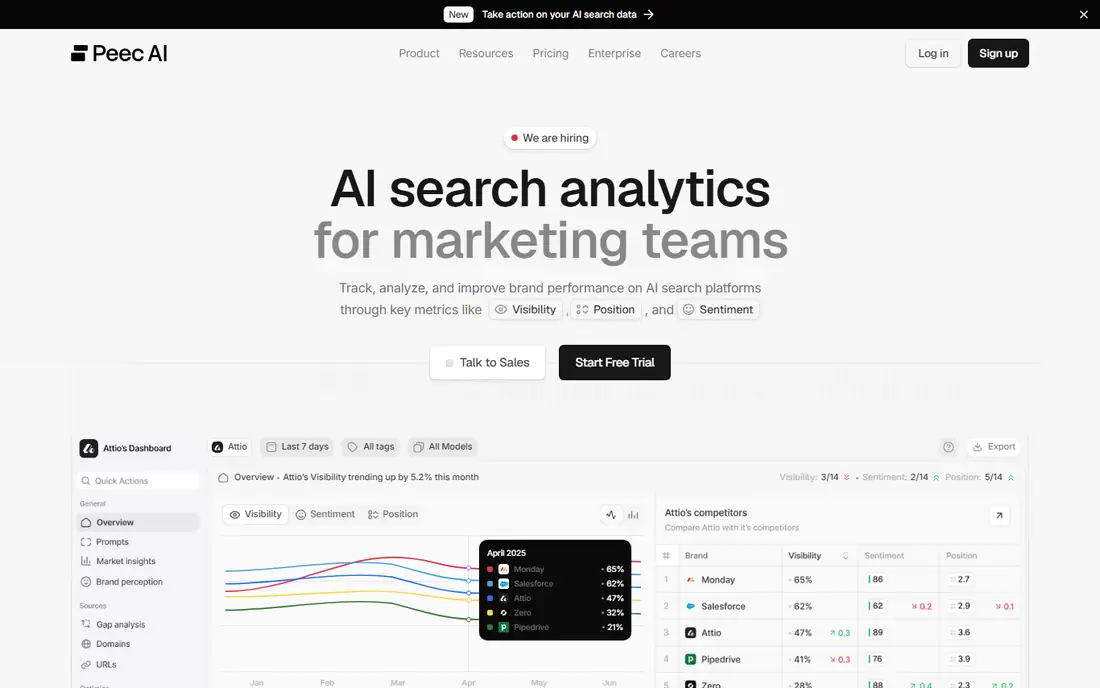
Peec AI suits agencies and mid-size teams that need to track a brand and its rivals together. Starter at $95 per month covers 50 prompts, Pro at $245 covers 150, and Advanced at $495 covers 350, with daily tracking and unlimited users in recent listings. That structure makes it easy to price a client program by prompt count, and reports compare a brand against competitors in a readable format.
The limit is engine choice. Entry plans let a team pick a subset of models, such as ChatGPT, Perplexity, and Gemini, rather than every engine at once, so a team that needs Claude or Copilot coverage should check the tier that includes them. Peec AI is a strong mid-market pick, not the cheapest entry point.
- Prompt ladder of 50, 150, and 350 prompts
- Unlimited users on plans in recent listings
- Competitor comparison and readable reports
- Entry plan covers a subset of models, not every engine
- Price rises quickly with prompt count
- No free plan for testing
Profound is the enterprise name in LLM visibility, with coverage across ChatGPT, Claude, Gemini, Perplexity, Copilot, Grok, and other AI surfaces in recent listings. Its analytics go beyond mention counts to citation sources, conversation volume, and how AI answers describe a brand, which helps large teams justify content and PR work. The Starter plan is listed at $99 per month in recent comparisons, which makes it accessible to test.
The catch is that entry coverage can be narrow, with ChatGPT only on Starter in some listings, and full multi-engine tracking sits on higher tiers. Small brands should start with Otterly.ai or Peec AI, and move to Profound when AI visibility becomes a board-level channel with a budget to match.
- Wide coverage across 11 AI surfaces in recent listings
- Deep analytics on citations and conversation volume
- Built for large brands
- Entry plan covers ChatGPT only in some listings
- Enterprise features and pricing rise quickly
- Overkill for a small local brand
Sona AI Visibility stands out for B2B teams that must show what AI visibility earned, not just that it rose. It tracks mentions and competitor mentions across 11 engines, connects citations and prompts to pipeline and revenue on one timeline, and tracks which AI crawlers reach pages from server logs or an edge worker without a JavaScript tag. Brands start at $75 per month billed annually, with agencies from $199 per month in recent listings.
The trade-off is setup. Revenue linking works best when a CRM and pipeline data are connected, so a team without that setup will get mention data first and revenue data later. For a B2B team that already tracks pipeline, Sona is one of the most useful tools in this list.
- Mention tracking across 11 engines in recent listings
- Links citations and prompts to pipeline and revenue
- 14-day free trial
- Brand plans start at $75 per month billed annually
- Agency plans start higher
- Revenue linking needs CRM setup to work well
Scrunch AI focuses on how AI assistants describe and use a brand, not just whether they name it. It covers ChatGPT, Claude, Gemini, Perplexity, and more, separates custom prompts a team writes from industry prompts that reflect real buyer questions, and gives guidance on content and agent pages. Recent listings put Starter from $250 per month billed annually or $300 monthly, with Growth higher.
The catch is price and scope. Scrunch AI suits teams with a large prompt library and a content program to act on the findings, not a small brand testing AI visibility for the first time. Check the current pricing page, because billing terms change the monthly figure.
- Broad engine coverage including ChatGPT, Claude, Gemini, and Perplexity
- Separates custom prompts from industry prompts
- Guidance on how AI describes a brand
- Higher entry price in recent listings
- Pricing varies by billing term
- Less suited to a tiny prompt list
Semrush AI Visibility Toolkit suits teams that already live in Semrush. AI mention and citation data appear next to classic rankings, keyword gaps, and site audits, so a team can see a ranking drop, an AI citation gap, and a content gap in one dashboard. That pairing saves time for SEO teams that report both classic and AI visibility to clients.
The limit is pricing clarity. AI Visibility is an add-on with its own terms, so existing Semrush users should check the add-on page for prompt limits and engine coverage before assuming it is included. Teams that do not use Semrush will get better value from a dedicated tool such as Otterly.ai or Peec AI.
- AI data sits next to classic rank tracking, keyword research, and audits
- Familiar reporting for SEO teams
- Add-on model for existing users
- Add-on pricing is separate from the core plan
- Full AI coverage may need a higher tier
- Not a standalone tool for non-Semrush users
Ahrefs Brand Radar suits SEO teams that already use Ahrefs for backlinks and keyword research. It tracks brand mentions across AI answers using a large prompt index, and it pairs that data with the backlink and content data Ahrefs is known for. Custom prompts are listed from $50 per month in recent comparisons, with the AI Visibility Index from $199 per month.
The catch is cost stacking. Brand Radar sits on top of an Ahrefs plan, so the total monthly cost is higher than a standalone tool, and a team that only needs AI tracking will pay for research features it may not use. For an Ahrefs-first team, though, keeping AI data in the same suite is a real workflow win.
- Large prompt index for brand mentions
- AI data next to backlink and keyword research
- Custom prompts available from $50 per month in recent listings
- AI Visibility Index starts at $199 per month in recent listings
- Requires an Ahrefs plan for full use
- Less focused than a dedicated GEO tool
AthenaHQ suits teams that want tracking plus a plan for what to change next. It monitors brand visibility across AI engines, including Claude in recent listings, and pairs the data with optimization recommendations, so a team gets actions rather than a chart alone. That strategy layer helps content and PR teams prioritize pages, reviews, and citations.
The limit is transparency and fit. Entry pricing is not stated plainly on the site in recent listings, so a buyer needs a sales conversation to price it, and a small team that only wants a weekly mention count will find AthenaHQ more than it needs. Use it when AI visibility is a strategy program, not a curiosity check.
- Blends visibility data with optimization recommendations
- Covers ChatGPT, Claude, Gemini, and other engines in recent listings
- Suited to strategy-led teams
- Pricing is not transparent on the entry page in recent listings
- Less suited to a simple prompt tracker
- Needs a strategy budget to use well
How we picked these
We compared official pricing and feature pages and recent October 2026 comparisons that re-checked prices and engine coverage. We favored tools that operate today, run a fixed prompt list on a schedule, cover at least ChatGPT plus one other engine, and state prompt limits plainly. We did not claim hands-on testing, and we used See website where pricing was custom, add-on based, or not stated on the vendor page.
How to track LLM visibility well
A tool gives numbers, but a method turns those numbers into decisions.
Start with 25 to 50 buyer prompts
Write prompts the way a buyer would ask them, not the way a brand would describe itself. Include category questions, comparison questions, and problem questions, plus a few branded prompts, and keep the list fixed for at least 30 days.
Judge trends, not single days
AI answers change on almost every run, and identical brand lists appear in less than 1 in 100 runs in one published test of nearly 3,000 prompts. Review a four-week trend, not a single day, and react only when a trend moves for several weeks.
Track citations, not just mentions
A mention without a citation is weaker than a mention that links to a page, a review, or a comparison. Check which sources AI answers cite, and build content, reviews, and listings on the sources that already appear.
Keep one primary tool
Different tools sample different prompts, model versions, and settings, so numbers cannot be mixed across tools. Pick one primary tool, keep the prompt list stable, and use a second tool only for a one-time audit.
Frequently asked questions
What is LLM visibility tracking?
LLM visibility tracking measures how often AI answers name a brand, cite its pages, or recommend a competitor, when given a fixed list of buyer-style prompts. Tools run those prompts through engines such as ChatGPT, Gemini, and Perplexity on a schedule and report trends over time.
Which tool is best for a small business?
Otterly.ai is the best small business pick, at $29 per month for 15 prompts, because it covers the main engines and gives simple weekly reports. Peec AI is the next step when a prompt list grows past 50 or when an agency needs unlimited users.
How many prompts should I track?
Start with 25 to 50 prompts covering category, comparison, and problem questions, plus a few branded terms. A list that small is easy to review weekly, and it can grow once the first 30 days show which questions actually drive mentions.
Can ChatGPT alone track my brand visibility?
No, because ChatGPT does not run continuous monitoring against a brand or topic on its own. A dedicated tool is needed to run a fixed prompt list on a schedule, store results, and show trends and competitor movement over time.
Is LLM visibility the same as SEO ranking?
No, and the two should be reported separately. SEO ranking measures position in classic search results, while LLM visibility measures mentions, citations, and recommendations inside AI answers, which follow different rules and change more often.
Sources
See where you really rank - block by block
ProMapRanker scans Google Maps across a grid of your service area. Simple monthly plans from $19, white-label on every plan.
Start freeKeep reading
 zoom alternatives
Best Zoom Alternatives in 2026
Compare Zoom alternatives in 2026, with free meeting limits and prices, so you can pick the best alternative to Zoom for your team, class, or community.
Read → which software is best for remote work
Which Software Is Best for Remote Work in 2026
Answering which software is best for remote work, we compare Slack, Zoom, Asana, Notion, Teams and more, with pricing and honest tradeoffs in 2026 now.
Read → which ai tool is best for content writing
Which AI Tool Is Best for Content Writing in 2026
Wondering which ai tool is best for content writing? We compare ChatGPT, Claude, Jasper, Grammarly, and more on price, quality, and best use in 2026 now.
Read →