 ProMapRanker
Best Tools for Pest Management in 2026

Key takeaways
- Pest-specific tools beat generic scheduling apps because they handle routes, recurring services, and chemical records in one place.
- Small operators get the best value from route priced tools such as GorillaDesk, while larger firms need the depth of PestPac or FieldRoutes.
- Always price by routes, technicians, or active customers, since vendors count those things differently.
- Chemical tracking and customer records matter for compliance, so check those features before you judge a tool on price alone.
Quick comparison
| Pick | Great for | Pricing starts at | Free tier | |
|---|---|---|---|---|
 PestPac | Midsize to enterprise pest firms | See website | No | Visit |
 FieldRoutes | Growth and marketing focused firms | See website | No | Visit |
 GorillaDesk | Small pest and lawn operators | $49 per month | Free trial | Visit |
 Jobber | General field service with pest work | $39 per month | Free trial | Visit |
 Housecall Pro | Growing field service teams | $59 per month | Free trial | Visit |
 Fieldwork | Mobile first small operators | $59 per month | Free trial | Visit |
 Briostack | Pest and lawn customer retention | See website | No | Visit |
 ServiceTitan | Large multi-team operations | See website | No | Visit |
The best tools for pest management
We compared official feature pages, pricing pages, and public documentation for software that helps pest management businesses schedule, route, invoice, and keep chemical and customer records.
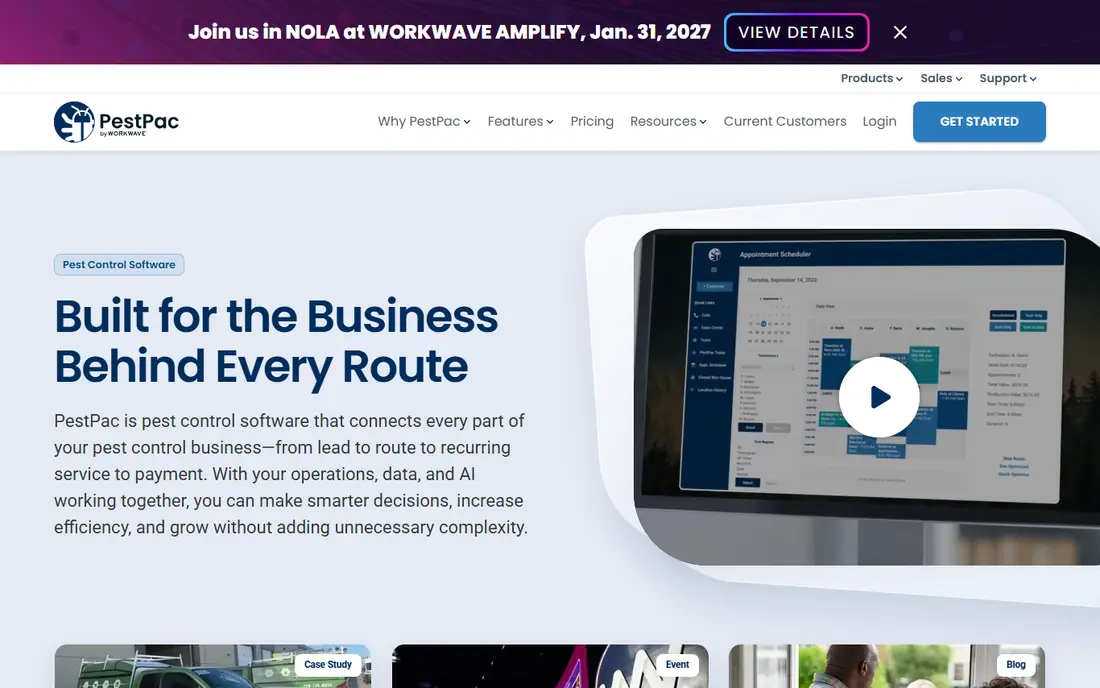
PestPac, from WorkWave, is built specifically for pest control, with recurring route management, chemical tracking, bait station servicing, and multi-unit accounts in one system. Its route optimisation and newer AI assisted routing tools aim to build denser routes, which matters when fuel and technician time are your largest costs. A customer portal and native payments also cut down on phone calls about balances and appointments.
The price for that depth is a longer setup and a quote based price that depends on your size and modules. Small firms may find simpler tools faster to learn and cheaper to run. For a midsize or large firm that needs compliance records, commercial accounts, and route density at scale, PestPac is one of the most complete options in this list.
- Deep route optimisation
- Chemical and compliance tracking
- Customer portal and payments
- Quote based pricing
- Implementation takes longer than simpler tools

FieldRoutes combines pest control operations with sales and marketing tools, including marketing automation, a sales dashboard, and dynamic routing. That mix suits firms that want to grow, not just run routes, because follow-up, reviews, and upsell work sit in the same system as scheduling. Its analytics help owners see which routes, technicians, and services are actually profitable.
The trade-off is cost and commitment. FieldRoutes is priced by arrangement and often on annual terms, so it is a bigger decision than a month to month starter tool. For a growing firm that will use the marketing side, that cost can pay for itself. For a stable solo operation, a simpler route priced tool may be the better value.
- Strong marketing and sales tools
- Dynamic routing
- Analytics and dashboards
- Higher starting cost
- Annual terms are common

GorillaDesk prices by route rather than by technician, which keeps costs predictable for a small operator with one or two routes. It covers scheduling, dispatching, quotes, invoicing, payments, and a customer portal, with a mobile app so technicians can see jobs and update them in the field. That focus makes it quick to set up, often in days rather than weeks.
Larger firms may outgrow it, since its integrations and advanced reporting are thinner than PestPac or FieldRoutes. But for a startup or a small pest and lawn business that needs to invoice today and route well tomorrow, GorillaDesk is hard to beat on value. Its 14 day trial is a good way to test whether route based pricing fits your crew.
- Clear route based pricing
- Easy scheduling and invoicing
- Mobile app for technicians
- Fewer enterprise features
- Integrations are more limited than larger platforms
Jobber is a general field service tool used by many trades, including pest control, lawn care, and cleaning. It handles quoting, scheduling, invoicing, payments, and customer reminders in a clean interface that new staff learn quickly. For a pest business that also does other field work, or that values simplicity over pest-specific depth, that breadth is a real advantage.
The limit is pest specificity. Jobber does not match PestPac or FieldRoutes on chemical tracking, bait station records, or pest route optimisation, so a firm with strict compliance needs should check those features carefully. Pricing starts at $39 per month for one user on annual billing, with extra users adding cost. For a small, generalist team, it remains a strong, low friction choice.
- Easy to learn
- Strong quoting and invoicing
- Good mobile app
- Lacks some pest-specific chemical tools
- Per user costs add up as teams grow
Housecall Pro bundles users into plan tiers, starting at $59 per month for one user on annual billing, with larger tiers for five and eight users. It covers scheduling, dispatching, online booking, invoicing, and payments, with automated reminders that cut no-shows. That bundle suits a growing team that wants predictable user counts rather than paying per technician from day one.
Watch the tier jumps, though. Moving from one user to a larger team can mean a large step up in monthly cost, so map your crew size for the next year before you choose a tier. Like Jobber, it is a general field service tool, so pest-specific compliance depth is less than a specialist platform. For a growing multi-trade firm, it is a solid middle ground.
- Bundled user tiers
- Online booking
- Automated reminders and payments
- Cost jumps when you move tiers
- Pest-specific features are thinner than specialist tools
Fieldwork is built for pest control operators, with invoicing, chemical compliance tracking, CRM, and mobile field access in one platform. Its pricing model is notable: plans start at $59 per month per field technician, while office users are free, which helps a small firm where several office staff need access but only a few technicians are in the field. Setup is described as days, not months, which suits a firm switching from paper or spreadsheets.
As a newer platform, Fieldwork has a smaller integration library than older rivals, so check any accounting or payment tool you rely on before switching. For a modern, mobile first small operator that wants pest-specific features without enterprise complexity, it is a fresh and well priced option, with a two week trial to test it.
- Office users free
- Chemical compliance tracking
- Fast setup
- Newer and smaller than older rivals
- Fewer third party integrations
Briostack is an all-in-one pest and lawn platform with automated scheduling, routing, customer communications, invoicing, and a customer portal. Its marketing sequences and territory management aim to help firms keep customers and grow routes in defined areas, rather than just recording jobs. Technicians get a mobile app with automatic syncing, so schedule changes reach the field without phone calls.
Pricing is largely arranged rather than published as a simple plan, so you will need a quote based on your customer count and team size. That makes it harder to compare at a glance, but it also means the vendor can tailor the package. For a small to midsize pest and lawn firm focused on retention and upselling, Briostack is worth a demo alongside FieldRoutes.
- Automated scheduling and marketing
- Customer portal
- Territory management
- Pricing is largely quote based
- Less suited to very small solo operators
ServiceTitan is a large field service platform used across pest control, HVAC, plumbing, and other trades, with scheduling, dispatching, CRM, marketing, reporting, and payments in one system. For a large, multi-location pest firm that also runs other trades, that breadth and reporting depth are hard to match, and its per technician pricing scales with the team you actually run.
For a small pest firm, ServiceTitan is usually too much: pricing is quote only and widely reported as several hundred dollars per technician per month, plus implementation fees, and setup takes time. It belongs at the top of this list for scale, not for value. If you run a large operation and need one platform across trades, ask for a full written quote before deciding.
- Very deep field service platform
- Strong reporting
- Works across trades
- Quote only pricing
- High cost and long implementation for small firms
How we picked these
We compared official feature pages, pricing pages, and public documentation, and we favoured tools that are actively used by pest management businesses, cover scheduling, routing, invoicing, and customer records, and explain their pricing model clearly or honestly note where pricing is by quote. We included specialist pest platforms alongside general field service tools because many pest firms choose between those two routes. We did not claim hands-on testing, and where pricing was not published we wrote See website rather than guessing.
How to choose a pest management tool for your business
Start with your crew and route shape, not with the feature list. Count your technicians, routes, and active customers, then price each tool on that exact shape, because route priced, per technician, and per customer models give very different totals for the same firm. A solo operator and a ten technician firm can reasonably choose opposite tools from this list and both be right.
Next, check the pest-specific work you cannot skip: chemical usage records, label and safety documentation, bait station servicing, recurring service agreements, and customer history. Test those workflows in a trial with real jobs, not just a demo account, and ask how data exports work if you ever leave. The cheapest tool that misses a compliance record is not cheap once an audit or a customer dispute arrives.
Frequently asked questions
What is the best tool for pest management for a small business?
For a small pest business, GorillaDesk at $49 per month for one route is a strong value pick, with Fieldwork close behind for firms that want chemical tracking and free office users. Both are quick to set up and cover scheduling, invoicing, and mobile field work. Larger firms should look at PestPac or FieldRoutes for deeper routing and compliance tools.
How much does pest control software cost?
Pest control software ranges from $39 to $59 per month for small generalist or route based tools, up to quote based pricing for larger specialist platforms. FieldRoutes and PestPac do not publish a single starting price, because cost depends on team size, customer count, and modules. Always ask for a quote on your actual technician and customer counts, and check for implementation and payment processing fees.
Do pest management tools track chemicals?
Specialist tools such as PestPac, FieldRoutes, and Fieldwork include chemical tracking and compliance records, which help with label, usage, and safety documentation. General tools such as Jobber and Housecall Pro are weaker here, so if chemical records matter to your work, test that workflow first and confirm what reports you can export for an audit.
Can I use Jobber for pest control?
Yes, many pest operators use Jobber for quoting, scheduling, invoicing, and payments, especially if they also do other field work. It is easy to learn and well supported, but it lacks some pest-specific features such as detailed chemical and bait station tracking. If those features are central to your business, a specialist tool may be a better long term fit.
Sources
See where you really rank - block by block
ProMapRanker scans Google Maps across a grid of your service area. Simple monthly plans from $19, white-label on every plan.
Start freeKeep reading
 zoom alternatives
Best Zoom Alternatives in 2026
Compare Zoom alternatives in 2026, with free meeting limits and prices, so you can pick the best alternative to Zoom for your team, class, or community.
Read → which software is best for remote work
Which Software Is Best for Remote Work in 2026
Answering which software is best for remote work, we compare Slack, Zoom, Asana, Notion, Teams and more, with pricing and honest tradeoffs in 2026 now.
Read → which ai tool is best for content writing
Which AI Tool Is Best for Content Writing in 2026
Wondering which ai tool is best for content writing? We compare ChatGPT, Claude, Jasper, Grammarly, and more on price, quality, and best use in 2026 now.
Read →