 ProMapRanker
Best Speech Therapy Apps for Kids in 2026

First words and early language · Pricing starts at: $59.99 per year
Key takeaways
- Speech Blubs suits toddlers and late talkers who respond to video modelling, while Articulation Station suits children working on specific sounds.
- Splingo and Otsimo cover language understanding and communication in different ways, so match the app to the goal, not to a general ranking.
- Short practice with a parent or therapist present works better than long solo screen time, especially for young children.
- Apps are supplements, not a replacement for a speech-language pathologist, and a child with a delay should be assessed by a professional.
- Our pick for most families is Speech Blubs for early words, Articulation Station for sound practice, and Otsimo for communication support, chosen with an SLP where possible.
Quick comparison
| Pick | Great for | Pricing starts at | Free tier | |
|---|---|---|---|---|
| Speech Blubs | First words and early language | $59.99 per year | Free trial | Visit |
 Articulation Station | Specific sound practice | Free | Yes | Visit |
 Splingo | Listening and language games | Free | Yes | Visit |
 Otsimo Speech Therapy | Speech practice for children | Free | Yes | Visit |
 Otsimo AAC | Picture-based communication | Free | Yes | Visit |
 Tiga Talk | Speech practice through play | Free | Yes | Visit |
 Little Wheels Talk and Listen | Vehicle-themed sound practice | $4.99 one-time | No | Visit |
 SpeechLP | Therapist-guided sound games | See website | Free trial | Visit |
The best speech therapy apps for kids
These apps are not medical treatment on their own. They are practice tools that work best alongside play, conversation and, where needed, sessions with a speech-language pathologist (SLP). We compared official feature pages, pricing pages and app store listings, and we favoured apps designed by or with SLPs, apps with a clear age range, and apps that are still updated in 2026. This article is general information only, not medical advice, and a parent with concerns about a child's speech should talk to a paediatrician or an SLP.
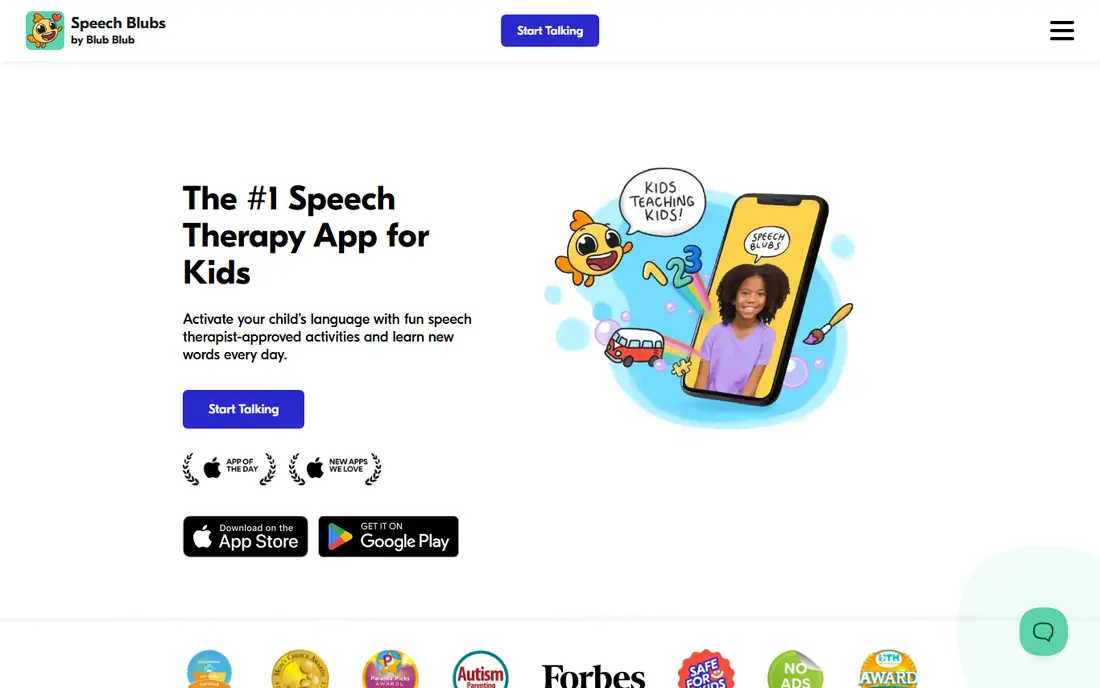
Speech Blubs uses video modelling, where children watch other children say words and sounds, then try to copy them. That format suits toddlers, late talkers and preschoolers who learn by watching and imitating, including children with Down syndrome or autism spectrum diagnoses, according to the developer. Activities cover first words, sounds, sentences and early social language, with new content added over time.
The cost is the main drawback. At $59.99 per year, Speech Blubs is a subscription to weigh against other therapy costs, and video content needs a stable connection. It also suits younger children best, so an older child working on specific speech sounds may need Articulation Station instead. Try the trial first, and watch whether your child imitates during sessions, since that response is the sign it is working.
- Video modelling helps imitation
- Wide range of early language activities
- Suits toddlers and preschoolers
- Subscription cost adds up over years
- Needs reliable internet for video content
- Some content suits younger children only
Articulation Station is the most clinically structured app here, and it is the one many SLPs recommend for home practice. It was developed by speech-language pathologists and covers English sounds with flashcards, stories, matching games and sentences, all at word, sentence and story levels. A child practises a target sound, an adult listens and scores each attempt, and the app records attempts for playback and progress checks.
That adult role is both a strength and a limit. A parent or SLP needs to listen and score, which makes practice more accurate but also more demanding than a game a child plays alone. The basic app is free, with extra sounds available as paid packs, and the main app is for Apple devices. For a child already in therapy with clear target sounds, this is the strongest home practice choice.
- Structured practice at word, sentence and story levels
- Over 1,000 target words
- Recording and playback for self-checking
- Apple devices only for the main app
- An adult should score attempts
- Extra sound packs cost extra
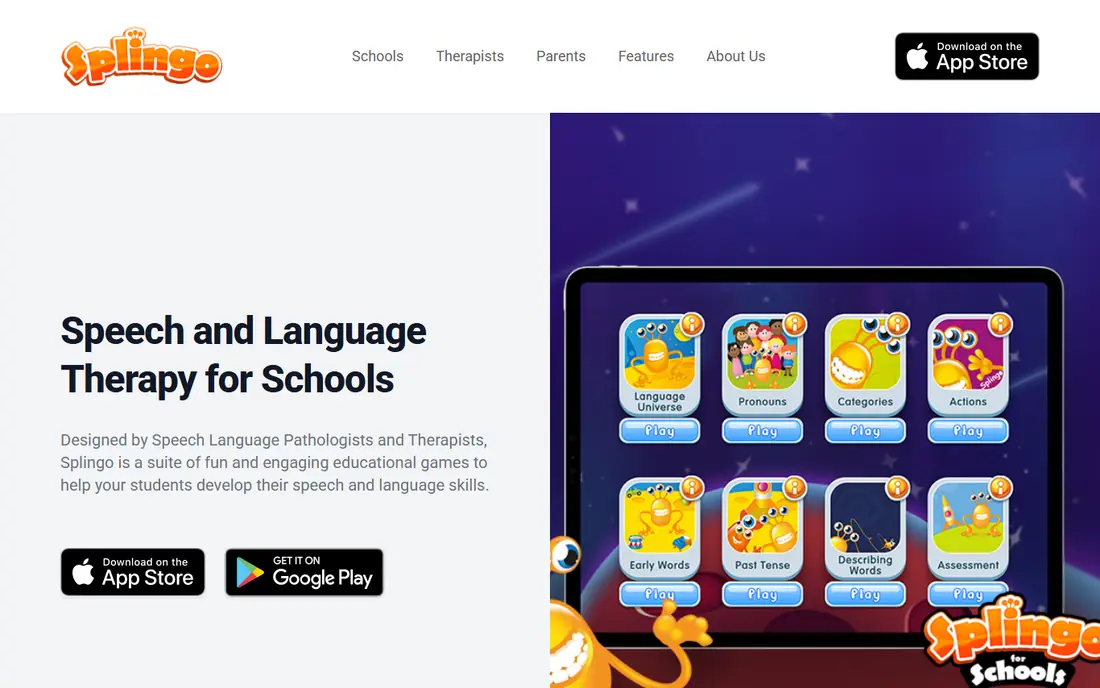
Splingo focuses on understanding language, not just saying words. Children follow spoken instructions from an alien character, starting with single words and building to instructions with several parts, such as actions, locations and descriptions. That progression helps children who understand less than they can say, or who struggle to follow instructions in class. Separate packs cover pronouns, actions, categories, describing words and past tense.
The busy cartoon scenes can distract some children, and an adult may need to help at first, especially for younger users. Splingo also offers a schools platform, which differs from the individual app packs, so check which version you are buying. For language understanding and listening, rather than sound production alone, Splingo fills a gap other apps here leave open.
- Designed by speech and language therapists
- Four levels from single words to complex instructions
- British and American audio options
- Cartoon style can feel busy for some children
- School platform differs from the older app packs
- Some packs cost extra
Otsimo Speech Therapy offers game-based speech practice designed for children, including children with autism and other developmental needs. Activities focus on sounds, words and early language through play, with goals that parents can follow. The free entry point makes it easy to test whether a child responds to its style before paying for more content.
As with many game apps, depth varies. Otsimo is a good starting point and a good supplement, but it does not replace the structured sound-by-sound practice of Articulation Station for a child with specific articulation goals. Use it for regular, enjoyable practice, and check the parent dashboard to see which activities your child actually completes.
- Games built for children with speech needs
- Clear goals for parents
- Free entry point
- Content depth varies by goal
- Some features need paid access
- Younger children need adult guidance
Otsimo AAC serves a different need from the speech practice apps in this list. It is an augmentative and alternative communication (AAC) tool, which means it helps a child communicate with pictures and symbols when speech is limited or not yet developed. A child can tap symbols to build messages, make requests and share ideas, which reduces frustration and supports language growth even before speech appears.
AAC setup works best with guidance from an AAC specialist or an SLP, who can choose the right vocabulary and board layout for a child. Building custom boards also takes time. Do not judge Otsimo AAC by whether it improves speech sounds, since its job is communication. For a nonverbal or minimally verbal child, that job matters more than any drill.
- Picture symbols help nonverbal and minimally verbal children communicate
- Customisable boards
- Distinct from speech practice apps
- Needs an AAC specialist for best setup
- Not a speech production app
- Custom boards take time to build well
Tiga Talk offers speech practice through simple, playful activities aimed at young children. Its appeal is low friction: a family can try it free, open a short activity, and practise sounds and words without a complex setup or a subscription decision. That simplicity suits a first app, a short daily practice slot, or a child who is new to speech apps.
The trade-off is depth. Tiga Talk does not offer the detailed tracking, sound libraries or therapist tools of Articulation Station or SpeechLP, so it works best as a supplement or a starting point. If a child needs structured work on specific sounds, move to a more detailed app and keep Tiga Talk for light, enjoyable practice.
- Playful speech activities for young children
- Free to try
- Simple interface for families
- Smaller content library than larger apps
- Less tracking than therapist-led tools
- Availability varies by store
Little Wheels Talk and Listen is a small, focused app for late talkers aged about 18 months to 4 years who love vehicles. It uses cars, trucks and other vehicles to teach speech sounds, with a one-time price of $4.99, offline use and no ads. For a family on a tight budget, that one-time cost is a clear advantage over yearly subscriptions, and the focused theme can hold a vehicle-obsessed toddler's attention far better than a general app.
The theme is also the limit. A child who does not care about vehicles may not engage, and the app does not cover the broad language range of Speech Blubs or Splingo. Buy it when the theme fits your child, use it for short joint sessions, and treat it as a low-cost, low-risk first step rather than a complete therapy program.
- One-time price, no subscription
- Uses vehicles to teach over 100 speech sounds
- Works offline and is ad-free
- Vehicle theme suits some children and bores others
- Narrow focus compared with broader apps
- Small developer, so updates may be slower
SpeechLP is built around the link between a child and their speech therapist. When a therapist changes a child's target sounds, the levels on the child's game map update at once, so home practice always matches therapy goals. Children play through levels, practise sounds in games, and see progress on a map, which gives practice a clear structure without feeling like a drill sheet.
SpeechLP works best when a therapist is involved, since its main advantage is that live link. Without a therapist setting targets, it is still usable, but less distinct from other game apps. Paid plans apply for full use, with monthly and annual options listed on the vendor site, so check the plan that fits a family or a practice before committing.
- Levels update when a therapist changes target sounds
- Game map motivates practice
- Works on Apple devices and the web
- Best with a therapist involved
- Paid plans needed for full use
- Newer app, so content is still growing
How we picked these
We compared official feature pages, pricing pages and app store listings, and we favoured apps designed by or with speech-language pathologists, apps with a clear age range and goal, and apps still updated in 2026. We excluded apps that only offer general learning, apps with no clear speech focus, and apps that have not been updated for years. Prices come from vendor pages and app store listings checked in October 2026, and they can change, so check the listing before paying. Again, these apps support practice; they do not replace assessment or therapy by a qualified SLP.
How to choose and use a speech app
Start with the goal, not the app. For first words and imitation, start with Speech Blubs or Little Wheels. For specific sounds, start with Articulation Station or SpeechLP. For understanding language, start with Splingo. For communication without speech, start with Otsimo AAC. One app matched to the goal beats three apps used at random.
Practise together, in short sessions
Sit with your child, model the words, praise attempts and keep sessions to ten or twenty minutes, especially for toddlers. A child learns speech from interaction, not from a screen alone, so your presence matters more than any app feature. If a session leads to frustration, stop, play, and try again another day.
Share progress with your SLP
If your child has an SLP, show them the app, the target sounds and the progress reports before relying on it at home. An SLP can confirm whether the app matches therapy goals, whether scoring is accurate, and how much home practice is helpful. That check also prevents a child practising the wrong sound pattern for weeks.
Watch for red flags
Seek professional advice if a child is not using words by the expected age range, loses words they once had, is hard to understand for family members, or struggles to follow simple instructions. An app cannot assess hearing, oral motor skills or language development, and early assessment helps far more than waiting to see if an app alone fixes the issue.
Frequently asked questions
What is the best speech therapy app for kids overall?
There is no single best speech therapy app for kids, because the right app depends on the goal. Speech Blubs suits early words, Articulation Station suits specific sounds, Splingo suits language understanding, and Otsimo AAC suits communication without speech. Match the app to the goal, and check with an SLP when possible.
Can a speech app replace a speech therapist?
No. Apps support practice between sessions and at home, but they cannot assess a child, diagnose a delay, or plan therapy. A child with a speech or language concern should be assessed by a speech-language pathologist, who can recommend the right app and the right amount of practice.
What is the best speech therapy app for kids who are late talkers?
For late talkers, Speech Blubs and Little Wheels Talk and Listen are strong starting points, since both focus on first words and imitation for toddlers. Keep sessions short, practise together, and seek an early intervention assessment if progress is slow or a child is not meeting milestones.
Is Articulation Station free?
The basic Articulation Station app is free, with extra sound packs available as paid purchases. The Hive subscription version offers a parent plan and a professional plan for SLPs, with pricing listed on the vendor site, so check which version suits home use before paying.
How much screen time is right for speech practice?
For toddlers, ten to twenty minutes of joint practice, with a parent present, is a sensible session length. Older children can handle longer sessions, but practice should still be broken up, paired with play and conversation, and stopped if frustration builds.
Do these apps work for children with autism?
Some apps here, including Speech Blubs and Otsimo, are designed with children with autism in mind, using video modelling, visual supports and game play. Every child is different, so try a trial, watch how your child responds, and discuss the choice with their SLP or care team.
Sources
See where you really rank - block by block
ProMapRanker scans Google Maps across a grid of your service area. Simple monthly plans from $19, white-label on every plan.
Start freeKeep reading
 wpforms alternatives
Best WPForms Alternatives in 2026
We compare 9 wpforms alternatives for WordPress forms, with free and paid options, current pricing notes, and honest limits for small business sites in 2026.
Read → windows task scheduler alternatives
Best Windows Task Scheduler Alternatives in 2026
Looking for Windows Task Scheduler alternatives? We compare 9 schedulers for Windows and cross-platform work, from free tools to enterprise automation.
Read → which ai video service is best
Which AI Video Service Is Best in 2026
which ai video service is best? We compare 10 legitimate AI video services on price, avatars, editing and output quality to help you pick the right tool.
Read →