 ProMapRanker
Best Solar Design Software in 2026


Residential design and sales proposals · Pricing starts at: $135 per user per month
Key takeaways
- OpenSolar is the strongest free core platform for residential teams, while Aurora Solar leads for residential design and sales proposals at scale.
- HelioScope suits commercial and industrial layouts, and PVsyst remains the engineering standard for bankable yield studies.
- Solargraf suits Enphase-focused contractors, and SolarEdge Designer is free for SolarEdge installers.
- Our pick for most residential installers is Aurora Solar for proposals, with OpenSolar as the best no-cost starting point.
Quick comparison
| Pick | Great for | Pricing starts at | Free tier | |
|---|---|---|---|---|
| Aurora Solar | Residential design and sales proposals | $135 per user per month | No | Visit |
 OpenSolar | Free residential design and proposals | Free | Yes | Visit |
 HelioScope | Commercial and industrial layouts | $135 per license per month | Free trial | Visit |
 PVsyst | Engineering yield simulation | CHF 700 per year | No | Visit |
 Solargraf | Enphase-focused residential teams | $2,799 per year | No | Visit |
 SolarEdge Designer | Free design for SolarEdge installers | Free | Yes | Visit |
 Arka 360 | AI-assisted design and CRM | See website | No | Visit |
 PVcase | Utility-scale engineering design | See website | No | Visit |
 Energy Toolbase | Storage economics and dispatch | See website | Free trial | Visit |
The best solar design software
Solar design tools must do three jobs well: model roofs and shading accurately, size systems and storage sensibly, and turn the design into a proposal a homeowner or business can trust. The nine tools below cover residential sales, commercial layouts and utility-scale engineering, with prices from free to quoted enterprise tiers.
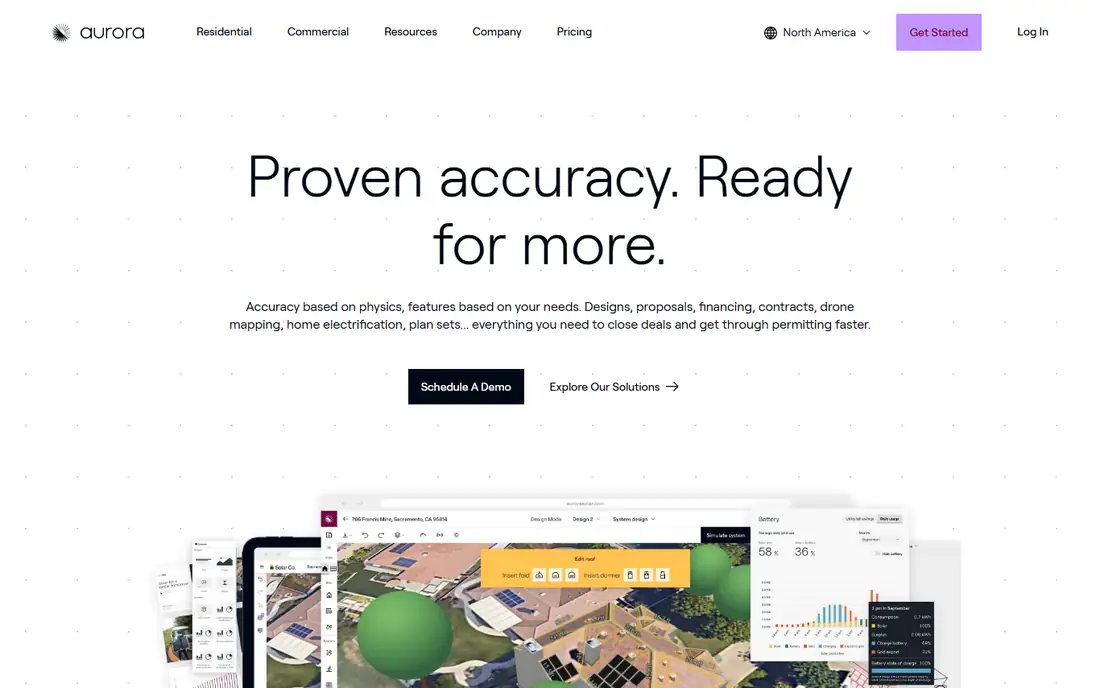
Aurora Solar is the established choice for residential installers who sell on the first visit. Aerial imagery, 3D roof modelling and shading analysis produce a design that looks credible in a proposal, and financing options, production estimates and close tools sit in the same workflow. That speed matters when a homeowner compares two quotes in the same week.
The published Basic price is $135 per user per month on annual billing, with $159 per month on monthly billing in earlier listings, and Premium at $220 per user per month on annual billing. Lower tiers cap users and monthly projects, so growing teams should price the tier that matches their volume. For established residential sales teams, Aurora remains the benchmark.
- Detailed 3D modelling and shading analysis
- Strong proposal and financing tools
- Widely used by US residential installers
- $135 per user per month on annual billing is a real cost for small teams
- Project caps apply on lower tiers
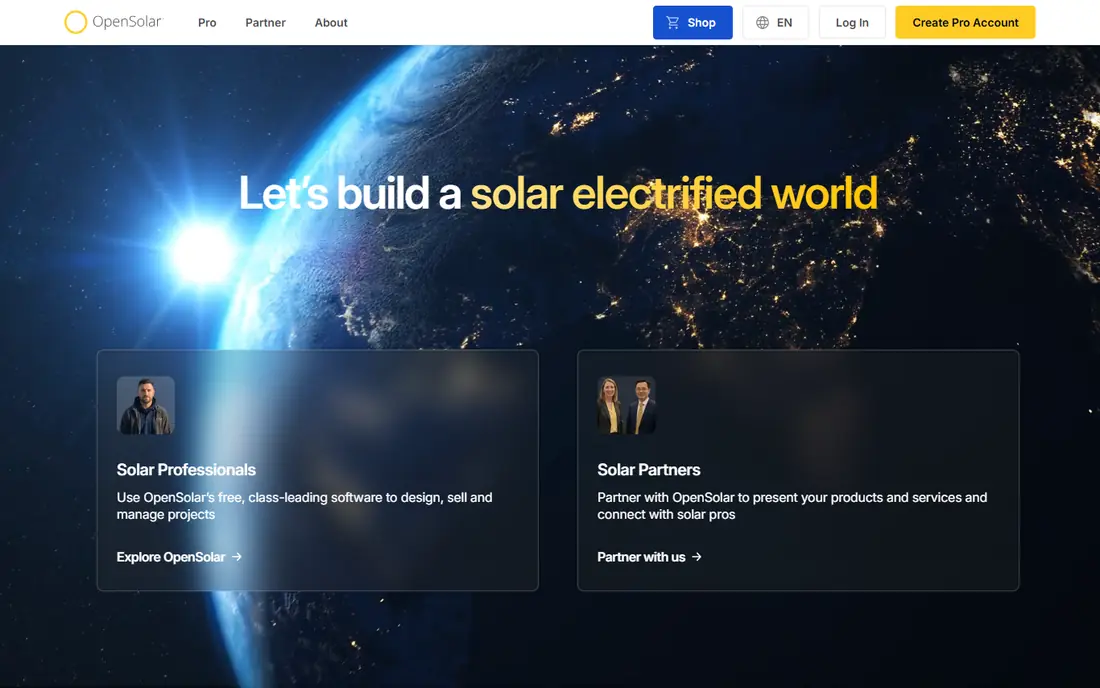
OpenSolar gives small residential teams a complete design, proposal, financing and project workflow without a licence fee. Designs, proposals, a basic CRM and e-signatures are included in the core platform, which makes it a genuine starting point rather than a limited demo. Its model runs on partner revenue, so expect partner hardware and finance offers inside the workflow.
Paid extras include accounting connectors at $49 per month in published listings and API access priced per project. Commercial teams with complex layouts may still need HelioScope or PVsyst alongside it. For a lean residential installer, OpenSolar is hard to beat on value.
- Full core design and proposal suite at no licence cost
- Built-in CRM and e-signatures
- Partner hardware and finance options
- Paid API access and accounting connectors
- Less suited to complex commercial work than HelioScope
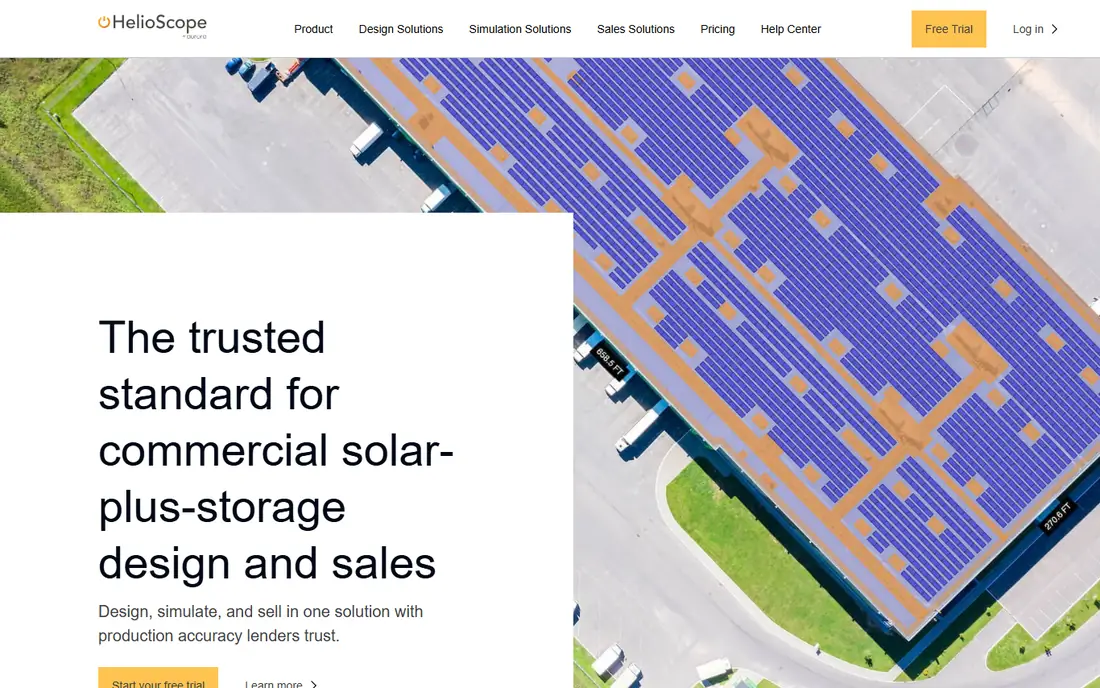
HelioScope is built for commercial and industrial work, where roof planes, carports, ground mounts and storage need careful layout. Its design tools handle larger arrays and more complex site conditions than a residential sales tool, and integrated storage modelling helps size commercial solar-plus-storage in one workflow. Engineering exports support the later stages of a project.
Published pricing is $1,620 per licence per year for Basic and $2,640 per year for Pro, which works out to $135 and $220 per licence per month on annual terms, with project caps per licence per month. Residential-only teams may prefer Aurora or OpenSolar for proposals. Commercial teams will find HelioScope a better fit.
- Strong commercial array design
- Storage modelling in the workflow
- CAD-style exports for engineering
- Residential sales proposals are thinner than Aurora
- Project caps apply per licence per month
PVsyst is the engineering standard behind many financed solar projects. It simulates production with detailed loss factors, shading, temperature and system design inputs, producing P50 and P90 yield figures that lenders and independent engineers expect. When financing depends on the numbers, PVsyst is often the tool behind them.
It is not a sales platform. There is no homeowner proposal flow or CRM in the same sense as Aurora or OpenSolar, so most serious operations use PVsyst alongside a design and sales tool. Published pricing is CHF 700 per year for a Professional licence. For engineering-grade simulation, it remains the reference point.
- Bankable P50 and P90 yield studies
- Detailed loss and shading modelling
- Trusted by lenders and engineers
- Desktop engineering tool, not a sales or proposal tool
- Learning curve for new users
Solargraf, by Enphase, combines residential design, proposals and third-party financing for contractors who work heavily with Enphase equipment. The Express Editor speeds up proposal creation, and direct financing partner links reduce the back-and-forth that slows a sale. For Enphase-focused teams, that integration is a practical advantage.
Published pricing starts at $2,799 per year for Starter and rises to $12,999 per year for Enterprise, with overage fees per extra project. Small teams should model their annual project count against those tiers. Solargraf suits residential contractors who want design and financing tied together.
- Residential design plus third-party financing in one place
- Express Editor for fast proposals
- Enphase ecosystem fit
- Annual pricing from $2,799 can be steep for solo installers
- Project overage fees apply at higher volumes
SolarEdge Designer is free for installers working with SolarEdge equipment, and it handles layout, string design and production estimates for those systems. Because it is tied to the SolarEdge ecosystem, component choices and electrical design follow that platform closely, which reduces errors for SolarEdge jobs.
The limit is scope. Teams that regularly quote several inverter brands will still need a vendor-neutral design tool. For a SolarEdge-focused installer, however, Designer is a strong no-cost option that covers design and proposals without adding a licence fee.
- Free for SolarEdge installers
- Accurate string design and layout for SolarEdge systems
- Proposal outputs included
- Built around SolarEdge equipment, so multi-vendor teams need another tool
- Fewer CRM features than OpenSolar
Arka 360 positions itself as an AI-assisted design platform with CRM built in, aimed at residential and light commercial installers who want design and customer management together. Automated roof modelling can speed up the first draft of a design, and CAD export helps where permit drawings need more detail. The combined workflow suits teams that want fewer handoffs between sales and design.
Pricing varies by plan and is best confirmed with the vendor for your team size and volume. Because Arka 360 is less established than Aurora, ask for customer references in your market and test shading accuracy on roofs you know. For teams that like an AI-first workflow, it is worth a trial.
- AI-assisted roof modelling and design
- Design plus CRM in one platform
- CAD export options
- Pricing is quoted or varies by plan
- Newer brand than Aurora or OpenSolar, so check references
PVcase serves utility-scale developers who need automated plant layout, terrain handling and engineering outputs at a scale that residential tools cannot manage. Its AutoCAD-based workflow supports large ground-mount projects, substation placement and detailed design documentation. That focus makes it a poor fit for a two-person residential team, and a strong fit for a utility developer.
Pricing is quoted, so developers should request a proposal based on project pipeline and team size. Choose PVcase when the core problem is engineering a large plant efficiently, not producing a homeowner proposal. Pair it with PVsyst for yield work where financing requires it.
- Automated utility-scale plant layout
- Substation and civil design support
- AutoCAD-based engineering workflow
- Quoted pricing only
- Far more tool than a residential installer needs
Energy Toolbase goes deepest on storage economics. It models dispatch, rates, demand charges and bill savings for solar-plus-storage, then monitors performance after install. For commercial customers where storage payback depends on tariff details, that depth can change the recommendation. It also supports solar proposals, though layout is not its main strength.
Pricing should be confirmed with the vendor, since tiers and user counts affect the quote. Use Energy Toolbase alongside a layout tool when storage is central to the sale. For storage-heavy commercial work, its economics modelling is a genuine advantage.
- Deep storage dispatch and economics modelling
- Monitoring for storage performance
- Strong for solar-plus-storage proposals
- Pricing is quoted or tier-based
- Design layout is thinner than Aurora or HelioScope
How we picked these
We compared official product pages, published pricing and public installer feedback for solar design tools live in October 2026. We kept only tools that design photovoltaic systems, model production or shading, or produce proposals and engineering outputs for solar projects. We included free, residential, commercial and utility-scale options, and we wrote See website where pricing is quoted or varies by volume. We favoured tools with current vendor pricing pages over older roundups.
What to check before you buy
Start with the project types you actually sell. Residential sales teams need fast proposals and financing, commercial teams need layout and storage depth, and utility developers need engineering automation. A tool that excels at one of those jobs may be weak at another, so judge it on your own projects, not a feature list.
Test accuracy on known roofs
Model three roofs you have already installed, including one with shading and one with multiple planes. Compare the production estimate with actual generation where you have it, and check how the tool handles trees, chimneys and dormers. A pretty proposal that overstates production will cost trust later.
Check proposal and permit outputs
Confirm what a homeowner sees, what financing options appear, and what exports you get for permits and engineering. Some tools produce strong proposals but weak CAD exports, while others do the reverse. If you outsource engineering, ask your engineer which exports they accept before you buy.
Model the full cost
Add licence fees, per-project overage, API or connector charges, and any financing partner costs. OpenSolar is free at the core but charges for some connectors, while Aurora and HelioScope cap projects on lower tiers. Price a normal month of projects, not a single demo project, before you commit.
Frequently asked questions
What is the best solar design software?
Aurora Solar is our pick for most residential installers for its design depth and proposal tools, while OpenSolar is the best free starting point. HelioScope leads for commercial layouts, and PVsyst leads for engineering yield studies. Many firms use two tools: one for sales and one for engineering.
What is the best solar software for small installers?
OpenSolar is the strongest free option for small residential teams, since its core design, proposals, CRM and e-signatures cost nothing. SolarEdge Designer is also free for SolarEdge installers. Start free, learn your volume, and move to a paid platform when project caps or features become a limit.
How much does solar design software cost?
Published prices range from free with OpenSolar and SolarEdge Designer to $135 per user or licence per month on annual billing for Aurora Solar and HelioScope, $2,799 per year for Solargraf Starter, and CHF 700 per year for PVsyst Professional. Quoted tools such as PVcase and Arka 360 depend on team size and volume.
Do I need PVsyst if I already use Aurora or OpenSolar?
For most residential sales, no. Aurora and OpenSolar cover design and proposals well. PVsyst becomes important when financing, lenders or independent engineers require bankable P50 and P90 yield studies, or when a project needs detailed loss modelling that sales tools do not provide.
Which tools handle battery storage design?
Aurora Solar, HelioScope, Energy Toolbase and Solargraf all model storage, with Energy Toolbase going deepest on dispatch and bill economics. HelioScope covers commercial solar-plus-storage in one workflow, while Aurora and Solargraf cover residential storage in proposals. Confirm tariff and rate handling for your market during a trial.
Do I need a drone for accurate solar design?
Not usually. Remote design from aerial imagery is enough for most straightforward residential roofs. A drone workflow earns its cost on complex roofs, heavy shading or areas where aerial imagery is out of date. Drone work also needs a licensed pilot and proper permissions, so treat it as a separate operational choice.
Sources
See where you really rank - block by block
ProMapRanker scans Google Maps across a grid of your service area. Simple monthly plans from $19, white-label on every plan.
Start freeKeep reading
 wpforms alternatives
Best WPForms Alternatives in 2026
We compare 9 wpforms alternatives for WordPress forms, with free and paid options, current pricing notes, and honest limits for small business sites in 2026.
Read → windows task scheduler alternatives
Best Windows Task Scheduler Alternatives in 2026
Looking for Windows Task Scheduler alternatives? We compare 9 schedulers for Windows and cross-platform work, from free tools to enterprise automation.
Read → which ai video service is best
Which AI Video Service Is Best in 2026
which ai video service is best? We compare 10 legitimate AI video services on price, avatars, editing and output quality to help you pick the right tool.
Read →