 ProMapRanker
Best RV Apps in 2026: 9 Apps Compared

Key takeaways
- RV-safe routing matters most for larger rigs, because car GPS apps do not account for height, weight, and length limits.
- Campground choice works best with two sources, such as a review app plus an official park page, since listings can go out of date.
- Free apps cover many overnight stops, while paid plans add offline maps, trip planning, and RV-specific routing.
- Check rig limits, hookups, and seasonal closures before arrival, even when an app listing looks complete.
Quick comparison
| Pick | Great for | Pricing starts at | Free tier | |
|---|---|---|---|---|
 RV LIFE | RV-safe routing and trip planning | $65 per year | Free trial | Visit |
 Campendium | Campground reviews and cell reports | Free | Yes | Visit |
 iOverlander | Free and remote overnight spots | Free | Yes | Visit |
 RV Parky | Quick overnight stop search | Free | Yes | Visit |
 The Dyrt | Campground search and trip planner | Free | Yes | Visit |
 Roadtrippers | Road trip route planning | Free | Yes | Visit |
 Harvest Hosts | Farm and winery overnight stays | $99 per year | No | Visit |
 KOA | KOA campground booking | Free | Yes | Visit |
 AllStays | Offline campground and dump station data | See website | No | Visit |
The best RV apps
We compared official listings, pricing pages, and app store details for apps that serve RV travelers in the US. The list covers routing, campgrounds, free stops, and booking, because one app rarely does all four well.
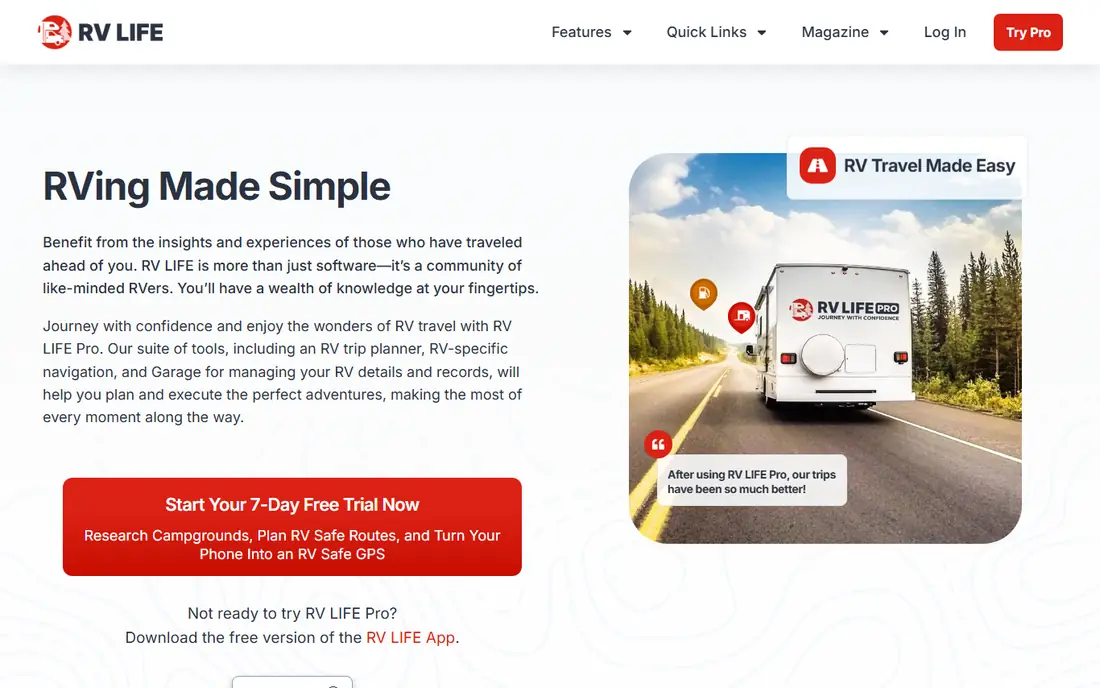
RV LIFE is our pick for drivers of larger rigs because it plans routes around limits that car apps ignore. Enter rig height, weight, length, and other details, and the planner avoids low clearances and weight-restricted roads where data is available. It also pairs that routing with campground search and trip planning, so stops and driving days sit in one plan.
The catch is cost and learning time. Basic browsing is free, but RV-safe routing sits behind RV LIFE Pro, listed at $65 per year with a trial period in current listings. That price is fair for frequent travelers, but occasional campers may prefer a free campground app plus careful manual route checks. Always confirm a bridge or road limit with local signs, since no app replaces road signage.
- Routing based on rig height, weight, and length
- Trip planner with campground search
- Offline maps on paid plans
- Full routing needs a paid plan
- The tool set takes time to learn

Campendium is the review app many RVers open first when choosing a campground. Reviews cover site size, access roads, hookups, noise, and cell coverage, which matters for travelers who work from the road. Filters help narrow results by price, hookups, and rig length, and photos often show what a site really looks like.
The paid side is now bundled as Roadpass Pro in some listings, at $59.99 per year, which adds navigation and trip tools beyond Campendium alone. That bundle may suit frequent travelers, but it can feel like extra cost for someone who only wants reviews. Use the free reviews for research, then confirm price and availability with the campground itself.
- Detailed user reviews and photos
- Cell coverage reports
- Filters for price, hookups, and rig size
- Paid features sit in a bundled plan
- Listing details can age between visits
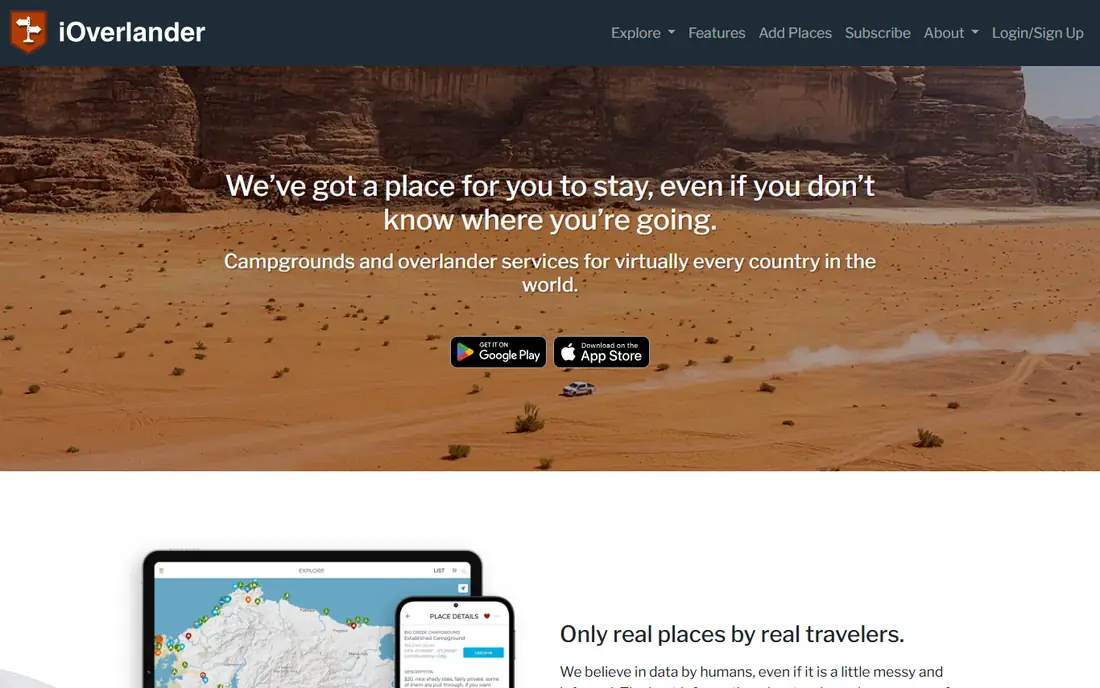
iOverlander is the app for travelers who camp off the main campground grid. Its community database lists free campsites, dispersed spots, water sources, fuel stops, and repair points, with GPS coordinates and recent notes from other travelers. That breadth helps on rural routes where formal campgrounds are thin.
The honest limit is consistency. Because listings come from users, detail and freshness vary, and a spot that suited one rig may not suit another. Check the date of the latest report, read access notes for road surface and clearance, and have a backup stop in mind. Paid Pro, at $59.99 per year in current listings, adds offline regions and map overlays.
- Community database of free and informal spots
- Global coverage
- Water, fuel, and repair listings
- Quality varies by contributor
- Offline access needs a paid plan
RV Parky suits a driver who needs a stop tonight and does not want to wade through menus. Search shows nearby RV parks, campgrounds, rest areas, and fuel stops on a clear map, and the core listings are free. Its simplicity is a real advantage when signal is weak or patience is short after a long drive.
The trade-off is depth. RV Parky does not try to be a full trip planner or a routing engine, so pair it with an RV-safe GPS app for larger rigs. For a quick overnight check, though, few apps are faster. It is a good second app to keep beside a planner such as RV LIFE.
- Simple and fast search
- RV parks, rest areas, and fuel stops
- No paywall for core listings
- Plainer design than rivals
- Fewer trip planning tools
The Dyrt covers campgrounds, RV parks, and public land sites with reviews, photos, and booking links where available. Its trip planner maps campgrounds along a route, which helps when planning several nights at once. Pro, at $59.99 per year in current listings, adds offline access, map layers for dispersed camping, and campground discounts.
Free users still get a useful search tool, but the trip planner and offline maps are the main reasons to pay. If most trips stay near home and signal is reliable, the free version may be enough. If trips cross rural areas, offline access alone can justify Pro for a season.
- Large campground database
- User reviews and photos
- Trip planner and offline access on Pro
- Some useful features need Pro
- Discounts vary by campground
Roadtrippers is the best route planner on this list for the journey itself, rather than for rig limits. Build a multi-stop trip, add attractions, restaurants, and campgrounds along the way, and adjust stops by dragging them into a new order. It suits RVers who plan trips around places to see, not just places to sleep.
The limit matters for larger rigs. Roadtrippers does not replace RV-safe routing, so check height and weight limits separately before driving a planned route. Use it for ideas and day-by-day planning, then run the driving route through RV LIFE or another rig-aware tool. That two-app habit gives both a good trip and a safer drive.
- Easy multi-stop route building
- Points of interest along the route
- Campground search on a route
- Not an RV-specific routing tool
- Some planning features need a paid plan
Harvest Hosts offers overnight stays that feel different from a standard campground. Members stay at farms, wineries, breweries, museums, and other small businesses, usually for one night, with no per-night camping fee. Classic membership is listed at $99 per year, with higher tiers adding Boondockers Welcome locations and other benefits.
The rules matter. Most hosts offer no hookups, so the rig must be self-contained, and guests are expected to support the host, often by buying something. Arrival windows and rig length limits vary by host. For travelers who enjoy local food and quiet farm stays, Harvest Hosts is a strong add-on. It does not replace a campground for longer stays or full hookups.
- Unique stays at farms, wineries, and breweries
- No per-night camping fee at host sites
- Route tools in the app
- Most sites lack hookups
- Guests are expected to support the host business
- Rig must be self-contained
KOA suits travelers who value predictability. The app searches KOA campgrounds, shows site types and amenities, and handles booking, which helps families who want hookups, laundry, and play areas without surprises. KOA Rewards, at $39 per year in current listings, adds a discount on daily rates at participating locations.
The obvious limit is scope. KOA covers its own network, not every campground, so it works best beside a broader search app such as Campendium or The Dyrt. If a route passes several KOAs, the app alone may cover most nights. If not, use it for the KOA nights and another app for the rest.
- Large KOA campground network
- Booking and trip tools in one app
- Consistent site standards
- Limited to KOA locations
- Rewards membership costs extra for discounts
AllStays is a long-running favorite for travelers who need practical data in areas with weak signal. Its Camp and RV listings cover campgrounds, rest areas, dump stations, Walmart overnight notes, and other services, with filters for hookups, price, and rig details. Downloaded data helps when a route leaves coverage behind.
The app is not the prettiest on this list, and pricing varies by app store listing, so check the current price in the store before buying. What it offers in return is depth. For a traveler who plans dump stops, fuel, and overnight options in advance, AllStays earns its place beside a prettier planner.
- Deep filters for campgrounds, dump stations, and services
- Useful offline data
- Strong for remote travel
- Pricing varies by store listing
- Interface is functional rather than polished
How we picked these
We compared official app listings, pricing pages, and feature descriptions, and we favored apps that are live in October 2026 and serve US RV travel. We included both free and paid tools, because a good RV setup usually mixes them. We left out general car GPS apps that do not account for rig size, since they do not fit the RV routing need.
How to build a simple RV app setup
Start with routing, then add stays. If the rig is large, RV LIFE or a similar rig-aware tool should set the driving route, while a campground app handles the overnight choice. Add iOverlander or RV Parky for free and last-minute stops, and keep AllStays or an offline tool for low-signal stretches. Check each listing against the campground or host page before arrival, and confirm hookups, length limits, pet rules, and seasonal closures.
For fuel and services, plan dump stations and fuel stops as part of the route, not as an afterthought, especially on rural legs. Save offline maps before leaving coverage, and keep a paper backup for the day's route if the trip crosses remote areas. A simple setup used well beats a large set of apps that are never opened at the right moment.
Frequently asked questions
What are the best RV apps for beginners?
RV LIFE suits larger rigs for routing, while Campendium and The Dyrt suit campground research. RV Parky is a simple backup for overnight stops. Start with one routing app and one campground app, then add others only when a gap appears.
What are the best RV GPS apps?
RV LIFE Pro is the main rig-aware option on this list, because it routes around height, weight, and length limits where data is available. Car GPS apps such as Google Maps and Waze help with traffic and hazards, but they do not replace rig-aware routing for a large vehicle.
What are the best apps for RV travel and free camping?
iOverlander is the strongest free-camping database, with community spots, water, and service listings. Campendium also covers free and dispersed sites with reviews. Always check recent reports and local rules, since free sites can close or change access.
Do I need to pay for an RV app?
Not always. RV Parky, Campendium, and iOverlander offer useful free tiers, and KOA booking is free to browse. Paid plans mainly add offline maps, RV routing, and trip tools. Pay when a feature will be used often enough to cover its yearly cost.
Can one app handle routing, campgrounds, and booking?
No single app on this list does all three at the same level. RV LIFE comes closest for routing plus planning, but campground reviews are stronger on Campendium and The Dyrt, and booking is simplest inside each campground brand's own app. A two or three app setup is normal for RV travel.
Sources
See where you really rank - block by block
ProMapRanker scans Google Maps across a grid of your service area. Simple monthly plans from $19, white-label on every plan.
Start freeKeep reading
 wpforms alternatives
Best WPForms Alternatives in 2026
We compare 9 wpforms alternatives for WordPress forms, with free and paid options, current pricing notes, and honest limits for small business sites in 2026.
Read → windows task scheduler alternatives
Best Windows Task Scheduler Alternatives in 2026
Looking for Windows Task Scheduler alternatives? We compare 9 schedulers for Windows and cross-platform work, from free tools to enterprise automation.
Read → which ai video service is best
Which AI Video Service Is Best in 2026
which ai video service is best? We compare 10 legitimate AI video services on price, avatars, editing and output quality to help you pick the right tool.
Read →